Home
>
Blog
>
>
What a Medical Billing Summary Reveals to an IME (That the Chart Alone Won't)
Before your next exam, here's what a medical billing summary puts in front of you:
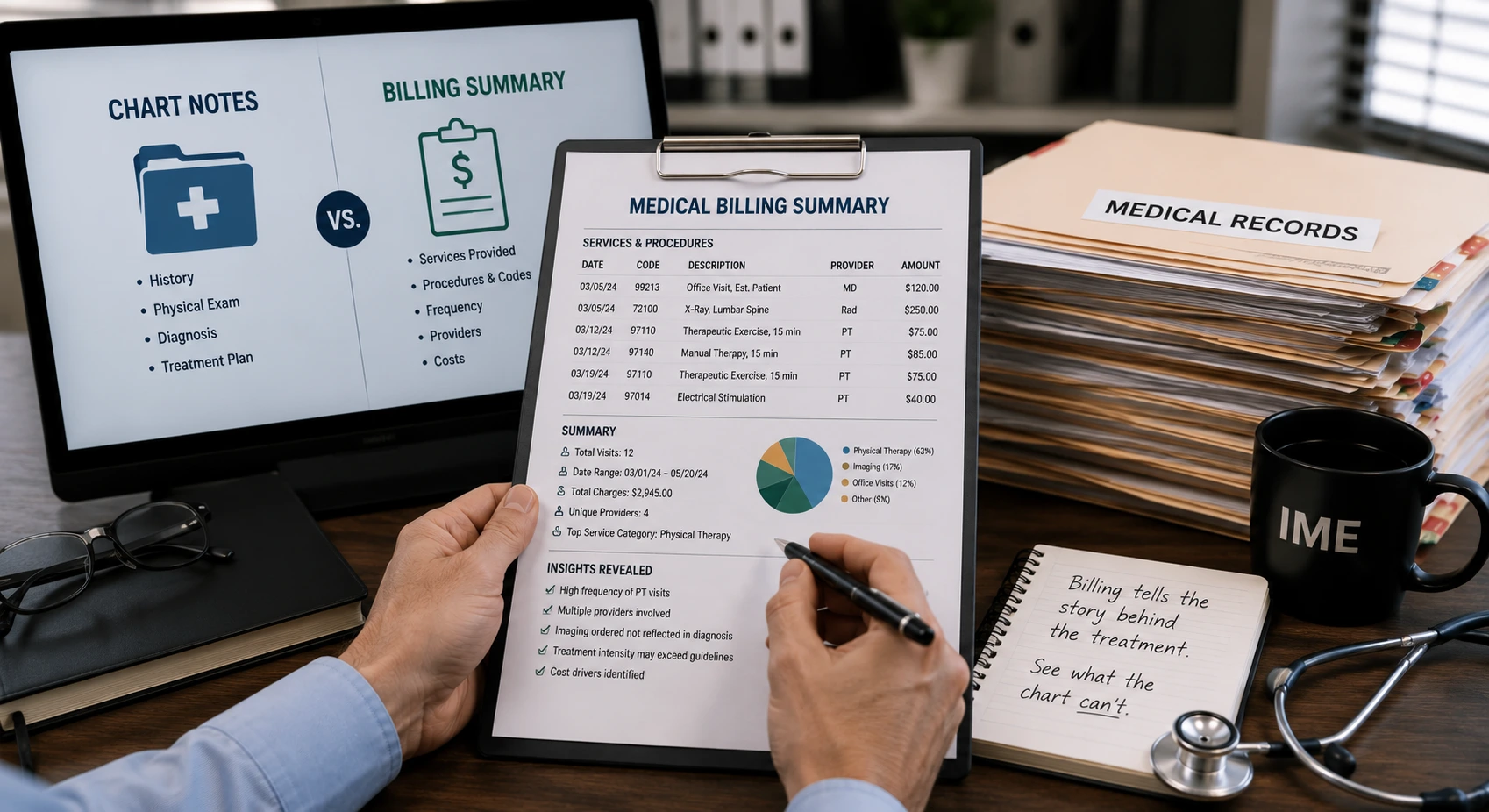
- The chart shows care, billing shows utilization – frequency, providers, and treatment intensity the narrative can miss.
- It surfaces billing-vs-records mismatches – charges without documentation and duplicates, flagged for your review.
- It's organized, code by code – dates, providers, and procedure codes you can read at a glance.
- It flags, it doesn't judge – you decide necessity, reasonableness, and causation, not the summary.
Read on for what a billing summary reveals, and how to put it to work in your IME review.
The chart tells you what was done. The billing tells you how much, how often, and by whom, and sometimes the two don't line up. For an IME, a medical billing summary turns a stack of ledgers and procedure codes into a picture you can actually read. So what does it reveal? Let's walk through it.
Quick level-set: a medical billing summary is an organized extraction of the billing records, dates of service, providers, procedure or CPT codes, and charges, pulled into one place so you can see treatment as utilization, not as a narrative alone. It sits right alongside the record review, and it answers a different question.
Why an IME should read the billing, not the chart alone
Here's the thing: the chart tells the clinical story, but it's easy to under-read how much care actually happened. Billing makes utilization visible, the frequency of visits, the mix of providers, the modalities, the escalation over time. For an evaluation that touches treatment intensity, that picture matters. And when the billing and the records disagree, that's something you'll want to see before you write.
AI Speed, Human Accuracy
LezDo TechMed extracts billing data with AI-assisted tools, then a medical or paramedical reviewer verifies the codes, dates, and totals against the records. Fast, and checked, because a billing figure you cite has to hold up.
What a billing summary reveals that the chart alone doesn't
Three things stand out. First, utilization: how often the claimant was treated, by how many providers, and whether care intensified or tapered. Second, the providers themselves, a billing ledger often lists names a quick read of the narrative would miss. Third, the rhythm of care: clusters of dates, long gaps, a burst of treatment right before a key date. None of that changes the diagnosis, but all of it shapes how you read the record.
That utilization picture is exactly what a billing summary is built to show, the same discipline we cover in our guide to medical record review billing.
Want the billing picture before your next exam?
Where the billing and the records disagree
This is where a billing summary earns its keep. It surfaces charges that don't have matching documentation, the same service billed twice, or codes that don't square with what the notes describe. To be clear, the summary flags the discrepancy. It doesn't call it fraud, over-billing, or unnecessary care. That reading is yours to make.
The most useful move is to line the charges up against the documented care. Read the billing next to a medical chronology built for IME work, and against the records themselves while you're reviewing complex records as an IME, and the mismatches surface quickly.
Billing shows you how much care happened. The chart shows you what was documented. The gap between them is where an IME looks twice.
The line a billing summary won't cross
A medical billing summary organizes the charges and flags where they don't match the records. It does not determine medical necessity, the reasonableness of a charge, causation, or whether anything improper occurred. Those are your calls as the examiner, and other qualified professionals', not the summary's. Keeping that line clean is what makes the summary safe to rely on, and what keeps your opinion defensible.
What a Billing Summary Reveals
Utilization
The full picture
Frequency, providers, and treatment intensity over time
Billing vs Records
Flagged
Charges without documentation and duplicates, surfaced for your review
Coded & Sourced
Verifiable
Dates, providers, and procedure codes traceable to the record
Medical Billing Summary FAQs for IMEs
What is a medical billing summary?

An organized extraction of the billing records, dates of service, providers, procedure or CPT codes, and charges, pulled into one readable place so you can see treatment as utilization, not as narrative alone. For an IME, it sits alongside the record review.
What does a medical billing summary reveal to an IME?
The utilization picture: how often, by whom, and how intensely the claimant was treated, plus providers a narrative might miss and any charges that don't match the documented care. It shows treatment as spend and frequency, which the chart alone can under-represent.
Can a billing summary tell me if treatment was unnecessary or over-billed?
No. It flags discrepancies between the billing and the records (charges without documentation, duplicates, codes that don't square with the notes). Whether that reflects necessity, reasonableness, or anything improper is the examiner's determination, not the summary's.
How is a billing summary different from a medical chronology?
A chronology organizes the clinical events over time; a billing summary organizes the charges, codes, and dates. Read together, they show whether the documented care and the billed care line up.
Is the billing summary accurate enough to cite?
LezDo TechMed uses a human-in-the-loop model: AI-assisted extraction, then a medical or paramedical reviewer verifies codes, dates, and totals against the records. No honest process claims 100% accuracy, but the review step is what makes the figures reliable enough to rely on.
What records do you need to build a billing summary?
The billing records or ledgers (itemized statements, CMS-1500 forms, EOBs where available) alongside the medical records, so charges can be matched to documented care. Anything missing is flagged so it can be requested.
Does a billing summary speed up an IME review?
Yes. Instead of piecing utilization together from the chart, you get it at a glance, which frees your time for the medical questions the exam actually turns on.
How to put it to work
Use the billing summary as a second lens, not a verdict. Read it beside the chronology and the records, note where utilization and documentation diverge, and let it sharpen the questions you bring to the exam. A clear billing summary won't write your opinion, but it will keep you from forming one with half the picture.
Source Credit : All metrics derived from LezDo TechMed’s internal project data.
Anjana Devi Vijay
Anjana Devi Vijay is a Certified Legal Nurse Consultant (CLNC) and Medical–Legal Research Analyst with 9+ years of experience in medical record review, deposition summary analysis, and medico-legal research. She specializes in transforming complex healthcare documentation into accurate, actionable insights that support attorneys, insurers, and medical evaluators. With expertise in clinical documentation analysis and legal case support, she creates research-driven content focused on improving decision-making and case outcomes.













.png)