Home
>
Blog
>
>
Catching Contradictions: What a Deposition Summary Should Flag for Attorneys
Before your next cross, here's what a deposition summary should actually do for you:
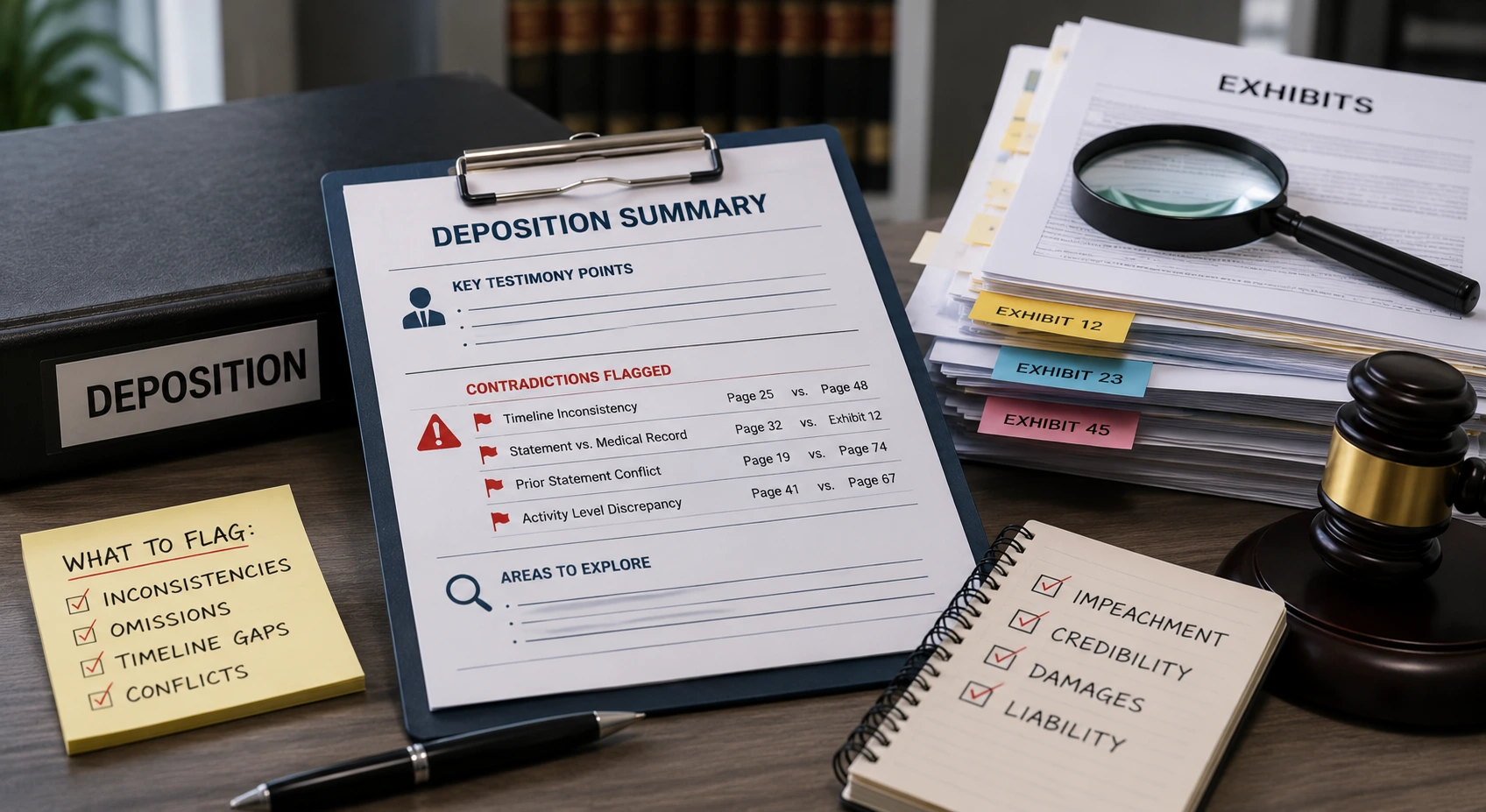
- Contradictions win cross – the moments testimony conflicts with the records or itself are the case-changers.
- A summary should flag, not only condense – it points to the conflicts and their page and line, so you don't hunt.
- Cross-reference to the records – a contradiction only lands when testimony is lined up against the chart.
- You decide what it means – the summary surfaces the conflict; the legal significance is your call.
Read on for what a good deposition summary flags, and how to catch the contradictions that change a case.
The line that wins a cross-examination is almost never the one everyone remembers. It's the small contradiction, buried on page 214, where the deponent said something that doesn't match page 30, or doesn't match the medical records. Catching that is the whole job of a good deposition summary. Miss it, and opposing counsel won't. So how do you make sure your summary actually surfaces it? Let's get into it.
Quick level-set: a deposition summary condenses hours of testimony into a document you can work from, so you're not re-reading the transcript to find one answer. For catching contradictions, the format matters less than one thing: whether the summary flags where the testimony conflicts, and points you to the exact page and line.
Why contradictions are the point of a deposition summary
Here's the thing: a summary that only shortens the transcript saves you reading time, but it doesn't change your case. A summary that flags contradictions changes how you cross, what you concede, and where you press. The value isn't in condensing 300 pages to 30. It's in surfacing the five lines that don't add up.
Every Flag, Page and Line
A useful deposition summary ties each key point to its page and line, so when you flag a contradiction, you can put the exact testimony on the screen in seconds. That traceability is what makes it usable at deposition and at trial.
What a good deposition summary flags
Three kinds of conflict are worth catching. First, self-contradictions, where the deponent's own testimony shifts, an onset date that moves, a mechanism of injury that changes. Second, conflicts with other witnesses, where two accounts of the same event don't line up; across many witnesses, that becomes tracking testimony inconsistencies at scale. Third, and often the most useful, conflicts with the medical records, where the testimony says one thing and the chart documents another.
That last one only works when the testimony is read against the records. Line the deposition up next to a medical chronology that cross-checks testimony against the chart, and the mismatches stop hiding.
Need contradictions surfaced before your next cross?
How to actually catch the contradictions
The habit that surfaces the most is simple: read the testimony against the documented record, not on its own. Flag every point where the deponent's account and the common clashes in the medical records pull in different directions. For expert depositions especially, that discipline pays off, reviewing a defense expert's deposition transcript against the chart is where you find the opinion that outran the evidence.
And keep the page-line citations attached to every flag. A contradiction you can't put on the screen with the exact words is a contradiction you can't use.
A deposition summary that only shortens the transcript saves you time. One that flags the contradictions can change the case.
The line the summary won't cross
A deposition summary organizes and condenses the testimony and flags where it conflicts, with the records, with other witnesses, or with itself, and points to the source. What it doesn't do is decide whether a contradiction matters, judge the witness's credibility, or tell you how to use it. That's your call as the attorney. The summary hands you the material and the citation; the strategy is yours. Keeping that line clean is part of what makes the summary reliable.
What a Contradiction-Ready Summary Gives You
Flagged Conflicts
Surfaced
Self-contradictions, witness conflicts, and testimony that clashes with the records
Page & Line
Citable
Every flag tied to the exact testimony, ready for the screen
Records Cross-Check
Verified
Testimony read against the chronology, so mismatches don't hide
Deposition Summary FAQs for Attorneys
What should a deposition summary flag for an attorney?

Where the testimony conflicts: with itself (shifting dates, changing accounts), with other witnesses, and with the medical records, each tied to the page and line so you can use it. A summary that only condenses the transcript misses the point.
How does a deposition summary help catch contradictions?
By surfacing inconsistencies you'd otherwise hunt for across hundreds of pages and pointing to the exact testimony. Read against the records, it shows where a deponent's account and the documentation diverge.
Does a deposition summary decide whether a contradiction matters?
No. It flags the conflict and cites the source. Whether it's significant, how to use it, and what it says about credibility are the attorney's calls, not the summary's.
What's the best way to catch contradictions with the medical records?
Read the deposition next to a medical chronology so testimony and documented care sit side by side. Contradictions that hide in a straight read jump out when the two are aligned.
Why do page-line citations matter for contradictions?
Because a contradiction you can't put on the screen with the exact words is hard to use. Page-line references let you pull the precise testimony at deposition or trial in seconds.
Can a summary catch contradictions in an expert's deposition?
Yes. Read the expert's testimony against the records and you can flag opinions that outrun the documented evidence. That cross-check is often where an expert deposition turns.
Is a contradiction-focused summary accurate enough to rely on?
When the flags are tied to page-line citations and, for LezDo TechMed, verified through a human review step, yes. No honest process claims 100% accuracy, but traceable citations are what make the flags usable.
The bottom line
For a trial attorney, the value of a deposition summary isn't the page count you save. It's the contradictions it puts in your hand before opposing counsel finds them. A summary that flags the conflicts, ties them to the record, and cites the page and line lets you walk into cross knowing exactly where the testimony breaks. That's the difference between a shorter transcript and a sharper case. It's also the first thing to ask about when you compare deposition summary services.
Source Credit : All metrics derived from LezDo TechMed’s internal project data.
Anjana Devi Vijay
Anjana Devi Vijay is a Certified Legal Nurse Consultant (CLNC) and Medical–Legal Research Analyst with 9+ years of experience in medical record review, deposition summary analysis, and medico-legal research. She specializes in transforming complex healthcare documentation into accurate, actionable insights that support attorneys, insurers, and medical evaluators. With expertise in clinical documentation analysis and legal case support, she creates research-driven content focused on improving decision-making and case outcomes.













.png)