Home
>
Blog
>
>
Which Deposition Summary Format Actually Fits an IME or QME Evaluation
A deposition summary is only useful to an evaluator if its format fits how an evaluator works, and most are formatted for the attorney who ordered them. Here is what fits an IME or QME:
- Scannable, with page-line pointers: an evaluator needs to find the clinically relevant testimony fast and jump to the exact page and line to quote it.
- Testimony, not characterization: it should give the deponent's documented words, not the summarizer's spin, so the opinion stays independent.
- Organized so the medical testimony surfaces: grouped in a way that fits the evaluation's questions, not only the legal issues.
- Consistent and reusable: the same format across every deposition in the case, so nothing has to be relearned.
Read on for which deposition summary format actually fits an IME or QME evaluation, and why the format decides whether you can use it.
Most deposition summaries an IME or QME evaluator receives were not formatted for them. They were formatted for the attorney who ordered them, around the legal theory of the case. That is not wrong, but it means the format an evaluator opens may not be the format an evaluator can actually use, and format is the difference between a summary that speeds an evaluation and one that has to be reworked before it helps. The question worth asking is not whether the summary is thorough. It is whether its format fits how you evaluate.
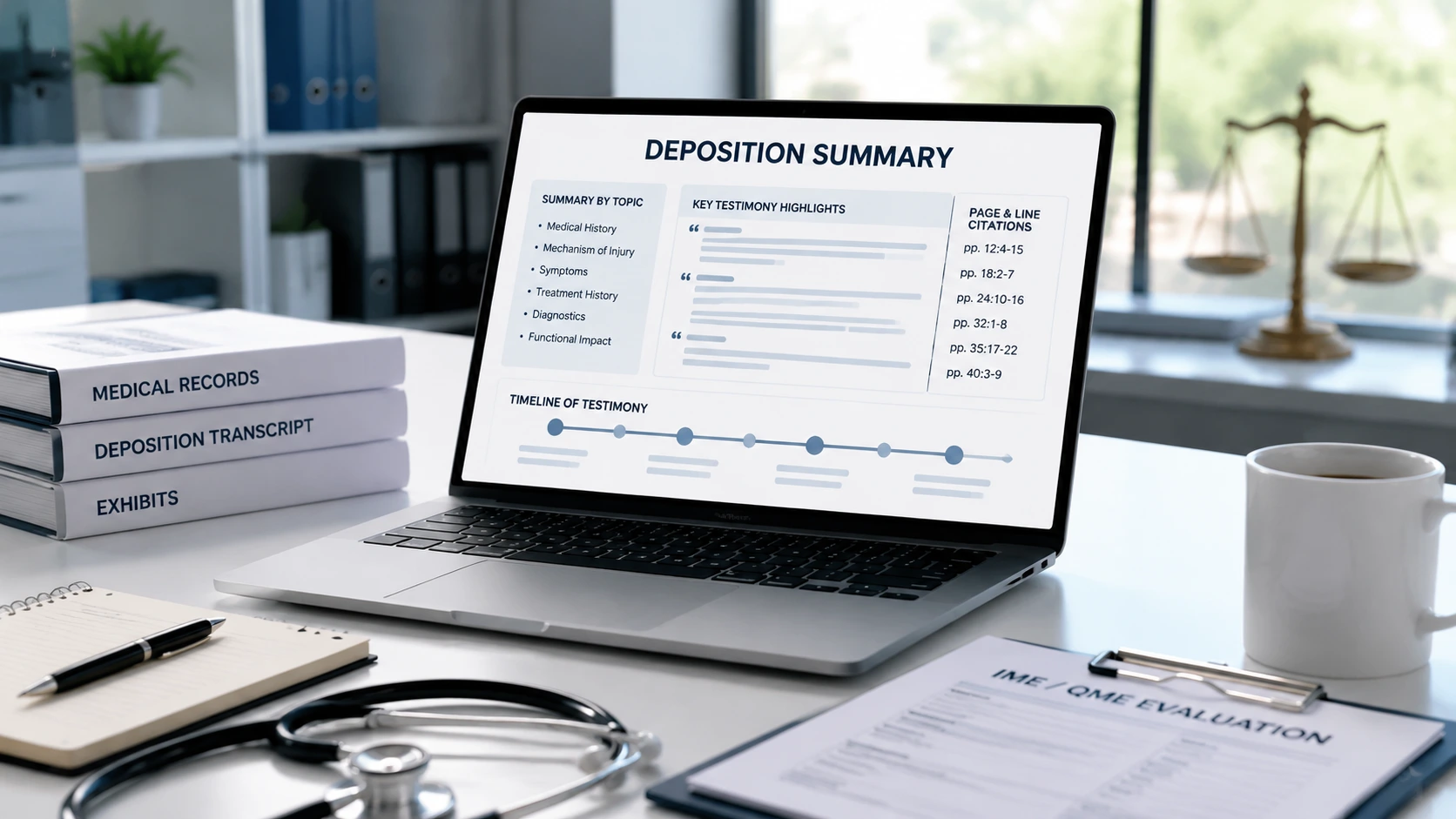
Here is the grounding. A deposition summary condenses sworn testimony from a transcript into a shorter, organized document, with references back to the page and line. For an evaluator, a usable one is scannable, points back to the exact testimony, gives the deponent's words rather than a characterization of them, and is organized so the clinically relevant testimony surfaces. Get the format right and the summary drops into exam prep and the report. Get it wrong and you are reading the transcript anyway.
Why format, not length, decides usability
A full day of deposition testimony can produce 200 or more transcript pages, and a half day runs 100 to 120 (trialbase). Whether an evaluator can use that before the exam comes down to the summary's format.
The three formats, and what each is built for
Deposition summaries come in three broad formats, and each was designed for a different job. A page-line summary tracks the transcript closely and stays long and detailed. A topic or issue summary groups testimony by subject and compresses more. A narrative summary reads shortest, retelling the testimony as prose. None is universally correct; each fits a purpose, which is exactly why the deposition summary format also controls your cost. The point for an evaluator is that the format was usually chosen for the attorney's purpose, not the evaluation's.
What an evaluator actually needs from the format
An IME or QME evaluator needs three things from the format that an attorney-oriented summary does not always provide. First, fast scanning with page-line pointers, so the clinically relevant testimony can be found and quoted precisely in the report. Second, the deponent's actual words rather than a characterization, because an evaluation has to rest on what was said, not on how someone framed it. Third, organization that surfaces the medical testimony, not only the legal issues. A format that delivers those turns a deposition into usable input for the opinion. A format that does not leaves the evaluator to rebuild it. This is part of why the right summary speeds up IME and QME evaluations instead of adding a step.
Want a deposition summary formatted for your evaluation, not just the file?
So which format fits an evaluation?
For most IME and QME work, the practical answer is a topic or issue format anchored by page-line references: organized so the testimony that bears on the medical questions is grouped and findable, with a pointer to the exact page and line behind every point so it can be verified and quoted. That combination gives an evaluator the speed of a topic summary and the traceability of a page-line one. A pure page-line summary is complete but can take nearly as long to read as the transcript. A pure narrative can read fastest, but only if it stays anchored to the words, which brings up the real risk.
The narrative-format risk to your opinion
A narrative summary that retells testimony in prose can drift from the deponent's words into the summarizer's characterization, and for an evaluator that is not a style preference, it is an exposure. An opinion built partly on a characterization of testimony rather than the testimony itself is harder to defend when the summary is put next to the transcript. A usable format keeps the evaluator close to the actual words and cites where they are, which is the same concern behind why deposition summaries can put QME opinions at risk. Whatever the format, it should hand you the testimony, not an argument about it.
For an evaluator, the best deposition summary format is the one that hands you the testimony you need, points to where it is, and characterizes nothing.
Where AI fits the formatting, and where it does not
AI helps with format at the mechanical level. It can condense a long transcript quickly, group testimony by topic, and attach page-line references faster than a person alone, which matters when a case carries several depositions and an exam date is close. What it cannot reliably do is judge which testimony is clinically relevant to the evaluation, or tell when a condensed line has drifted from what the deponent actually said. So a dependable, evaluator-ready summary pairs that speed with a trained reviewer who checks the condensed testimony against the transcript and keeps the format anchored to the words. The format can be produced fast; whether it is faithful is a human question.
One boundary sits under all of it. A deposition summary condenses and organizes what the witness testified to and points back to the transcript. It does not interpret the medical significance of the testimony, form the opinion, or decide what the evaluation should conclude. That is the evaluator's independent professional work. The summary's job is to hand the evaluator the testimony in a format they can actually use, neutral, scannable, and traceable, so the opinion is built on the record and stays the evaluator's own.
Format is not a cosmetic choice. For an IME or QME evaluation, it decides whether a deposition becomes usable input or another stack to read, and it does that before you have read a single line.
What makes a deposition summary format fit an evaluation
200+
Transcript pages in a full day
Format, not length, decides whether an evaluator gets through it before the exam. (trialbase)
3
Formats to choose from
Page-line, topic, and narrative, each built for a different purpose.
1
Format that usually fits
Topic or issue organization anchored by page-line references, giving speed and traceability.
Frequently Asked Questions
Which deposition summary format is best for an IME or QME evaluation?

For most evaluations, a topic or issue format anchored by page-line references. It groups the testimony that bears on the medical questions so it is findable, and it points to the exact page and line behind each point so it can be verified and quoted. That gives an evaluator the speed of a topic summary and the traceability of a page-line one.
Why does the format of a deposition summary matter to an evaluator?
Because most summaries are formatted for the attorney's legal theory, not the evaluation's medical questions. A format that fits how an evaluator works, scannable, page-line traceable, and organized around the medical testimony, drops into exam prep and the report. One that does not has to be reworked before it helps.
What is wrong with a narrative-format deposition summary for an evaluation?
A narrative can drift from the deponent's words into a characterization of them, and an opinion built on a characterization rather than the testimony is harder to defend when the summary is compared with the transcript. If a narrative format is used, it should stay anchored to the actual words with page-line references.
What should an evaluator look for in a deposition summary format?
Fast scanning with page-line pointers, the deponent's actual words rather than a characterization, and organization that surfaces the clinically relevant testimony. A consistent, reusable format across every deposition in the case helps too, so nothing has to be relearned from one summary to the next.
Does a deposition summary interpret the testimony for the evaluator?
No. The summary condenses and organizes what the witness testified to and points back to the transcript. Interpreting the medical significance and forming the opinion are the evaluator's independent professional work. The summary's job is to deliver the testimony in a usable, neutral, traceable format.
Can AI format a deposition summary for an IME or QME?
AI can condense, group by topic, and attach page-line references quickly, which helps when several depositions and an exam date collide. It cannot reliably judge clinical relevance or catch when a line has drifted from the testimony, so a trained reviewer checks the format against the transcript before it reaches the evaluator.
For an IME or QME evaluator, the deposition summary that helps is the one whose format fits how you evaluate: scannable, anchored by page-line references, faithful to the deponent's words, and organized so the medical testimony surfaces. For most evaluations that means a topic or issue format tied to page-line pointers, giving you speed without giving up traceability, and never a narrative that characterizes the testimony instead of citing it. Ask for the format that fits your work, not the one built for the file, and a deposition becomes usable input for the opinion instead of one more transcript to read.
Ready for deposition summaries formatted for your evaluation and traceable to the line? Partner with LezDo TechMed for deposition summary services, or estimate a summary and see what an evaluator-ready format looks like for your next exam.
Source Credit : All metrics derived from LezDo TechMed’s internal project data.
Anjana Devi Vijay
Anjana Devi Vijay is a Certified Legal Nurse Consultant (CLNC) and Medical–Legal Research Analyst with 9+ years of experience in medical record review, deposition summary analysis, and medico-legal research. She specializes in transforming complex healthcare documentation into accurate, actionable insights that support attorneys, insurers, and medical evaluators. With expertise in clinical documentation analysis and legal case support, she creates research-driven content focused on improving decision-making and case outcomes.













.png)