Deposition Summary Guide: Examples, Formats and How to Write One
A deposition summary turns hundreds of transcript pages into a clear, case-ready roadmap. Here is what this guide covers:
What a deposition summary is: a condensed, page-referenced version of the transcript that surfaces admissions, contradictions, and key facts.
The five formats: page-line, page, topic-by-topic, chronological, and narrative, each suited to a different kind of case, with real samples you can view.
How to draft one: a step-by-step process and a copy-paste template you can reuse.
When to outsource and where AI fits: how expert review keeps a fast summary accurate.
Read on for the formats, the samples, the template, and the drafting steps.
A precise deposition summary turns hundreds of transcript pages into a clear, case-ready roadmap you can trust. Tired of scrolling through lengthy deposition transcripts to find the three lines that matter? You don't have to be.
In this guide, let's walk through what a deposition summary is, the formats it comes in, and a step-by-step way to draft a precise one, with real samples and a template you can reuse.
What is a deposition summary?
A deposition summary is a condensed, page-referenced version of a deposition transcript. It captures the witness's key statements, admissions, contradictions, and facts, and links each point back to the page and line of the original transcript, so a reader can find the source in seconds. Attorneys cannot read thousands of pages to locate the handful of lines that shape a case. A summary puts those lines in front of them in a compact, organized form.
What is a deposition, and why does it matter?
A deposition is part of pre-trial discovery: the sworn, recorded testimony of a witness, taken outside the courtroom in a question-and-answer format. Attorneys question the witness under oath to learn the facts and the witness's position. A single deposition often runs to hundreds of pages, and the useful information sits scattered among them. Because that testimony guides pre-trial and trial strategy, legal teams keep returning to it, and the more witnesses deposed, the harder the raw transcripts are to work with.
Deposition summary vs deposition transcript
A deposition transcript is the raw, word-for-word record of everything said between the attorney and the witness. The court reporter captures every question, answer, objection, pause, and exchange between counsel. Transcripts are long, and a single one can run to hundreds of pages, sometimes wandering into off-topic discussion. Finding the significant facts inside them takes time.
A deposition summary turns that lengthy transcript into a clear, organized document and links each point back to the transcript page. A reader can grasp the key statements, admissions, and contradictions without reading the full transcript. A well-drafted summary even makes complex medical, billing, accident reconstruction, and biomechanical testimony readable for non-specialists. In short: the transcript is the complete record; the summary is the fast, sourced way to use it.
Most cases are decided long before trial
Government data shows only about 3% of civil cases are resolved by a trial; the rest settle or resolve during discovery. That is where deposition testimony, and a clear summary of it, carries the case.
Why do you need a deposition summary?
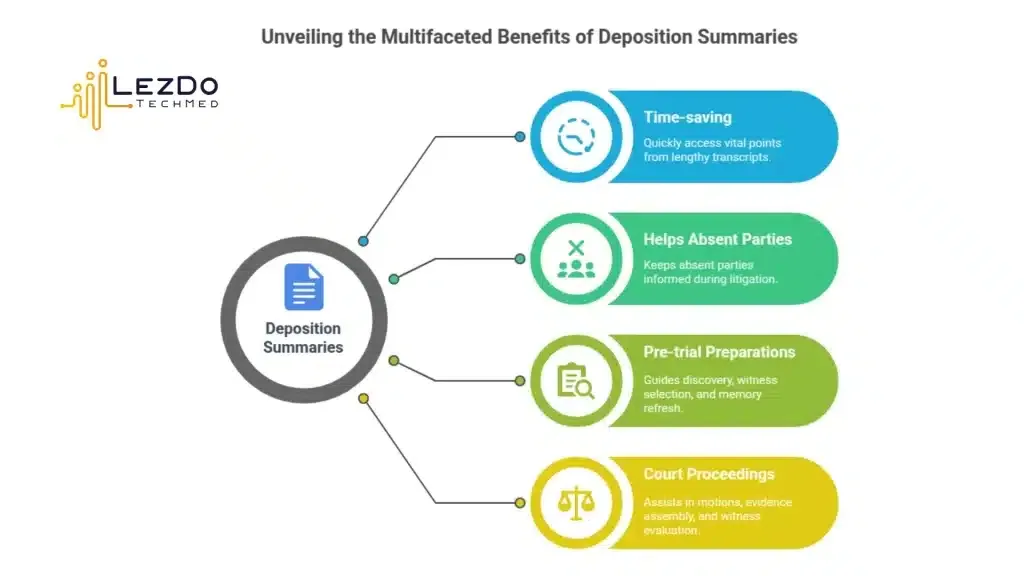
Legal teams rely on deposition summaries because they save time and make testimony usable at every stage. Here is what a good summary does:
Serves as a roadmap through pre-trial discovery, motion practice, mediation, and trial preparation, so attorneys read a focused summary instead of raw transcripts.
Saves hours when a case has multiple depositions, letting the team absorb key points in minutes.
Helps people who missed the deposition, including insurance adjusters, co-counsel, and clients, understand what was said.
Strengthens preparation by supporting interrogatories, motions, and witness examinations, and by refreshing a witness's memory before testimony.
Supports strategy and impeachment by making inconsistencies in testimony easy to locate.
Deciding what an inconsistency means for the case, and how to use it, stays with the attorney. The summary's job is to surface it and cite the page.
Who relies on deposition summaries?
Deposition summaries are used across medical, legal, insurance, and life care planning work. The people who lean on them include plaintiff and defense attorneys in personal injury and workers' compensation cases, insurance adjusters and claims teams, litigation support teams, medical experts like IMEs, QMEs, and CMEs, paralegals, and mass tort teams. They use the summary to review testimony quickly, weigh the credibility of statements, support settlement discussions, prepare for trial, and understand testimony that bears on a medical evaluation.
Want deposition summaries that are accurate and case-ready?
Deposition summary formats: which one fits your case?
There is no single right format. The best one depends on the case type and how you plan to use the testimony. Here is a quick comparison of the five formats, followed by a real sample of each.
Format
How it condenses the transcript
Best used when
Page-line
Captures key testimony point by point with exact page-and-line citations
Commercial and financial cases where precise references matter
Page (page-wise)
Summarizes by page ranges rather than line by line
You want a solid overview without line-level detail
Topic-by-topic
Groups testimony under set topics in a topic, pages, and summary layout
Fact-heavy cases like workers' compensation
Chronological
Arranges the facts in date order
Personal injury and criminal cases where sequence matters
Narrative
Reads as flowing prose that follows the deposition
Trial preparation and insurer review
1. Page-line summary
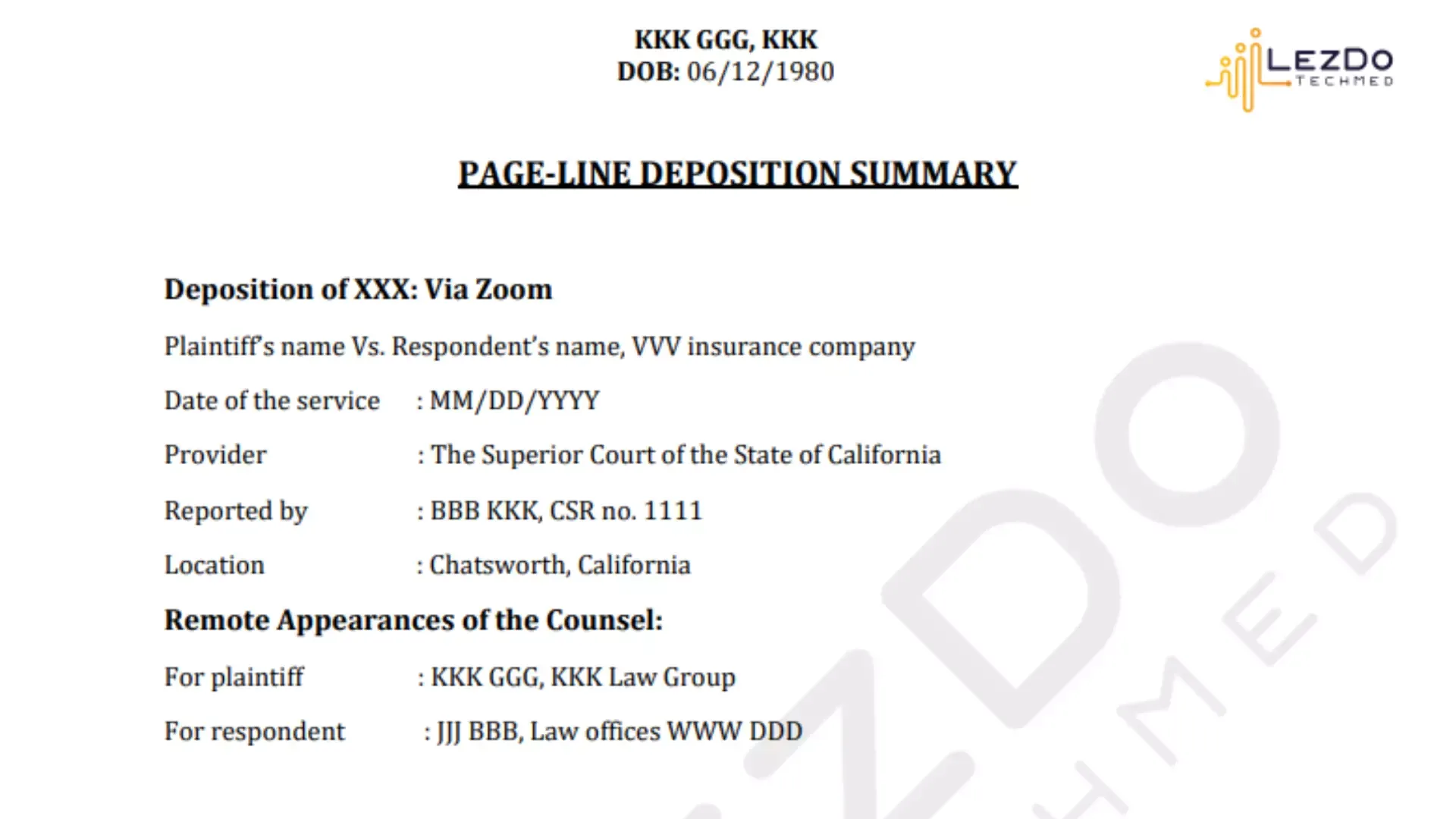
A page-line summary filters the key testimony point by point and ties each one to the exact page and line of the transcript. It takes more time than the other methods, and it is the most convenient choice for commercial and financial transaction cases. A minimum of five pages is usually compressed into a single page. The sample below shows how it reads.
A page summary works like the page-line method but references page ranges, for example pages 10 to 15, instead of individual lines. It gives a good overview without diving into every line. See the depo summary sample below.
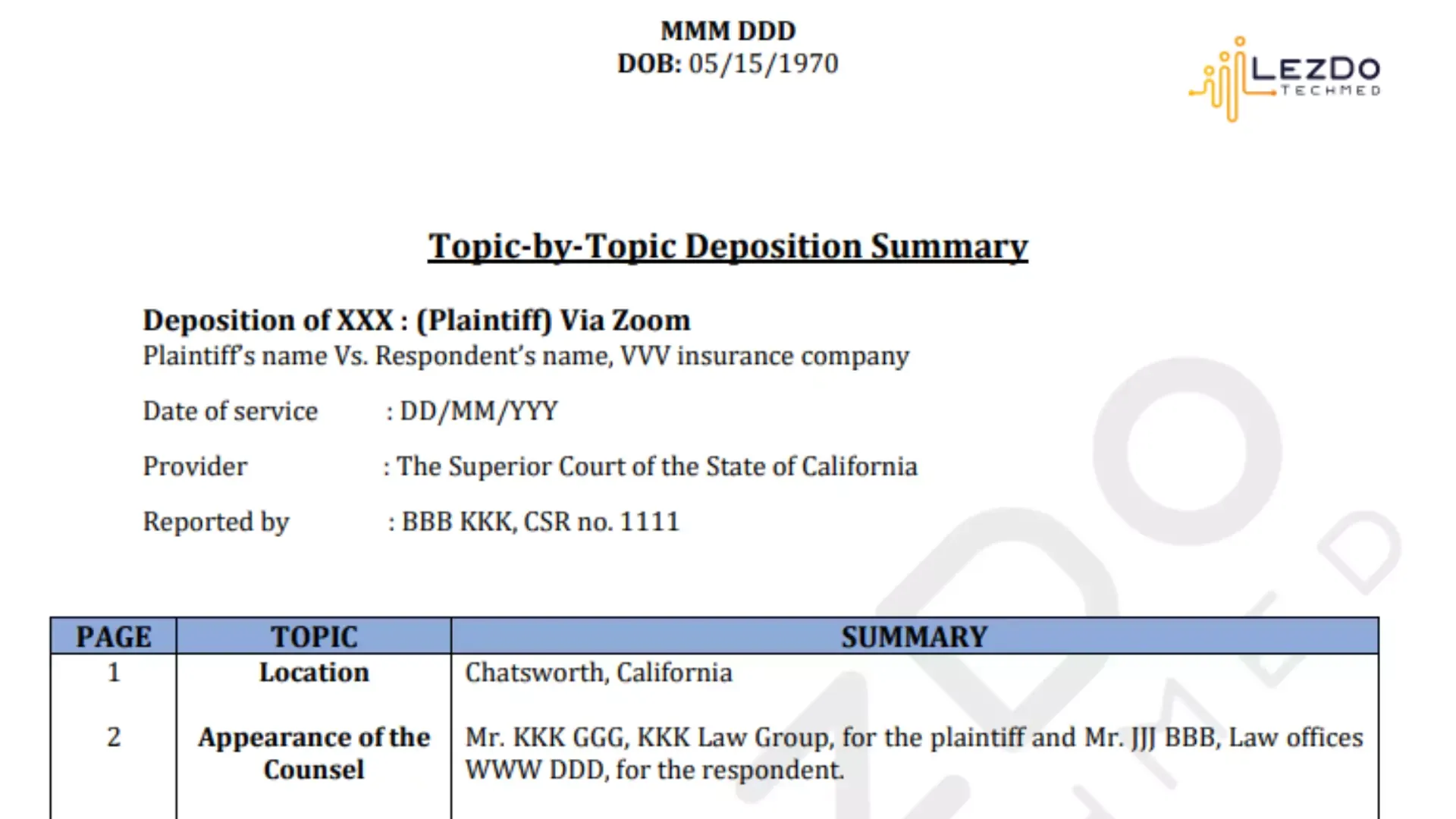
A topic-by-topic summary organizes testimony under predefined topics, usually in three columns: topic, pages, and summary. Topics might include the witness's background, education, current and prior jobs, prior accidents, the subject accident, later accidents, and injuries. This format suits fact-oriented cases like workers' compensation. The sample below will guide you.
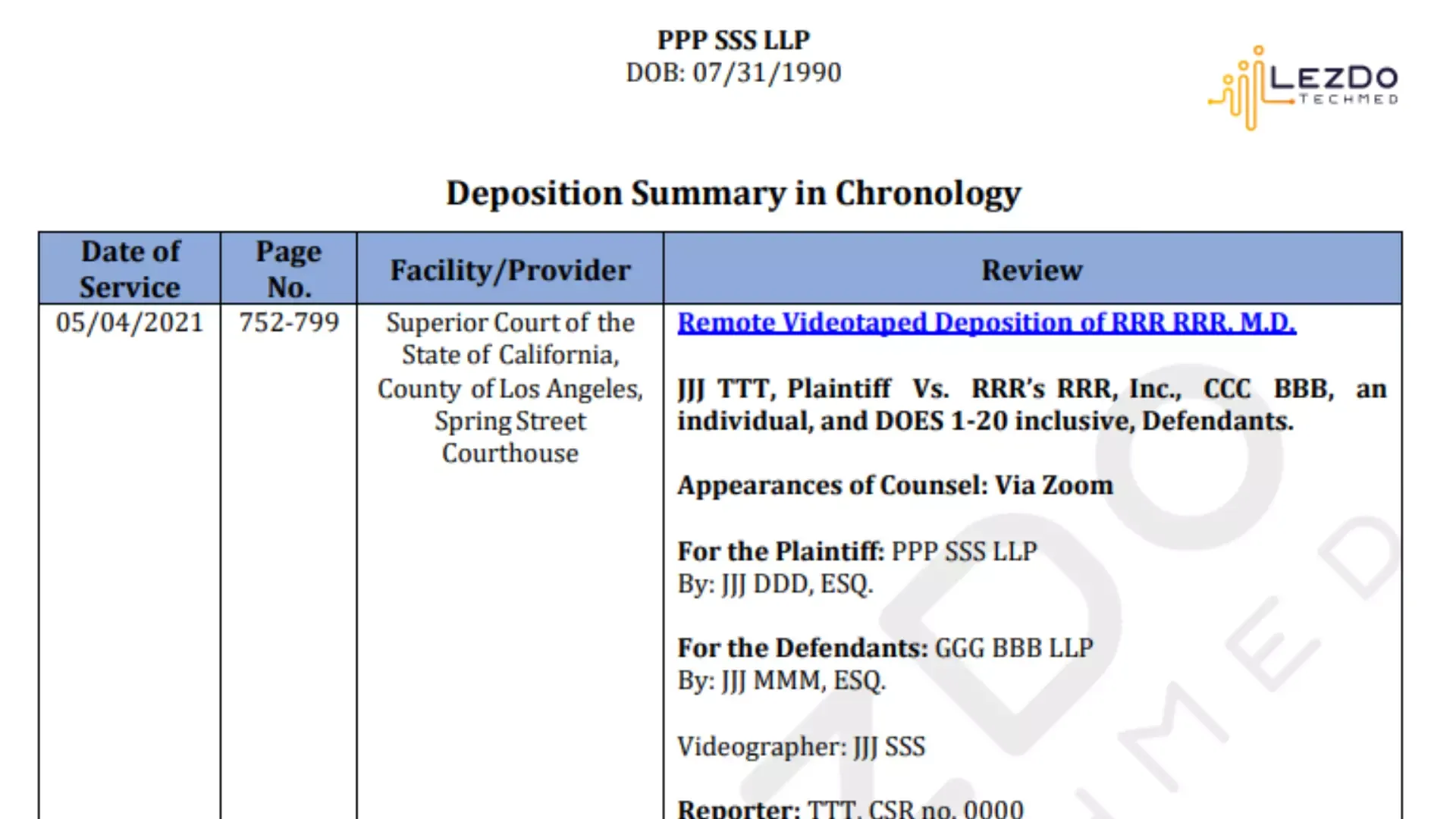
A chronological summary abridges the transcript and arranges the facts in date order. Sequence matters in personal injury and criminal cases, so attorneys often prefer testimony organized this way. The sample below is an example.
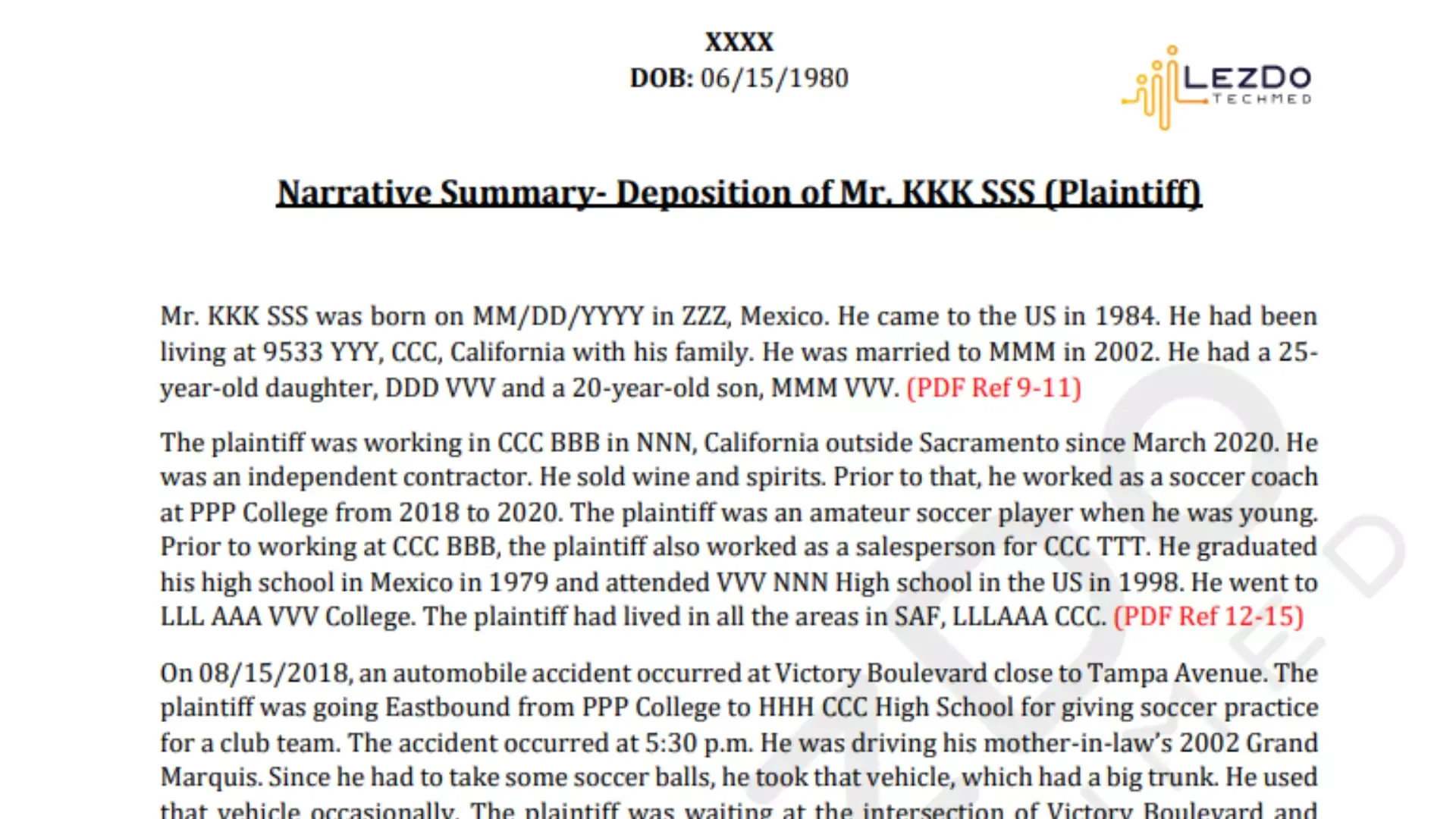
A narrative summary is written in paragraph form and follows the flow of the deposition, so it reads like a story. Insurers and attorneys preparing for trial often prefer it, and it can condense more than ten transcript pages into a single page. From these formats, you can pick the one that fits your lawsuit; the sample below shows how a narrative summary reads.
A strong deposition summary filters the noise and preserves what matters most: the admissions, contradictions, and facts that shape the case.
How to draft a deposition summary, step by step
Drafting a deposition summary is not about shortening the transcript. It is about condensing the critical facts without changing their meaning. Here is how experienced summarizers do it.
1. Read the transcript in full
Read the entire transcript first to understand the context and purpose of the deposition. Notice what the attorney is driving at and how the witness responds, refuses to answer, hesitates, or contradicts earlier statements. That reading tells you which testimony supports the claims at issue.
2. Highlight the key testimony
Mark the points that belong in the summary: admissions, clarifications, contradictions, and facts tied to the claims. Annotating as you go makes the drafting faster and cleaner.
3. Organize and format
From the highlighted points, plan the structure: which format fits, what sections it needs, and how to present it. A deposition summary calls for care and scrutiny, because it collates and condenses testimony with precision rather than rewriting it.
A copy-paste deposition summary template
Here is a simple topic-by-topic skeleton you can copy and adapt. Swap the bracketed prompts for your case details.
Header
Fill in
Case
[caption and case number]
Deponent
[name and role]
Deposition date
[date]
Prepared by
[name]
Topic
Page:Line
Summary of testimony
Background and employment
[00:00]
[what the witness stated]
Accident details
[00:00]
[what the witness stated]
Prior conditions
[00:00]
[what the witness stated]
Treatment
[00:00]
[what the witness stated]
Admissions and contradictions
[00:00]
[what the witness stated]
How long does a deposition summary take?
As a rough benchmark, an experienced reviewer can summarize somewhere around 25 transcript pages an hour, though the real time varies from a few hours to a few days depending on three things:
Type of witness. Layperson testimony is quicker to summarize. Expert witness transcripts from doctors, engineers, or accident reconstruction specialists are technical and take longer.
Transcript length. Longer transcripts of 150 to 300 pages naturally take more time than shorter ones.
Case complexity. Multi-party cases, extensive treatment history, conflicting facts, or unreliable witnesses all call for extra scrutiny.
What makes a good deposition summary?
A good deposition summary is:
Relevant. Focused on facts that matter to the case.
Clear. Written in simple, neutral language without unnecessary jargon.
Well-structured. Organized by topic or timeline for easy reference.
Accurate on key facts like names, dates, and details.
Objective. Reports the testimony without adding interpretation.
Useful. Ready for a legal team to act on quickly.
The summarizer's job is to filter the clutter without losing the legal significance of any statement.
Common mistakes to avoid
Because teams build strategy and claim decisions on these summaries, a small error can carry real weight. The mistakes that show up most often are:
Padding the summary with unnecessary detail, which buries the testimony that matters.
Missing an admission, a contradiction, or a key statement.
Skipping headings, page references, and consistent formatting, which makes the summary hard to check.
Relying on AI alone, which can miss context, tone, or a critical fact.
Slipping the reviewer's own opinion into the summary.
Finalizing without a quality check, which lets errors and inconsistencies through.
When should you outsource deposition summaries?
Even if your team knows how to summarize a deposition, the volume and detail often make a specialist worth it. Outsourcing to deposition summary services for law firms helps on three fronts. It saves time, since attorneys and paralegals juggling multiple cases can hand off a slow, careful task. It saves money, because per-hour in-house summarizing is expensive; you can check a cost estimator before you commit. And it improves the work, since trained reviewers who understand both the legal and medical sides tend to catch the points that matter.
Where AI fits, and where it does not
AI speeds up deposition work. It can index a long transcript, surface keywords, and locate important sections faster than a person working alone, which shortens turnaround. What AI cannot reliably read is legal strategy, witness credibility, contextual relevance, and the nuance in testimony. That is why a dependable summary pairs AI drafting with a trained reviewer who checks it against the transcript, rather than shipping the draft as written.
One boundary is worth stating plainly. A deposition summary organizes and reports what the testimony says and cites the page. It does not decide whether a witness is credible, what caused an injury, who is liable, or what the case is worth. Those calls belong to the attorney and the retained experts. The summary makes sure every point is in front of them and traceable to its source.
Why deposition summaries carry litigation
~96%
Resolved without a trial
Most civil cases settle or resolve in discovery, where deposition testimony is decisive. (BJS)
347,991
Civil cases filed, FY2024
Federal civil filings rose 22% in the year ending March 2024. (U.S. Courts)
5
Summary formats
Page-line, page, topic-by-topic, chronological, and narrative, each suited to a different case.
Frequently Asked Questions
What is a deposition summary?
A deposition summary is a condensed, page-referenced version of a witness's sworn testimony. It surfaces the most relevant facts, admissions, and statements from the transcript and links each back to the page, so the testimony is fast to use.
What is the difference between a deposition summary and a transcript?
A transcript is the complete, word-for-word record of the deposition. A summary condenses that record into the key points and cites the transcript page for each, so a reader gets the substance without reading every page.
What are the different deposition summary formats?
There are five: page-line, page, topic-by-topic, chronological, and narrative. Page-line suits commercial cases, topic-by-topic suits workers' compensation, chronological suits personal injury, and narrative suits trial preparation. You can view a sample of each above.
How long does a deposition summary take?
An experienced reviewer can summarize roughly 25 transcript pages an hour, but the total depends on the witness type, the transcript length, and the case complexity, so it ranges from a few hours to a few days.
How long should a deposition summary be?
There is no fixed length. A single summary page can condense around ten transcript pages, and the goal is to keep every point that matters while cutting repetition, not to hit a page count.
What makes a good deposition summary?
Accuracy on key facts, clarity, relevance, and a neutral tone. A good summary includes only what matters to the case, cites the transcript page, and adds no interpretation of its own.
Who prepares deposition summaries?
Paralegals, legal assistants, and specialized medical-legal service providers experienced in analyzing testimony. For technical or high-volume transcripts, many firms outsource to a dedicated summary service.
Can AI prepare deposition summaries?
AI can speed up transcript review and surface key points, but it can miss context, tone, and credibility. A trained reviewer checking the draft against the transcript is what keeps a fast summary accurate.
What mistakes should I avoid when drafting a deposition summary?
Avoid copying text verbatim, missing an admission or contradiction, and adding personal opinion. Keep the summary factual, cited to the page, and useful to the case.
Drafting a good deposition summary does not have to be complicated. With a clear process, the right format, and a careful eye, you can turn long transcripts into sourced, easy-to-use documents that actually move a case forward. Start simple, stay focused on the facts that matter, and let the testimony speak for itself.
Ready for deposition summaries that are accurate, well-organized, and case-ready? Partner with LezDo TechMed, or start with a free trial and see the difference on your next transcript.
Source Credit : All metrics derived from LezDo TechMed’s internal project data.
Anjana Devi Vijay
Anjana Devi Vijay is a Certified Legal Nurse Consultant (CLNC) and Medical–Legal Research Analyst with 9+ years of experience in medical record review, deposition summary analysis, and medico-legal research. She specializes in transforming complex healthcare documentation into accurate, actionable insights that support attorneys, insurers, and medical evaluators. With expertise in clinical documentation analysis and legal case support, she creates research-driven content focused on improving decision-making and case outcomes.
















.png)


.webp)