Home
>
Blog
>
>
How to Measure the Quality of a Medical Record Index
- A medical record index can look complete and still be unreliable; quality is measured by whether it holds up when you use it.
- Completeness: every record in the production is accounted for in the index, with nothing dropped or doubled.
- Accuracy: each entry's date, provider, and page reference actually match the document it points to.
- Traceability: every entry links to a verifiable source page, usually a Bates number.
- Gap visibility: the index surfaces what is missing, not just what is present.
A medical record index is easy to judge by how it looks and hard to judge by whether it works. A clean, well-formatted index can still send you to the wrong page, miss records, or quietly present a copy as an original. The only real test of quality is what happens when you actually use it.
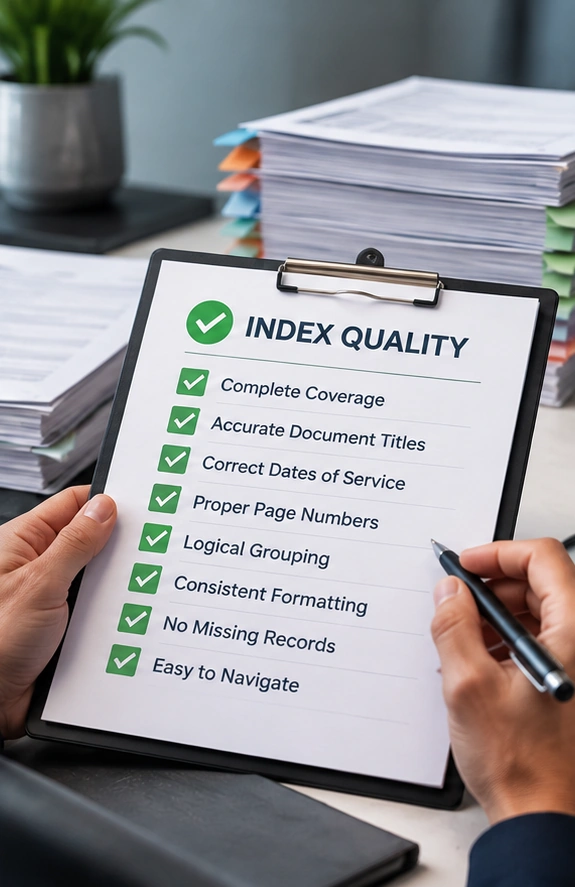
So how do you measure whether a medical record index is any good? As a legal nurse consultant who builds and checks these, I use five measures: completeness, accuracy, traceability, consistency, and gap visibility. Run an index through those and you learn in minutes whether it can be trusted, or whether it just looks finished.
Completeness: is every record accounted for?
A quality medical record index accounts for every page in the production, with nothing dropped and nothing double-counted. Completeness is the first measure because an index that is missing records is worse than no index, since it tells you the file is covered when it is not.
Check it by reconciling the index against the page count of the source production. The totals should match. If the index lists fewer records than the file contains, documents were skipped; if it lists more, duplicates were likely counted as separate records. Either way, the index does not describe the file you actually have.
An index that looks finished is not the same as one that works
Formatting is easy to see and accuracy is easy to miss. A medical record index can be clean, consistent, and completely wrong about which page a record is on. Quality is measured by use: pick entries at random and see whether they hold.
Accuracy: do the entries match the documents?
A quality index is accurate, meaning each entry's date, provider, record type, and page reference match the document it points to. Accuracy is what separates an index you can rely on from one you have to double-check, which defeats the point of having it.
Measure it by spot-checking. Pick a sample of entries at random and open the pages they reference. Does the record on page 312 match what the index says is on page 312? Is the date the entry lists the date on the document? An index that fails a random spot-check fails everywhere you did not look, because the errors you catch are rarely the only ones. This is also where reading the clinical terms correctly matters, since an index that records "rule out" as a diagnosis is inaccurate even when the page number is right.
Not sure an index you received holds up?
Traceability: can every entry be verified?
A quality medical record index makes every entry verifiable by linking it to a specific source page, usually a Bates number. Traceability is what lets you trust the index without re-reading the file, and what lets you defend a date or a record at a deposition.
Measure it by asking of any entry: can I get from this line to the exact page it came from, in seconds? If the index uses stable page or Bates references that resolve to real pages, it is traceable. If entries point to nothing, or to page numbers that shifted when the file was edited, the index cannot be verified, and an index you cannot verify is a summary you are taking on faith.
Consistency: is the whole index built the same way?
A quality index is internally consistent: the same categories, date formats, and provider naming used from the first entry to the last. Consistency is what makes an index usable as a whole and comparable across files, and its absence is a quiet sign the index was assembled by different hands without a standard.
A medical record index is judged the moment you click an entry to verify it. Either it holds, or it was only ever decoration.
Gap visibility: does it show what is missing?
The highest measure of a medical record index is whether it surfaces what is not there. A quality index does not just catalog the records that arrived; it flags the providers named but never produced, the studies referenced but not included, and the treatment periods with no documentation.
This is the measure most indexes fail, because it is the hardest and the one that takes real review. An index that only lists present records is a catalog. An index that also names the gaps is a finding aid, and surfacing those gaps is how indexing helps attorneys spot missing records before a deadline does. Measure it by asking: does this index tell me anything about what should be here and is not? If it is silent on gaps, it is doing half the job.
Five measures of a medical record index
Complete
Every record accounted for
The index reconciles to the production's page count, nothing dropped or doubled.
Accurate
Entries match the pages
Dates, providers, and page references check out on a random spot-check.
Traceable
Every entry verifiable
Each line resolves to a real source page, usually a Bates number.
Frequently asked questions about medical record index quality
How do you measure the quality of a medical record index?

Measure it on five things: completeness (every record accounted for, reconciled to the page count), accuracy (dates, providers, and page references match the documents), traceability (every entry links to a verifiable source page), consistency (the same structure throughout), and gap visibility (it flags what is missing, not just what is present).
How can I quickly check if an index is reliable?
Run four fast checks: reconcile the index total against the production's page count, open ten random entries to confirm the page and date match, scan for consistent date and provider formatting, and look for a list of flagged gaps. An index that passes those is usually trustworthy; one that fails any is not.
What is the most common flaw in a medical record index?
Silence on gaps. Many indexes catalog the records that arrived but never flag the providers named but not produced, the studies referenced but missing, or the undocumented treatment periods. An index that only lists present records is doing half the job.
Why does traceability matter in an index?
Because everyone downstream relies on the index without re-reading the file. If each entry links to a verifiable source page, usually a Bates number, a date or record can be confirmed and defended in seconds. An index whose entries cannot be traced is a summary taken on faith.
Does a legal nurse consultant judge the medicine when checking an index?
No. A legal nurse consultant checks the index for completeness, accuracy, traceability, consistency, and gaps, and confirms the clinical terms were read correctly. Diagnosis, causation, and legal conclusions stay with the qualified physician and the attorney.
How to run the check in practice
You do not need to audit an entire index to measure its quality. Reconcile the index total against the production page count for completeness. Pull ten entries at random and open their pages for accuracy and traceability. Scan for consistency in how dates and providers are written. And look for a gap list, or ask where it is. Those four quick checks tell you most of what you need to know.
The reason this matters is that an index is a trust instrument. Everyone downstream, the attorney, the expert, the evaluator, relies on it without re-verifying the file, so a bad index does not announce itself; it just quietly sends good people to wrong pages and lets missing records stay missing. Measuring quality before you rely on it is cheaper than discovering the gaps at a deposition.
One line on where my work stops. As a legal nurse consultant, I build and check indexes for completeness, accuracy, traceability, consistency, and gaps, and I flag what is missing. I do not diagnose, decide causation, or reach a legal conclusion. Those stay with the physician and the attorney, working from an index they can trust.
Source Credit : All metrics derived from LezDo TechMed’s internal project data.
Janu Padmaprasad
Janu Padmaprasad is a certified Legal Nurse Consultant with seven years of experience in the medical-legal ecosystem. She understands the operational and evidentiary challenges faced by injury attorneys, medical evaluators, life care planners, and insurance professionals. By combining her research insights with expertise in medical chronology preparation, she writes solution-driven articles on medical data analysis that help medical-legal experts strengthen case outcomes and enhance their business operations.













.png)


