Home
>
Blog
>
>
Table of Contents vs. Index vs. Chronology: Three Things People Confuse
- A table of contents, an index, and a chronology are three different tools for a medical record set, and they are not interchangeable.
- A table of contents lists the sections in order; it tells you what is in the file and roughly where.
- An index maps every record to its exact page; it tells you where any specific document is.
- A medical chronology reads the records and tells the clinical story in a dated narrative.
- Most cases need more than one: a TOC to navigate, an index to locate, and a chronology to understand.
A table of contents, an index, and a chronology get used as if they are the same thing, and they are not. Each answers a different question about a medical record set, and asking for the wrong one is how a firm ends up with a deliverable that does not do what the case needed.
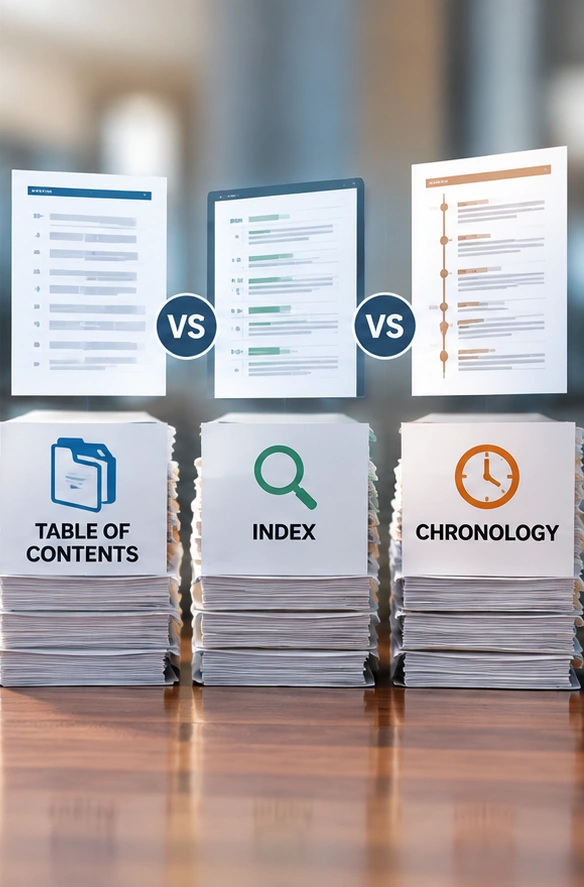
Here is the distinction in one line each. Medical record indexing, table of contents and medical chronologies have their own weightage in record reviews. A table of contents tells you what is in the file and in what order. An index tells you where any specific record is. A chronology tells you what happened, clinically, and when. One lists, one locates, one interprets. As a legal nurse consultant, I build all three, so let me separate them cleanly and show when each is the right tool.
What is a table of contents for a medical record set?
A table of contents is an ordered list of the sections in a record set, usually by provider or record type, that tells a reader what the file contains and roughly where each section begins. It is the high-level map: hospital records start here, the treating physician there, imaging after that.
A table of contents is about structure, not precision. It gets you to the right section of a large file quickly, but it does not point you to a specific document or a specific page. For a reader who just needs to see what is in the production and jump to the right neighborhood, a TOC is enough.
List, locate, interpret: three different jobs
A table of contents lists what is in the file. An index locates any specific record on its page. A chronology interprets the records into a dated story. A firm that asks for one when it needed another gets a deliverable that technically works and still does not answer the question the case was asking.
What is an index for a medical record set?
An index is a navigable map that ties every record to its exact page, so any specific document can be located in seconds. Where a table of contents gets you to the right section, an index gets you to the right page, usually by a Bates number.
An index lists each record with its date, provider, type, and page reference, and often adds a provider index with date ranges. The difference from a table of contents is precision: a TOC says "imaging starts on page 300," an index says "lumbar MRI, 03/14, page 312." If the task is to find and verify a specific fact, the index is the tool, which is also why it is easy to confuse with, but is not the same as, the difference between sorting and indexing.
Not sure which deliverable your case needs?
What is a medical chronology, and how is it different?
A medical chronology reads the organized records and presents the clinical events as a dated narrative, with each entry traced to its source page. A table of contents and an index both point you at the records; a chronology interprets them.
That is the real dividing line. A TOC and an index are navigation tools, built so a reader can find things. A chronology is an interpretation tool, built so a reader can understand the treatment story without reading every page. An index tells you the lumbar MRI is on page 312; a chronology tells you what the MRI showed, when it was ordered, and how it fits the course of care. The two are not competitors, because the chronology is usually built on top of a sorted, indexed file, which is the same reason sorting is not the same as making a medical chronology.
A table of contents lists, an index locates, a chronology interprets. Ask for the one that answers your actual question.
When do you need which one?
Sorting vs medical chronology vs table of contents- How to pick the right one at the right time?
The right tool depends on what you are about to do with the file.
- Use a table of contents when a reader needs to see what is in a large production and jump to the right section, without needing a specific page.
- Use an index when you need to find and verify specific records fast, cite exact pages, or hand a navigable file to an expert.
- Use a chronology when you need to understand and present the treatment story: valuing a case, drafting a demand, preparing for a deposition, or briefing an expert.
Most litigation files end up needing more than one. A large record set is sorted, given a table of contents and an index so it can be navigated, and then a chronology is built on top so the story can be told. They stack; they do not substitute.
Three tools, three jobs
Table of contents
Lists what is in the file
Get to the right section of a large production quickly, by provider or record type.
Index
Locates any record
Find and cite a specific document on its exact page, usually by Bates number.
Chronology
Interprets the records
Read the treatment story as a dated narrative, each entry traced to its source.
Frequently asked questions
What is the difference between a table of contents and an index for medical records?

A table of contents lists the sections of a record set in order, usually by provider or record type, so you can jump to the right section. An index maps every individual record to its exact page, usually by Bates number, so you can find a specific document. A TOC gets you to the neighborhood; an index gets you to the page.
Is a medical index the same as a medical chronology?
No. An index locates records; it tells you where a document is. A medical chronology interprets records; it reads them and presents the clinical events as a dated narrative tied to source pages. An index is a navigation tool, a chronology is an interpretation tool, and the chronology is usually built on top of an indexed file.
Do I need all three for a case?
Often yes, in layers. A large production is sorted, given a table of contents and an index so it can be navigated, and then a chronology is built so the treatment story can be understood. Smaller or narrower tasks may need only one, which is why confirming the deliverable up front matters.
Which should I order first?
Order follows dependency. The records are sorted first, then a table of contents and an index are built on the sorted set, and a chronology is built last, on the indexed file. Asking for a chronology without the sorting and indexing underneath risks a narrative built on a disorganized file.
Does a legal nurse consultant decide the case when building these?
No. A legal nurse consultant organizes, maps, and reads the documented records and flags gaps and inconsistencies. Diagnosis, causation, and legal conclusions are made by the qualified physician and the attorney, using whichever tool the case requires.
How they work together
The cleanest way to think about it is as layers. Sorting puts the records in order. A table of contents labels the sections of that order. An index maps every record in it to a page. A chronology reads the mapped records and tells the story. Each layer is built on the one beneath it, and skipping a layer is what leaves a reader with a tool that does not reach the job.
So when the words blur together, keep the questions straight. What is in the file? That is a table of contents. Where is this specific record? That is an index. What happened, and when? That is a chronology. Match the deliverable to the question, and the file does what the case needs.
One line on where my work stops. As a legal nurse consultant, I organize, map, and read the documented records and flag the gaps and inconsistencies. I do not diagnose, decide causation, or reach a legal conclusion. Those stay with the physician and the attorney, working from whichever of these tools the case actually calls for.
Source Credit : All metrics derived from LezDo TechMed’s internal project data.
Janu Padmaprasad
Janu Padmaprasad is a certified Legal Nurse Consultant with seven years of experience in the medical-legal ecosystem. She understands the operational and evidentiary challenges faced by injury attorneys, medical evaluators, life care planners, and insurance professionals. By combining her research insights with expertise in medical chronology preparation, she writes solution-driven articles on medical data analysis that help medical-legal experts strengthen case outcomes and enhance their business operations.













.png)