Home
>
Blog
>
>
How Deposition Summaries Speed Up IME and QME Evaluations
Deposition summaries let IMEs and QMEs spend less time searching through transcripts and more time forming credible medical opinions.
Are you working on Independent Medical Examinations (IME) or Qualified Medical Evaluations (QME)? If yes, you already know the pressure. You face tight deadlines, complex medical histories, and stacks of documents that demand your attention.
Now think about your last case.
- How long did you spend reading deposition transcripts?
- How many times did you go back to verify a statement?
- Did you ever feel like you were searching more than analyzing?
The real problem is- most of your time isn’t spent on evaluation but on information hunting.
This is exactly where deposition summaries transform your workflow.
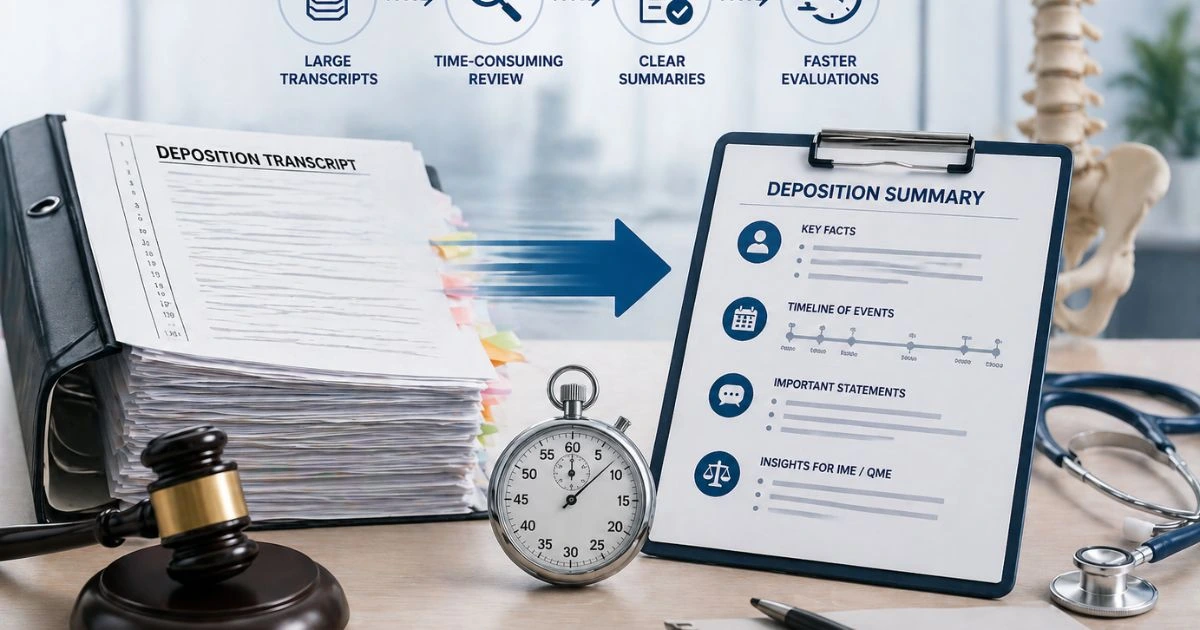
Deposition summaries change the speed, quality, and efficiency of IME/QME processes by distilling hundreds of pages of legal testimony into concise and actionable reports.
Save 60–80 Hours Monthly
Using deposition summaries can save 3–4 hours per case, helping IMEs/QMEs save 60–80 hours per month across high-volume workflows.
The Hidden Time Drain in IME and QME Workflows
An IME/QME evaluation may sound straightforward:
- Review records
- Analyze facts
- Provide medical opinion
But, in reality, the process looks very different.
A single case may also include:
- Thousands of pages of medical records
- 100-300 pages of multiple deposition transcripts
- Multiple witness statements
- Prior injury documentation
Among these, deposition transcripts are often the least structured yet most time-consuming documents.
Because they include:
- Long narratives
- Repetitive questioning
- Irrelevant details
- Unclear timelines
- Mixed medical and non-medical information
Imagine, you have a full day of evaluations lined up. The claimant is already waiting in the room, but you got a deposition transcript of 347 pages long waiting on your desk.
Sounds familiar? You are buried under the mountains of records even before the evaluation begins.
New depositions arrive, and new insights emerge. Without reviewing the testimony, your evaluation will be incomplete, no matter how experienced you are.
Deposition summaries fill this gap.
What a Deposition Summary Actually Does
A deposition summary is not just a shorter version of a complex transcript. A well-prepared summary:
- Filters irrelevant conversations, repetitions, and filler content.
- Organizes testimony into logical sections such as, injury details, medical history, treatment timeline, and work impact.
- Links deposition testimony with medical facts, making it easier to correlate with records.
- Highlights contradictions, admissions, and key statements.
In other words, it converts raw testimony into usable insight.
How Deposition Summaries Save IME/QME Time
Let’s walk through the IME/QME workflow and see where deposition summaries make a measurable difference.
1. Initial Case Review: From Hours to Minutes
Without a Summary:
You start reading a 200-page transcript. Important details are scattered. You don’t know what matters yet, so you read everything.
Time spent: 3–5 hours
Mental effort: High
Output: Fragmented understanding
With a Summary:
You begin with a structured document that already highlights:
- Key injury descriptions
- Timeline of events
- Relevant admissions
Time spent: 30–60 minutes
Mental effort: Focused
Output: Clear case overview
Impact: Faster orientation leads to faster decision-making throughout the case.
See how an accurate deposition summary look like!
2. Eliminate the Verification Loop
You read the deposition once. During evaluation, every time you may need to revisit the transcript to verify a date, confirm a statement, or check whether the claimant mentioned a prior condition.
Going through hundreds of pages of transcript for details during evaluation is a silent time killer.
With a structured deposition summary, you have:
- Date of incident
- Onset of symptoms
- Treatment progression
- Recovery or complications
You no longer need to cross-reference the 200-page transcript, and instead you check the summary and move forward.
Impact: Fewer interruptions during analysis means faster, more focused report writing.
3. Faster Identification of Medically Relevant Testimony
Not all testimony matters for medical evaluation.
You care about:
- Mechanism of injury
- Symptom descriptions
- Functional limitations
- Prior medical conditions
A full transcript forces you to dig for these, but a summary delivers them upfront.
Impact: You spend time analyzing medical facts, not searching for them.
4. Detect Inconsistencies Immediately
In IME/QME evaluations, inconsistencies can change the entire outcome. For example:
A claimant denies prior injury in deposition, but medical records show previous treatment. When reading a transcript, such contradictions are easy to miss.
In a summary, contradictions and inconsistencies are often:
- Highlighted
- Grouped
- Clearly presented
Impact: Faster identification of red flags improves accuracy and credibility.
5. Faster Report Preparation
Deposition summaries save more time in IME/QME report preparation.
To prepare IME/QME reports, you need:
- Referencing deposition statements
- Supporting conclusions with testimony
- Structuring medical opinions clearly
Without a Summary
- Revisit transcripts multiple times
- Search for exact statements
- Risk missing or misquoting context
With a Summary
- Key points are already extracted
- Statements are easy to locate
- Structure aligns with report needs
Impact: Report preparation becomes faster, smoother, and more accurate.
6. Standardized Output Across Every Case
All deposition transcripts are not alike. Some are:
- Disorganized
- Verbose
- Difficult to follow
- Filled with technical jargon
But deposition transcript summaries standardize everything into a consistent format. It helps you predict your IME/QME workflow. For more on that, see which deposition summary format fits an IME or QME evaluation.
Impact: Consistency reduces decision fatigue and speeds up IME/QME processes.
7. Better Case Throughput
Let’s understand it better.
In a case, you take around 5 hours to read and understand the deposition and note down the vital facts. At the same time, you take only 1 to 2 hours to do the same while using the summary. Here, you save around 3 to 4 hours per case.
Now multiply that across 5 cases per week and 20 cases per month. You’re saving 60–80 hours a month.
Impact: You can handle more evaluations, complete your IME/QME reports on time, or reduce workload stress, without sacrificing quality.
8. Reduced Mental Fatigue
Deposition summaries not only save your time or speed up the processes. It saves you from mental fatigue.
Reading long transcripts during evaluation leads to:
- Decreased attention
- Missed details
- Slower comprehension
Accurate deposition summaries reduce this burden by:
- Presenting only relevant content
- Using structured formatting
- Eliminating repetition
Impact: You stay sharp, focused, and efficient throughout the evaluation.
"A well-prepared deposition summary transforms scattered testimony into focused medical-legal insight—making evaluations faster, clearer, and less exhausting."
How LezDo TechMed Makes this Effortless for You
You don’t have to spend your valuable hours crafting deposition summaries. LezDo TechMed offers deposition summary services tailored to the needs of IME and QME evaluations. Our team understands medico-legal processes and their focus. Every summary we prepare is structured around what evaluators actually need during medical evaluations.
With LezDo TechMed, you get:
- Medically focused: Summaries are organized and structured around injury details, treatment history, symptom progression, and functional limitations.
- Inconsistency flagging: Every contradiction between the testimony and the medical records is clearly identified and reported to ensure nothing vital is missed.
- Page-line references: Every key fact is traceable back to the original transcripts for verification and report preparation.
- Faster turnaround: Deposition summaries are delivered on timelines that fit your evaluation schedule.
- Consistent formatting: Our summaries follow a standard structure, and so your review process becomes smooth across cases.
Whether you handle a few evaluations per month or handle high-volume IME/QME cases, we scale up with your caseload. When you outsource deposition summaries to us, we ensure you do not spend your time buried in deposition transcripts and more time to do the core tasks where your expertise is required.
How Deposition Summaries Speed Up IME/QME Evaluations
60–80
Hours Saved Monthly
Save 3–4 hours on each case and reclaim valuable review time
5×
Faster Case Orientation
Turn a 200-page transcript into a 30–60 minute review
40%
Less Mental Fatigue
Reduce repetitive reading and lower the risk of missing key details
FAQs
How do deposition summaries save time in IME and QME evaluations?

Deposition summaries condense lengthy transcripts into structured insights, helping evaluators review key testimony faster and reduce preparation time significantly.
Why are deposition summaries useful for IMEs and QMEs?
They highlight medically relevant testimony, organize timelines, and surface contradictions, making evaluations more efficient and accurate.
Can deposition summaries improve IME/QME report preparation?
Yes. They make it easier to reference testimony, support medical opinions, and prepare defensible reports faster.
How do deposition summaries help identify inconsistencies?
They flag contradictions between testimony and medical records, helping evaluators spot red flags quickly.
Do deposition summaries reduce the need to reread transcripts?
Yes. Structured summaries eliminate repeated transcript searches by putting key facts and statements upfront.
Can deposition summaries improve evaluation accuracy?
Yes. By surfacing critical facts, treatment progression, and prior conditions, they help reduce missed details and support stronger opinions.
How much time can deposition summaries save per case?
They can save several hours per case, often reducing transcript review time from 3–5 hours to under an hour.
Do deposition summaries help manage high IME/QME caseloads?
Yes. Faster case review improves throughput, helping evaluators handle more cases without sacrificing quality.
How do deposition summaries reduce mental fatigue?
They remove repetitive reading and organize only relevant testimony, helping evaluators stay focused and efficient.
Should IMEs and QMEs outsource deposition summary preparation?
Outsourcing can save time, improve consistency, and provide medically focused summaries tailored for faster, more reliable evaluations.
Conclusion
Your core task is evaluating, analyzing, and forming credible opinions. If you spend your valuable time searching through raw transcripts, you are wasting your precious hours.
Deposition summaries don’t change the complexity of your cases. They change how efficiently you move through them. A well-prepared summary helps you in faster case reviews, accurate IME/QME reports, fewer errors, and a workload that doesn’t wear you down.
Source Credit : All metrics derived from LezDo TechMed’s internal project data.
Anjana Devi Vijay
Anjana Devi Vijay is a Certified Legal Nurse Consultant (CLNC) and Medical–Legal Research Analyst with 9+ years of experience in medical record review, deposition summary analysis, and medico-legal research. She specializes in transforming complex healthcare documentation into accurate, actionable insights that support attorneys, insurers, and medical evaluators. With expertise in clinical documentation analysis and legal case support, she creates research-driven content focused on improving decision-making and case outcomes.













.png)