Home
>
Blog
>
>
Page-Line, Topic, or Narrative? The Deposition Summary Format That Controls Your Cost
Before you order a deposition summary for a workers' comp file, remember that the format sets the cost:
- Format sets the cost – depth drives time, and time drives price, so the format is your biggest lever.
- Page-line for disputes – the most detailed and costly format; worth it when testimony may be quoted or challenged.
- Topic-wise for speed – a mid-cost workhorse; find the issues fast without line-by-line detail.
- Narrative for overviews – the leanest, most budget-friendly format; best for routine files or a first read.
Read on to match the right format to each case and stop overpaying by default.
The fastest way to control what a deposition summary costs isn't negotiating the page rate. It's picking the right format. Feeling like your workers' comp files spend too much on summarizing depositions? Nine times out of ten, that's a format mismatch, not a pricing problem. Let's fix it.
Quick level-set: a deposition summary condenses hours of sworn testimony into a document your team can actually use, so you find the answers without re-reading the whole transcript. The format you pick decides how deep that document goes, and depth is what you pay for. Match the format to the case, and the cost mostly takes care of itself.
Why the format is the real cost lever
Format drives cost because format drives depth, and depth drives time. A line-by-line breakdown of a 250-page treating-physician deposition takes far longer to produce than a two-page narrative of the same testimony, so it costs more. Neither one is better on its own. The detailed version is only worth it when the case actually needs that detail. So the real money question isn't what your rate is. It's how much detail this deposition really needs.
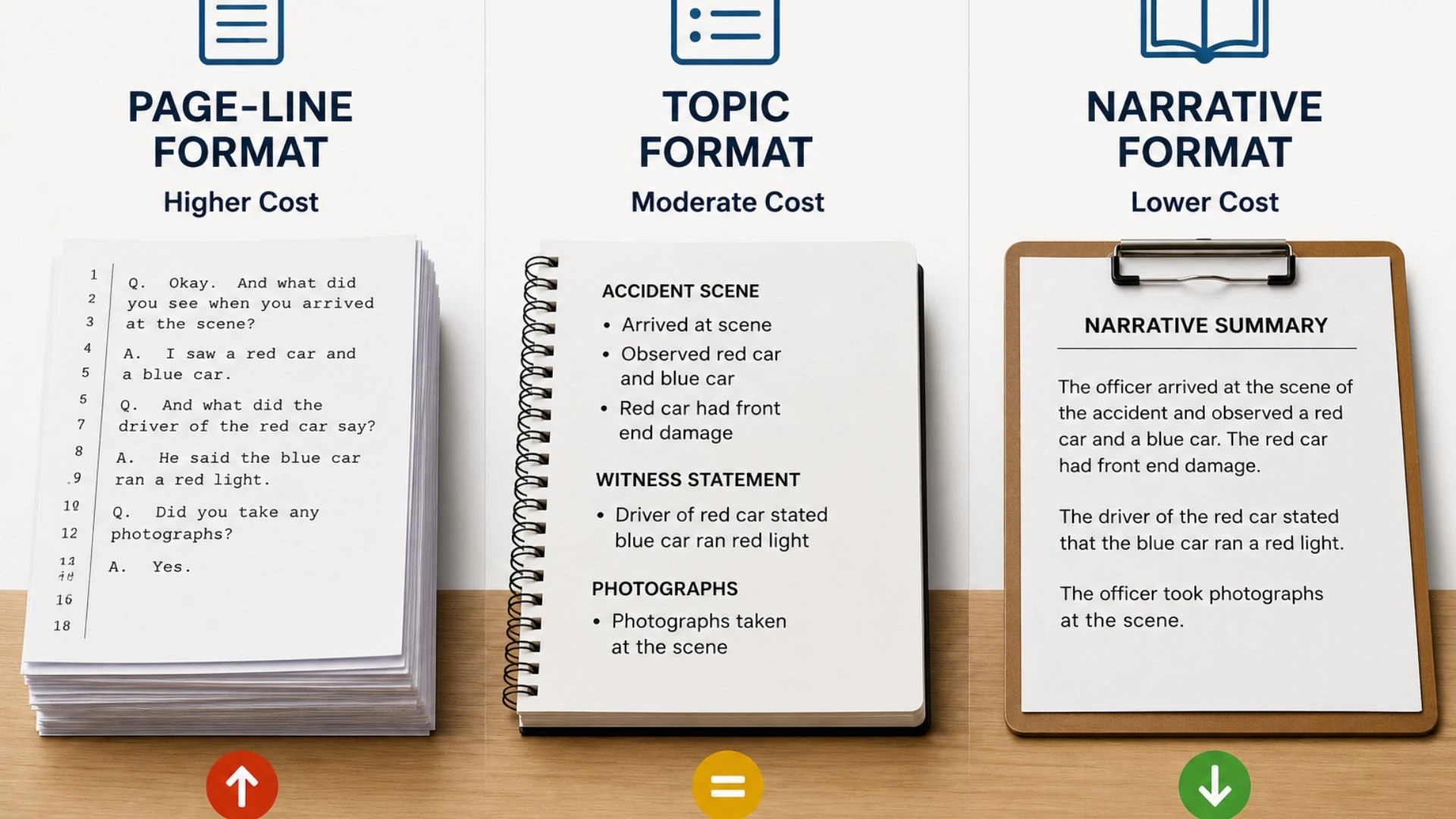
3 Formats, 3 Cost Levels
Page-line, topic-wise, and narrative summaries trade depth for cost. Matching the format to the case is what keeps deposition summary spend under control.
Page-line summary: when every line has to be defensible
Choose a page-line summary when you may need to quote or challenge exact testimony. It captures each point with its page and line reference, so you can pull up the precise words at a hearing or cross-check them against the medical records in seconds.
This is the most detailed format, so it's the most expensive per page. It earns that cost on the files where precision matters: a disputed AOE/COE, a prior-injury or apportionment fight, an applicant whose account shifts, or any witness you might impeach. When a summary will be quoted or cross-referenced, page-line usually pays for itself the first time it saves you from missing a contradiction.
Topic-wise summary: organized around the issues you argue
Choose a topic-wise summary when you need to find issues fast without line-by-line detail. It groups the testimony by subject, injury mechanism, prior injuries, work status, treatment history, so you jump straight to the part you're working on.
It sits in the middle on cost, and it's the workhorse for most WC files. You give up exact page-line precision, but you gain speed: an adjuster or attorney can scan the topics that drive the claim and skip the rest. For a lot of cases, that is the best return on the dollar.
Not sure which format your case needs?
Narrative summary: the story, condensed
Choose a narrative summary when you want a clear overview at the lowest cost. It reads as a flowing, date-ordered account of what the witness said, without the scaffolding of page and line citations.
Because it's the leanest format, it's the most budget-friendly. It fits routine files, early case assessment, or a first read before you decide whether a deeper summary is even warranted. The trade-off: if you later need to quote or challenge testimony, you may have to go back for more detail, so use it where the case is straightforward.
You'll also see issue-focused and witness-focused versions. Those are really targeted blends of the three above, zeroed in on one disputed issue or one deponent. Same principle applies: the tighter and deeper the focus, the more it costs, and the more it should be reserved for what's genuinely in dispute.
How to match the format to the WC case
Match the format to what the deposition actually has to do, and you stop overpaying by default. A quick way to decide: if the testimony is likely to be quoted or challenged, go page-line; if you mainly need to locate issues across a long deposition, go topic-wise; if it's a routine file or a first look, a narrative summary is usually enough. Order the depth the case earns, not the depth you always order.
The cheapest deposition summary isn't the one with the lowest page rate. It's the one whose format fits the case.
One line to keep clean
Whatever the format, a deposition summary organizes and condenses what was said and flags where it agrees or conflicts with the records. It doesn't decide compensability, apportionment, or causation, and it isn't legal strategy. LezDo TechMed's deposition summary services structure the testimony and point you to the source, and you and your experts draw the conclusions. Keeping that line clean is part of what makes the summary both useful and defensible.
Match the Format to the Case
Page-Line
Highest detail, highest cost
For disputed or high-stakes depositions you may quote or challenge
Topic-Wise
Balanced cost
Find issues fast across a long transcript
Narrative
Leanest cost
A quick overview for routine files or an early read
Deposition Summary Cost & Format FAQs
Which deposition summary format is the most cost-effective?

It depends on the case. A narrative summary is the leanest and most budget-friendly for routine files or a first read. A topic-wise summary is the workhorse when you need to find issues fast. A page-line summary is the most detailed and costs the most, and it pays off on disputed or high-stakes depositions. The cheapest choice is the format that fits the case, not the lowest page rate.
What's the difference between a page-line and a narrative deposition summary?
A page-line summary captures each point with its page and line reference for precise quoting or cross-checking. A narrative summary reads as a condensed, date-ordered story of the testimony without citations. Page-line is deeper and more expensive; narrative is leaner and cheaper.
How do I decide which format a workers' comp deposition needs?
Ask what the summary has to do. If the testimony may be quoted or challenged (disputed AOE/COE, apportionment, prior injuries), use page-line. If you mainly need to locate issues across a long transcript, use topic-wise. If it's a routine file or an early read, a narrative summary is usually enough.
Does outsourcing deposition summaries actually save money?
It can, when the depth matches the case and the summary is accurate enough to trust without re-reading the transcript. The savings come from fewer attorney and paralegal hours and faster case movement. A summary that needs rework erases that saving, so accuracy and the right format matter as much as the rate.
How is a deposition summary priced?
Pricing is typically per page or per report, and it depends on the format, the page volume, the complexity, and how fast you need it. The format you choose is the biggest driver, because it sets the depth. Confirm scope up front so the cost is predictable.
What is a page-line deposition summary?
A summary that captures each point of testimony with its page and line reference, so you can quote or cross-check the exact words quickly. It's the most detailed and most expensive format, best reserved for testimony you may need to challenge.
Does a deposition summary interpret the testimony or give an opinion?
No. It organizes and condenses the testimony and flags where it lines up with or contradicts the records. Compensability, apportionment, causation and strategy are for the attorney and qualified experts, not the summary.
The bottom line on cost
Here's the honest version: the cheapest summary isn't the one with the lowest page rate. It's the one whose format fits the case, so you aren't paying for detail you'll never use or going back for detail you needed. Get the format right, and cost stops being a guessing game.
Source Credit : All metrics derived from LezDo TechMed’s internal project data.
Anjana Devi Vijay
Anjana Devi Vijay is a Certified Legal Nurse Consultant (CLNC) and Medical–Legal Research Analyst with 9+ years of experience in medical record review, deposition summary analysis, and medico-legal research. She specializes in transforming complex healthcare documentation into accurate, actionable insights that support attorneys, insurers, and medical evaluators. With expertise in clinical documentation analysis and legal case support, she creates research-driven content focused on improving decision-making and case outcomes.













.png)