Why Do Defense Attorneys Need Medical Chronologies in Injury Claims?
A defense attorney needs a medical chronology because it turns a messy injury record into a usable timeline. It helps counsel test the plaintiff's medical story, identify gaps, separate prior conditions from claimed injuries, and prepare the file for strategy, negotiation, expert review, and trial.
Injury claims can carry years of medical records behind one short allegation. A defense attorney may receive emergency records, orthopedic notes, therapy records, pain management files, imaging reports, prior provider records, and late supplemental documents. Some pages repeat. Some details appear once. Some facts matter only when compared with what happened before and after the incident.
The defense does not need a pile of records. It needs to know what the records actually show. A medical chronology organizes the record into a timeline that helps counsel understand what happened, what existed before the claimed injury, what changed afterward, and which points need closer review.
A well-prepared medical chronology does not argue the case. It gives defense counsel a reliable map of the medical evidence before decisions are made about causation issues, damages, settlement posture, expert review, or trial preparation.
What Is a Medical Chronology in an Injury Claim?
A medical chronology is a date-ordered summary of medical events prepared from the records in the file. Each entry usually identifies the treatment date, provider, facility, complaint, diagnosis as documented, treatment, test results, imaging findings, and relevant notes.
For injury claims, source references are important. A defense attorney should be able to move from a summary entry to the original provider note, report, page reference, or Bates number quickly.
Medical records tell the story in pieces. A chronology puts those pieces in sequence, and that sequence matters because defense review often turns on timing.
55-60% Less Record Navigation
Effort In injury-claim review, a medical chronology can reduce time spent locating dates, providers, treatment events, and gaps because the sequence is already organized.
Why Does the Timeline Matter to the Defense?
Defense attorneys review medical records to understand whether the medical story is complete, consistent, and connected to the claim being made. Raw records make this difficult because provider files are often grouped by facility, not by the course of events.
A medical chronology helps counsel see the claim as a medical timeline instead of a file dump. Once the timeline is visible, the defense team can ask sharper questions about prior history, treatment gaps, unrelated care, and expert review.
What Should Defense Attorneys Look for in a Medical Chronology?
A useful defense chronology is not the longest summary in the file. It is the one that helps the team understand the record with accuracy and restraint.
Defense attorneys should look for:
Pre-injury medical history with prior complaints, surgeries, medications, and similar symptoms when documented.
Exact timeline of the claimed injury, including first treatment, follow-up care, imaging, and therapy.
Objective findings such as imaging impressions, examinations, and procedure reports.
Treatment progression showing improvement, worsening, discharge, referrals, or continued complaints.
Gaps, conflicts, missing records, and unexplained changes flagged for attorney review.
The best chronologies summarize what matters without becoming another oversized document.
7 Ways a Medical Chronology Helps Defense Attorneys
Establishing What Happened Before the Claimed Injury
Pre-incident history can be one of the most important parts of a defense review. A claimant may have earlier complaints, chronic conditions, prior injuries, surgeries, imaging, medication use, or treatment for the same body part. A chronology places that history beside the post-incident care so counsel can compare the medical baseline with later complaints.
Evaluating Whether the Records Support the Claimed Medical Sequence
Injury claims often depend on how the medical evidence lines up with the alleged event. A chronology helps attorneys review when symptoms first appeared, whether treatment was immediate or delayed, what providers documented about the history, and whether diagnostic testing supports the condition being claimed. It shows where the sequence is clear and where legal or expert analysis may be needed.
Some useful defense issues appear in gaps, changes, and inconsistencies. A chronology can identify missing treatment periods, different dates of injury, conflicting symptom descriptions, delayed follow-up, records referenced but not produced, or different accounts of how the injury occurred.
An inconsistency is not proof of fraud. It gives defense counsel an issue to investigate, clarify in discovery, raise with an expert, or explore during deposition.
Separating Accident-Related Treatment From Unrelated Care
Many claimants have a long medical history. Not every visit in the record set will relate to the injury claim. A chronology helps counsel separate pre-existing history, incident-related complaints, new treatment, ongoing symptoms, unrelated care, and later developments.
Understanding the Progression of the Claimed Injury
A single medical note rarely explains the full injury picture. Defense counsel often needs to follow the progression from first complaint to diagnosis, treatment, response, improvement, worsening, surgery, discharge, or future care recommendation. In sequence, the defense team can see how the claimed condition developed across the record.
Preparing for Depositions and Medical Expert Review
Depositions and expert reviews become harder when counsel has to search raw records for every date. A source-linked chronology helps locate treatment dates, diagnostic studies, surgical history, medication changes, therapy progress, provider opinions, and contradictory documentation.
Supporting Settlement and Litigation Strategy
A chronology does not set the value of a case or decide whether the claim should settle. It helps defense counsel assess the medical evidence first. The timeline may reveal strengths, weaknesses, missing records, unclear future treatment, prior similar complaints, or issues that need expert input.
"A defense chronology is powerful because it does not argue first. It lines up the medical story so counsel can see what is strong, thin, missing, or worth challenging."
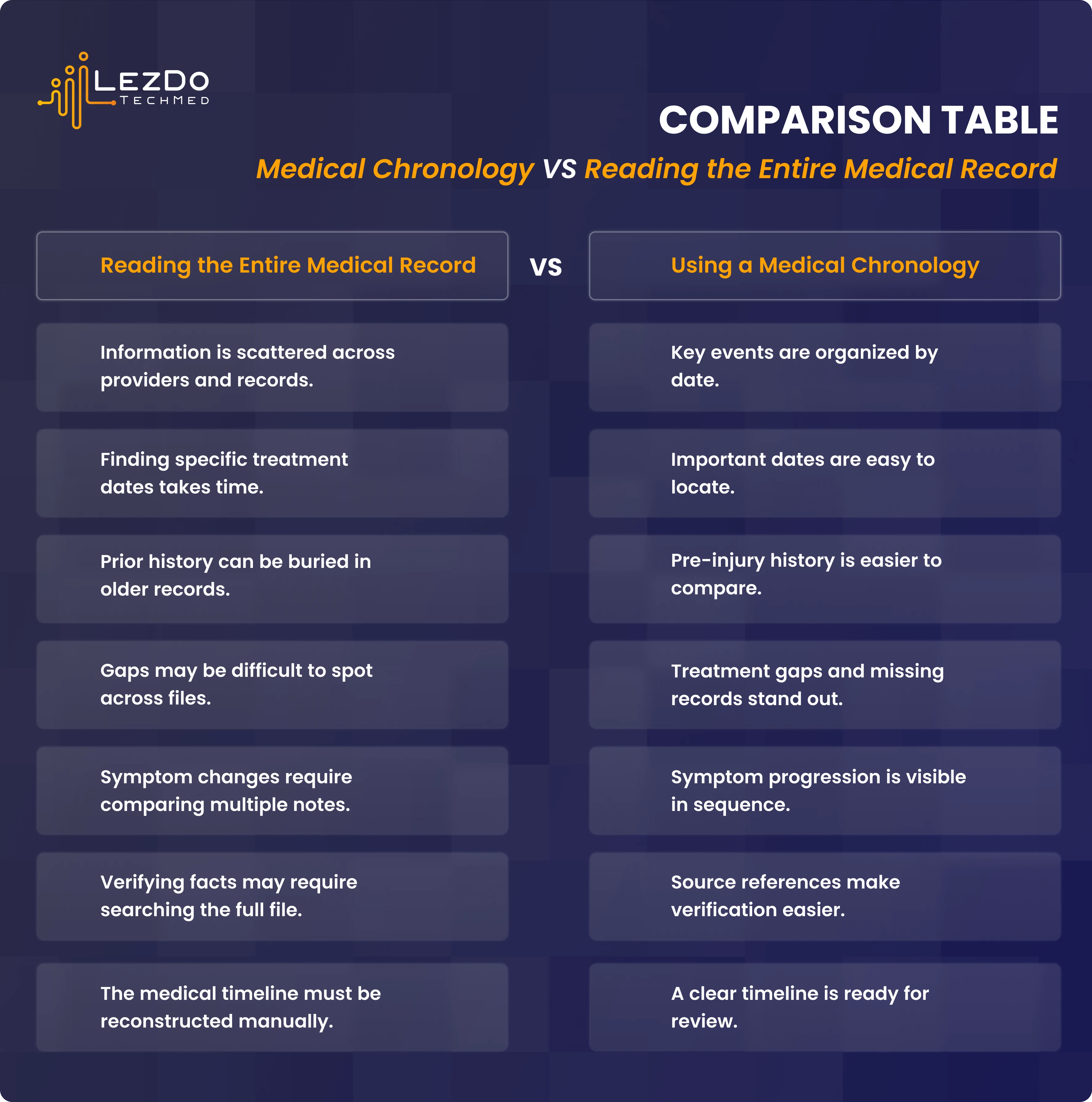
Medical Chronology vs. Reading the Entire Medical Record
A chronology does not replace the original records. It gives defense counsel a clear map for navigating and reviewing them.
Difference Between: Medical Chronology vs. Reading the Entire Medical Record
What a Defense Chronology Helps Counsel See
35%
Earlier Gap Recognition
Date-ordered review helps teams spot missing treatment periods, absent reports, and delayed follow-ups before depositions or expert review.
40%
Stronger Prior-History Visibility
Pre-incident treatment, similar symptoms, prior imaging, and chronic conditions become easier to compare with post-incident care.
30%
Faster Expert Prep
A source-linked chronology helps attorneys send experts a cleaner timeline while keeping the full record available.
When Should Defense Attorneys Request a Medical Chronology?
Timing affects value. A medical chronology service is helpful late in litigation, but it is often more useful before the defense team spends hours rebuilding the medical story manually.
During initial case evaluation, the chronology helps counsel understand the medical picture before discovery planning or early settlement discussions. Before a deposition, it helps prepare questions around treatment dates, prior complaints, gaps, and symptom changes. Before expert review, it helps identify missing records and key medical events the expert may need to verify.
To wrap up,
A defense attorney should not have to reconstruct the medical story from scattered records every time the case needs an answer. A strong medical chronology turns the record into a usable timeline: what happened, what existed before, what changed after, what was treated, what is missing, and what the records actually support.
That is why defense attorneys need medical chronologies in injury claims. A chronology gives the defense team the medical sequence they need before strategy, negotiation, expert review, or trial.
A medical chronology can show the treatment sequence. But what happens when part of that sequence is missing?
Source Credit : All metrics derived from LezDo TechMed’s internal project data.
Vishnu Priya Vinu
Vishnu Priya Vinu is a Certified Legal Nurse Consultant (LNC) and Medical-Legal Research Analyst with over two years of experience in medical record review, medico-legal research, and content development. She specializes in blogs, articles and E-books that bridges the gap between healthcare and law. Her strong medical background brings depth and accuracy to content, enabling law firms, medical evaluators, and insurance professionals to gain insights on complex medical data analysis. She delivers evidence-based insights and strategic content that strengthen case outcomes and support informed decision-making.















.png)