Home
>
Blog
>
>
The Missing Page That Loses a Med-Mal Case: Why Sorting & Indexing Isn't Optional
Key Takeaways
- The record was never missing – it just wasn't findable when it mattered most.
- Every large file has a weak point – and it's rarely where firms expect it.
- Volume doesn't just add pages – it multiplies the chance one of them gets buried.
- The fix costs nothing at intake – and a case at trial.
Here's exactly where it breaks, and how to catch it before you're the one explaining a missing page.
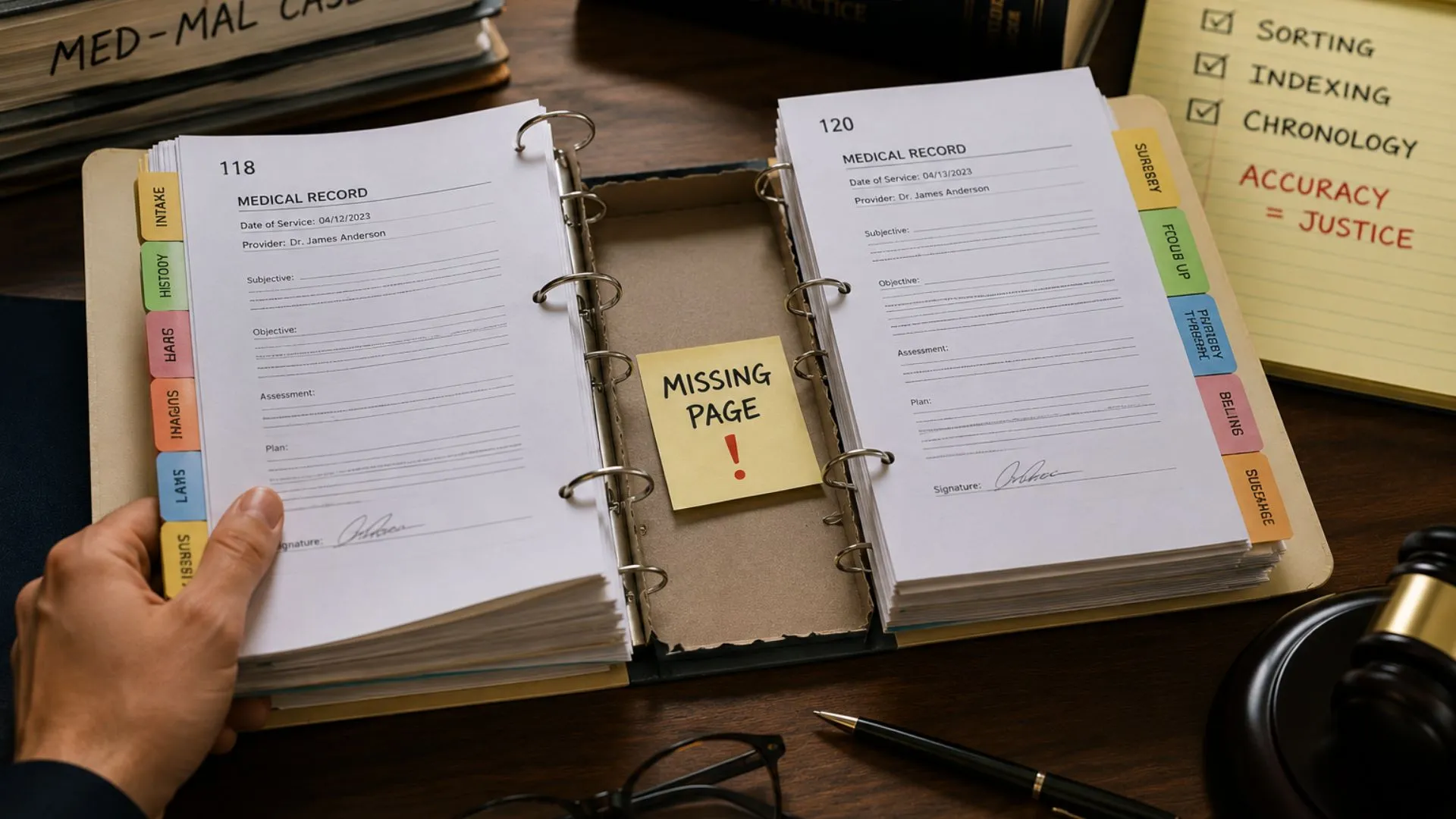
Have you ever built a case around a timeline, only to have opposing counsel bring up a page that contradicts it, a page that was sitting in your own file the whole time? The record wasn't missing. It just wasn't sorted well enough to find fast.
Sorting and indexing can feel like the boring part of case prep. But it's what decides whether the page you need takes thirty seconds to find, or turns up too late, buried deep in a file you never fully organized.
Here's why this one quiet step carries more risk than most firms realize, and what tends to break first as caseloads grow.
What Sorting & Indexing Actually Means
Sorting and indexing turns a stack of raw medical records into a file you can actually search.
- Sorting: Organizing records by provider, date, and record type, so the file follows a logical order instead of the order pages happened to arrive.
- Indexing: Tagging each page or section with what it is and where it belongs, so any specific nursing note, lab result, or physician's order can be found in seconds.
Done well, it turns a disorganized stack of records into a file where any page can be pulled up in seconds, cross-referenced against a timeline, and handed to an expert without a scramble. Done poorly, it turns the same file into a liability, one that only shows up when you're already under deadline pressure.
1 Missing Page, 1 Lost Moment
A record that isn't sorted and tagged by provider, date, and type isn't a filing gap. It's a page you won't have when the case needs it most.
It's Not Missing. It's Just Too Late to Find.
Every med-mal case comes down to a handful of pages: the informed consent form, the nursing note timed an hour before the code, the lab result that was flagged and never acted on. Those pages exist. They're just buried somewhere in a file that can run thousands of pages deep, pulled from a dozen providers, in a dozen formats.
A poorly sorted record doesn't lose you the case outright. It loses you the moment. The violation is in the file. You just don't have it in hand when the expert asks for it, when opposing counsel raises it first, or when the deposition clock is already running.
Seeking High Quality Sorting & Indexing Service?
What Breaks First as Case Volume Grows
Sorting a 200-page file by hand is easy. Sorting 20 of them a month, each running thousands of pages, is where firms start to feel the strain. A few things go wrong again and again:
- Records trickle in from different providers on different timelines, so the file is never really "done."
- A junior associate indexes under deadline pressure, and the file ends up ordered by when records arrived, not by what the case actually needs.
- No standard format, so every associate builds files their own way, and nothing is searchable across cases.
- A busy season doubles the caseload, but the review team stays the same size.
- A missing or duplicate page sits unnoticed until someone stumbles on it, usually too late.
None of this is carelessness. It's a workflow that wasn't built to scale, and workflow gaps stay invisible until a deadline forces them into view.
"An index that can't scale with your caseload isn't a filing system. It's a risk you haven't priced in yet."
One thing worth remembering: indexing organizes the record so nothing relevant goes unseen. It doesn't build your case theory, that's still on you and your expert. Its only job is to make sure the page you need is never the page you can't find.
How to Keep Indexing From Becoming Your Weak Point
A few habits keep this risk in check as your caseload grows:
1. Use one index format, every file, every associate.
If two paralegals index the same record type differently, nothing stays searchable when a deadline hits.
2. Flag gaps at intake, not at trial prep.
A missing set of notes found three weeks out is fixable. Found the night before, it's a scramble.
3. Tie every record to a master timeline as it's indexed.
Knowing where a page came from isn't enough. You need to know what happened when.
4. Keep sorting and case-strategy work separate.
One person doing both means one job gets rushed. Let your case-building talent focus on strategy, not page-flipping.
5. Plan for volume spikes before they land.
If your caseload doubles some seasons, check your indexing capacity now, not the week 100 new files show up.
Why Sorted & Indexed Records Matter for Med-Mal Cases
70%
Faster Page Retrieval
A properly indexed file gets the right page to you in seconds, not hours.
45%
Fewer Missed Records
Standardized sorting catches gaps and duplicates before they reach case prep.
2x
Caseload Handled
Scalable indexing keeps files organized even as volume doubles.
The Bottom Line
The record you need to win a med-mal case is rarely missing. It's misfiled, buried, or indexed in a way that made sense the day it arrived and makes no sense the day you need it. Standardize how every file gets sorted, flag gaps early, and build indexing capacity that flexes with your caseload, before a volume spike turns a filing problem into a case-losing one.
Source Credit : All metrics derived from LezDo TechMed’s internal project data.
Vishnu Priya Vinu
Vishnu Priya Vinu is a Certified Legal Nurse Consultant (LNC) and Medical-Legal Research Analyst with over two years of experience in medical record review, medico-legal research, and content development. She specializes in blogs, articles and E-books that bridges the gap between healthcare and law. Her strong medical background brings depth and accuracy to content, enabling law firms, medical evaluators, and insurance professionals to gain insights on complex medical data analysis. She delivers evidence-based insights and strategic content that strengthen case outcomes and support informed decision-making.














.png)