Home
>
Blog
>
>
7 Ways to Cut APS Summarization Costs Without Slowing Underwriting
Trying to trim APS spend without adding days to the cycle? Start here:
- Match depth to the case – not every APS needs a full deep-dive; triage by complexity and face amount.
- Complete records cut hidden costs – an incomplete APS means physician follow-ups, rework, and delay.
- AI plus human review is the sweet spot – the speed of automation with the accuracy of a reviewer.
- Measure hours saved, not the fee – the ROI is reclaimed underwriter time and faster time-to-issue.
Read on for all seven ways to cut APS summarization cost without slowing underwriting down.
APS costs are easy to look at the wrong way. When the invoice feels high, the instinct is to shop the page rate. But the real cost of an APS isn't the summary fee, it's the underwriter hours it either saves or wastes. Want to spend less without adding days to your cycle? Let's walk through seven ways that actually work.
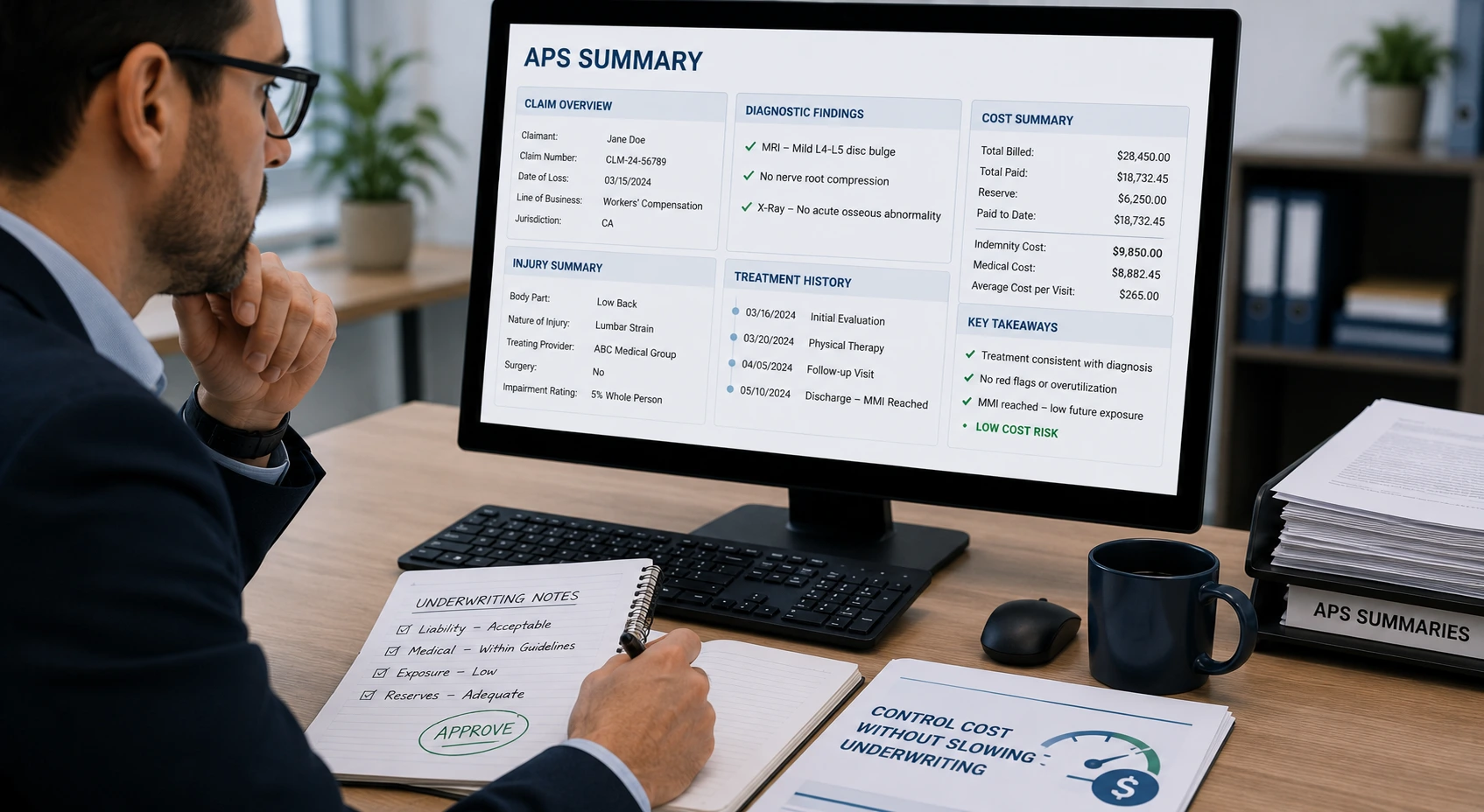
Quick level-set: an APS summary extracts the risk-relevant medical information from an Attending Physician Statement and related records, conditions, medications, diagnostics, hospitalizations, current status, and organizes it so an underwriter can assess risk without reading the raw 40-page packet. Do it well, and the summary pays for itself in reclaimed time. Do it poorly, and you pay twice.
Why APS cost is really an underwriting-time question
Here's the thing: a summary that's cheap but incomplete sends the underwriter back into the APS anyway, so you've paid for the summary and the read. A summary that's complete and structured replaces the read entirely. That's the lever. Every tip below is really about buying back underwriter time, not shaving a few cents off a page.
6 to 8 Hours a Week, Reclaimed
In one published engagement, an insurer's underwriters reclaimed 6 to 8 hours a week after moving to structured, AI-assisted APS summaries with medical-expert audit, with ROI reported within months. The savings came from time, not the page rate.
Ways 1 to 3: stop paying for the wrong depth
1. Match the summary depth to the case. Not every APS needs a full deep-dive. Triage by face amount and complexity: a clean, low-face case may need a short risk-fact extract, while a large, complex one earns the full treatment. Paying full price on every APS is where budgets quietly leak.
2. Get the APS complete the first time. Incomplete records are the hidden cost driver, they trigger physician follow-ups, rework, and delay, and every follow-up adds days and dollars. Order the APS complete, or flag what's missing up front, so the summary is built once, not three times.
3. Standardize the format to your underwriting workflow. A summary that maps to the exact risk fields your underwriters use cuts re-reading time to almost nothing. It's also the fastest route to lower turnaround, which is really the same lever as cost, whether outsourcing APS summaries cuts your turnaround comes down to the same complete-and-structured discipline.
Want lower APS cost without a slower cycle?
Ways 4 to 6: pay for speed and accuracy, not page count
4. Use AI-assisted extraction with a human check. AI pulls the risk-relevant data fast and consistently, and a medical or paramedical reviewer verifies it against the APS. That pairing is the cost sweet spot: the speed of automation without the risk of an unverified miss. No honest process claims 100% accuracy, and the review step is exactly what makes the summary safe to underwrite from.
5. Compare cost per case, not price per page. The number that matters is the fully loaded cost per APS (the fee plus any internal re-verification) against what an underwriter's hour costs. A cheaper page rate that sends the summary back for rework is the expensive option. Weigh the in-house versus outsourced question on total cost, not the sticker.
6. Right-size for volume. APS volume spikes, but fixed nurse-reviewer headcount doesn't flex. Variable, outsourced capacity lets you scale summary spend up and down with application volume, which is part of why APS summaries built to speed up underwriting tend to pay off across a whole book, not a single case.
The cheapest APS summary isn't the one with the lowest page rate. It's the one your underwriter never has to re-read.
Way 7, and the line to keep clean
7. Measure the ROI in reclaimed hours and cycle time. The return isn't the invoice you avoided, it's the underwriter hours freed and the faster time-to-issue that lifts placement. Track hours saved per APS and days off the cycle, and the ROI case makes itself to leadership.
One line to keep clean: an APS summary extracts and organizes the risk-relevant medical information documented in the records. It doesn't make the underwriting decision, assign a rating, or give a medical opinion. Those stay with your underwriters and medical directors. The summary just gets the facts in front of them faster, and cheaper, when it's done right.
Cut Cost, Keep Speed
Match Depth
Triage
Full summaries only where face amount and complexity earn them
Complete First
Fewer follow-ups
A complete APS cuts physician chases, rework, and delay
Hours Saved
The real ROI
Reclaimed underwriter time and faster time-to-issue, not the page rate
APS Summary Cost FAQs for Underwriting Teams
How do I cut APS summarization costs without slowing underwriting?

Match the summary depth to the case, get the APS complete up front, standardize the format to your risk fields, pair AI extraction with a human check, compare cost per case rather than page rate, scale with volume, and measure the ROI in underwriter hours saved. Cost and speed move together when the summary is complete and structured.
What actually drives the cost of an APS summary?
Depth and completeness. A full deep-dive on every APS, plus physician follow-ups and rework on incomplete records, is where cost piles up. Matching depth to the case and getting records complete the first time removes most of the avoidable spend.
Is outsourcing APS summaries cheaper than doing them in-house?
It depends on your fully loaded cost per case. Outsourced capacity flexes with volume and frees underwriter hours; in-house makes sense at low, steady volume. Compare total cost (fee plus re-verification) against an underwriter's hourly cost, not the page rate alone.
How do I show the ROI of APS summaries to leadership?
Track two numbers: underwriter hours reclaimed per APS and days removed from the cycle. Multiply hours saved by the underwriter's loaded cost, and tie faster time-to-issue to placement. That turns a summary fee into a measurable return.
Does AI make APS summaries cheaper?
AI-assisted extraction is fast and consistent, which lowers cost, but it needs a human review step to stay reliable. LezDo TechMed pairs AI extraction with a medical-expert audit. No honest process claims 100% accuracy; the review is what makes the summary safe to underwrite from.
Does an APS summary make the underwriting decision?
No. It extracts and organizes the risk-relevant medical information from the records. The rating, the decision, and any medical opinion stay with your underwriters and medical directors. The summary just gets the facts in front of them faster.
How can I keep APS costs predictable across a book?
Use transparent per-case pricing, keep records complete to avoid surprise follow-ups, and scale outsourced capacity with application volume so you're not carrying fixed headcount through slow months. Predictable inputs make the cost predictable.
The bottom line
Cutting APS summarization cost isn't about finding the cheapest vendor. It's about buying back underwriter time: match the depth to the case, get the records complete, structure the summary to your workflow, pair AI with a human check, and measure the return in hours and cycle days. Do that, and the summary stops being a line item to trim and starts being the thing that speeds your whole underwriting cycle.
Source Credit : All metrics derived from LezDo TechMed’s internal project data.
Anjana Devi Vijay
Anjana Devi Vijay is a Certified Legal Nurse Consultant (CLNC) and Medical–Legal Research Analyst with 9+ years of experience in medical record review, deposition summary analysis, and medico-legal research. She specializes in transforming complex healthcare documentation into accurate, actionable insights that support attorneys, insurers, and medical evaluators. With expertise in clinical documentation analysis and legal case support, she creates research-driven content focused on improving decision-making and case outcomes.













.png)