10 Record Details QME Providers Should Never Miss in a Medical Chronology
QME providers should never miss first treatment dates, provider roles, diagnostic reports, prior history, treatment gaps, or missing records.
QME providers should never miss the record details that explain the medical sequence leading into the evaluation: the first documented complaint, provider roles, diagnostic findings, prior history, treatment gaps, missing records, and functional status. These entries carry the most weight when a Qualified Medical Evaluation is being prepared, and a chronology that buries or compresses them makes the evaluator's job harder, not easier.
Picture a QME file with several hundred pages of records pulled from four or five providers over several years. Somewhere in there is the note documenting the first complaint, the original imaging report a later note only references, and a three-month gap in treatment that might mean something or might simply mean the records were never produced. A chronology that flattens all of that into a generic summary line does not save the evaluator time, it just moves the searching into the chronology itself.
Let's walk through the ten details that deserve deliberate attention, and how a QME provider can confirm a chronology is actually capturing them.
What Record Details Should QME Providers Never Miss?
A Qualified Medical Evaluation often involves a large record set spanning multiple providers, facilities, and years of treatment. The medical chronology is not meant to capture every line from every note. It is meant to preserve the details that identify what happened, when it happened, who documented it, and exactly where it appears in the records.
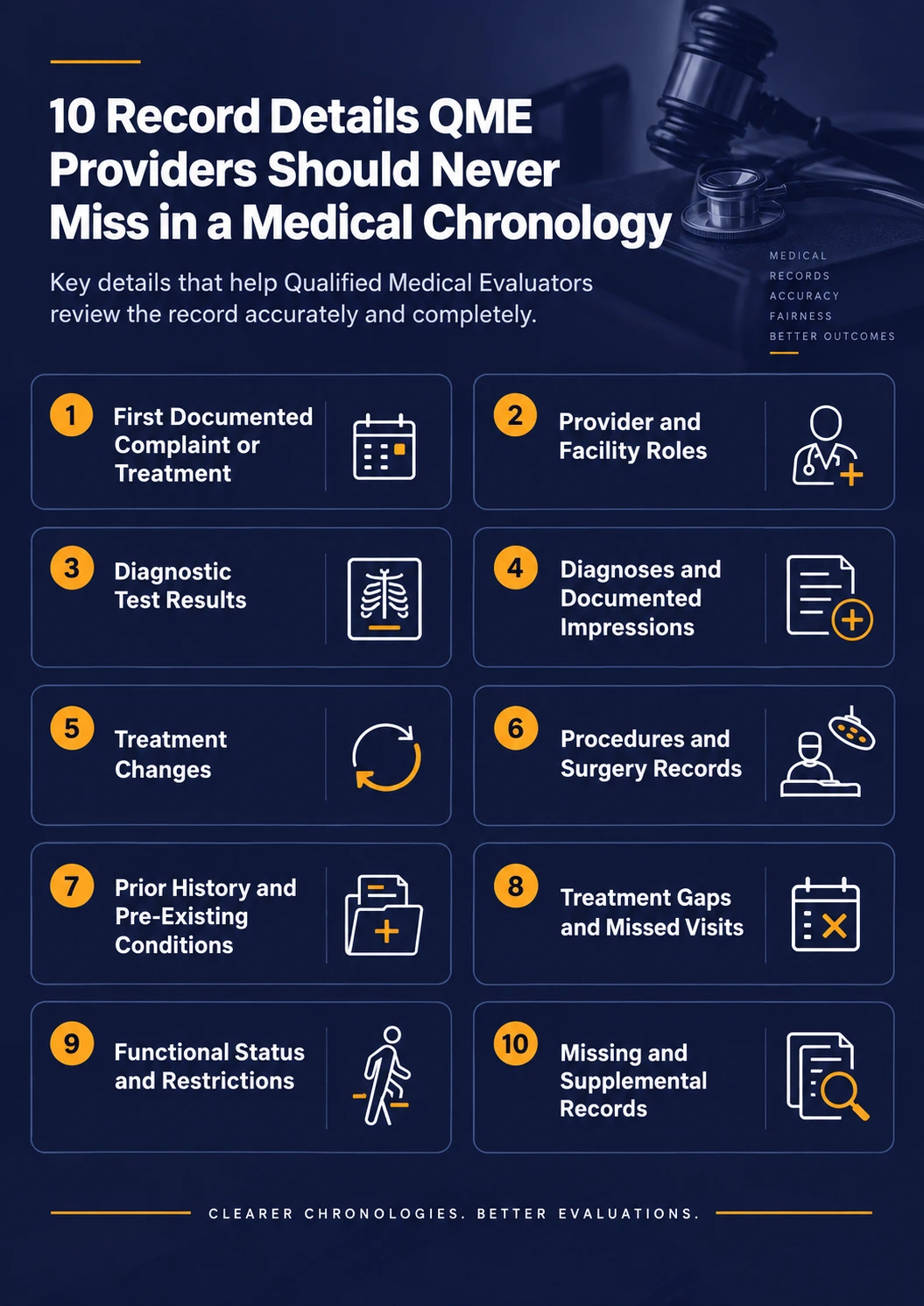
10 Record Details QME Providers Should Never Miss in a Medical Chronology
60% of QME Preparation Time Goes Into Locating Source Details
Providers preparing a QME spend a significant share of review time tracing summarized entries back to original records. A chronology built around the ten details below reduces that searching by keeping source references attached to the entries that matter most. Source Credit: Figure reflects LezDo TechMed internal project data.
Why Do These 10 Details Matter Most in a QME Chronology?
1. First Documented Complaint or Treatment
This sets the starting point for the medical timeline. The chronology should show the date, provider, reported complaint, examination findings, and source reference, and should distinguish an intake history from a clinical evaluation, since the two carry different weight. This helps the QME provider see exactly where the documented care sequence begins, rather than inferring it from a later summary note.
2. Provider and Facility Roles
Provider roles should be clear because different people may document different parts of the same event.
The treating clinician, ordering provider, interpreting radiologist, facility, note author, and signing provider may not be the same. A good chronology keeps those roles separate when the record does.
3. Diagnostic Test Results
These should be tied to the original report whenever one is available. MRI, CT, X-ray, EMG, laboratory, and pathology findings are often repeated or paraphrased in later notes, and those versions do not always match the original wording. The original report gives stronger source support; if it is missing, the chronology should say so rather than relying on a secondhand reference.
4. Diagnoses and Documented Impressions
Diagnoses and impressions should be recorded exactly as documented. If the provider writes "rule out," "possible," "probable," or "history of," the chronology should preserve that context. Small wording changes can change how the entry reads.
Want a sample chronology that keeps key QME record details traceable?
The chronology should capture new medications, therapy referrals, injections, surgery consults, bracing, activity changes, and follow-up plans. Repeated, unchanged medication lists should not crowd the timeline with duplicate entries unless a specific change is relevant, since that repetition buries the changes that actually matter.
6. Procedures and Surgery Records
Procedures and surgeries should include the date, facility, provider, procedure name, key documented findings, and post-procedure plan.
If a follow-up note references surgery but the operative report is missing, the chronology should flag the missing source. That is more useful than silently relying on a later summary.
7. Prior History and Pre-Existing Conditions
Prior history should be visible and sourced.
Earlier complaints, chronic conditions, prior imaging, surgeries, and treatment should be shown when documented. The chronology should not decide whether prior history explains the current condition. It should organize the facts for QME review.
The chronology should show when records pause, when appointments are missed, or when therapy ends. If the gap may reflect missing records, the wording should say no record was located in the supplied file.
9. Functional Status and Restrictions
Functional status can matter in QME review when it is documented.
The chronology may include range of motion, activity limits, work-status notes, assistive devices, therapy progress, and discharge status. These entries should be tied to the provider note that documents them.
10. Missing Records and Supplemental Records
Missing records and supplements should be clearly tracked.
If an MRI, operative report, consult note, therapy evaluation, or prior provider file is referenced but absent, the chronology should flag it. If supplemental records arrive later, the chronology should show where they fit in the timeline.
"A QME chronology should protect the details that change the timeline. First visits, original reports, prior history, and gaps deserve source support."
How Should QME Providers Verify These 10 Details?
QME providers can verify these details by tracing the most important chronology entries back to the source records.
Start with the entries that carry the most timeline weight. First treatment, original diagnostic reports, procedures, prior history, restrictions, and missing-record notes are good places to begin. Check whether the date, provider, record type, and wording match the cited page.
Then look for context. If a note says symptoms improved, does the entry also show what treatment led up to that note? If therapy ended, does the chronology show whether the discharge was completed, discontinued, or interrupted by missing records? If a medication changed, does the timeline show the provider and reason when documented?
This verification step prevents one common review problem: treating a summary line as stronger than the record. A well prepared chronology report should make the source easy to reach, but the source still matters.
For QME providers, the value is practical. The 10 details help organize review, but source testing helps confirm whether the chronology is ready to support evaluation preparation.
How Do These Details Support QME Report Preparation?
These ten details give the provider a clear record map before drafting begins. A QME report often addresses what records were reviewed, when symptoms were first documented, what diagnostic studies showed, what treatment followed, and whether prior history or missing records affect the overall picture. A chronology that captures all ten makes each section faster to draft and easier to defend if questioned later.
It also cuts down on last-minute searching during drafting, since the source reference already sits beside the relevant entry instead of requiring another pass through the raw file.
The medical chronology should still function as a review aid, not a substitute for judgment. It organizes the factual sequence; the QME provider applies the professional analysis on top of it.
Strengthening QME Evaluation Readiness
40%
Diagnostic Clarity
Preserved qualifier language keeps documented impressions accurate for evaluator review.
25%
Record Completeness
Clearly flagged missing records prevent an incomplete file from reading as finished.
35%
Provider Accuracy
Distinct role labels reduce confusion across multi-facility record sets.
Frequently Asked Questions
What details should a QME provider check in a medical chronology?
First treatment, provider roles, diagnoses, diagnostic results, treatment changes, procedures, prior history, gaps, restrictions, and outcomes, each with a source reference.
Why do provider roles matter in QME chronology review?
Because the ordering, interpreting, treating, and signing provider may be different people. A chronology that blurs them into one label loses information the evaluator may need.
Should prior history be included in a QME chronology?
Yes, when documented. The QME provider decides how that history fits into the current evaluation, not the chronology.
Can a chronology show missing records?
Yes. A reliable chronology flags records referenced elsewhere in the file but not located in the supplied record set.
Does a chronology replace QME record review?
No. It organizes the record sequence and source path, but does not substitute for the evaluator's own reading of the file.
How should original diagnostic reports be treated compared to later summaries?
Original reports carry more weight than a later note's paraphrase. If the original is missing, the chronology should say so.
What makes a treatment gap worth flagging?
A gap worth flagging could reflect either a genuine break in care or records never produced, since those two explanations lead an evaluator to different conclusions.
How detailed should functional status entries be?
As detailed as the source allows, with each entry tied to the specific note that documented it, not summarized in general terms.
Is it normal for a QME chronology to run long given the record volume?
Length should follow the record set. What matters more is whether the ten details above are captured accurately and sourced clearly.
Who interprets what these details mean for the evaluation?
The QME provider. The chronology organizes the documented facts; the evaluator applies professional judgment to what they mean.
To Conclude
QME providers should never miss the record details that hold the timeline together. First treatment, diagnostic reports, provider roles, treatment changes, prior history, gaps, restrictions, and missing records all deserve careful attention.
The chronology should make those details easier to find and verify, keeping the record organized without moving into medical-legal opinion, that judgment stays with the evaluator.
Source Credit : All metrics derived from LezDo TechMed’s internal project data.
Vishnu Priya Vinu
Vishnu Priya Vinu is a Certified Legal Nurse Consultant (LNC) and Medical-Legal Research Analyst with over two years of experience in medical record review, medico-legal research, and content development. She specializes in blogs, articles and E-books that bridges the gap between healthcare and law. Her strong medical background brings depth and accuracy to content, enabling law firms, medical evaluators, and insurance professionals to gain insights on complex medical data analysis. She delivers evidence-based insights and strategic content that strengthen case outcomes and support informed decision-making.













.png)