What Medical Records Does a Life Care Planner Need Before Cost Projection?
Verify before you cost. Every future care recommendation entering a cost projection should trace to a named provider, a date and a page.
Attribution changes the weight. A recommendation from the operating surgeon and the same words in a primary care note are different evidence.
A gap in records is not a gap in care. State the date range and what the records show. Do not assume the cause.
Missing records are findings. Anything referenced but never produced belongs on the review, while there is still time to request it.
The review organizes and flags. Causation, impairment, disability and future cost stay with the life care planner or the treating physician.
A surgeon's note from eighteen months ago says the patient may need a revision procedure. That single sentence can carry real weight in a life care plan. Before it becomes part of future care costing, one question has to be answered clearly.
Where is that recommendation documented, who made it, and do later records confirm, change, or drop it?
That question is the reason the medical records a life care planner needs are never just the ones that arrived. They are the ones that can be traced, attributed and dated.
You are not building a plan from a diagnosis. You are building it from what the documentation supports, item by item. Every recommendation, limitation, treatment pattern and missing record should trace back to a page before it enters the cost projection.
What the Review Covers
Medical record review for life care planners is the structured review of a record set to identify documented treatment history, diagnoses, procedures, functional limitations, provider recommendations, treatment gaps, prior history, and missing records that affect future care planning.
The purpose is to build a reliable medical foundation before future care needs are evaluated. Summarizing the chart is the smaller half of that work.
Treatment already delivered, by date, provider and service type
Every provider involved, including those referenced but never produced
Diagnoses and complaints documented in the records
Imaging, procedures, therapy and rehabilitation records, with reports attached
Functional limitations and where each one appears
Future treatment recommendations, attributed to the provider who made them
Missing, duplicate or unclear records
Items needing your professional review before costing
The review stays inside the record. It organizes and flags what the documents say. It does not decide causation, impairment, disability, damages or future cost.
A Cost You Cannot Source Is a Cost You Will Defend Twice
Verified records before costing, not after the plan is filed. Every recommendation in a life care plan should trace back to a provider, a date and a page.
Why Verified Facts Matter
Future care planning depends on details that trace to a source, not on a general understanding of the injury.
The Details That Change a Plan
You need to know whether a future surgery recommendation came from the treating specialist or from someone relaying a conversation. Whether therapy records show sustained improvement or a plateau. Whether durable medical equipment was documented as temporary or long term. Whether a similar complaint existed before the incident.
Each of those changes something. Some change a line item. Some change the plan.
What Happens When They Are Not Verified
When the details sit buried across scanned PDFs from several providers, the plan can begin on a foundation nobody has verified, and the first person to test it will not be you. Planners who outsource the review usually cite that exposure as the reason, not the hours saved.
The review reduces the risk by separating documented facts from open questions. It can show that a provider recommended continued therapy on a specific date, that an imaging report documented a specific finding, or that a referenced follow-up record never arrived. What weight those facts carry stays your professional determination.
Costing a plan from records you have not verified?
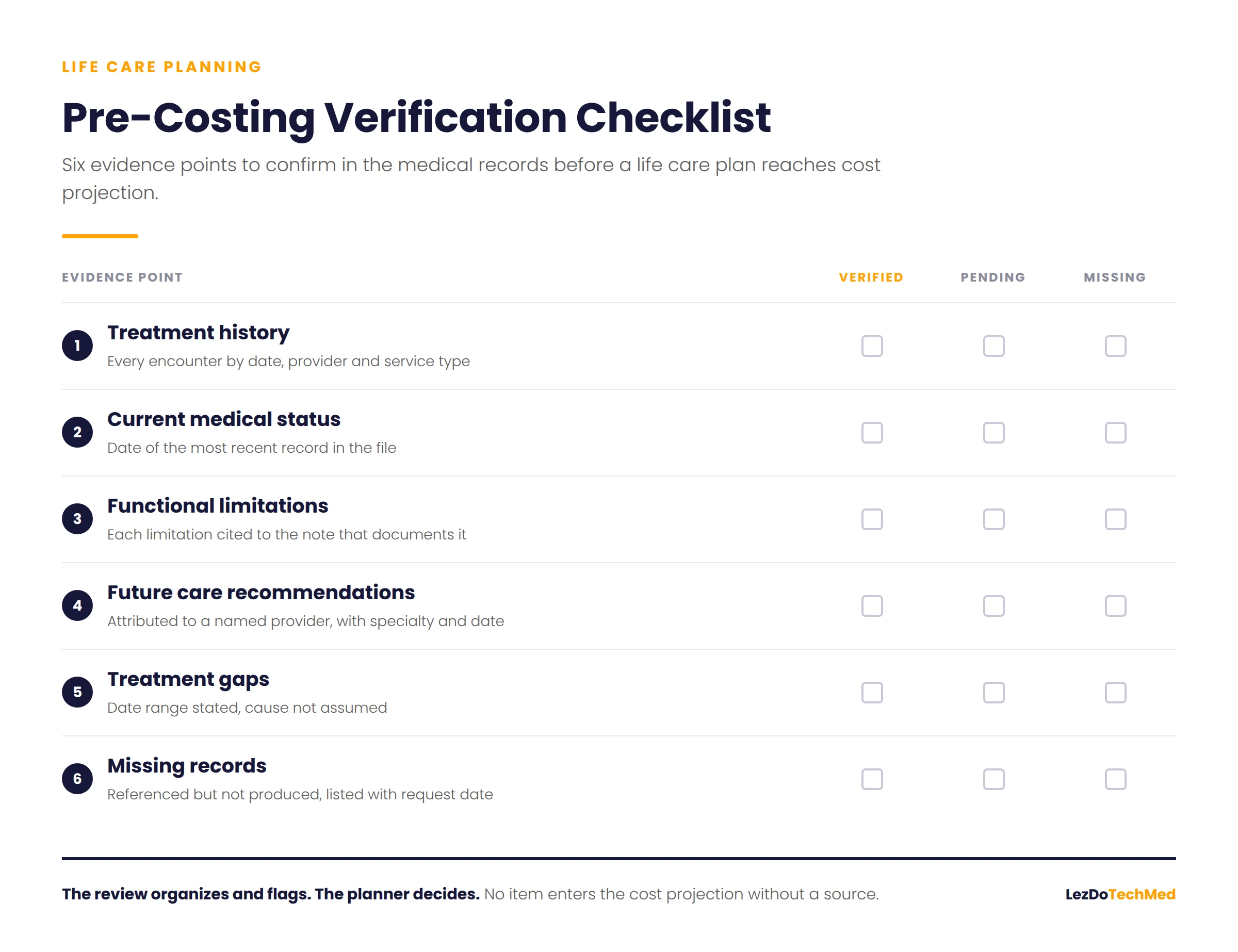
Six evidence points deserve a deliberate check before a single cost is projected.
Treatment History
You need the full treatment path: emergency care, hospital admission, surgery, therapy, pain management, specialist care, rehabilitation, medication changes and follow-up visits.
The review should organize this by date, provider and service type, so you are not rebuilding a timeline out of scattered files. A case timeline can arrange those verified events in date order afterwards. The review comes first, because it establishes whether the underlying records are complete enough to build one on, and the same discipline carries into billing accuracy inside a life care plan.
Current Medical Status
Plans get built from the most recent documented condition. The review should identify the latest available records, current complaints, recent examination findings, medication use, therapy status and standing follow-up recommendations.
If the newest record in the file is eleven months old, that belongs on the first page of the review. Not discovered after the costing work has started.
Functional Limitations
Limitations hide in therapy notes, physician evaluations, discharge summaries, occupational therapy records, home health notes and specialist reports. Rarely in one place.
The review should point to where each one is documented: mobility restrictions, reduced range of motion, cognitive concerns, limits on activities of daily living, work restrictions, assistive device use. It should not decide what any limitation means for future need. It should make each one fast to find and easy to verify.
Future Treatment Recommendations
This is where attribution matters most. Future care may involve surgery, therapy, medication, injections, durable medical equipment, home care, specialist follow-up or rehabilitation services.
A review should capture each recommendation as documented, with the provider who made it and where it appears.
"Future care needed" is not strong enough to cost. This is:
Revision procedure discussed by orthopedic surgeon in note dated 04/12/2026. See page 318.
That gives you a source. It does not tell you how to value the recommendation, and it should not try.
Specialty carries weight too. A recommendation from the operating surgeon and the same words in a primary care note are different evidence, and the review should let you see which one you have.
Records may be missing. Authorization may have been delayed. The patient may have changed providers, or a referral may have gone out with the specialist record never following it back. The review should avoid assumptions and state what is verifiable:
No available therapy records found between 04/12/2026 and 06/18/2026. Orthopedic note dated 06/18/2026 references continued therapy recommendation.
Clear, limited, source-aware. That sentence tells you where to look without telling you what to think.
Missing Records
An absent report often holds the detail the plan turns on. The review should flag anything referenced but not produced:
Imaging reports and radiologist reads
Operative reports
Discharge summaries
Therapy and rehabilitation records
Specialist consultations
Medication lists
Home health records
Durable medical equipment documentation
Follow-up recommendations
Prior medical records
Flagging a missing record does not rank its importance. It tells you the file may be incomplete while there is still time to request what is needed.
A recommendation without a source is a cost you will have to defend twice.
Where the Review Stops
Medical record review supports life care planning. It does not replace it.
The reviewer organizes records, summarizes documented treatment, flags missing files, identifies prior history and cross-references details across providers. The reviewer does not decide causation, disability, impairment, standard of care, damages or future cost. Those belong to the qualified professional responsible for the plan, the opinion or the legal strategy.
How a Boundary Breach Reads on the Page
That boundary protects the usefulness of the review. A review should not say "prior back condition is unrelated to the current complaint." A safer and more useful entry reads:
2019 lumbar complaint documented in primary care note. No available lumbar treatment records found between 2020 and the subject incident date, based on records reviewed.
That gives you a documented fact pattern without inserting a conclusion into your input.
What a Useful Review Delivers
The best review is not the longest one. It is the one that gets you to the right fact quickly and shows you where that fact came from.
The Eleven Elements
Clear provider sequence with date ranges for each source
A treatment timeline you can read without reconstructing it
Key diagnoses and complaints with source references
Procedures and diagnostic findings, reports attached
Therapy and rehabilitation detail, including response and plateau
Medication history where it bears on future need
Functional limitation notes with sources
Future care recommendations by provider and date
Prior history flags
Missing record notes, with what was requested and when
Open questions that need planner, attorney or expert review
Questions to Ask Before You Trust a Review
Can I see the source behind each key entry?
Which providers are named but missing from the records?
How are future care recommendations attributed?
What is the date range for each provider record?
How are treatment gaps worded?
Who verified the review after any AI-assisted extraction?
Are limitations, recommendations and missing records separated clearly?
These answers tell you whether the review is ready to support planning work, or whether the file still needs cleanup.
What Record Preparation Can Change
20 to 8 weeks
Turnaround on Record Preparation
Florida life care planning firm, as published
70%
Cases Returned Within 24 Hours
As reported by the firm during the engagement
1.2M
Pages Processed Annually
As reported by the firm during the engagement
Frequently Asked Questions
Why is medical record review important for life care planners?
Medical record review organizes and verifies treatment history, functional limitations, provider recommendations, prior history and missing records before future care planning begins, so the plan rests on documented facts.
Does medical record review decide future care needs?
No. Medical record review organizes and flags documented medical facts. Future care opinions and cost projections are made by the qualified life care planner or another appropriate professional.
What records matter most before future care planning?
Hospital and emergency records, specialist notes, operative reports, therapy records, imaging reports with the radiologist's read, medication lists, discharge summaries, home health records and documented provider recommendations.
How should treatment gaps be described in a review?
By documented facts: the last available treatment date, the next available treatment date, and any explanation found in the records. A documentation gap is not proof that care did not occur.
Should missing records be flagged in the review?
Yes. Records referenced but never produced may hold details that affect future care evidence, and flagging them early leaves time to request them before costing.
How does medical record review help before cost projection?
It confirms whether future care recommendations, functional limitations, treatment history and provider notes are supported by records, and identifies what is missing, before any of it is used to build costs.
What is the difference between medical record review and medical chronology for life care planners?
Medical record review establishes what the record set contains, what is missing, and where each fact sits. A medical chronology arranges verified medical events in date order. The review normally comes first, because a chronology built on an incomplete set inherits the gaps.
Can medical record review identify future treatment recommendations?
Yes. A review identifies documented future treatment recommendations, the provider who made each one, the date, and the page where it appears.
Why does source referencing matter in life care planning?
Source referencing lets you verify where each important fact came from, whether that is a provider note, imaging report, therapy record, operative report or discharge summary, and defend the plan line by line.
Can AI assist medical record review for life care planning?
Yes. AI works well for extraction, indexing and first-pass organization. A trained medical reviewer then verifies context and accuracy, because unverified AI output is where errors enter.
When to Order the Review
Earlier than most planners do. Consider a review before deep planning begins when the file has multiple providers, a long treatment history, catastrophic injury, surgery performed or recommended, complex rehabilitation needs, conflicting provider opinions, large PDF sets with no index, missing or duplicate records, relevant prior history, or unclear current status.
Early review prevents rework. It also buys time to request missing records while requesting them is still routine, rather than during the week the plan is due.
Why Source Context Matters
A recommendation is easier to evaluate when its source is clear. If the file says continued therapy is recommended, the useful questions are practical ones:
How recent is the recommendation?
Did a specialist make it, or was it relayed?
Is it repeated in later records?
Is the supporting diagnostic report available?
Do later notes show improvement, discharge, or continued symptoms?
Is a missing record likely to change the reading?
None of this tells you what to conclude. It gives you a record foundation you can defend line by line. The same principle drives why different source types carry different weight: where a note came from matters as much as when it was written.
The Bottom Line
Life care planning starts with documented medical facts. When records are scattered, incomplete, duplicated or hard to follow, the plan inherits every one of those problems and carries them into the cost projection.
A verified record foundation does not make the planning decisions for you. It makes sure the decisions you do make are anchored to records someone else can open, check and understand.
For complex files, that is the difference between a plan you present and a plan you defend. The related questions this raises, from prior history to missing records, run through our wider medical record review articles.
Source Credit : All metrics derived from LezDo TechMed’s internal project data.
Shabila Thomas
Shabila Thomas is a Certified Legal Nurse Consultant (CLNC) and Medical-Legal Research Analyst with over two years of experience in medical record review, medico-legal research, and content development. She specializes in blogs, articles, and content that decode complex medical information, industry trends, and regulatory updates for the medico-legal field. Her clinical background and research-first approach help law firms, medical evaluators, and insurance professionals understand complex medical data, identify relevant insights, and make faster, better-informed decisions.














.png)


.webp)