Home
>
Blog
>
>
Synthesizing Pediatric Psych Records for Social Media MDLs
Here is what a social media harm claim asks of the record, and where review fits:
- The proof is scattered across systems: The clinical picture lives in adolescent psychiatric records, school counseling logs, and IEPs that were never designed to be read together.
- The baseline decides the case: What the child's mental health looked like before heavy platform use, and how it changed after, is the comparison the whole claim rests on.
- One timeline makes it usable: Cross-referencing the documented records into a single dated chronology lets your experts see the sequence at a glance.
- We organize, the expert opines: LezDo synthesizes and flags the documented evidence; whether platform use caused the harm is for the retained psychiatric or psychological expert and the court.
Read on for how a pediatric psych chronology is built, and what to check before you rely on one.
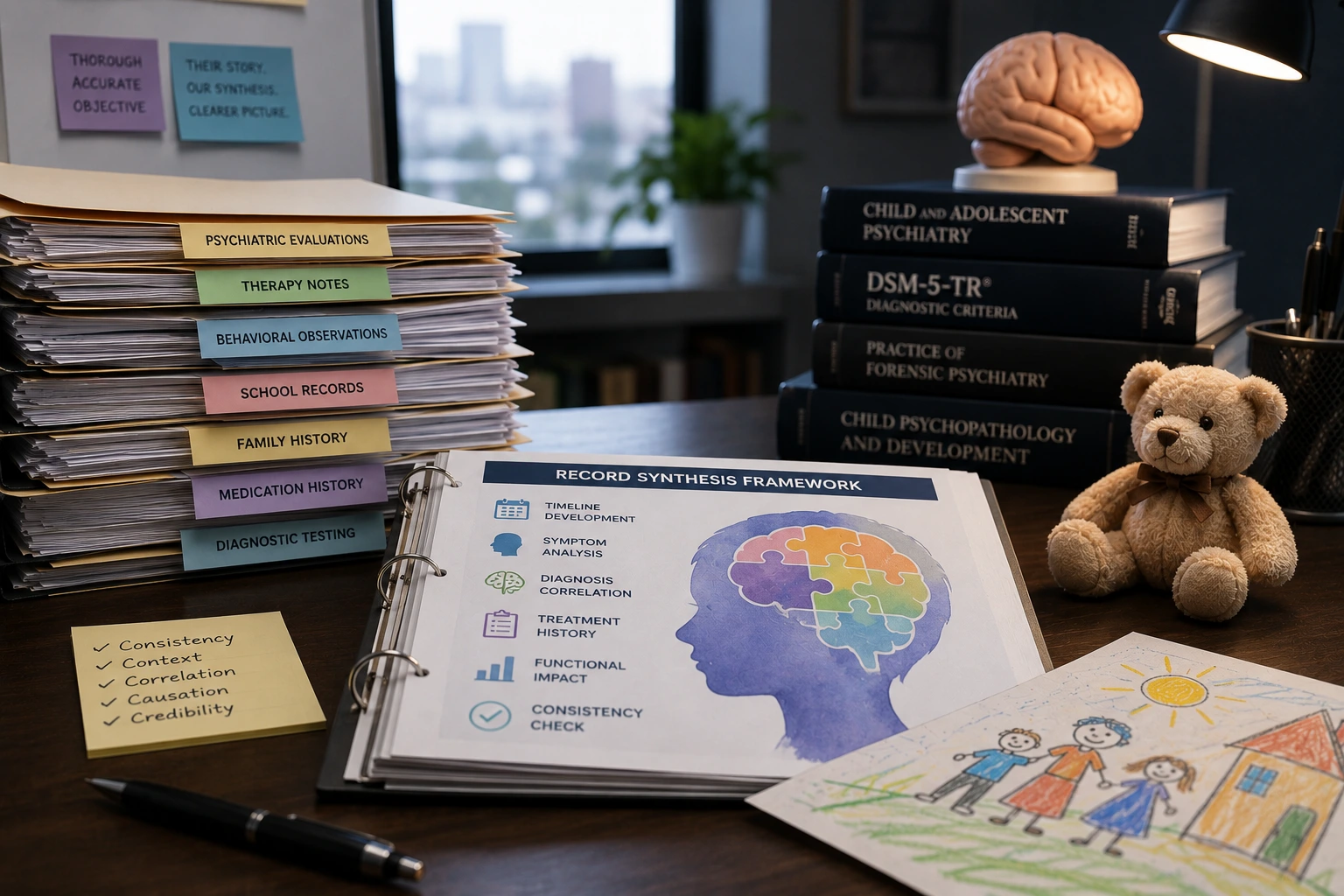
Synthesizing pediatric psychiatric records turns a scattered set of clinical, school, and counseling files into one dated timeline that shows a child's mental health before and after heavy social media use. In the social media adolescent harm litigation, that timeline is the evidence the case is built on. Are you staring at a pile of counseling logs, therapy notes, and school records that will not line up? You are not the only firm facing that right now.
Plaintiff firm case acquisition has pivoted hard toward pediatric social media harm claims in 2026, and the volume is rising fast. The federal social media addiction cases are consolidated as a multidistrict litigation (MDL), a procedure that groups similar suits before one judge, and separate child-safety claims involving other platforms are emerging alongside them. Whatever the platform and whatever the forum, each individual claim depends on the same thing: a credible, documented timeline of a young person's mental health.
Source Credit: In re: Social Media Adolescent Addiction/Personal Injury Products Liability Litigation, MDL No. 3047, U.S. District Court for the Northern District of California (Judge Yvonne Gonzalez Rogers); defendants include Meta, TikTok (ByteDance), Snap, and YouTube (Google). Several thousand cases are pending; there have been confidential pre-trial settlements by some defendants in 2026 and an early state-court jury verdict against social media defendants in 2026. Roblox child-safety claims are a separate, emerging litigation and are not part of MDL 3047. This is active, fast-moving litigation; confirm the current docket, parties, and status before relying on these details.
This post is for the mass tort plaintiff firms building these files. Let's walk through why causation is so hard to document here, which records the timeline pulls from, and how a clean synthesis supports your experts without stepping into their role.
Why causation is so hard to document in a social media harm claim
Causation is difficult in a pediatric social media harm claim because adolescence is already a period of mental health change, and the alleged harm has to be separated from everything else happening in a young person's life. Anxiety, depression, disordered eating, self-harm, and sleep disruption all have many contributors, including family history, other stressors, and developmental factors. A defense will reasonably argue that the condition would have appeared regardless of any platform.
So the question the record has to answer is a sequence question. What did the child's mental health look like before heavy platform use began, what changed after, and how does that change line up with the documented usage. A retained child and adolescent psychiatrist or psychologist can only address that if the before, the during, and the after are documented and placed side by side. When the picture is scattered across a pediatrician's notes, a school counselor's logs, an Individualized Education Program (IEP), and a therapist's file, the sequence is easy to lose.
A fast-growing docket, one record problem
Several thousand pediatric social media cases are pending in the federal MDL alone, and the inventory is still climbing. Every one of them turns on the same fragile thing: a timeline of a child's mental health assembled from records that were never meant to be read together. (Source: MDL No. 3047 pending-case counts are reported in the low thousands and rising as of mid-2026; confirm the current figure on the court docket.)
The records a pediatric social media timeline pulls from
A usable pediatric social media chronology draws on several record sources at once, and the value is in cross-referencing them rather than summarizing each on its own. Most of these are not the classic hospital chart, which is part of why they are so easy to miss.
- The adolescent psychiatric and therapy record. Psychiatric evaluations, therapy notes, medication history, and any documentation of anxiety, depression, disordered eating, self-harm, or suicidality, with dates.
- The school counseling and disciplinary record. School counselor logs, behavioral referrals, attendance changes, and nurse visits, which often capture the earliest signs before a family reaches clinical care.
- The IEP and 504 record. An IEP (a special-education plan) or a 504 plan can document functional decline, accommodations, and the timing of when a child's functioning changed at school.
- The primary care record. Pediatric well-child visits and screenings that establish the baseline and flag prior conditions and family history.
Placed on one timeline, these sources let a reader follow the arc: the baseline, the first documented signs, the clinical diagnosis and treatment, and how each lines up with the usage history the attorney provides in discovery. Building that combined timeline is the heart of our medical chronology service, and the underlying outsourced medical record review is what turns the scattered files into it.
Cross-referencing the records against the digital usage timeline
The most valuable thing a synthesis does in these cases is line the documented mental health record up against the documented usage history, so the sequence is visible instead of assumed. This is where the brief's real question lives, and it is a documentation task before it is a clinical opinion.
From the record review side, that means placing the psychiatric, school, and counseling entries on one dated timeline, marking where the usage history the legal team has obtained lines up with a documented change, and flagging what sits in the background: a pre-existing condition, a family history, another stressor, or a gap where records are missing. LezDo TechMed does not obtain the platform data, diagnose the condition, or decide whether the platform caused the harm. We build the synthesized timeline so the retained expert can weigh the sequence and the attorney can see the case clearly.
Working a social media inventory and drowning in counseling logs and IEPs? We can synthesize the records into one clear timeline your experts can rely on.
Where these timelines break down
Most pediatric social media timelines run into trouble in one of three predictable places, and each is a records problem before it is a clinical one.
The first is the missing baseline. If the pre-platform records are never gathered, the timeline starts in the middle of the story, and the before-and-after comparison the case depends on has a hole in it. The school and pediatric records that establish the baseline are exactly the ones firms tend to request last.
The second is the overlooked school record. School counseling logs, disciplinary referrals, and IEP documentation often capture the first functional changes months before a family reaches a therapist. If the timeline rests only on the clinical file, it misses the earliest and sometimes strongest part of the sequence.
The third is the unflagged confounder. Over an adolescence, a young person accumulates other stressors, a family history, and pre-existing conditions. Missing a documented alternative explanation does not strengthen the claim. It weakens it, because opposing counsel will build its case on exactly what the timeline left out.
What a strong pediatric psych synthesis looks like
A strong pediatric social media synthesis reads as one clear, dated account of a young person's mental health, drawn from every relevant system and written so a legal reader and an expert can use it without returning to the raw files. A few things separate a strong one from a stack of summaries.
It carries the psychiatric, school, and counseling records on the same timeline, so the sequence is visible. It defines the terms, so a legal reader understands what an IEP, a 504 plan, or a specific screening tool means. It marks where the usage history lines up with a documented change, and it flags gaps, prior conditions, and other stressors openly. And it stays in its lane, presenting the documented facts and leaving the diagnosis and the causation opinion to the retained expert.
The counseling log, the IEP, and the therapy note each hold one piece of the story. The case appears only when someone puts them on the same timeline.
How experienced teams prepare a social media file
Teams that handle these files well decide early that the school and pediatric records are evidence, not background, and they request them at the start rather than after the clinical file is already summarized. They ask for a synthesis that puts the psychiatric, school, and counseling records on one timeline, and they keep the record reviewer and the retained expert in separate lanes so the synthesis informs the opinion without pre-empting it. When a firm is screening a large social media inventory, that discipline is what separates the claims with a documented sequence from the ones that only have a diagnosis.
If you want to pressure-test a pediatric psych synthesis before it reaches your expert, these questions help.
Questions to ask about a pediatric social media timeline
- Have the pre-platform baseline records (pediatric and early school) been gathered, or does the timeline start mid-story?
- Are the school counseling logs, disciplinary referrals, and IEP or 504 records included, not just the clinical file?
- Is the psychiatric and therapy history captured in dated sequence, with medications and diagnoses noted as documented?
- Does the timeline mark where the usage history lines up with a documented change, without assuming the link?
- Are prior conditions, family history, and other stressors flagged as potential confounders?
- Does the synthesis stop at the documented facts, leaving diagnosis and causation to the retained expert?
What a disciplined synthesis process looks like at LezDo TechMed
48 hours
Medical chronology and narrative summary turnaround
Standard delivery once scope is confirmed, depending on record volume; multi-source pediatric files are scoped case by case.
24 to 48 hrs
Sorting and indexing
Initial sort and index of a record set, so scattered files become readable fast, depending on volume and condition.
3 layers
Quality-control review
Every deliverable passes through a three-layer quality-control process supported by medical and paramedical reviewers.
Frequently asked questions
What does it mean to synthesize pediatric psychiatric records for a social media MDL?

It means building one dated timeline that pulls together a child's adolescent psychiatric records, school counseling logs, IEP or 504 documentation, and pediatric baseline into a single account. The synthesis shows the mental health picture before and after heavy platform use and lines it up against the usage history, so a retained expert can assess the sequence.
Why is causation so hard to prove in social media harm cases?
Causation is hard because adolescence is already a time of mental health change and conditions like anxiety, depression, and self-harm have many contributors. To support causation, the record has to show the baseline, the documented change, and how it lines up with platform use, which requires a complete, well-organized timeline rather than a single diagnosis.
Which records matter most in a pediatric social media claim?
The adolescent psychiatric and therapy records, the school counseling and disciplinary logs, the IEP or 504 documentation, and the pediatric baseline all matter. The school and counseling records are often overlooked, yet they frequently capture the earliest functional changes before a family reaches clinical care.
What is an IEP, and why does it matter here?
An IEP, or Individualized Education Program, is a formal special-education plan that documents a student's needs, accommodations, and functional status. In a social media harm claim it can show when and how a child's functioning declined at school, which helps date the change the case depends on.
Does LezDo TechMed decide whether social media caused a child's harm?
No. LezDo TechMed organizes, summarizes, and cross-references the documented records and flags gaps and confounders. Whether platform use caused a specific child's harm is a diagnosis and causation question for the retained child and adolescent psychiatrist or psychologist and the court, and the case decision belongs to the attorney.
Does LezDo obtain the plaintiff's social media usage data?
No. The usage history comes from the platforms and discovery, handled by the legal team. LezDo TechMed cross-references the documented medical, school, and counseling records against the usage timeline the attorney provides; it does not collect or produce the platform data itself.
What is the status of the social media addiction MDL?
The federal social media addiction cases are consolidated in MDL No. 3047 in the Northern District of California before Judge Yvonne Gonzalez Rogers, with Meta, TikTok, Snap, and YouTube as defendants and several thousand cases pending. There have been confidential pre-trial settlements by some defendants and an early state-court verdict in 2026; confirm the current docket and status against primary sources. Roblox child-safety claims are a separate, emerging litigation.
How fast can LezDo TechMed synthesize a pediatric record set?
Standard medical chronology and narrative summary delivery is 48 hours once scope is confirmed, and initial sorting and indexing is generally 24 to 48 hours, both depending on record volume, file condition, and scope; 24-hour expedited delivery is available where feasible. Multi-source pediatric files are scoped individually, and timelines are confirmed after a scope review rather than guaranteed per case.
The bottom line for social media MDL claims
A pediatric social media harm claim rises or falls on a synthesized timeline: the psychiatric record, the school counseling logs, the IEP, and the pediatric baseline, read against the usage history and against each other. Building that timeline is documentation work, and it is the work that lets your retained expert address causation and lets you evaluate the claim on solid ground.
If you are screening or working a social media inventory, the first practical step is to get the clinical, school, and counseling records onto one clean, dated timeline, starting with the baseline records before they slip through. LezDo TechMed organizes and flags the documented evidence. The psychiatrist, the psychologist, and the attorney draw the conclusions. Ready to turn a stack of scattered pediatric records into a usable timeline? Partner with LezDo TechMed, or start with a short pilot.
Source Credit: Social media litigation details are from public MDL No. 3047 dockets and reporting and are subject to change; confirm the current status before relying on them. LezDo TechMed service figures are published company benchmarks and are scope-dependent, not per-case guarantees. LezDo TechMed organizes, summarizes, and cross-references documented medical information for review by the appropriate qualified professional and does not diagnose, determine causation, or opine on liability. No protected health information or identifiable minor case facts are used in this content.
Source Credit : All metrics derived from LezDo TechMed’s internal project data.
Anjana Devi Vijay
Anjana Devi Vijay is a Certified Legal Nurse Consultant (CLNC) and Medical–Legal Research Analyst with 9+ years of experience in medical record review, deposition summary analysis, and medico-legal research. She specializes in transforming complex healthcare documentation into accurate, actionable insights that support attorneys, insurers, and medical evaluators. With expertise in clinical documentation analysis and legal case support, she creates research-driven content focused on improving decision-making and case outcomes.









.png)