Home
>
Blog
>
>
Deposition Summaries for Product Liability Cases: What Testimony Matters Most?
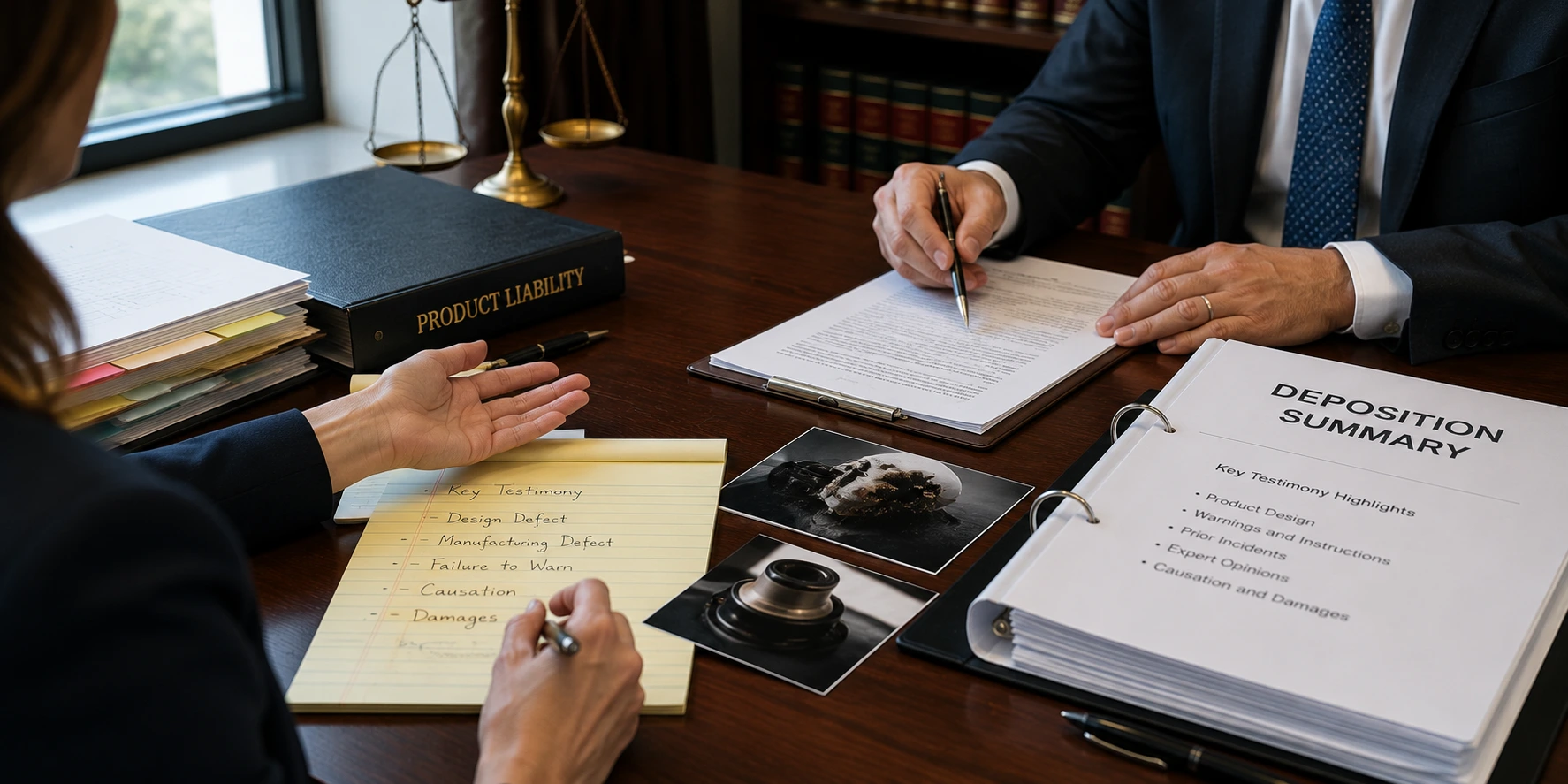
Product liability depositions produce a lot of testimony, but only some of it decides the case. A deposition summary for these cases should organize testimony around the issues that actually matter. Here is what to surface:
- Notice and knowledge: what the company knew about the risk, and when, cited to the page and line.
- Design and alternatives: the design choices, testing, and any alternative the witness discussed.
- Warnings and instructions: what the witness said about the warning, its wording, and how it was decided.
- Use and causation testimony: how the product was used and what witnesses said tied the injury to it.
- Hold the line: the summary organizes and cites the testimony on these issues; it does not decide defect or liability.
Read on for the testimony that matters most in product liability depositions, and the line the summary does not cross.
Product liability litigation runs on depositions, and there are a lot of them. Corporate witnesses, design and engineering staff, warnings personnel, the plaintiff, and medical witnesses can each sit for hours, and the transcripts pile up fast. The problem is not a shortage of testimony, it is finding the testimony that decides the case inside all of it. A deposition summary for a product liability case earns its keep by organizing the testimony around the issues that matter, so an attorney is not rereading a corporate representative's full transcript to find the two answers about what the company knew.
Here is the grounding. A deposition summary condenses sworn testimony into a shorter, organized document with references back to the page and line. In a product liability case, the most useful version organizes that testimony by issue, notice, design, warnings, use, and the medical testimony on injury, so the answers that bear on each element are grouped and cited rather than scattered across the transcript.
Product liability dominates the MDL docket
As of January 2026, product liability cases made up about 40 percent of all pending multidistrict litigations, the single largest category, according to figures from the Judicial Panel on Multidistrict Litigation.
Notice: what the company knew, and when
In many product liability cases, the testimony that carries the most weight is about notice, what the manufacturer knew about a risk and when they knew it. A corporate witness's answers about internal reports, complaints, testing results, or prior incidents can be the difference-making testimony, and they are often buried in hours of routine questioning. A deposition summary should pull those answers together and cite them to the page and line, so the attorney sees the notice testimony as a set rather than as isolated moments. Keeping consistent testimony organized across many witnesses is the same discipline behind a consistent deposition summary in a mass tort or MDL.
Design, testing, and alternatives
The second cluster is design. What a witness said about the design choices, the testing that was or was not done, and any alternative design discussed goes to the heart of a product case. The summary captures that testimony by issue, so the design answers from an engineering witness sit together and each is traceable to its source. When several witnesses testify about the same design decision, the summary should make it easy to line their answers up, which is why structured methods for summarizing multiple depositions matter in these cases.
Want product liability depositions summarized by the issues that decide the case?
Warnings, instructions, and how they were decided
The third cluster is warnings. Testimony about what the warning said, how its wording was chosen, who signed off, and whether anyone raised concerns is central to a failure-to-warn theory. A deposition summary should surface the warnings testimony and keep it with its citation, so an attorney can see what the witness said about the warning without reconstructing it from scattered answers. The summary records what was said about the warning and cites it; whether the warning was adequate is a question for the attorney and the jury, not the summary.
Use of the product and the medical testimony on injury
The last cluster ties the product to the harm. How the plaintiff used the product, and what medical witnesses testified about the injury and its relationship to the product, are what connect the alleged defect to the claimed damages. The summary captures the use testimony and the medical testimony, ties the medical answers back to the treatment records where possible, and keeps each cited. Anchoring every answer to its page and line is why page-line references are not optional in a product case, where the same transcript may be read by several experts and the trial team.
In a product liability case, the deposition summary should organize testimony by the issues that decide it: notice, design, warnings, use, and injury. Each answer, cited to the line.
The Right Balance Between AI and Human Review
Sorting a stack of product liability transcripts by issue is work AI can speed up. It can find where witnesses were asked about notice, design, or warnings and gather those answers faster than a person reading each transcript end to end. What it cannot reliably do is tell which answer actually matters to the theory of the case, or recognize when a routine-sounding answer is the notice admission the whole case turns on. So a dependable product liability summary pairs that speed with a trained reviewer who reads the testimony against the issues, ties the medical answers to the records through medical record review, and flags the answers that carry weight. The tool organizes the volume; the reviewer decides what matters.
One boundary holds this together. A deposition summary for a product liability case organizes the testimony by issue, notice, design, warnings, use, and injury, and cites each answer to its source. It does not decide whether the product was defective, whether the warning was adequate, whether the company was on notice as a legal matter, or who is liable. Those determinations belong to the attorney, the retained experts, and the jury. The summary's job is to make the testimony on each issue visible and traceable, so the people who decide the case are working from an organized record instead of raw transcripts.
What matters most in a product liability deposition is not every answer, it is the answers that go to notice, design, warnings, use, and injury. A summary that surfaces those and cites them is the one a trial team can actually work from.
Testimony that matters in product cases
40%
Share of pending MDLs
Product liability is about 40 percent of all pending multidistrict litigations, the largest category. (JPML, Jan 2026)
4
Issue clusters to organize
Notice and knowledge, design and testing, warnings, and use tied to the injury.
1
Line the summary holds
It organizes and cites the testimony by issue; it does not decide defect, adequacy, or liability.
Frequently Asked Questions
What testimony matters most in a product liability deposition?

The answers that go to notice and knowledge, design and testing, warnings, and how the product was used and tied to the injury. A deposition summary for a product case should organize the testimony around those issues and cite each answer to the page and line, so the difference-making testimony is grouped rather than scattered.
How should a summary handle a corporate representative's deposition?
By pulling the answers that bear on notice, design, and warnings together and citing each. A corporate witness's key admissions about what the company knew and when are often buried in hours of routine questioning, so the summary surfaces them as a set the attorney can see and verify quickly.
Should a product liability summary organize by issue or by page order?
By issue, in most cases. Grouping the testimony by notice, design, warnings, use, and injury lets the attorney see all the answers on an element together, while page-line citations keep each answer traceable to its place in the transcript. That is more useful than a straight page-order digest for building the case.
Does the summary decide whether the product was defective or the warning adequate?
No. The summary organizes the testimony on each issue and cites it. Whether the product was defective, whether the warning was adequate, whether the company was on notice as a legal matter, and who is liable are for the attorney, the retained experts, and the jury, not the summary.
How does the summary connect the product to the injury?
It captures the testimony on how the product was used and the medical testimony about the injury, ties the medical answers back to the treatment records where possible, and cites each. It presents that testimony for the attorney and experts to weigh; it does not itself opine on whether the product caused the injury.
Can AI organize product liability transcripts by issue reliably?
AI can gather answers on notice, design, and warnings across many transcripts quickly, which helps given the volume in these cases. It cannot reliably judge which answer matters to the theory, so a trained reviewer reads the testimony against the issues and flags the weight-bearing answers before the summary is relied on.
Product liability cases generate more testimony than any trial team can reread, so the value of a deposition summary is in the sorting. Organize the testimony by the issues that decide these cases, notice and knowledge, design and testing, warnings, and use tied to the injury; group the answers that bear on each; cite every one to the page and line; tie the medical testimony back to the records; and leave the judgment about defect, adequacy, and liability to the attorney, the experts, and the jury. Do that, and the summary turns a wall of transcripts into a record the team can actually litigate from.
Ready for product liability deposition summaries organized by the issues that matter and traceable to the line? Partner with LezDo TechMed for deposition summary services, or try an issue-organized summary and see the difference. For the full method behind it, see our guide to drafting a deposition summary.
Source Credit : All metrics derived from LezDo TechMed’s internal project data.
Anjana Devi Vijay
Anjana Devi Vijay is a Certified Legal Nurse Consultant (CLNC) and Medical–Legal Research Analyst with 9+ years of experience in medical record review, deposition summary analysis, and medico-legal research. She specializes in transforming complex healthcare documentation into accurate, actionable insights that support attorneys, insurers, and medical evaluators. With expertise in clinical documentation analysis and legal case support, she creates research-driven content focused on improving decision-making and case outcomes.











.png)


