Home
>
Blog
>
>
How to Summarize Expert Witness Testimony Without Distorting the Opinion
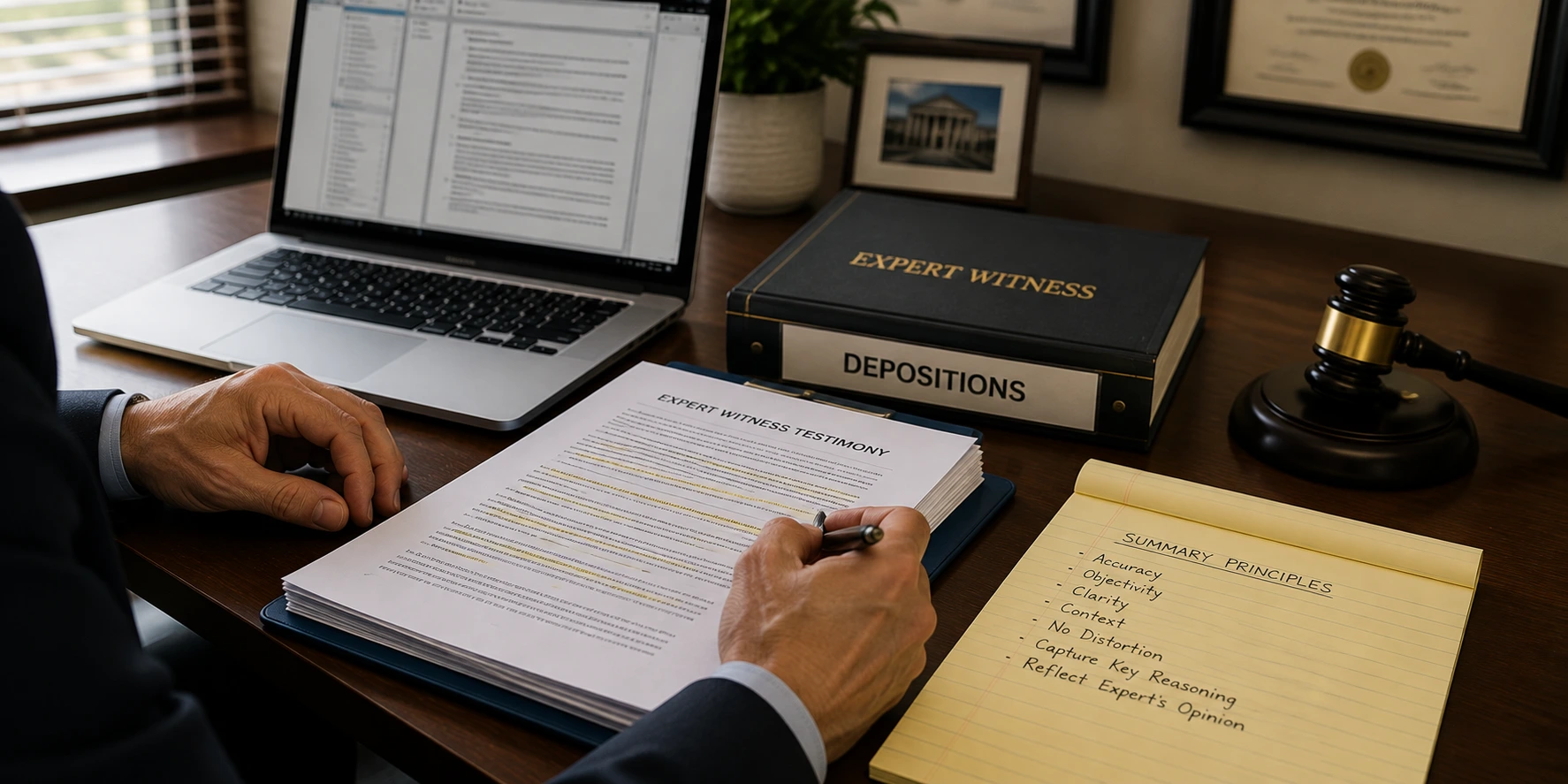
Expert testimony is precise and heavily qualified, so the risk in summarizing it is distortion: making the opinion cleaner, stronger, or broader than the expert gave it. Here is how to summarize it faithfully:
- Preserve the exact opinion: keep the conclusion and the degree of certainty the expert stated, not a tidied-up version.
- Keep the methodology and basis: note what the expert relied on and how they reached the opinion, cited to the page and line.
- Carry every qualifier: assumptions, limits, and conditions are part of the opinion, not filler to cut.
- Capture the concessions: what the expert conceded on cross belongs in the summary.
- Do not grade the opinion: the summary records and cites the testimony; whether it is admissible or right is for the attorney and the court.
Read on for how to summarize expert testimony without distorting it, and the line the summary does not cross.
Expert testimony is the hardest kind to summarize well, because it is built to be precise. An expert states an opinion, ties it to a method, and hedges it with assumptions and limits, and every one of those pieces is doing work. The temptation in a summary is to clean it up, to state the conclusion crisply and drop the qualifiers that make it read less certain. That is exactly the mistake. A summary that tightens an expert opinion into something more confident or broader than the expert actually gave has not shortened the testimony, it has distorted it, and it has done so in the direction most likely to mislead the team relying on it.
Here is the grounding. A deposition summary condenses sworn testimony into a shorter, organized document with references back to the page and line. When the witness is an expert, the goal is fidelity: capture the opinion, its degree of certainty, the method behind it, and every qualifier, so the summary reads the way the expert testified, not the way it would sound at its strongest.
The scope of the opinion is the point
Federal Rule of Evidence 702, amended in December 2023, was revised in part because experts sometimes overstate their conclusions. A deposition summary should preserve the exact scope of the opinion rather than inflate it.
Why summaries distort expert opinions
Distortion usually is not deliberate; it is what happens when a dense opinion gets compressed by someone focused on brevity rather than fidelity. The expert said the finding held "assuming the reported history is accurate," and the summary keeps the finding and drops the assumption. The expert limited the opinion "within the field of orthopedics," and the summary states it without the limit. Each cut makes the opinion read stronger. The revised Federal Rule of Evidence 702 was changed partly because experts can overstate conclusions, and a summary that trims the qualifiers does the overstating for them. The fix is to treat every qualifier as part of the opinion, not as trimming.
Preserve the opinion and its degree of certainty
The core of a faithful expert summary is the opinion stated exactly, with the certainty the expert attached to it. If the expert said "more likely than not," the summary says that, not "concluded." If the expert offered the opinion "to a reasonable degree of medical certainty," the summary carries that phrasing. Recording the opinion in the expert's own framing, cited to the page and line, is what lets the attorney see the actual strength of the testimony. This is the same discipline that separates an issue-based summary built for expert review from a loose paraphrase.
Need expert depositions summarized without inflating the opinion?
Keep the methodology and the basis
An expert opinion is inseparable from how the expert reached it, so a faithful summary keeps the method with the conclusion. What the expert reviewed, the technique they applied, the data they relied on, and any standard they invoked belong alongside the opinion, cited to the page and line. An attorney reading the summary needs to see not just the conclusion but the path to it, because that path is what the opposing side will test and what a court examines. Keeping the opinion anchored to its method and its citation is part of why the expert-versus-fact-witness distinction matters: expert testimony has to be summarized as reasoned opinion, method included.
Carry the qualifiers and the concessions
The qualifiers and the concessions are where expert testimony is most often distorted, and where the summary earns its trust. Every assumption the opinion rests on, every limit the expert placed on it, and every point the expert conceded on cross-examination is part of the record and belongs in the summary, cited. An opinion that was narrowed under questioning should read as narrowed, not as first offered. Capturing the concessions faithfully is often the most useful thing an expert summary does, because those are the points the other side built and the trial team needs to see, as a summary of a defense expert's transcript shows.
Summarizing an expert opinion means keeping its qualifiers, not cutting them. A summary that drops the limits reports a stronger opinion than the expert actually gave.
How AI helps, and where a reviewer is needed
Working through a long expert deposition is something AI can speed up. It can gather where the expert stated the opinion, described the method, and was pressed on cross, faster than a person reading the whole transcript. What it cannot reliably do is tell which qualifier changes the meaning of the opinion, or recognize when compressing an answer has quietly widened it. That is the exact failure mode that distorts expert testimony. So a dependable expert summary pairs that speed with a trained reviewer who reads the opinion in context, keeps the method and the qualifiers with the conclusion, and preserves the scope the expert actually stated. The tool gathers the testimony; the reviewer keeps it faithful.
One boundary holds this together. A deposition summary of an expert records the opinion, the degree of certainty, the methodology, the assumptions and limits, and the concessions, and cites all of it. It does not decide whether the opinion is admissible under Rule 702, whether the methodology is sound, or whether the expert is right. Those determinations belong to the attorney and the court. The summary's job is to present the expert's testimony exactly as given, faithful to its scope, so the people who challenge or rely on it are working from what the expert actually said rather than a cleaned-up version.
Summarizing expert testimony well is not about making the opinion easier to read. It is about keeping it accurate, because an expert opinion stripped of its qualifiers is a different opinion than the one the expert gave.
Summarizing expert testimony faithfully
4
Elements to preserve
The opinion, its degree of certainty, the methodology, and every qualifier, each cited.
702
The rule in the background
FRE 702, amended December 2023, addresses experts overstating conclusions; a summary should not overstate for them.
1
Line the summary holds
It records and cites the opinion as given; it does not decide admissibility, soundness, or whether the expert is right.
Frequently Asked Questions
What does it mean to distort an expert opinion in a summary?

It means summarizing the opinion so it reads stronger, cleaner, or broader than the expert actually gave it, usually by dropping the qualifiers, assumptions, or limits. The conclusion survives but its scope changes, which misleads the team relying on the summary. Faithful summarizing keeps the opinion at exactly the scope the expert stated.
How do you summarize expert testimony without distorting it?
Preserve the opinion and its degree of certainty in the expert's own framing, keep the methodology and basis with the conclusion, carry every assumption and limit, capture the concessions from cross-examination, and cite each to the page and line. The goal is fidelity to the scope of the opinion, not brevity at the cost of accuracy.
Why keep the expert's qualifiers and assumptions?
Because they are part of the opinion. An opinion that holds "assuming the reported history is accurate" or "within the field of orthopedics" means something different without those limits. Dropping them makes the opinion read stronger than it is, so the summary carries every qualifier and cites it alongside the conclusion.
Should an expert summary include what the expert conceded on cross?
Yes. Concessions and narrowed opinions from cross-examination are often the most useful part of the testimony, because they are what the opposing side built. A summary that keeps only the direct-examination version has hidden them, so the concessions are captured and cited so the trial team can see them.
Does summarizing expert testimony mean judging whether the opinion is admissible or correct?
No. The summary records the opinion, certainty, methodology, qualifiers, and concessions, and cites all of it. Whether the opinion is admissible under Rule 702, whether the methodology is sound, and whether the expert is right are for the attorney and the court, not the summary.
Can AI summarize expert testimony without distorting it?
AI can gather the opinion, method, and cross-examination quickly, which helps with dense transcripts. It cannot reliably tell which qualifier changes the meaning or notice when compression widened an opinion, so a trained reviewer keeps the method and qualifiers with the conclusion and preserves the stated scope before the summary is relied on.
An expert opinion is precise on purpose, so a deposition summary has to be faithful to it rather than tidy about it. Preserve the opinion and the exact degree of certainty; keep the methodology and basis with the conclusion; carry every assumption, limit, and qualifier; capture the concessions from cross-examination; cite all of it to the page and line; and leave the judgment about admissibility and soundness to the attorney and the court. Handle expert testimony that way and the summary reports the opinion the expert actually gave, at the scope they gave it, which is the only version worth relying on.
Ready for expert deposition summaries that keep the opinion, the method, and the qualifiers intact and traceable to the line? Partner with LezDo TechMed, or estimate a summary to see how it is handled. For the full method behind it, see our guide to drafting a deposition summary.
Source Credit : All metrics derived from LezDo TechMed’s internal project data.
Anjana Devi Vijay
Anjana Devi Vijay is a Certified Legal Nurse Consultant (CLNC) and Medical–Legal Research Analyst with 9+ years of experience in medical record review, deposition summary analysis, and medico-legal research. She specializes in transforming complex healthcare documentation into accurate, actionable insights that support attorneys, insurers, and medical evaluators. With expertise in clinical documentation analysis and legal case support, she creates research-driven content focused on improving decision-making and case outcomes.











.png)


