Home
>
Blog
>
>
Narrative Summary vs. Medical Chronology: Which Helps Attorneys Manage Medical Facts Better?
Key Takeaways
- A medical chronology is best for date-by-date treatment tracking and record verification.
- A narrative summary is best for understanding the medical story in a readable, attorney-ready format.
- Attorneys should choose based on case purpose, record volume, deadline, and the level of medical complexity.
- Neither document should diagnose, determine causation, or provide legal conclusions.
Have you ever reviewed a medical record stack and wondered whether you need a chronology, a narrative summary, or both?
That question comes up often in personal injury, medical malpractice, workers' compensation, mass tort, and insurance litigation files. The records may be long, repetitive, incomplete, and spread across many providers. The attorney needs to understand what happened medically, but the file does not present itself in a clean legal story.
This is where the fear begins. What if a treatment gap is missed? What if a pre-existing condition is buried in a primary care note? What if the demand package relies on a simplified injury story, but the records show a more complicated medical history? What if the defense finds the contradiction first?
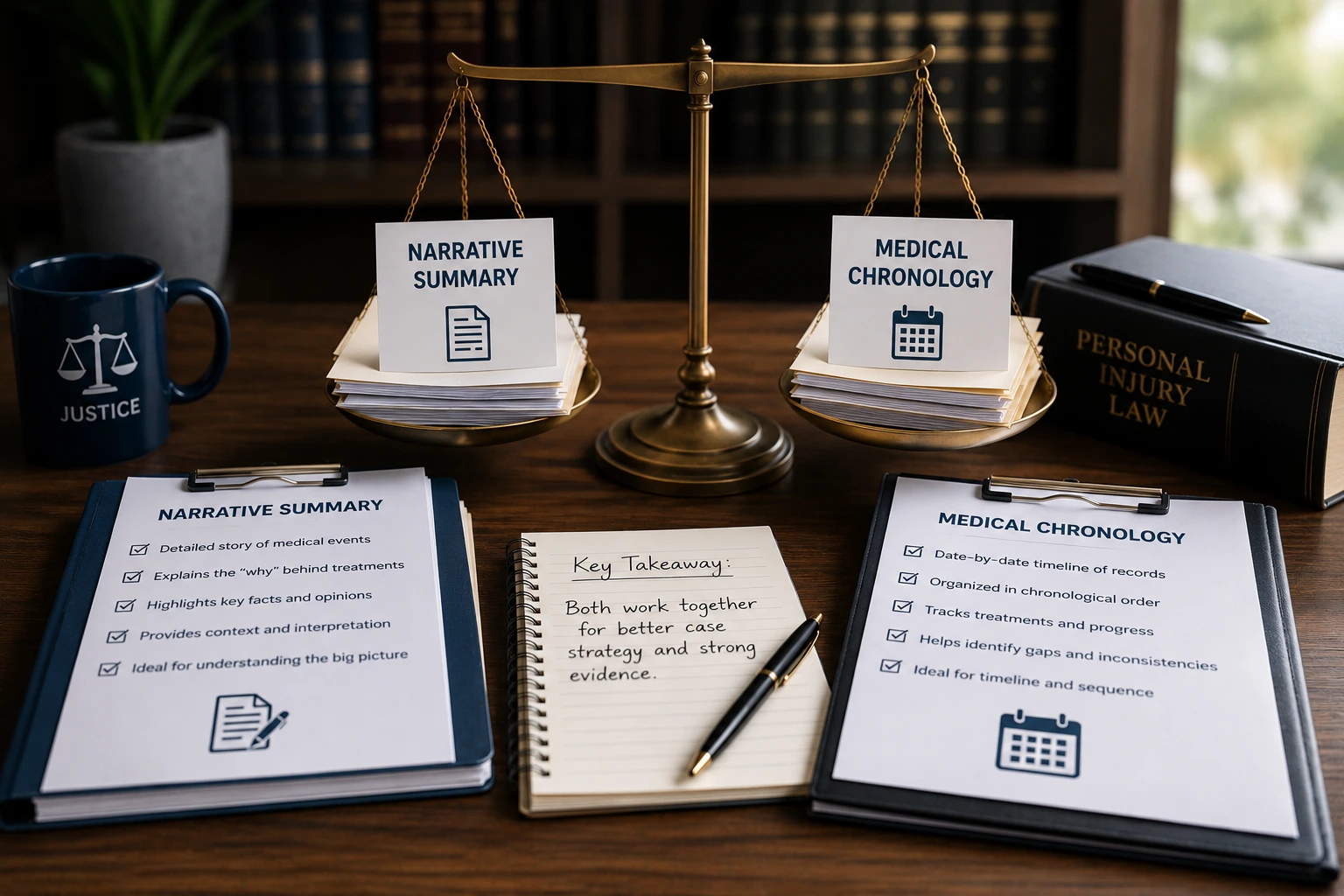
Both narrative summaries and medical chronologies help attorneys manage medical facts. But they do different jobs. Choosing the right one depends on what the attorney needs to do next.
24 to 48 Hours for Sorting and Indexing
Once records are received, sorting and indexing can be completed within 24 to 48 hours so chronology or narrative review begins from an organized record set.
What a medical chronology does best
A medical chronology organizes medical events by date. It helps attorneys see the sequence of treatment from the first documented event through follow-up care, procedures, therapy, imaging, referrals, and later medical visits.
This format is especially useful when timing matters.
A chronology helps attorneys answer questions such as:
1. When did treatment begin?
The first documented complaint or visit may matter during early case evaluation.
2. How consistent was the treatment?
Gaps in care, delayed follow-up, or interrupted therapy become easier to see.
3. What happened before and after the incident?
Pre-incident records can be separated from post-incident treatment.
4. Which providers were involved?
Orthopedists, neurologists, pain management physicians, hospitals, therapists, and primary care providers can be tracked clearly.
5. Where can the source be verified?
Page references, Bates numbers, or source file notes help attorneys return to the original record.
For attorneys, the greatest strength of a chronology is structure. It turns scattered records into a timeline. That can be crucial when preparing for deposition, expert review, mediation, or trial.
What a narrative summary does best
A narrative summary explains the medical record in a readable story format. Instead of listing each event only by date, it helps the attorney understand the larger medical picture.
This is useful when the attorney needs to understand the case quickly, prepare a demand, brief a team member, or review the medical story before strategy discussions.
A narrative summary may explain:
1. The injury and treatment story - What symptoms were documented, what care followed, and how treatment progressed.
2. Major diagnoses and procedures - The summary can group important findings without forcing the attorney to read every encounter note.
3. Prior medical history - Pre-existing conditions, earlier complaints, or relevant past treatment can be presented in context.
4. Treatment gaps and inconsistencies - The summary can flag where records appear incomplete or where the medical story changes.
5. Medical facts needing attorney review - The reviewer can identify documented issues without giving legal or medical opinions.
The strength of a narrative summary is readability. It helps attorneys see the case story, not only the case timeline.
Need help turning medical records into attorney-ready summaries?
Why attorneys fear choosing the wrong format
The wrong format can create false confidence.
If an attorney only receives a narrative summary for a medically complex file, they may understand the broad story but miss exact dates, treatment gaps, or source references. If they only receive a chronology for a case with complicated prior history, they may see the timeline but miss the larger pattern across providers.
The risk is not simply inconvenience. The risk is that important facts stay hidden.
For example, a chronology may show that the client treated for back pain after an accident. But a narrative summary may explain that earlier primary care records documented recurring back complaints, a prior MRI, and a medication history before the incident. That context does not decide the case, but it helps the attorney prepare for the questions that may come later.
On the other hand, a narrative summary may describe treatment progression well, but the attorney may still need a chronology to locate exact dates, page references, and provider sequence.
When a medical chronology is the better first choice
A medical chronology is often the better first step when the attorney needs precise date control.
Choose a chronology when:
1. The case has many providers - Multiple providers make it harder to track treatment order.
2. Treatment gaps matter - Chronologies make time gaps more visible.
3. The attorney needs page-level verification - Source references are easier to organize in a chronological format.
4. Deposition or expert review is coming - The attorney may need quick access to exact dates and events.
5. The file includes before-and-after records - Pre-incident and post-incident treatment can be separated clearly.
Chronologies are especially helpful when the medical record stack is large and the attorney needs a reliable map before deeper analysis.
"A chronology tells attorneys when the medical events happened. A narrative summary helps them understand what the medical records are saying as a whole."
When a narrative summary is the better first choice
A narrative summary is often the better first choice when the attorney needs the medical story in a readable form.
Choose a narrative summary when:
1. The attorney needs a case overview - A narrative summary can explain the treatment story without requiring a full record read.
2. The medical history is complicated - Prior conditions, comorbidities, procedures, and specialist care may need context.
3. The file is being prepared for demand or mediation - A readable summary can support internal strategy and communication.
4. The attorney needs to brief another team member - The summary helps someone understand the case faster.
5. The records contain scattered but related facts - Narrative format connects related details across providers.
A narrative summary is strongest when the question is not only "when did this happen?" but "what does the documented medical history show?"
When attorneys need both
Many cases benefit from both formats.
The chronology gives the attorney a timeline. The narrative summary gives the attorney the medical story. Together, they help the legal team move between date-level verification and broader case understanding.
This is especially useful in files involving:
- High record volume.
- Multiple injuries.
- Prior medical history.
- Treatment gaps.
- Conflicting provider notes.
- Surgery or pain management.
- Long-term therapy.
- Expert review.
The chronology helps the attorney verify what happened and when. The narrative summary helps the attorney understand how the documented facts fit together.
Choosing the Right Medical Record Tool
Medical Chronology
Best for timeline control
Use it when dates, treatment sequence, provider order, and page references matter most.
Narrative summary
Best for medical story clarity
Use it when the attorney needs a readable explanation of the record as a whole.
Both together
Best for complex files
Use both when the case has high volume, prior history, gaps, or multiple providers.
Frequently asked questions
Is a narrative summary the same as a medical chronology?

No. A chronology organizes events by date, while a narrative summary explains the medical story in a readable format.
Which one is better for attorneys?
It depends on the case purpose. Chronologies are better for timeline control. Narrative summaries are better for understanding the broader medical picture.
Can attorneys use both in the same case?
Yes. Complex cases often benefit from both because the attorney needs exact dates and a clear medical story.
Does a narrative summary provide medical or legal opinions?
No. It should summarize and organize documented medical facts, not diagnose, determine causation, assess liability, or give legal conclusions.
When should a chronology be prepared first?
Prepare a chronology first when the attorney needs to verify dates, provider sequence, treatment gaps, and source references.
What both formats should avoid
Whether the deliverable is a chronology or a narrative summary, the boundaries matter.
A medical-legal reviewer should not diagnose, determine causation, assess liability, calculate damages, or give legal opinions. The reviewer should organize, summarize, cross-reference, and flag documented medical information.
The attorney remains responsible for legal strategy. Medical experts remain responsible for medical opinions. The summary or chronology should make their work easier, not replace it.
To wrap up,
Narrative summaries and medical chronologies are not interchangeable. They answer different needs.
A chronology gives attorneys control over dates and sequence. A narrative summary gives attorneys clarity over the medical story. When the fear is missing a critical fact, the safest approach is to choose the format that matches the case question. For simple timeline review, start with a chronology. For broader medical understanding, start with a narrative summary. For complex records, use both.
Source Credit : All metrics derived from LezDo TechMed’s internal project data.
Vishnu Priya Vinu
Vishnu Priya Vinu is a Certified Legal Nurse Consultant (LNC) and Medical-Legal Research Analyst with over two years of experience in medical record review, medico-legal research, and content development. She specializes in blogs, articles and E-books that bridges the gap between healthcare and law. Her strong medical background brings depth and accuracy to content, enabling law firms, medical evaluators, and insurance professionals to gain insights on complex medical data analysis. She delivers evidence-based insights and strategic content that strengthen case outcomes and support informed decision-making.













.png)


