Home
>
Blog
>
>
Why Strong Case Evaluation Starts with Medical Record Review
Key Takeaways
- Evaluation readiness starts before the IME or QME appointment. The record set must be organized, complete enough for review, and tied back to source documents.
- Medical record review helps evaluators see the treatment timeline, prior history, diagnostic findings, procedures, medications, work restrictions, and gaps without rebuilding the file from scratch.
- A review-ready file should flag missing records, duplicate documents, inconsistent histories, unclear dates, and late supplemental records.
- Better review reduces avoidable rechecking, but it does not replace the evaluator's professional judgment.
- For IME and QME teams, the goal is simple: give the evaluator a record set that supports focused review before the report work begins.
A file can be complete and still not be ready
Medical record review affects evaluation readiness because the evaluator cannot review efficiently when the record set still has to be reconstructed. An Independent Medical Evaluation (IME) or Qualified Medical Evaluation (QME) depends on more than the presence of records. It depends on whether the records are usable before the evaluator sits down to prepare.
That sounds basic until you open the file.
There may be one PDF with 900 pages, another with duplicate treatment notes, a third with imaging reports placed far away from the orthopedic visits, and supplemental records arriving after the first review. The evaluator may have the records, but not the working sequence.
This is where better medical record review changes the preparation stage. It turns the file into something the evaluator can actually read for medical issues, rather than spend the first hour sorting providers, dates, missing reports, and repeated pages.
For IME and QME evaluators, readiness means the medical evidence is organized enough to support the evaluator's own analysis. It should not diagnose, decide causation, assign impairment, make standard-of-care findings, or tell the evaluator what conclusion to reach. It should organize and flag what the records document.
What usually makes an IME or QME file hard to review
IME and QME files become difficult to review when the medical story is scattered across providers, dates, formats, and late additions. The evaluator may need to understand the whole treatment course, but the records often arrive in a form that hides the sequence.
Common problems include:
- Large PDF files with no useful index
- Duplicate pages mixed with new records
- Provider packets placed out of date order
- Diagnostic reports separated from the related visits
- Prior injuries or pre-existing conditions mixed into current treatment
- Missing operative reports, imaging reports, therapy notes, or specialist records
- Late supplemental records that change the review sequence
- Handwritten or low-quality pages that need closer checking
- Conflicting patient histories across intake forms, progress notes, and deposition testimony
In a workers' compensation or personal injury evaluation, a few dates can matter a lot. When did symptoms first appear in the records? When was imaging ordered? What did the radiology report actually state? Were work restrictions documented before or after a reported change in condition? Did the patient report a prior injury to one provider but omit it elsewhere?
The evaluator decides what those facts mean. The review process should make those facts easier to locate.
That distinction matters. A good review does not try to become the opinion. It prepares the evidence trail so the opinion work can begin from a clearer place.
Need medical record support before an IME or QME evaluation?
Better review starts with the record set, not the final summary
Better medical record review begins by making the record set reviewable before anyone writes a polished summary. A clean deliverable is useful only if the foundation is also clean.
Here is what that usually means in practice.
1. Build a record inventory
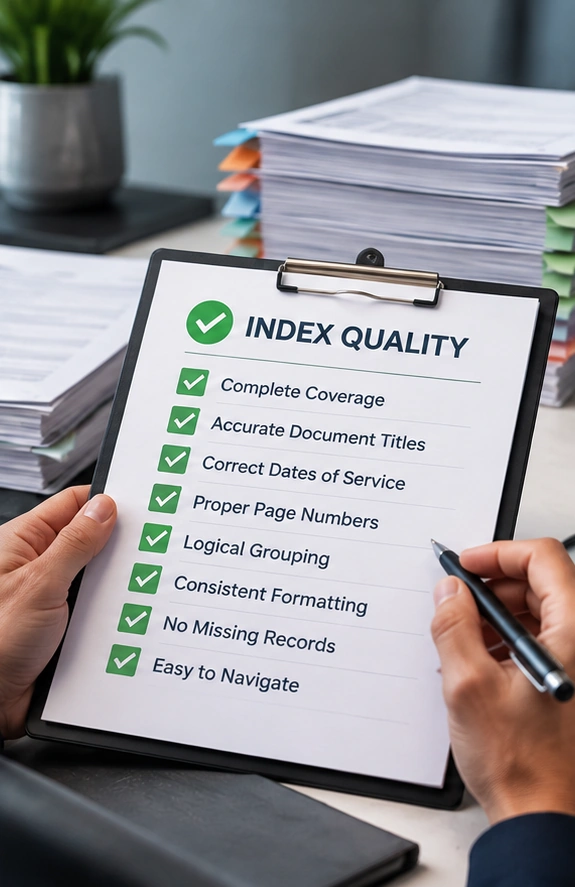
The first step is to identify what was received: provider names, date ranges, document types, page ranges, and file names. This is the basic control point. Without it, nobody can confidently say whether the file is complete enough for the assigned scope.
2. Separate providers and document types
Progress notes, imaging reports, operative reports, therapy notes, hospital records, billing records, and correspondence should not all sit in one undifferentiated block. IME and QME evaluators often need to move quickly between clinical categories.
3. Place the treatment sequence in order
The timeline should show how the medical history developed. That includes first documented complaints, diagnostic testing, conservative care, specialist referrals, procedures, medication changes, functional limitations, and work restrictions where documented.
4. Flag gaps, duplicates, and unclear dates
A missing record is a missing piece of the picture. If the chart references an MRI but the MRI report is absent, that needs to be flagged. If the same page appears four times, that also matters because it inflates volume and slows review.
5. Track prior history and supplemental records
Prior injuries, chronic conditions, earlier surgeries, and later supplemental records can affect how the evaluator reads the sequence. The review should make those items visible without overexplaining what they mean.
6. Keep source references visible
Page references, provider names, and dates help the evaluator verify the material quickly. If the evaluator has to hunt for every source, the summary becomes another document to check instead of a useful working tool.
7. Leave the opinion to the evaluator
This is the boundary I keep coming back to. Medical record review should organize, summarize, and flag. The evaluator applies professional judgment.
Evaluation readiness means the evaluator can review the medical issues without first rebuilding the record set.
A published IME workflow example shows the same problem
A published LezDo TechMed case study involving a California neurosurgery-focused IME firm described a familiar preparation problem: thousands of pages per case, disorganized and unindexed records, difficulty building clear chronologies, long deposition analysis, and supplemental-record gap management.
That combination creates a quiet drain on the evaluator's time. The medical professional may be ready to evaluate the case, but the file is asking for administrative reconstruction first.
In that case study, LezDo TechMed supported the workflow through medical record sorting and indexing, medical chronology and treatment-timeline creation, deposition summarization, supplemental-record integration, and missing-record identification. The published results included a 62% reduction in review time and 40% faster case processing.
Those numbers should be read in context. They do not mean every IME or QME file will produce the same result. They do show the operational direction: when record review removes avoidable searching, duplicate checking, and sequence-building, the evaluator's time is protected.
For QME teams, the same point often appears around appointment deadlines and supplemental records. A late packet can change the review sequence. A missing imaging report can hold up a clean discussion of treatment history. A prior condition can be documented in one provider's intake but absent from later notes.
The evaluator still decides what matters.
The review team should make sure the evaluator can find it.
Frequently Asked Questions
What is medical record review for IME and QME evaluators?

Medical record review for IME and QME evaluators is the organized review of medical records before an evaluation. It identifies treatment history, diagnostic reports, procedures, medications, work restrictions, prior conditions, missing records, and source references so the evaluator can review the file more efficiently.
How does medical record review improve evaluation readiness?
Medical record review improves evaluation readiness by turning scattered records into a structured timeline with clear provider details, document categories, and gap flags. This helps the evaluator prepare without spending unnecessary time rebuilding the file sequence.
Does medical record review replace the evaluator's opinion?
No. Medical record review does not replace the evaluator's opinion. It organizes documented medical information and flags issues for review, while the evaluator remains responsible for medical analysis, conclusions, and report opinions.
Why do source references matter in medical record review?
Source references matter because evaluators need to verify where a fact came from. Provider names, dates, and page references reduce searching and make the summary easier to check against the original record set.
Finally,
Evaluation readiness depends on better medical record review because the evaluator's time should go toward evaluation, not file reconstruction. When the records are indexed, sequenced, cross-referenced, and checked for gaps, the evaluator can move into the medical questions with less avoidable friction.
This is especially important when the file includes years of treatment, multiple providers, prior injuries, diagnostic testing, work restrictions, and supplemental records. The risk is not simply that the file is long. The risk is that the useful facts are buried in a way that slows preparation or creates repeated checking.
Good review does not make the evaluation easier by reducing the medical complexity. It makes the evaluation more workable by making the documentation clearer.
That is the practical value. Medical record review prepares the record set so the qualified evaluator can do the work only the evaluator can do.
Source Credit : All metrics derived from LezDo TechMed’s internal project data.
Jebisha Jenishofen
Jebisha Jenishofen is a Certified Legal Nurse Consultant and Medical–Legal Research Analyst with over five years of experience in the medical-legal industry. She specializes in medical record analysis, medical-legal research, and content development, creating clear and informative resources on personal injury, medical malpractice, insurance claims, and healthcare litigation. By combining clinical knowledge with research expertise, she transforms complex medical information into practical insights for medical-legal professionals.













.png)


