Home
>
Blog
>
>
7 Ways a Deposition Summary Can Help Track Testimony Inconsistencies
Key Takeaways
- A useful deposition summary should make inconsistent testimony easier to find and compare.
- Page-line references are essential because mass tort teams need to verify testimony quickly.
- Inconsistency tracking works better when summaries are organized by issue, witness, and source support.
- A summary should flag testimony changes without deciding credibility or legal strategy.
- Cross-witness comparison matters in mass tort work because one transcript rarely tells the whole pattern.
Inconsistent testimony gets missed in large transcript volumes
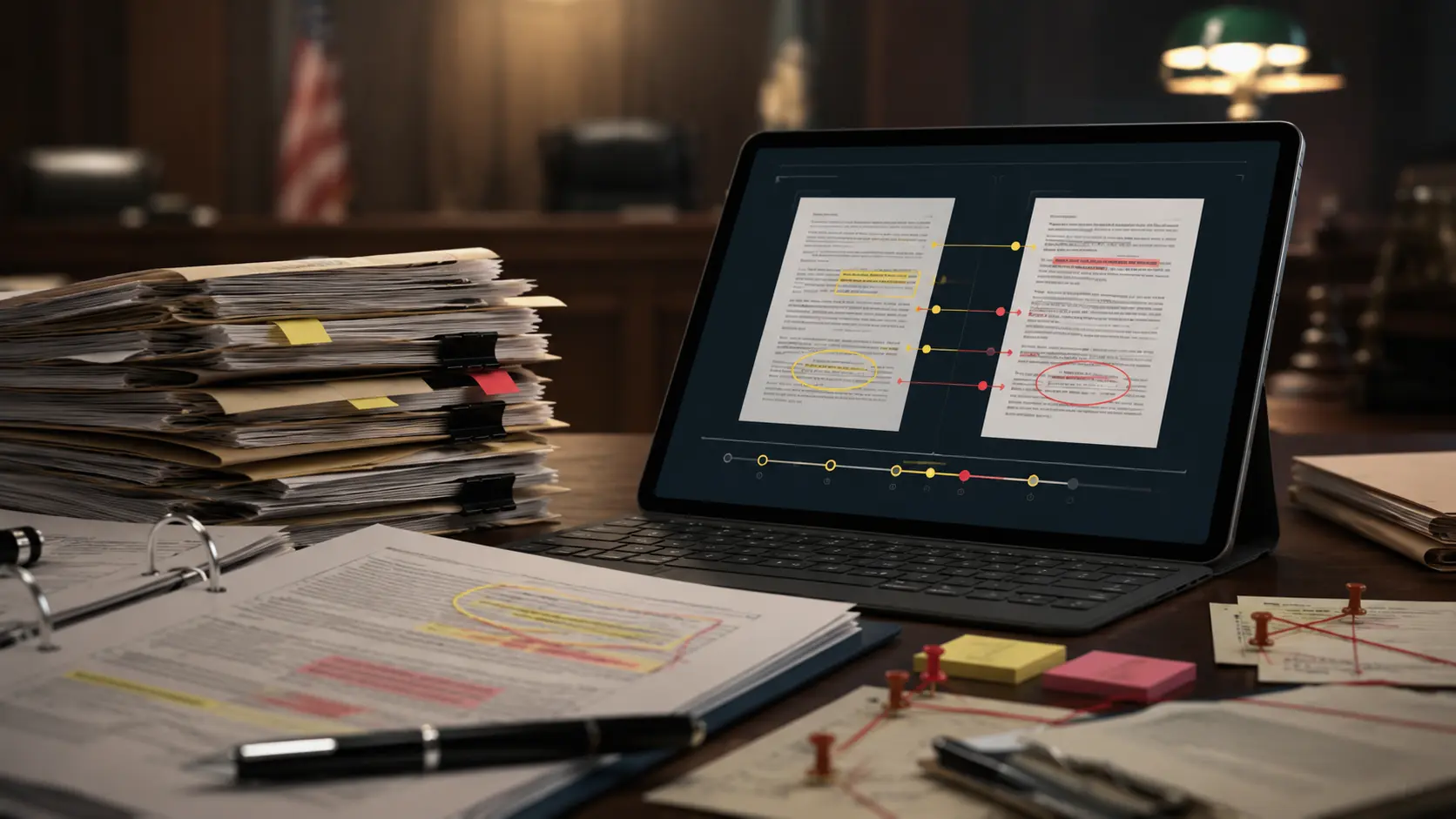
A deposition summary helps mass tort attorneys track testimony inconsistencies by turning long transcripts into issue-based, page-line supported review material. When a team is working through dozens or hundreds of depositions, inconsistent answers can hide in plain sight.
One witness says the product was used before a diagnosis. Another gives a different date. A treating provider remembers a symptom history differently from the plaintiff. A corporate witness explains a warning process one way in one transcript and adds a qualification three depositions later.
None of that helps if the team only has full transcripts and scattered notes.
Mass tort attorneys do not need a deposition summary that simply retells what everyone said. They need a summary that helps them compare testimony, verify the source, and decide what needs attorney review.
That is where inconsistency tracking begins.
Why mass tort testimony gets hard to compare
Mass tort testimony gets hard to compare because the same issue may appear across many witnesses, case files, medical histories, products, and time periods. The inconsistency may not sit inside one dramatic answer. It may appear as a small difference across several transcripts.
That is what makes this work tedious.
A plaintiff may give one exposure date in written discovery and a slightly different sequence during deposition. A prescribing physician may describe warning knowledge differently from a sales representative. A corporate witness may testify about training, labeling, complaint handling, or adverse-event processes in a way that shifts between cases. A family witness may confirm daily limitations that do not match the medical-record timeline.
Mass tort teams are usually tracking more than one fact:
- Product use or exposure dates
- Treating-provider history
- Warnings or risk information
- Recall or complaint history
- Employment or functional limitations
- Damages-related testimony
- Expert or corporate witness positions
A deposition summary should make those issue threads easier to follow. It should not flatten testimony into broad notes such as "witness discussed product use" or "doctor reviewed medical history." Those lines may be true, but they do not help the attorney find the inconsistency. When the conflict sits inside a single witness's testimony rather than across many, that is catching contradictions in a single deposition.
Need high-quality deposition summaries?
Seven ways deposition summaries help track inconsistencies
A deposition summary helps track inconsistencies when it is built for comparison from the start. For mass tort attorneys, that means the summary should make testimony searchable by issue, grounded in page-line references, and clear about what changed.
Here are seven practical ways it helps.
1. It pulls key testimony out of long transcripts
Mass tort transcripts can run long because background, medical history, product use, exposure, warnings, damages, and expert topics all compete for space. A summary helps pull the testimony that matters into a usable format.
The full transcript still controls. The summary simply points the team to the relevant answers faster.
2. It keeps page-line references attached
An inconsistency is only useful if the attorney can verify it. Page-line references let the team return to the exact answer, check the surrounding question, and decide whether the testimony is actually inconsistent or only appears that way in isolation.
3. It groups testimony by issue
Issue-based sections help mass tort teams compare the same topic across multiple witnesses. Product identification, exposure period, warnings, symptom history, diagnosis timeline, prior condition, and damages testimony should not be buried in one long narrative.
4. It flags answer changes inside the same transcript
Sometimes the inconsistency happens within one deposition. A witness may answer one way before seeing an exhibit and then narrow or change the answer later. A good deposition summary should show that movement.
5. It supports cross-witness comparison
Mass tort cases often depend on patterns across witnesses. A plaintiff, treating physician, corporate representative, and expert may all touch the same issue from different angles. Summaries help the team compare those answers without rereading every transcript each time.
6. It separates inconsistency from interpretation
A summary should flag testimony that appears inconsistent, but it should not decide credibility, legal effect, or trial strategy. That belongs to the attorney. The summary's role is to organize and point.
7. It creates follow-up flags
Some inconsistent testimony needs another step. The team may need to check medical records, written discovery, plaintiff fact sheets, prior deposition testimony, exhibits, or expert materials. A useful summary notes the follow-up trail.
A deposition summary earns its place when it helps the attorney compare testimony without losing the page-line trail.
What inconsistency-focused summaries should include
Whether it is prepared in-house or through deposition summary services, an inconsistency-focused deposition summary should be organized around how the mass tort team will use the testimony later. The summary should help attorneys compare answers across witnesses, not only remember what one witness said.
That usually means including:
Witness and case details: deponent name, role, date, case identifier, and transcript range.
- Issue headings: product use, exposure, warnings, injury history, diagnosis timeline, prior condition, damages, corporate knowledge, or case-specific topics.
- Page-line references: exact transcript support for important answers.
- Answer-change notes: places where testimony shifts after an exhibit, clarification, or repeated questioning.
- Cross-reference flags: testimony that should be compared with another witness, medical record, plaintiff fact sheet, interrogatory response, or exhibit.
- Admission and denial tracking: answers that confirm, deny, qualify, or retreat from a key fact.
- Follow-up items: missing exhibits, unclear dates, inconsistent histories, or topics for attorney review.
In one published LezDo TechMed case study involving a California neurosurgery-focused IME firm, the client was dealing with time-consuming manual review, disorganized and unindexed records, difficulty building clear chronologies, and long deposition analysis. LezDo supported deposition summarization along with record sorting, chronology work, supplemental-record integration, and missing-record identification.
The published case study reported 44% faster deposition analysis.
I would keep that number in its lane. The point is not that a summary replaces attorney judgment. The point is that organized deposition analysis reduces avoidable transcript hunting. For mass tort teams, that matters because one missed change in testimony can affect how the team reviews a witness, an issue, or a group of related cases.
The safer way to think about it is this: a deposition summary should make comparison easier while keeping the source visible.
Inconsistency-Focused Deposition Summaries
15,000+
Depositions Summarized Annually
Annual deposition summary volume across litigation workflows
3 layers
Review Check
Deliverables pass through a three-layer quality-check
13+ years
Medical-Legal Experience
Professional experience accumulated since 2013
Frequently Asked Questions
What is a deposition summary?

A deposition summary is a structured summary of deposition testimony that helps legal teams locate important answers in a transcript. It may include issue headings, page-line references, admissions, denials, exhibit references, inconsistency flags, and follow-up notes.
How does a deposition summary help track testimony inconsistencies?
A deposition summary helps track testimony inconsistencies by organizing answers around issues and keeping page-line references attached. This lets attorneys compare testimony within one transcript and across multiple witnesses.
Why do mass tort attorneys need inconsistency-focused deposition summaries?
Mass tort attorneys often compare testimony across many plaintiffs, providers, corporate witnesses, experts, and case files.
What should be included in a deposition summary for mass tort cases?
A deposition summary for mass tort cases should include witness details, issue-based sections, page-line references, key testimony, answer changes, exhibit references, cross-witness comparison flags, and follow-up items for attorney review.
Can a deposition summary decide whether testimony is credible?
No. A deposition summary should not decide credibility. It can flag testimony that appears inconsistent or needs comparison, but the attorney decides how to evaluate and use that testimony.
Why are page-line references important in deposition summaries?
Page-line references help attorneys verify testimony against the full transcript. Without them, the team may have to search through long transcripts again before using an admission, contradiction, or issue-specific answer.
Finally,
A deposition summary can help mass tort attorneys track testimony inconsistencies because it gives the team a structured way to compare what witnesses said, where they said it, and what needs follow-up.
The full transcript remains the source. The attorney remains the decision-maker. The summary should make the transcript easier to use, especially when the same issue appears across plaintiffs, providers, corporate witnesses, experts, and exhibits.
When summaries are too broad, inconsistencies stay hidden behind phrases like "discussed exposure" or "reviewed medical history." When summaries are built for comparison, the attorney can see the issue, check the page-line, and decide what to do next.
That is the difference between reading testimony and tracking it.
Source Credit : All metrics derived from LezDo TechMed’s internal project data.
Jebisha Jenishofen
Jebisha Jenishofen is a Certified Legal Nurse Consultant and Medical–Legal Research Analyst with over five years of experience in the medical-legal industry. She specializes in medical record analysis, medical-legal research, and content development, creating clear and informative resources on personal injury, medical malpractice, insurance claims, and healthcare litigation. By combining clinical knowledge with research expertise, she transforms complex medical information into practical insights for medical-legal professionals.











.png)


