Home
>
Blog
>
>
What Makes a Consolidated Record File Easier to Review and Update
Key Takeaways
- A provider master list should reconcile legal names, facility names, departments, abbreviations, and known aliases without erasing the wording used in the source production.
- Every provider section needs a visible source trail showing which production or file supplied the records.
- Duplicates should be marked and compared before removal because one copy may contain an additional page, annotation, or clearer scan.
- A usable update process records what arrived, where it was inserted, what changed, and whether navigation was retested.
A consolidated record file is easier to review and update when it has one controlled provider list, visible source labels, stable page or Bates references, consistent document categories, transparent duplicate handling, a navigable index, working hyperlinks, and an update log for every supplemental batch. Those controls let a new reviewer understand the file without rebuilding it and allow later records to enter the same structure without breaking earlier references.
Reviewability and Updateability Depend on the Same Controls
A consolidated file becomes easier to review and update when its structure also supports later supplements. Provider names, sections, document types, page references, index entries, hyperlinks, and update notes should all follow one controlled method.
A file can look orderly on delivery and still be difficult to maintain. If provider names are inconsistent, page references depend on a temporary PDF order, or supplemental records have no defined entry point, every update becomes a partial rebuild. The litigation support team then spends time checking old work before it can add new records.
Start With One Controlled Provider Master List
One controlled provider master list makes the file easier to use because it gives every facility, practice, department, and individual provider a consistent place in the consolidated structure. It should preserve source wording while also recording the standardized label used in the index.
Multi-provider files often contain naming variations. A hospital may appear under its legal entity, campus name, health-system brand, radiology department, or billing vendor. A physician may appear by full name, initials, group practice, or specialty. Treating each variation as a separate provider can fragment one course of care. Merging them without a crosswalk can erase useful source detail.
A practical master list includes the standardized provider label, known aliases, facility or department relationship, date range, source batch, and notes about unresolved identity questions. When the name cannot be reconciled from the supplied records, the uncertainty should remain visible.
Preserve Where Every Record Came From
Every consolidated section should preserve where its records came from because source identity matters during verification and later updates. The reviewer should be able to tell whether a document arrived from a hospital production, physician office, records vendor, opposing party, prior counsel file, or supplemental batch.
Source preservation can be handled through production labels, folder tags, an intake log, or index fields. The method may vary, but it should survive consolidation. A record can be placed under its correct provider section without losing the fact that it arrived in a specific production.
This is especially important when the same document arrives from several sources. The duplicate may confirm overlap, reveal a missing page in one copy, or show that a later production included a clearer scan. Source labels allow the team to compare those copies without guessing which one was retained.
This source control strengthens the record-organization handoff that protects later review because each downstream user can see what the file contains, where it belongs, and what still appears incomplete.
Give Every Page a Stable Address
Stable page or Bates references make a consolidated file easier to update because existing citations, index entries, bookmarks, and links do not need to be rewritten when new records arrive. The team should decide the numbering method before building the final navigation layer.
If supplemental pages are inserted into the middle of a PDF and the file relies only on changing PDF page numbers, every later page may shift. A stable Bates scheme, supplement-specific range, or approved append-only method avoids that cascade. The right approach depends on the production protocol and the team's working rules.
A Bates or page-control log should record the assigned range, source batch, file name, date received, and any gaps, repeats, or excluded non-record pages. Sorting changes where a page appears in the working file; page control preserves how the team identifies it.
Use a Predictable Provider, Date, and Document-Type Structure
A predictable provider, date, and document-type structure makes the consolidated file easier to scan because every reviewer knows where a record should appear. The hierarchy should be chosen once and applied consistently across all providers and supplements.
For a multi-provider litigation file, the primary level may be provider or facility, followed by date and record type. Another matter may need overall chronology first, with provider and type shown in the index. The choice should follow the review purpose, not the order in which PDFs happened to arrive.
Clinical records, imaging, therapy, pharmacy, billing, authorizations, correspondence, and non-medical materials should not be blended without labels. Clear categories help the team distinguish treatment documentation from administrative or financial pages while keeping related records near each other.
Our discussion of preserving the medical story through record order explains why scan order and review order are rarely the same thing.
Handle Duplicates Without Losing Unique Information
Duplicates should be compared, labeled, and resolved under a documented rule because an apparent duplicate may contain a unique page, handwritten mark, different attachment, or better-quality image. Removing copies based only on the first page can create an incomplete consolidated file.
A careful duplicate check compares page count, content, dates, headers, attachments, scan quality, and source. Exact duplicates can be suppressed or moved according to the agreed scope, while near-duplicates remain identifiable. The index or quality log should show how the team handled them.
Transparent duplicate handling also prevents treatment frequency from being overstated. The same operative report appearing in three provider productions is still one operative report. The consolidated file should make that relationship clear without erasing the source history.
Build Navigation That Works for the Next Reviewer
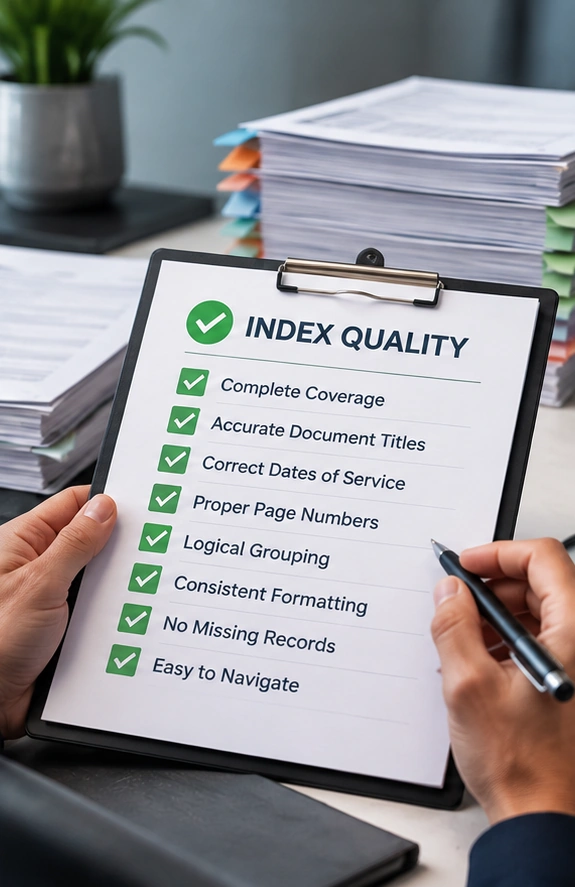
A consolidated file becomes review-ready when its index, bookmarks, and hyperlinks lead the next reviewer to the correct provider section and exact record. Each navigation layer should match the final order and use the same provider labels, dates, and document types.
The index supplies the map. Bookmarks provide section-level movement. Hyperlinks take the reviewer from an index entry to the cited page. Searchable OCR supports keyword lookup, but it should supplement the controlled index rather than replace it, especially when handwriting or poor scans are present.
Navigation should be tested from a clean copy of the delivered file. A link that works only on the preparer's computer or before the PDF is renamed is not a finished link. The quality check should sample the first, middle, and final entries in each major section and verify return navigation when included.
The relationship between sorting, indexing, and hyperlinking medical records shows why order, location, and one-click access must be checked as one connected workflow.
See a Facility-Wise Structure Before Choosing Your Format
Add Supplemental Records Without Rebuilding the File
Supplemental records are easier to add when the team follows a defined intake, placement, numbering, and verification rule. The update should expand the existing structure rather than create a second competing file or silently replace the earlier version.
An update log should identify the date received, source, provider, date range, page count, assigned reference range, insertion or appendix location, duplicate findings, apparent gaps, and navigation changes. The team should also record the new file version and preserve the prior controlled version according to its retention process.
After insertion, the index, bookmarks, hyperlinks, provider date ranges, and page-control log need retesting. If an old reference changed, the update note should identify it. A supplement is complete only when the new pages and the navigation that reaches them agree.
Keep Gaps, Conflicts, and Unclear Pages Visible
Gaps, provider conflicts, unreadable pages, and mixed-patient records should stay visible because a clean appearance must not imply that the file is complete or error-free. The consolidated index should distinguish what is present from what appears absent or unresolved.
Useful flags include a provider named in a referral but not produced, a date range mentioned on a certification but missing from the records, an imaging report without the related study, pages scanned out of sequence, or two provider names that may refer to the same practice. Each flag should cite the source that created the question.
Sorting and indexing does not determine why a gap exists or what a conflicting record means. It gives the litigation support team a traceable issue list so attorneys, reviewers, and record-request personnel can decide the next step.
A consolidated file is easy to update when new records can enter the existing structure without changing what every earlier reference means.
A Hypothetical Supplement Shows the Difference
Consider a hypothetical matter with records from a hospital system, an orthopedic group, a radiology practice, and physical therapy. The initial consolidated file uses standardized provider labels, stable Bates ranges, provider sections, a hyperlinked index, and an intake log.
A later production contains additional therapy visits, a duplicate hospital discharge summary, and an MRI report referenced in the earlier orthopedic notes. The team compares the duplicate, retains the new therapy records under the existing provider label, adds the MRI under the radiology section, assigns a supplemental Bates range, updates the provider date ranges, and retests the new links.
The file grows without losing its map. Earlier citations remain usable, the MRI gap can be closed with a documented update, and the new therapy dates appear in the same provider structure. No one needs to compare two uncontrolled PDFs to learn what changed.
Human Quality Control Should Test Review and Update Paths
Human quality control should test both how a reviewer uses the file and how a later supplement will enter it. AI-assisted tools can support classification, OCR, provider matching, and first-pass duplicate detection, but a trained reviewer should verify the finished structure before delivery.
- Provider check: confirm standardized labels, aliases, departments, and unresolved identities.
- Source check: verify the intake batch and original file for each consolidated record group.
- Page-control check: confirm Bates or page ranges, gaps, repeats, and the corresponding log.
- Content check: verify provider, date, document type, page sequence, duplicate status, and mixed-record concerns.
- Navigation check: test index entries, bookmarks, hyperlinks, OCR search, and return links when included.
- Update check: confirm the new version, supplement log, changed date ranges, closed or new gaps, and retested navigation.
When one provider-matching or hyperlink error is found, the reviewer should search for the same pattern across the file. Quality control is stronger when it checks the rule that failed, not only the single entry that exposed the failure.
How LezDo TechMed Supports Consolidated Record Files
LezDo TechMed supports litigation teams with sorting and indexing services that consolidate multi-provider medical records into a controlled working file. The scope may include provider-wise and date-wise organization, document-type grouping, source tracking, duplicate handling, Bates-reference support, index creation, bookmarks, hyperlinks, OCR searchability, missing-record flags, and supplemental-file updates.
AI-assisted tools may support document classification and first-pass identification, while trained human reviewers verify provider identity, page sequence, document type, source attribution, date ranges, navigation, and visible exceptions before delivery. The structure can be customized to the team's review and production requirements.
LezDo TechMed organizes and locates documented records. It does not diagnose, determine causation, decide liability, assess damages, give legal strategy, or replace the judgment of attorneys, experts, physicians, or other qualified professionals.
The Consolidated-File Control Framework
8
Core controls
Provider, source, page, order, duplicates, index, links, updates
3
Navigation layers
Index, bookmarks, and page-level hyperlinks
1
Update log
Every supplement recorded in the same control trail
Frequently Asked Questions
What is a consolidated medical record file?

It is one controlled working file that organizes records from multiple providers and productions under a consistent provider, date, document-type, page-reference, and navigation structure.
Should provider records be sorted by facility or by date?
The structure should match the review purpose. Many multi-provider files use provider or facility as the primary section and date order within each section, while the index supports cross-file chronology.
How should different versions of a provider name be handled?
Use one standardized index label and maintain a crosswalk of aliases, departments, legal entities, and source wording. Keep unresolved identity questions visible.
Should duplicate medical records be deleted?
Not automatically. Compare content, page count, attachments, annotations, source, and scan quality first. Handle exact and near-duplicates according to the agreed scope and record the decision.
How can supplemental records be added without breaking links?
Use stable page or Bates references, an approved supplement range or append method, a controlled update log, and retesting of index entries, bookmarks, and hyperlinks.
What should a consolidated record index include?
Include provider or facility, source batch, document type, date or date range, page or Bates range, duplicate status, and notes about missing, unreadable, mixed, or unclear records when relevant.
Can AI consolidate multi-provider records without human checks?
AI can assist classification, OCR, provider matching, and duplicate detection. A trained human should verify identity, context, page sequence, source control, and navigation before delivery.
The Bottom Line
A consolidated record file is easier to review and update when every provider has a controlled identity, every record keeps its source, every page has a stable address, every document follows a predictable structure, and every supplement enters through a documented update process. Reliable navigation turns those controls into a file the litigation team can use without rebuilding.
The practical test is straightforward: can a new reviewer understand what is present, locate the source page, see what remains unresolved, and identify what changed in the latest version? If so, the consolidated file is supporting the review instead of creating another review task.
Refer to our blog, 'The Index Is Only Useful If the Next Reviewer Can Trust It' to learn how provider labels, date ranges, page references, duplicate notes, and missing-record flags determine whether the next reviewer can rely on the index.
Source Credit : All metrics derived from LezDo TechMed’s internal project data.
Jebisha Jenishofen
Jebisha Jenishofen is a Certified Legal Nurse Consultant and Medical–Legal Research Analyst with over five years of experience in the medical-legal industry. She specializes in medical record analysis, medical-legal research, and content development, creating clear and informative resources on personal injury, medical malpractice, insurance claims, and healthcare litigation. By combining clinical knowledge with research expertise, she transforms complex medical information into practical insights for medical-legal professionals.













.png)