Home
>
Blog
>
>
The Record Order Problem: Why Sorting and Indexing Should Preserve the Medical Story, Not Just Arrange PDFs
Before a medical file moves into chronology, review, expert work, or demand preparation, sorting and indexing should help answer five practical questions:
- Are the records arranged in a way that follows the treatment story?
- Can each provider, date, and document type be located quickly?
- Are duplicates, missing pages, and mixed records clearly handled?
- Does the index help the reviewer find the same record again?
- Is the file ready for analysis, or only cleaner than before?
A file can look neat and still tell the story wrong.
That is the quiet problem.
The records are labeled. The PDF opens. The pages are not upside down. Someone may even say, “It’s organized.”
But then the attorney looks for the first orthopedic visit and finds it after the billing records. The MRI report appears before the complaint that led to it. Physical therapy notes are split across three sections. A prior injury is buried in a primary care note that no one flagged.
Now the file is not just messy. It is misleading.
For personal injury attorneys and paralegals, sorting and indexing should do more than arrange PDFs into a cleaner folder. It should preserve the medical story so the person reviewing the file can understand what happened, when it happened, who treated the patient, what changed, and what still needs attention.
Clean Order Is Not the Same as Useful Order
There is a difference between a file that looks arranged and a file that is ready for review.
A basic sort may place documents into folders by provider. That helps. But if the provider records are internally out of order, duplicated, or mixed with unrelated documents, the reviewer still has to rebuild the sequence.
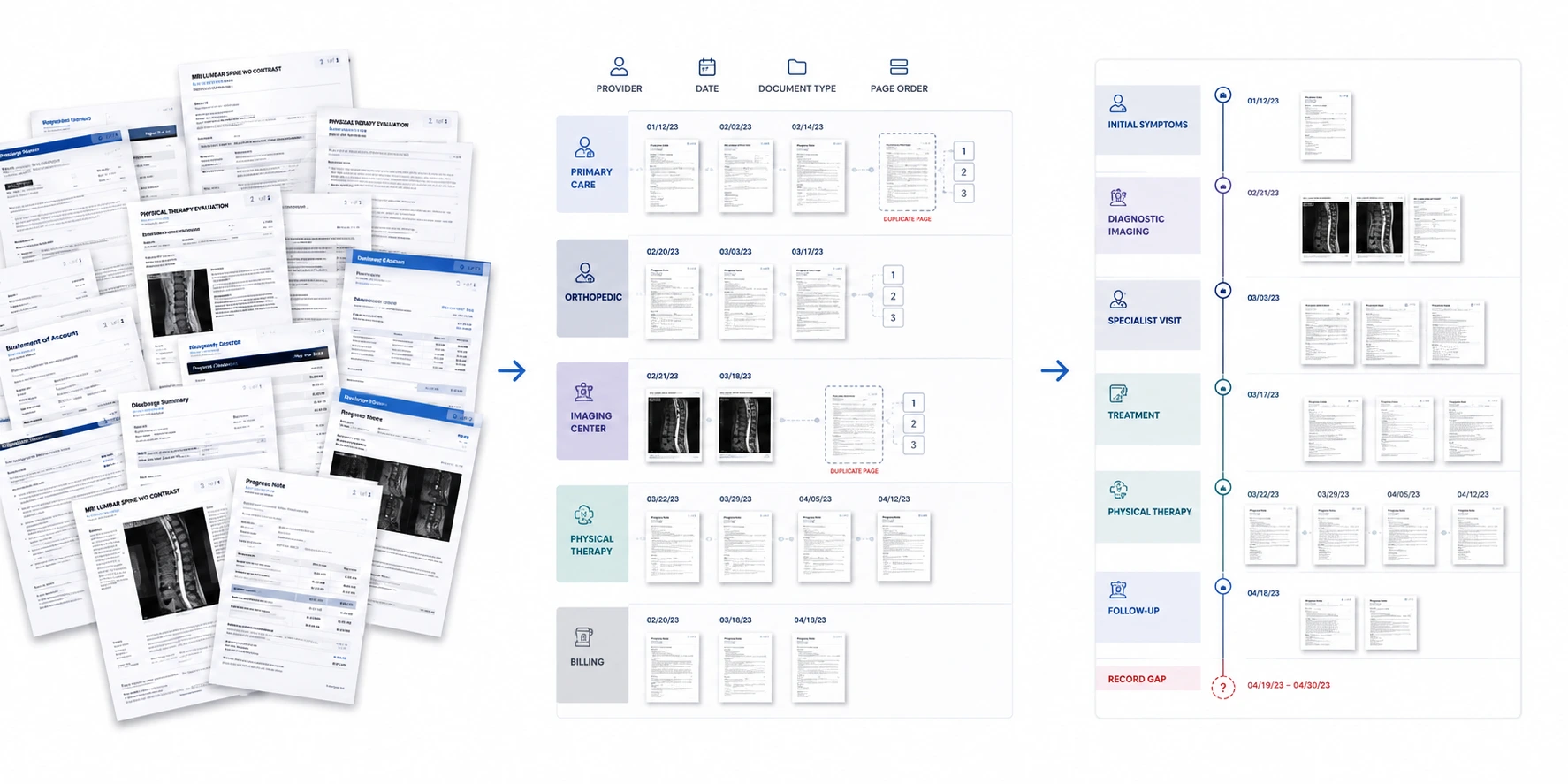
A useful index should help the legal team see the flow of care. Emergency room visit. Imaging. Specialist referral. Therapy. Follow-up. Procedure. Post-treatment status. Prior care, if relevant. Missing or unclear records should not disappear just because the file has nice folder names.
A medical record index should not only tell you where the pages are. It should help you understand whether the record set is ready to be trusted.
Why Record Order Affects Case Understanding
Medical records are not random documents. They are pieces of a timeline.
When those pieces are out of order, the treatment story can start to feel confusing. A later diagnosis may look like an earlier problem. A follow-up note may seem disconnected from the test that triggered it. A gap in treatment may look unexplained when the missing provider record is the real issue.
That matters in personal injury cases because attorneys often need to understand:
- When symptoms were first documented
- Which provider ordered testing
- Whether treatment changed after imaging
- Where prior complaints appear
- Whether bills match the treatment records
If the file order breaks those connections, the attorney spends review time repairing the record set instead of evaluating the case.
A Clean File Should Reveal the Care Flow
A useful medical record index does more than organize pages. It connects treatment, testing, referrals, and prior care so attorneys can review the case without rebuilding the timeline.
The Mixed-Provider Problem
One of the hardest parts of medical record organization is mixed-provider production.
A single PDF may contain hospital records, radiology reports, physical therapy notes, primary care records, billing pages, authorization forms, and duplicate discharge summaries. Sometimes one provider’s records contain documents from another facility. Sometimes fax headers and scanned batches make the source unclear.
If sorting and indexing only names the PDF, the problem remains hidden.
A stronger process separates the file into meaningful sections. It identifies the provider or facility, document type, date range, and page location. It also flags unclear pages when the source cannot be confidently confirmed from the record.
That kind of structure gives attorneys and paralegals a better starting point before deeper medical review begins.
Duplicates Can Distort the Story
Duplicates are not just annoying. They can create review confusion.
The same operative note may appear three times. A discharge summary may be repeated in different parts of the production. A billing page may be mixed with clinical notes. If duplicates are not handled carefully, the reviewer may waste time rereading the same document or mistake repeated pages for repeated treatment events.
Good indexing should make duplicate handling visible. It should not silently remove important pages without accountability, and it should not leave duplicates scattered throughout the file without explanation.
The goal is simple: reduce clutter while protecting traceability.
Curious how duplicates are handled in medical files?
Missing Records Should Be Easier to Notice
A well-organized file does not pretend to be complete.
That is one of the most important points.
If a treating physician refers the patient to a specialist, but no specialist record appears, the index should help the team notice. If an MRI is mentioned but the report is missing, that should be flagged. If therapy notes jump from week one to week six, the gap should be visible.
Sorting and indexing should help identify file problems such as:
- Missing diagnostic reports
- Missing referral or specialist records
- Date gaps inside a provider set
- Unreadable or incomplete pages
- Records referenced but not produced
This does not mean the indexing team decides what the missing record proves. It simply means the file should show where the record set may be incomplete.
Why Page Location Still Matters
A good index saves time only if the reviewer can find the same document again.
That sounds obvious, but it is often where weak indexing breaks down. A paralegal may locate an important MRI report once, but if the index does not show the page range clearly, the attorney has to hunt for it later. An expert may ask for the first pain management note, and the team loses time reopening several PDFs.
Page location matters because medical records are used more than once. They are reviewed during demand preparation, expert review, mediation, deposition preparation, and trial planning.
A strong index should make important records retrievable, not just findable by the person who sorted them the first time.
"Good indexing does more than organize records; it creates a reliable path back to the documents that support case preparation."
The Role of Sorting Before Chronology or Review
A chronology, narrative summary, billing review, or expert review is only as smooth as the file that feeds it.
If the records are poorly sorted, every later reviewer inherits the problem. The chronology writer has to untangle providers. The medical reviewer has to separate duplicates. The billing reviewer has to confirm whether charges match treatment records. The attorney has to verify whether the file is complete enough for demand prep.
This is why sorting and indexing should be treated as the first quality checkpoint, not a clerical afterthought.
It prepares the record set so later work can focus on analysis instead of cleanup.
Where Professional Support Fits
For larger or more complex files, sorting and indexing services can help organize medical records by provider, date, document type, and page reference before the file moves into deeper review.
LezDo TechMed’s role is to organize documented medical records into a clearer working structure based on the agreed scope. The work may include provider-wise sorting, date-wise organization, document-type grouping, duplicate handling, index creation, Bates reference support, and missing-record flagging when relevant.
LezDo TechMed does not diagnose, decide causation, determine liability, calculate damages, or replace legal or medical judgment. The purpose is to make the record set easier for qualified professionals to review.
File Readiness Snapshot
LezDo’s sorting and indexing service page lists these company-level figures:
- 1M+ pages sorted and indexed annually
- 24 hours standard turnaround
- 30% deduplication rate
- 99.8% accuracy rate
Source note: these are company-level performance figures from LezDo TechMed’s CaseDrive platform and are not a guarantee for every individual file.
Better File Organization. Smoother Medical Record Review.
78%
Provider and Document Structure Organized
Less Cleanup for Review Teams
86%
Duplicates and Missing Records Identified
Faster Record Verification
93%
Review-Ready File Structure Created
More Efficient Chronology and Expert Review
Frequently Asked Questions
What is sorting and indexing in medical records?

Sorting and indexing is the process of organizing medical records by provider, date, document type, and page location so attorneys, paralegals, reviewers, and experts can navigate the file efficiently.
Why is record order important in personal injury cases?
Record order helps legal teams understand treatment progression, provider sequence, diagnostic timing, prior care, and missing records. Poor order can make the medical story harder to follow.
Does sorting and indexing replace medical record review?
Does sorting and indexing replace medical record review?
What should a good medical record index include?
A useful index should include provider name, document type, date range, page range, duplicate notes, unclear pages, and missing-record concerns when relevant to the case scope.
When should a PI team use sorting and indexing?
Sorting and indexing is useful before medical chronology, narrative summary, billing review, expert review, deposition prep, demand preparation, or any workflow that depends on a clean medical file.
Final Thought
Sorting and indexing is not just about making a medical file look organized.
It is about protecting the order of the medical story.
When the file preserves provider sequence, treatment dates, document types, page locations, duplicates, and missing-record concerns, every next step becomes cleaner. Attorneys can review faster. Paralegals can find records with less rechecking. Experts receive a file that is easier to navigate. Chronologies and summaries start from a stronger foundation.
The records may still need careful analysis.
But at least the story is no longer buried inside the order of the pages.
Source Credit : All metrics derived from LezDo TechMed’s internal project data.
Shabila Thomas
Shabila Thomas is a Certified Legal Nurse Consultant (CLNC) and Medical-Legal Research Analyst with over two years of experience in medical record review, medico-legal research, and content development. She specializes in blogs, articles, and content that decode complex medical information, industry trends, and regulatory updates for the medico-legal field. Her clinical background and research-first approach help law firms, medical evaluators, and insurance professionals understand complex medical data, identify relevant insights, and make faster, better-informed decisions.













.png)