Creating Expert AI Deposition Summaries: Key Legal Benefits
AI doesn’t replace legal expertise—it amplifies it by turning long, complex testimonies into clear, accurate, and instantly usable deposition summaries.
One of the most recent significant advancements in the legal sector is the integration of artificial intelligence (AI) in various legal processes. AI is making a vital change in the way deposition summaries are created.
Earlier, lawyers and their paralegal teams had to spend countless hours reviewing deposition transcripts, understanding the case-focused testimonial facts, highlighting them, and preparing condensed summaries. However, now AI is streamlining this process, offering significant benefits to the legal teams.
In this blog, we’ll explore the key benefits of AI deposition summaries and how this technology is revolutionizing the legal profession.
Before analyzing the key benefits of AI in deposition summaries, let’s first understand what deposition summaries are. You know how significant a deposition is during the discovery phase. During a deposition, attorneys ask questions to the witnesses or experts under oath. Their responses are transcribed into a written document. These interviews can give vital insights into the legal cases.
A single case can have multiple depositions of tens of thousands of pages. Going through them every time you need a reference would be a tedious task. Having an abridged version of the depositions with all the vital facts can make the case preparation easy.
A deposition summary is the condensed version of the voluminous depo transcripts. It highlights the most critical points and testimonies. Crisp deposition summaries can assist lawyers like you in preparing for trial or settlement discussions.
You might wonder why I’m stressing these well-known facts- here’s why. Even to prepare precise deposition summaries, you need to sift through hundreds and thousands of pages. It also consumes your precious time. So, what is the solution? Can AI help you streamline this task? Let’s have a detailed analysis.
Why do you need AI Deposition Summaries? AI deposition summaries can give you immense benefits on saving your time, cost, efficiency and much more. Embracing AI in your deposition summary process helps you streamline your case discovery process and quickens case preparation.
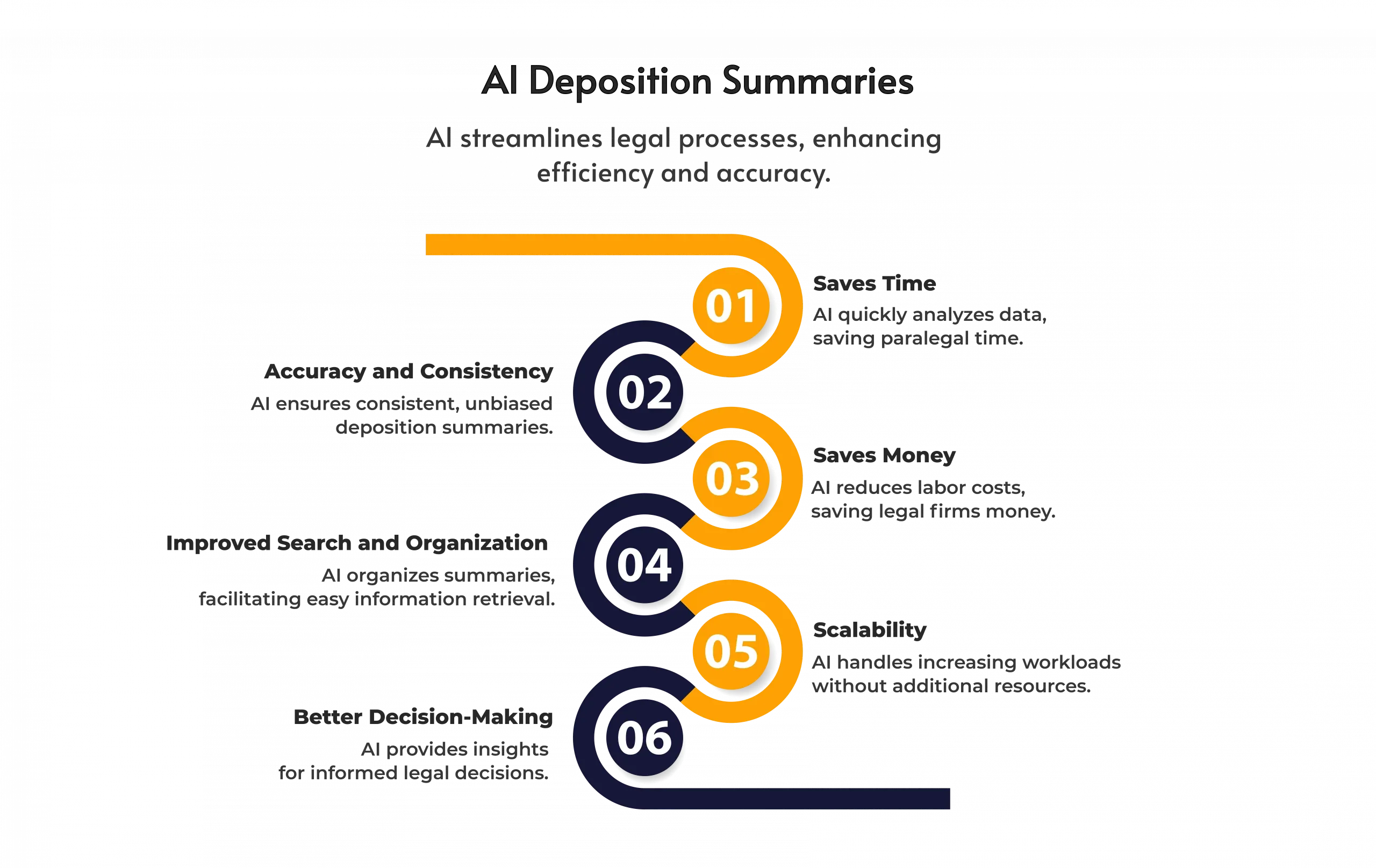
Here are some of the key benefits of using AI for deposition summaries:
1. Saves time
AI is capable of reviewing and analyzing vast amounts of data in a fraction of the time it would take a human. When summarizing depositions, AI can quickly identify vital facts, significant testimony, and relevant details, while maintaining accuracy and consistency.
This can help your paralegal team to work more efficiently by reducing the time spent on manual analysis and improving their efficiency.
For example, AI-generated deposition summary tools can analyze a deposition transcript and automatically highlight key sections, extract important quotes, and even create a concise deposition summary.
This means that legal professionals don’t have to sift through pages of text to find what they need. They can instead focus on strategy, client communication, or other high-priority tasks.
2. Accuracy and consistency
When humans summarize depositions, there is always the risk of overlooking important details or including personal bias in the process. Different individuals may have different interpretations of the same testimony. It can lead to inconsistencies across summaries.
On the other hand, AI is consistent in producing summaries without any bias, and each deposition is prepared in the same way. AI algorithms can also be trained to focus on specific areas of interest to ensure that most significant facts are always highlighted.
AI can also minimize errors in deposition summaries. As it works on a data algorithm, you can ensure that no vital information is missed. This consistency can be a huge advantage for you when preparing for trial, as legal teams need to rely on accurate summaries to make informed decisions.
3. Saves money
Legal administrative work can be expensive, particularly when it comes to time-consuming tasks like summarizing depositions. By automating the process, AI reduces the need for human labor, allowing legal teams to save money.
The cost savings can be significant, particularly for firms dealing with a high volume of cases or depositions. Law firms can process hundreds or even thousands of deposition transcripts in a fraction of the time it would take using traditional methods. This not only lowers operational costs but also allows firms to take on more cases without needing to hire additional staff.
If you have doubts on the efficiency of the AI deposition summary tools, you can prefer tools for tasks like sifting through vast testimonies and identifying the key facts for you. Then you can do a more critical process like drafting the deposition summary. This also will reduce considerable time in your usual summary process.
For your clients, this means a lot in the means of lower legal fees. This can be an added advantage for you and your legal firm to stay competitive in the legal market.
4. Improved search and organization
When compared to traditional summaries, AI deposition summaries are more organized and easier to navigate. Many AI summarization tools facilitate users searching for specific terms, phrases, or keywords in the summary. This makes it much easier to locate key information when preparing for trial or reviewing depositions for case strategy.
5. Scalability
As legal teams take on more cases, the volume of deposition summaries they need also increases. AI provides a scalable solution to this problem. Whether you’re working on a small case with just a few depositions or a large case with dozens, AI can handle the workload without any additional resources.
For large law firms, scaling the deposition summary process depending on the inflow of cases is critical to maintain speed and quality. With AI summarization tools, these firms can easily scale their operations and keep up with increasing workloads without compromising efficiency or accuracy.
6. Better decision-making
The basis of every legal claim is the need to make informed decisions. AI summaries provide a comprehensive and accurate summary of all the relevant data and help you make better decisions.
AI tools can identify patterns, highlight inconsistencies, and point out potential weaknesses in witness testimonies. This allows legal teams to approach cases with a clearer, more strategic mindset.
Moreover, by reducing the time spent on manual tasks, AI can free you up to spend more time analyzing the data and formulating case strategies. This leads to smarter decision-making and ultimately more successful case results.
7. Increased client satisfaction
Clients expect legal teams to handle legal matters efficiently to get them positive outcomes. When you use AI to streamline the deposition summary process, you can assure the clients with quicker and more accurate results.
This leads to greater client satisfaction. By reducing time and costs, you become more affordable to clients, providing them with more value for their money.
Where human review fits
Every benefit above depends on one condition: a trained person checks the AI's work before anyone relies on it. AI is quick at the first pass. It reads every page, pulls out likely key testimony and sorts it by topic. What it can't do is take responsibility for whether the summary says what the witness actually said. That part belongs to a human reviewer.
Here's how each benefit holds up with review in place, and what it turns into without it:
Time saved: holds when a reviewer verifies the citations once, before delivery. Skip that step and the attorney ends up rereading the transcript to confirm each point, and the savings are gone.
Consistency: AI applies the same structure to every transcript. A reviewer makes sure it applies the same care too, so a hedged answer like "I think it was March" isn't turned into a firm date.
Lower cost: holds when mistakes are caught in review. An error discovered at a hearing costs more to fix than one caught before the summary leaves the desk.
Search and organization: only as good as the tagging. A reviewer confirms each entry sits under the right issue and the right speaker.
Scalability: volume helps only if transcript fifty gets the same review standard as transcript one.
Better decisions: AI can surface patterns and apparent inconsistencies. A reviewer confirms they're really in the testimony, and the attorney decides what they mean for the case.
Client satisfaction: clients trust a summary someone accountable has checked, not one that simply arrived fast.
"AI delivers speed, accuracy, and consistency—freeing legal teams to focus on strategy while every critical testimony stays captured and error-free."
How LezDo TechMed Suits Your Needs
LezDo TechMed is a reliable solution for those who seek AI deposition summaries. Our technology integrated human supervision ensures that you get clear, accurate, and well-structured summaries.
Let’s see how LezDo TechMed’s services suits your requirements:
Accurate and reliable summaries: Our AI deposition transcript summary tool extracts key points and highlights crucial details with precision, reducing errors and inconsistencies. Our experts then review the key points to create a thorough and precise deposition summary ensuring accuracy in the data.
Saves time and costs: Automating the summarization process speeds up the work and lowers operational costs for you. We complete a larger number of pages by integrating AI with human expertise, without compromising quality and accuracy.
Scalable for any case size: We can handle large volumes of data efficiently with our AI tool. No matter how many pages you need to summarize, we maintain clarity and consistency.
Multiple templates: We have five different templates, such as chronological, narrative, topic-by-topic, page-wise, and page-line deposition summary formats. Whichever one you choose, we will deliver your summaries in your preferred template. If you need other summary formats, we will tailor them for you.
Tailored summaries: We understand that every case is different. We have trained our AI deposition summary software to adapt to the specific requirements of your cases. Each summary is tailored to the unique needs of each case and legal strategy.
Consistent and error-free: The AI summary tool helps us eliminate mistakes and ensure consistency across summaries. Our experts double-check everything, ensuring that each summary is clear, concise, and useful for case preparation.
Better case preparation: By letting AI do the initial review, our experts can focus on structuring the summaries in a way that supports you in preparing legal arguments. This makes it easier for you to analyze cases and build strong strategies.
Secure and confidential: We ensure that all legal documents are processed securely via our AI case management tool, CaseDrive.
Our AI-human approach gives you and your firm the best of both, fast AI-powered processing and legal human expertise.
Why AI Deposition Summaries Matter
3×
Faster Analysis
AI identifies key testimony and patterns faster
90%
More Consistent Output
Structured, unbiased summaries reduce variation
50%
Lower Review Costs
Automation cuts labor and overhead expenses
Frequently Asked Questions
How are AI deposition summaries different from traditional summaries?
In a traditional summary, a person reads and condenses the whole transcript. In an AI-assisted summary, AI handles the first pass, pulling out and sorting key testimony, and a trained reviewer then checks that draft against the transcript before it's delivered.
How do AI deposition summaries save time for legal teams?
AI speeds up the first read of long transcripts by extracting and organizing likely key testimony. Once a reviewer has verified the draft, attorneys and paralegals can work from the summary instead of reading every page themselves.
Are AI-generated deposition summaries accurate?
Their accuracy depends on the review behind them. AI can misread a hedged answer or attach testimony to the wrong speaker, so a trained reviewer should check each material point against the transcript. Human review lowers the risk of errors, but no summary should be treated as error-free.
How does AI improve consistency in deposition summaries?
AI applies the same structure and headings to every transcript. A reviewer keeps the judgment consistent too, making sure qualifiers, uncertainty and speaker attribution are handled the same way in every summary.
Can AI deposition summaries reduce legal costs?
Yes. Faster first-pass extraction reduces the hours spent reading transcripts, and catching mistakes in review costs less than correcting them after a summary has been used in case preparation.
How do AI deposition summaries improve case preparation?
AI can surface key testimony, patterns and apparent inconsistencies quickly. A reviewer confirms they're supported by the transcript, and the attorney decides how to use them in building the case.
Are AI deposition summaries searchable?
Yes. AI-assisted summaries are usually organized by topic and searchable, which makes it easier to find specific testimony, names or issues during trial preparation.
Can AI handle large volumes of deposition transcripts?
AI helps with volume by speeding up the first pass across many transcripts. Review capacity still matters, because every summary needs the same human check whether it's the first transcript in a case or the fiftieth.
What questions should firms ask an AI deposition summary provider?
Ask whether any AI output reaches you without human review, who performs that review, which steps are automated, how uncertain testimony is flagged, and whether your transcripts are used to train the AI.
How does LezDo TechMed deliver AI deposition summaries?
LezDo TechMed uses AI-assisted extraction for the first pass. Medical and paramedical reviewers then check the draft, and each summary goes through a three-layer quality-control process before it's delivered securely through the CaseDrive platform.
Questions to ask before you adopt
Whether you're buying an AI summary tool or outsourcing to a service that uses one, five questions show quickly how much human review is really involved:
Does any AI output reach me unchecked? If it does, your team becomes the reviewer, and the time savings shrink.
Who reviews the draft, and what's their background? Medical testimony reads differently to someone with clinical training.
Which steps are automated, and which does a person do? A clear answer names the steps. A vague one usually means the line isn't defined.
How does the summary show uncertainty? Look for flagged entries, not smooth wording laid over gaps.
Are my transcripts used to train the AI? Get the answer in writing, along with who can access the files.
Run a side-by-side test
The quickest way to judge an AI-assisted summary is to run it on a deposition your team has already summarized by hand. Choose a closed matter, send that transcript, and put the two versions side by side:
Did the new summary catch the testimony your team flagged?
Did it find anything your team missed?
Pick ten entries at random. Does each citation lead to testimony that supports the entry?
How long did your team spend checking it, compared with writing the original?
Those four answers will tell you more than any feature list. At LezDo TechMed, medical and paramedical reviewers check the AI-assisted draft, and each summary goes through three layers of quality control before it's delivered, so a trial run shows you the reviewed version rather than the raw output.
To sum up in short,
Creating expert deposition summaries is a valuable skill in legal proceedings. By following a structured approach, carefully reviewing transcripts, identifying key testimony, maintaining objectivity, and organizing information clearly, attorneys can effectively use deposition summaries to streamline their legal work.
Outsourcing deposition summary tasks to efficient firms will save you valuable time and cost. Whether handled in-house or outsourced, well-crafted AI deposition summaries enhance case strategy, save time, and contribute to successful litigation outcomes.
Source Credit : All metrics derived from LezDo TechMed’s internal project data.
Anjana Devi Vijay
Anjana Devi Vijay is a Certified Legal Nurse Consultant (CLNC) and Medical–Legal Research Analyst with 9+ years of experience in medical record review, deposition summary analysis, and medico-legal research. She specializes in transforming complex healthcare documentation into accurate, actionable insights that support attorneys, insurers, and medical evaluators. With expertise in clinical documentation analysis and legal case support, she creates research-driven content focused on improving decision-making and case outcomes.













.png)