Home
>
Blog
>
>
Applicant vs. Defense Deposition Summaries in Workers' Comp: What Differs
A workers' compensation deposition summary is not one deliverable. The applicant's deposition and the defense-side depositions need different reading. Here is what this guide covers:
- Why the applicant deposition is different: California Labor Code section 5710 puts the employer on the hook for the applicant attorney's fee, which shapes how the session runs.
- What each summary has to carry: subjective complaints and work history on one side, records custody and job duties on the other.
- The apportionment thread: prior injuries and prior claims surface in the applicant's own words, often in passing.
- Where the two summaries meet: the cross-reference that turns two transcripts into one usable picture.
Read on for how each side reads, and where the routing usually goes wrong.
In California, the employer pays for the applicant's attorney to attend the deposition the employer noticed. Labor Code section 5710(b) requires it: transportation, meals and lodging, lost wages, a free copy of the transcript, and under subsection (b)(4), a reasonable attorney's fee for the deponent, set by the appeals board and paid by the employer or its insurer.
That one provision changes how a workers' compensation applicant deposition behaves. Nobody is rushing. The record runs long, and it runs wide, because there is no billing pressure on the other side of the table to keep it short.
So when your workers' comp deposition summary comes back the same length and shape whether the deponent was the injured worker or the employer's HR manager, something has been read on autopilot.
Two depositions, two jobs
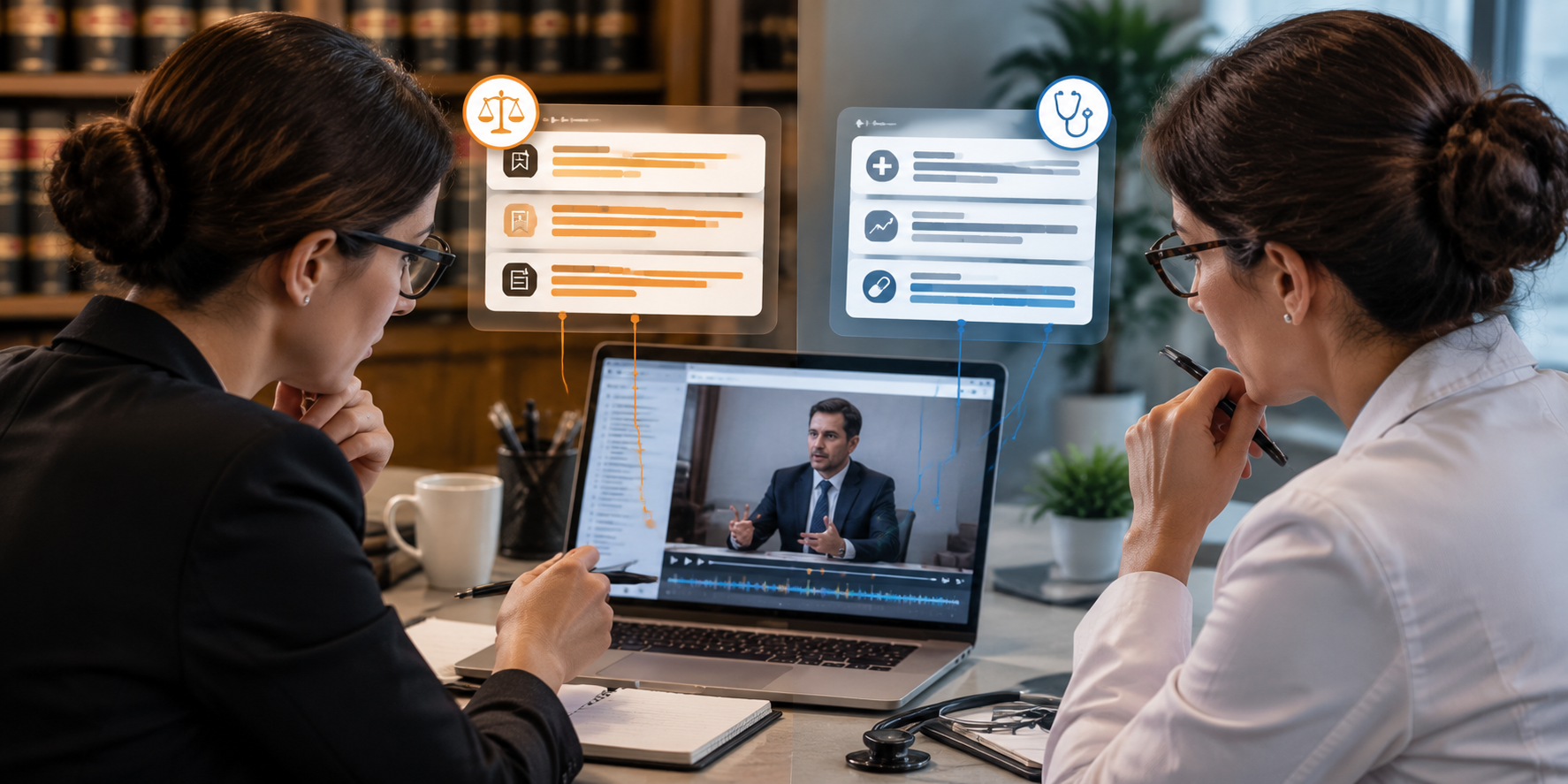
The applicant deposition and the defense-side deposition answer different questions, so their summaries carry different weight. The applicant's testimony builds the claim story: mechanism of injury, body parts, symptom history, work restrictions, prior treatment. The employer or witness deposition tests the frame around it: job duties as written, who reported what and when, what the personnel file holds.
Summarize both to a single template and the applicant summary comes back thin where it matters and padded where it does not.
Two Depositions, One Claim File
LezDo TechMed's review bench includes 90+ licensed nurses and doctors alongside 45+ certified paralegals, so the applicant transcript and the employer transcript can be read by the right person each time.
What the applicant summary must carry
An applicant deposition summary lives or dies on the injured worker's own words about the body and the job. Four threads matter more than the rest.
Mechanism and body parts. Exactly how the injury happened, in the worker's phrasing, and every body part they mention, including the ones raised in passing that never appeared on the claim form. A worker who says "my shoulder was sore too, but I only reported the back" has just put a second body part in the record.
Subjective complaints over time. What hurt then, what hurts now, what they can and cannot do. Quote it rather than compress it. The evaluating physician will be asked to reconcile these statements against the treatment records, and a paraphrase does not survive that comparison.
Prior injuries, prior claims, prior treatment. This is the apportionment thread, and it rarely arrives as a clean answer. It shows up as "I hurt that knee playing ball years back" while the witness is answering a question about their commute. Every one of these needs a page and line reference attached, because it is the first place the defense evaluator will look.
Work history and current activity. Other employers, side work, sports, caregiving. Not for the summary to interpret, only to record with citations.
We have written separately about how deposition summaries speed up IME and QME evaluations, and the applicant transcript is usually the document the evaluator reaches for first.
Not sure how your applicant transcripts should be scoped?
What the defense-side summary must carry
A defense-side deposition summary is a records and process document, not a symptom document. The deponent is usually a supervisor, an HR representative, a safety officer or a records custodian, and what they say tends to be checkable against paper.
Capture the job description as the witness describes it, not as the written job description reads. Those two diverge more often than anyone expects, and the gap is the point. Capture who knew about the injury, when, and how it was reported. Capture what documents exist, who holds them, and what the witness says was or was not produced. A custodian's answer of "we would have that, I would have to check" is a discovery item, and it belongs in the summary flagged as open rather than buried in a narrative paragraph.
One more thing the applicant summary does not need: the corporate designee's authority. When the witness is testifying for the employer rather than personally, that distinction has to be visible on the page.
The applicant transcript records a body. The employer transcript records a process. One summary format cannot serve both.
Where the two summaries meet
The value shows up when the two summaries sit side by side. The worker says the lifting was constant and heavy. The supervisor describes an occasional lift with a team. The worker reports the injury the same day; the HR witness describes a report two weeks later. Neither summary resolves the conflict, and neither should try. What they should do is make the conflict findable, with both citations attached, so counsel can decide what to do with it.
That cross-reference is also where the medical records come in. A statement in the applicant deposition about a prior knee problem means something different once the treatment history is beside it. We have covered how deposition summaries connect testimony to medical records in more depth.
What the summary does not decide
A deposition summary in a workers' compensation file records testimony and points to where it sits. It does not determine compensability, apportionment, permanent disability, industrial causation or credibility. Those belong to the QME or AME, the claims examiner and the judge. When a summary starts characterizing a worker as inconsistent rather than showing two cited passages and letting the reader see it, it has stopped being a summary.
How the Read Is Staffed
90+
Licensed Nurses and Doctors
Symptom, treatment and prior-condition testimony read by clinicians.
45+
Certified Paralegals
Procedural reading for custodian, HR and job-duty testimony.
3
Layers of Quality Control
No summary reaches the claim file without three reviews.
Frequently asked questions
What is different about a workers' comp applicant deposition summary?

An applicant deposition summary centers on the injured worker's own account: mechanism of injury, every body part mentioned, symptom history, prior injuries and work activity, all with page and line citations. A defense-side witness summary centers on job duties, reporting timelines and document custody instead.
Who pays for the applicant's attorney at a workers' comp deposition in California?
Under Labor Code section 5710(b)(4), when the employer or its insurer takes the deposition of a represented injured employee, a reasonable attorney's fee for the deponent is set by the appeals board and paid by the employer or insurer. The statute also covers travel, lost wages and a free transcript copy.
How should prior injuries in the applicant transcript be recorded?
Each mention gets its own cited entry, in the worker's own phrasing. Prior injuries, prior claims and prior treatment are what an evaluator examines when apportionment is at issue, and they usually arrive as passing remarks rather than direct answers.
Should the same reviewer summarize both the applicant and the employer depositions?
Not necessarily. The applicant transcript rewards clinical reading of symptoms, terminology and treatment history. The employer or custodian transcript rewards procedural reading of job duties, reporting and records. Many teams split the two and cross-reference at the end.
Who decides apportionment, the summary or the evaluator?
The evaluator. A deposition summary records what was said and marks where to find it. Apportionment, compensability, permanent disability and industrial causation are determined by the QME or AME, the claims examiner and the judge.
How should conflicts between the applicant and employer testimony be handled?
Show both passages with their citations and leave the conflict open. A summary that resolves the conflict on its own removes the attorney's chance to weigh it.
Getting the routing right
Ask one question when the transcript lands: is this witness describing a body or describing a process? Applicant, treating physician and evaluator transcripts go to a reviewer with clinical training. Supervisor, HR, custodian and safety transcripts go to a reviewer who reads procedure and paper for a living. It takes seconds to decide and it changes what comes back.
The cost argument follows the same line. Section 5710 already makes the applicant deposition the expensive one for the defense. A summary that misses a body part mentioned once, or a prior injury said in passing, adds a second cost later, when the evaluator has to go back into the transcript that was supposed to save them the trip. LezDo TechMed's deposition summary services route each transcript by what the testimony demands, and three layers of quality control sit between the reviewer and your file.
Two transcripts in the same claim file are not two copies of the same job. Read them that way and the file tells you less than it holds.
Source Credit : All metrics derived from LezDo TechMed’s internal project data.
Anjana Devi Vijay
Anjana Devi Vijay is a Certified Legal Nurse Consultant (CLNC) and Medical–Legal Research Analyst with 9+ years of experience in medical record review, deposition summary analysis, and medico-legal research. She specializes in transforming complex healthcare documentation into accurate, actionable insights that support attorneys, insurers, and medical evaluators. With expertise in clinical documentation analysis and legal case support, she creates research-driven content focused on improving decision-making and case outcomes.













.png)