Home
>
Blog
>
>
How Deposition Summaries Connect Testimony to Medical Records
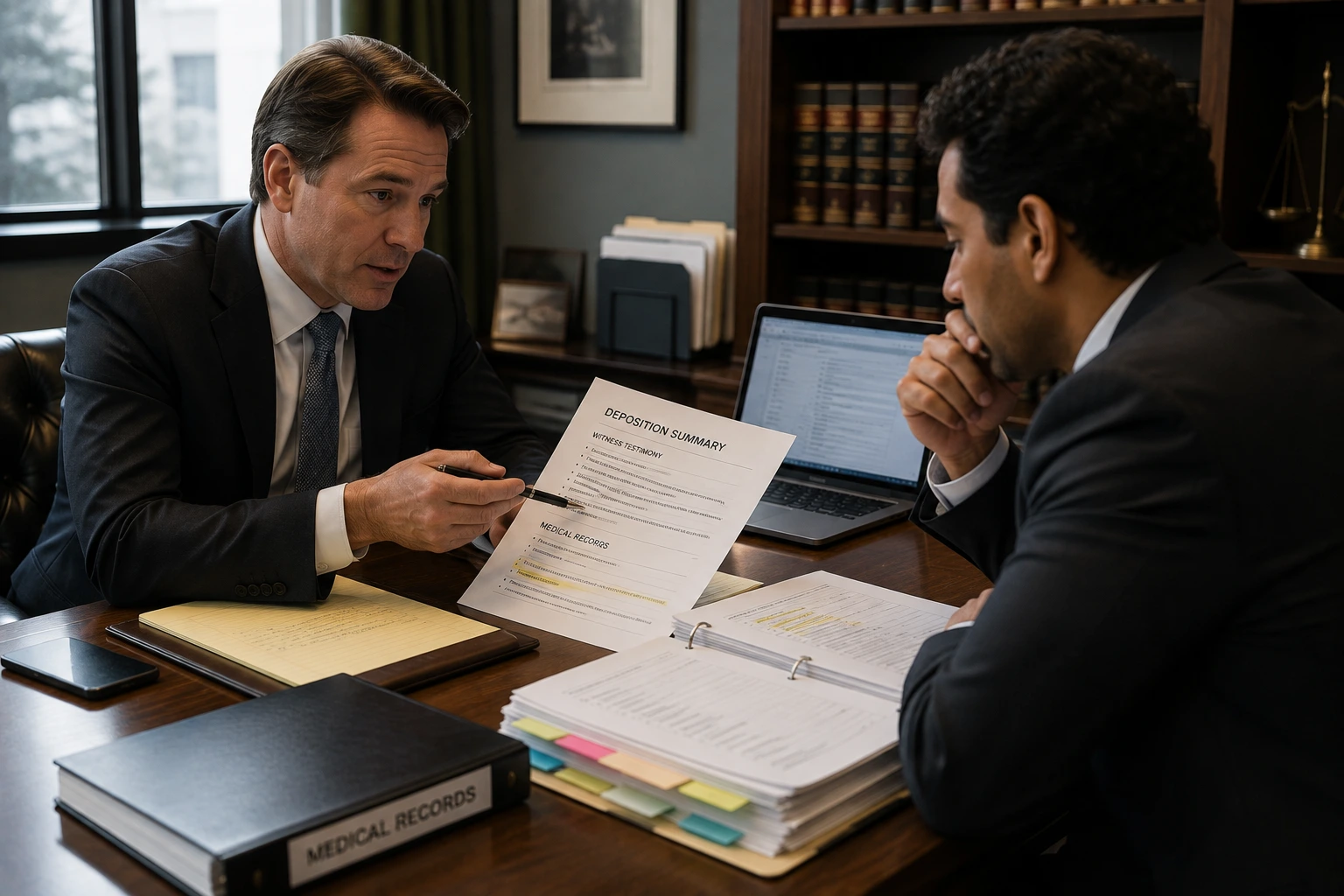
In a medical case, a deposition summary that only condenses testimony leaves half the work undone. The other half is tying that testimony back to the record. Here is how:
- Work the chain: testimony to the record it describes to the issue it affects, with a citation at each step.
- Cite both sides: the page and line of the answer, and the record locator for the document that shows the same event.
- Flag alignment and divergence: note where the testimony matches the record and where it does not, without deciding who is right.
- Stay in the lane: the summary shows the connection and cites it; the attorney decides what the match or the gap means.
Read on for the testimony-to-record workflow, and the line the summary does not cross.
In a medical case, the deposition is not the only sworn account of what happened. The medical record is already there, written closer to the event, and under the Federal Rules of Evidence it comes in as independent proof. A deposition summary that condenses the testimony and stops has captured one source while ignoring the one it should be measured against. The value in a medical case is not just what the witness said, it is how what they said lines up with what the record documents.
Here is the grounding. A deposition summary condenses sworn testimony into a shorter, organized document with references back to the page and line. In a case built on medical facts, that testimony describes events that are also written down in the treatment records. Connecting the two, the answer and the record that covers the same visit, injury, or finding, is what turns a summary into something a legal team can actually build a case on.
The record is independent evidence
Under Federal Rules of Evidence 803(6) and 803(4), medical records are admissible as business records and statements made for treatment. A deposition summary can tie each material answer to the record that documents the same event.
Why testimony without the record is only half the picture
A witness testifies from memory, sometimes years after the event. The record was written at the time. When a summary presents the testimony alone, the reader has no fast way to see whether the sworn answer matches the contemporaneous document or drifts from it. In a medical case that gap is often the whole point, because the treatment record is the fixed reference the testimony gets checked against. A summary that carries the connection lets the attorney see both accounts side by side instead of chasing the record down later. This is the same reason a deposition summary and medical chronology work better from the same reviewer: one person holding both sources can tie them together.
The chain: testimony, record, issue, citation
The workable method is a chain. Start with the material answer, tie it to the record entry that documents the same event, note the issue it bears on, and cite each step. So a witness's account of an emergency room visit is linked to the emergency room record of that visit, flagged to the issue it affects, with the page and line on one side and the record locator on the other. The reader sees the testimony, the document, and the connection between them in one place, rather than a condensed answer floating free of the evidence that supports or contradicts it.
Want deposition summaries that tie testimony back to the record?
Cite both the testimony and the record
A connection is only useful if the reader can verify it, so each link is cited on both sides. The testimony carries its page and line; the record carries its own locator, the date and source of the entry. An attorney reading the summary can pull the exact answer and the exact document in seconds and confirm the match without taking the summary's word for it. This is why page-line references are not optional: a connection the reader cannot trace back to both sources is a claim, not evidence.
Flag where they align, and where they diverge
The point of tying testimony to the record is not to make everything agree. It is to make the reader see clearly where the sworn answer matches the record and where it does not. A witness who describes an injury one way while the treatment note describes it another has created a divergence worth flagging, cited on both sides, so the attorney can weigh it. A summary that surfaces those points, without deciding which account is correct, gives the legal team the raw material for cross-examination and case strategy. Making the alignment and the gaps visible is often the most useful thing a summary does in a medical-legal case.
The testimony is one account of the event. The record is another, written at the time. A deposition summary in a medical case should tie them together and cite both.
How AI helps, and where a reviewer is needed
Matching testimony to a stack of medical records is work AI can speed up. It can surface where a deposition answer refers to a treatment, a date, or a provider, and point to the record entries that mention the same thing, faster than a person paging through both. What it cannot reliably do is judge whether the answer and the record are describing the same event, or tell a meaningful divergence from an ordinary difference in wording. So a dependable, record-linked summary pairs that speed with a trained reviewer who reads the testimony and the record together, using medical record review to confirm each connection before it goes in the summary. The tool proposes the links; the reviewer confirms them and flags the ones that matter.
One boundary holds this together. A deposition summary connects the testimony to the record, cites both, and flags where they align and where they diverge. It does not decide which account is accurate, diagnose the condition, or opine on causation or the extent of injury. Those determinations belong to the attorney and the retained experts. The summary's job is to make the testimony, the record, and the connection between them visible and traceable, so the people who make those calls are working from the complete evidence.
Connecting testimony to the record is not an extra step in a medical case. It is the step that makes a deposition summary worth reading, because the answer and the record that documents it are two halves of the same fact.
Tying testimony to the record
2
Sources to reconcile
The sworn testimony and the contemporaneous medical record, each cited to its own locator.
4
Links in the chain
Testimony, the record it describes, the issue it affects, and the citation at each step.
1
Line the summary holds
It shows and cites the connection; it does not decide which account is right or opine on causation.
Frequently Asked Questions
Why should a deposition summary connect testimony to the medical record?

Because in a medical case the record is independent evidence written at the time of the event, and the testimony is a later account of the same facts. Connecting the two lets the attorney see where the sworn answer matches the record and where it diverges, without hunting through the file to check.
How does a summary link an answer to the record?
It ties the material answer to the record entry that documents the same event, notes the issue it bears on, and cites both sides: the page and line of the testimony and the locator for the record entry, such as its date and source. The reader can then pull both and confirm the match.
What happens when the testimony and the record disagree?
The summary flags the divergence and cites both accounts so the attorney can weigh it. It does not decide which version is correct. A documented gap between sworn testimony and the contemporaneous record is often useful for cross-examination, so surfacing it clearly is part of the summary's job.
Does connecting testimony to the record mean interpreting the medicine?
No. The summary shows that an answer and a record entry describe the same event and cites both. It does not diagnose the condition, interpret the clinical findings, or opine on causation or the extent of injury. Those are for the attorney and the retained medical experts.
Can this be done accurately across a large record set?
Yes, with the right process. AI can surface where testimony and records refer to the same treatment or date, which helps at volume, but a trained reviewer confirms each connection and flags the meaningful divergences before the summary is relied on, so the links are accurate rather than merely fast.
How is this different from a plain deposition summary?
A plain summary condenses what the witness said. A record-linked summary also ties each material answer to the medical record that documents the same event and cites both, so the testimony is presented against the evidence it should be measured by rather than on its own.
In a medical case, a deposition summary earns its keep by connecting the testimony to the record behind it. Tie each material answer to the record that documents the same event, note the issue it bears on, cite both the page and line and the record locator, flag where the two agree and where they diverge, and leave the judgment about what the match or the gap means to the attorney and the experts. Handle it that way and the summary is not just a shorter transcript, it is a map from what the witness said to the evidence that tests it.
Ready for deposition summaries that tie testimony back to the record and keep both traceable to the line? Partner with LezDo TechMed for deposition summary services, or try a record-linked summary and see the difference. For the full method behind it, see our guide to drafting a deposition summary.
Source Credit : All metrics derived from LezDo TechMed’s internal project data.
Anjana Devi Vijay
Anjana Devi Vijay is a Certified Legal Nurse Consultant (CLNC) and Medical–Legal Research Analyst with 9+ years of experience in medical record review, deposition summary analysis, and medico-legal research. She specializes in transforming complex healthcare documentation into accurate, actionable insights that support attorneys, insurers, and medical evaluators. With expertise in clinical documentation analysis and legal case support, she creates research-driven content focused on improving decision-making and case outcomes.













.png)


