What Is an APS Summary and Why It Matters in Insurance Underwriting
A professionally structured APS summary transforms complex medical records into clear underwriting insights—helping insurers make faster, more accurate policy decisions.
Insurance underwriters often review hundreds of pages of medical records before making a policy decision. An APS summary simplifies this process by condensing complex Attending Physician Statement (APS) records into a clear, structured medical overview of an applicant’s most critical risks.
But what is an APS summary, and why does it matter so much in insurance underwriting today?
What Is an APS Summary?
An Attending Physician Statement (APS) is a detailed medical record provided by a patient’s treating physician during insurance underwriting. These records often contain years of clinical information, physician notes, test reports, medications, and treatment histories.
An APS summary converts those complex medical records into a simplified, organized clinical risk summary focused on underwriting risk. Instead of reading hundreds of pages manually, underwriters receive a structured medical summary that includes:
Major diagnoses
Current and past treatments
Surgical history
Medication lists
Hospitalizations
Lab and imaging findings
Lifestyle risk factors
Physician observations
Prognosis and ongoing care plans
The goal is simple: help underwriters make faster and more informed decisions.
What Does a Professional APS Summary Include?
A high-quality underwriting summary is not just a shortened version of medical records. It is a medically organized document designed specifically for underwriting analysis.
Patient Demographics
Provides age, gender, and policy details that support accurate risk evaluation.
Medical History
Captures past diagnoses and chronic conditions to define baseline health risk.
Treatment Timeline
Outlines medical visits and procedures to reflect condition progression and management.
Medication Review
Highlight prescriptions and medication adherence to show treatment consistency and overall stability.
Diagnostic Findings
Presents lab results and tests that validate clinical observations with objective data.
Risk Indicators
Identifies lifestyle and health factors that may influence underwriting outcomes.
Current Health Status
Summarizes functional ability, recovery progress, and physician-stated prognosis.
Red Flags
Emphasize critical medical findings that require immediate underwriting attention.
Current Diagnoses
Highlights active medical conditions, their severity, and expected progression.
Mental & Behavioral Health
Captures psychological conditions and behavioral patterns that may affect risk evaluation.
70% Faster Underwriting Reviews
Structured APS summaries reduce the time spent reviewing lengthy medical files. This improves underwriting speed, consistency, and operational efficiency.
Why Are APS Summaries Important in Insurance Underwriting?
APS summaries are not just a convenience — they are a core tool in the underwriting process. Here are the top 5 reasons why APS summaries matter in insurance underwriting.
1. Faster Underwriting Decisions
Instead of going through large medical files, underwriters get a short summary that helps them make decisions faster.
2. More Accurate Risk Assessment
Clear information makes it easier to understand the applicant’s health and identify possible risks.
3. Consistent Evaluation Standards
Using the same summary format helps ensure every case is reviewed in a similar way.
4. Reduced Operational Costs
Spending less time on reviews helps save effort and improves overall productivity.
5. Better Applicant Experience
Quick decisions mean applicants get faster responses, making
the process smoother.
Challenges in Reviewing Full APS Records Manually
Manual APS review is one of the biggest bottlenecks in the insurance industry. Here is why it is so difficult:
A single APS file can contain 100 to 500+ pages, making it difficult to review manually.
Different physicians use different formats and abbreviations, making records hard to read and standardize.
Many smaller practices still use handwritten notes, which are often hard to read and interpret.
Reading long records daily can cause fatigue and increase the chances of missing important medical details.
Manual review can take 3 to 5 days per file, leading to delays in underwriting decisions.
Spending hours on each file increases the operational cost per application.
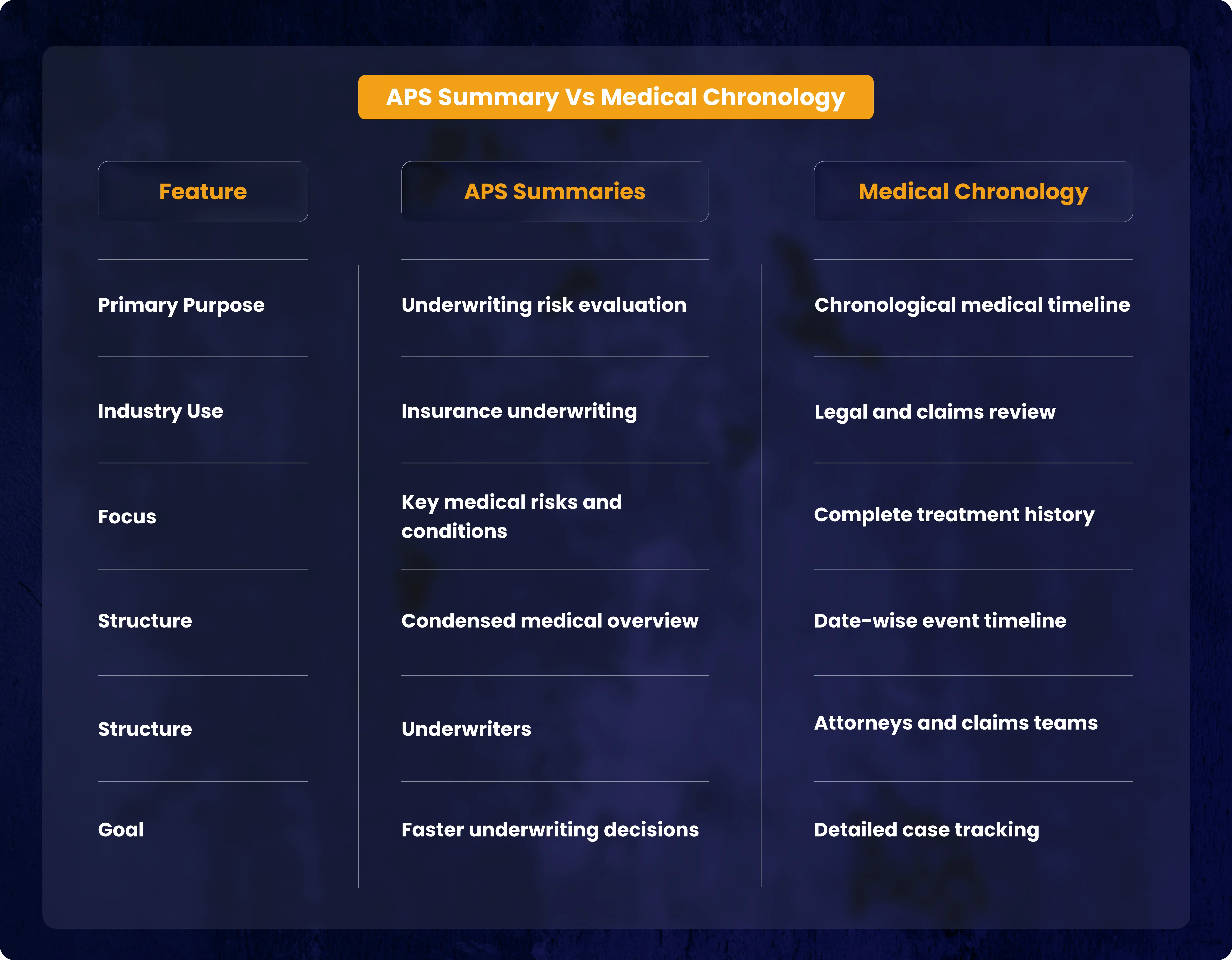
APS Summary vs. Medical Chronology: What Is the Difference?
Although APS summaries and medical chronologies both involve reviewing medical records, they serve different purposes in the insurance and legal industries.
An APS summary is mainly created for insurance underwriting. It focuses on the applicant’s overall health, major diagnoses, treatments, medications, risk factors, and current medical condition. The goal is to help underwriters quickly evaluate insurance risk and make faster policy decisions.
A medical chronology, on the other hand, is a date-wise timeline of medical events. It organizes every treatment, physician visit, hospitalization, procedure, and medical encounter in chronological order. Medical chronologies are commonly used in legal cases, claims review, and litigation support.
APS Summaries Vs Medical Chronology
Both are valuable medical review tools, but their purpose, structure, and end use are different.
How AI Is Transforming APS Summarization in Insurance
AI is transforming APS summarization in insurance by making medical record reviews faster, more accurate, and easier for underwriting teams. Instead of manually reviewing hundreds of pages of medical records, AI can quickly identify important health information and convert it into a structured APS summary.
Modern AI tools use Natural Language Processing (NLP) to ingest raw APS documents — including handwritten notes, scanned records, and unstructured clinical narratives — and extract only the underwriting-relevant findings. These are then structured into consistent, templated summaries that meet insurer-specific requirements.
This helps insurers speed up underwriting decisions, reduce manual workload, and improve overall efficiency.
This is how the AI APS summarization process works:
Step 1- Medical records are collected
Step 2 - AI extracts key medical information
Step 3 - Records are organized automatically
Step 4 - Risk-related information is highlighted
Step 5 - Human experts review the summary
Step 6 - Final APS summary is delivered
AI improves speed and efficiency dramatically. But still manual review plays a crucial role in ensuring underwriting quality and handling complex cases.
“AI-assisted APS summaries combined with expert medical review help insurers balance speed, accuracy, and confident risk assessment in modern underwriting.”
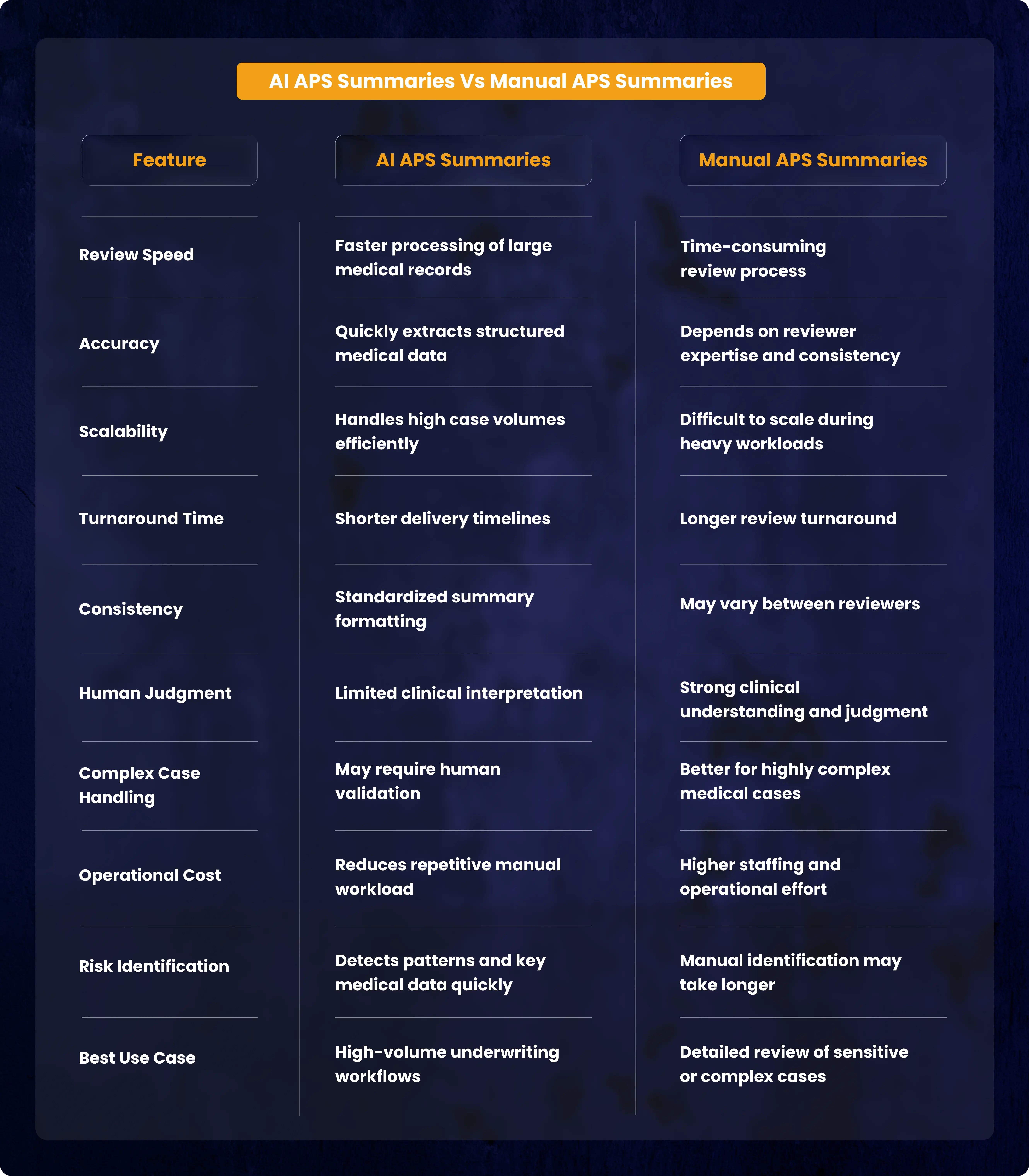
AI APS Summaries vs. Manual APS Summaries
The debate between AI APS summaries and manual APS summaries shows that both have their own advantages. AI helps speed up medical record reviews, while manual review provides deeper clinical understanding. The best underwriting results usually come from combining both speed and human expertise.
AI APS Summaries vs. Manual APS Summaries -Key Differences
Best Practices for Creating Underwriting-Ready APS Summaries
Whether your APS summaries are prepared in-house or by an outsourced team, the quality of the output directly determines the quality of underwriting decisions.
1. Use a condition-specific template
A generic summary misses important details. Use templates built around specific conditions — cardiac, oncology, psychiatric, or metabolic — so nothing critical gets overlooked.
2. Always highlight red flags clearly
Put high-risk findings at the top — things like advanced disease staging, missed medications, or frequent hospitalizations. Reviewers should spot critical information immediately, without digging through the document.
3. Summarize — do not just copy
Do not paste raw physician notes into the summary. Instead, pull out what matters for the underwriting decision and explain it clearly. A good summary answers the underwriter's question — it does not just repeat the doctor's words.
4. Keep a clear treatment timeline
List conditions, treatments, and outcomes in order. This helps underwriters quickly understand how a condition has progressed, whether treatment is working, and what the likely outcome is.
5. Bring both medical and underwriting knowledge
The best summaries are written by people who understand both clinical terminology and insurance requirements. Medical knowledge alone is not enough — the summary needs to be useful for risk decisions, not just medically accurate.
6. Always flag missing information
If something is missing — a surgery date, a specialist report, or an unclear diagnosis — clearly flag it in the summary. Never guess or leave it out silently. The underwriting team needs to know what is incomplete so they can follow up.
7. Follow HIPAA and compliance standards
Every APS summary contains sensitive patient health information. This makes compliance non-negotiable. All records must be handled, stored, and shared in line with HIPAA guidelines — and your insurer's internal compliance requirements must be followed at every step of the process.
Key Benefits of High-Quality APS Summaries
65%
Faster Risk Evaluation
Quickly identify key diagnoses, treatments, and underwriting red flags.
50%
Reduced Manual Review Time
Structured summaries reduce the need to review lengthy medical records manually.
100%
HIPAA-Compliant Process
Secure workflows ensure patient data privacy and regulatory compliance.
FAQs About APS Summaries in Insurance Underwriting
What is an APS summary in insurance underwriting?
A condensed review of medical records that helps underwriters assess an applicant's health risk quickly and accurately.
How does an APS summary affect life insurance approval?
An APS summary directly influences whether an application is approved, rated, or declined. It gives underwriters the medical evidence needed to make a fair and accurate decision.
What information is included in an APS summary?
Diagnoses, treatments, medications, surgeries, hospitalizations, lab findings, and current health status.
Why do underwriters use APS summaries?
Medical records can run hundreds of pages. APS summaries pull out only what matters — saving time and improving decision accuracy.
How long does manual APS review usually take?
Manual APS review can take several hours to multiple days, depending on record size and complexity.
Can AI summarize APS records accurately?
Yes. AI can quickly identify and organize important medical information from APS records.
Is human review still important in AI-generated APS summaries?
Yes. Human reviewers are still important because they help verify accuracy and handle complex medical cases.
What is the difference between an APS summary and a medical chronology?
An APS summary focuses on underwriting risk. A medical chronology is a date-ordered timeline used mainly in legal or claims contexts.
Why do insurance companies outsource APS summarization?
To reduce workload, speed up turnaround, and maintain consistent quality at a lower cost.
Are APS summaries HIPAA compliant?
Yes. Professional APS services follow strict HIPAA-compliant processes to protect patient health information at every stage.
How Outsourcing APS Summaries Benefits Lean Underwriting Teams
Many insurance companies — especially mid-sized carriers with small underwriting teams — struggle to handle APS summarization in-house. When case volumes increase, turnaround times slow down and summary quality becomes inconsistent.
Outsourcing to a specialist APS summarization team solves this problem directly:
Faster turnaround — summaries delivered within 24 to 48 hours, not weeks
Consistent quality — every summary follows the same structured format, every time
Dual expertise — reviewers who understand both medical records and underwriting requirements
Easy scalability — handle more cases without hiring or training new staff
HIPAA compliance — all records handled on secure, fully compliant platforms
At LezDo TechMed, our APS summary services are built specifically for insurance underwriting teams. We combine AI-assisted review with experienced medical professionals to deliver accurate, underwriting-ready summaries — within 48 hours, with a 99.8% accuracy rate and 13+ years of industry experience.
Choosing the right outsourcing partner is not just about saving time. It is about making better underwriting decisions every time.
Final Thoughts
APS summaries have become an essential part of modern insurance underwriting. They help underwriters review complex medical records faster and more accurately. This improves efficiency, consistency, and overall risk assessment quality. As AI-powered medical summarization continues to evolve, combining automation with expert human review will play a major role in the future of underwriting.
Source Credit : All metrics derived from LezDo TechMed’s internal project data.
Vishnu Priya Vinu
Vishnu Priya Vinu is a Certified Legal Nurse Consultant (LNC) and Medical-Legal Research Analyst with over two years of experience in medical record review, medico-legal research, and content development. She specializes in blogs, articles and E-books that bridges the gap between healthcare and law. Her strong medical background brings depth and accuracy to content, enabling law firms, medical evaluators, and insurance professionals to gain insights on complex medical data analysis. She delivers evidence-based insights and strategic content that strengthen case outcomes and support informed decision-making.















.png)