Home
>
Blog
>
>
Deposition Summary for Law Firms: Accuracy Checks Personal Injury Attorneys Should Expect
Before a personal injury attorney relies on a deposition summary, the summary has to do more than reduce transcript length.
- Source-faithful testimony - The summary should preserve what the witness said, with page-line references that let your team verify the source fast.
- Issue-based organization - Injury history, treatment testimony, prior conditions, work limits and record conflicts should be easy to find.
- Medical context with restraint - Medical terms should be explained clearly, while diagnosis, causation and liability opinions stay with qualified professionals.
- Quality-control checks - Names, dates, providers, page-line references and unclear answers need review before delivery.
Read on if you want deposition summary services for law firms to support case preparation without forcing your team back into the full transcript.
Deposition summary services for law firms should turn long testimony into source-faithful, review-ready information personal injury attorneys can trust. Tired of reading a 300-page transcript twice because the summary feels too thin, too broad or too detached from the page-line record? You do not have to accept that as normal.
The short answer is this: an accurate deposition summary is not the shortest version of the transcript. It is the version that helps your team find the testimony, verify the source and see where the witness statement may need to be compared with the medical records.
Let's start with the problem attorneys know well. A deposition transcript may include injury mechanism, prior complaints, treatment dates, medication history, provider names, work limitations, pain descriptions and later clarifications that do not arrive in a neat order. One answer may matter because of what came 80 pages earlier. Another answer may matter because it conflicts with an intake form, an MRI report or a treating provider note.
That is where accuracy in a deposition summary earns itsplace.
Accurate deposition summaries keep you close to the transcript
An accurate deposition summary should keep the attorney close to the original testimony by using clear page-line references and neutral wording. If your team cannot return to the transcript quickly, the summary has already lost part of its value.
For personal injury attorneys, page-line accuracy ispractical. It helps when you are preparing a demand, reviewing impeachment points, planning follow-up questions, briefing an expert or checking whether a witness described the same symptoms consistently across the record.
A page-line deposition summary tracks key testimony with page and line references. A narrative deposition transcript summary explains the testimony in a readable structure. Both formats can work, but both need source control.
The transcript is still the source. The summary is the map.
Evidence organization helps the attorney move through thefile faster. The attorney still decides how testimony is used in case analysis, negotiation, motion work or trial preparation.
Quality means context, not only clean wording
Deposition summary quality depends on context, issue grouping and careful source review. A polished paragraph can still be weak ifit loses the witness's qualification, skips the question that shaped the answer or groups unrelated testimony together.
Imagine a witness says she had "back pain before the accident," then later explains that the prior pain was intermittent and treated years earlier. A careless summary may flatten both answers into one broad line about prior back pain. A better summary separates the testimony, cites each page-line range and flags the need to compare the statement with prior medical records.
That flag is not a causation opinion. It is a review cue.
In deposition summary work, the reviewer should organize, summarize and cross-reference documented testimony. The reviewer may flag unclear statements, missing context or testimony that appears to need comparison with the records. The reviewer should not determine causation, liability, negligence, impairment, damages or case value.
A deposition summary earns its keep when it helps counsel locate testimony that agrees or conflicts with the records.
Why quality control matters
LezDo TechMed's published company figures include a 99.8% accuracy rate. Treat that as a company quality signal, not a per-summary promise. The usable detail is the process behind it: medical and paramedical reviewers, structured checks and a three-layer quality-control process.
Personal injury attorneys need issue-based deposition summaries
Personal injury attorneys need deposition summaries organized around case use because transcript order rarely matches legal work. The best format depends on how your team will use the testimony.
In a personal injury case, useful issue groups may include:
- Incident description and mechanism of injury
- Immediate complaints and emergency care
- Prior injuries, prior complaints and past treatment
- Treating providers, tests, procedures and medications
- Gaps in care or changes in treatment course
- Work restrictions, daily activity testimony and claimed limitations
- Testimony that may need comparison with medical records
The point is not to make the summary sound more sophisticated. The point is to reduce rework when your team needs one answer quickly.
If you want to check output style before sending a live matter, LezDo TechMed provides medical-legal deliverable samples. Samples help your team see whether the format gives enough detail, whether page-line references are easy to follow and whether the summary reads like a legal support document instead of a general abstract.
Medical testimony needs clinical literacy and restraint
Medical testimony in a deposition summary should be handled by someone who understands clinical language and also respects the legal-medical boundary. That combination matters because medical words in testimony are often imprecise.
A witness may say "slipped disc" when the record says disc protrusion. A provider may testify about radiculopathy, range of motion, injections or surgical recommendations. A plaintiff may describe symptoms in everyday language while the medical records use diagnostic terms.
The summary should make the testimony clear for the legal team without turning the reviewer into a physician or attorney. That means defining clinical terms when helpful, preserving the witness's language when necessary and avoiding conclusions the record reviewer is not qualified to make.
LezDo TechMed extracts, organizes and presents documented testimony and medical information so qualified professionals can review it more efficiently. We do not provide medical or legal opinions. We do not determine diagnosis, causation, liability, standard of care, impairment, apportionment, damages or settlement value.
That boundary protects the work. It also protects the reader.
Want to check the quality of deposition summaries?
AI can assist deposition summary work, but human review s till matters
AI-assisted tools can help classify transcript sections, extract names and draft first-pass summaries, but deposition testimony still needs human review for context and accuracy. A transcript is full of qualifiers, objections, unfinished answers and answers that only make sense when the question is read with them.
AI may capture that a witness discussed prior treatment. A trained reviewer checks whether the answer was definite, uncertain, corrected later or tied to a specific provider. AI may summarize a medical term. A reviewer checks whether the term was spoken by the witness, read from a recordor introduced by counsel.
LezDo TechMed combines AI-assisted workflows with human medical expertise. AI can support extraction, document classification, indexing andfirst-pass organization, while medical experts review for context, relevance and accuracy.
When records, transcripts and deadlines are moving at the same time, workflow visibility matters too. CaseDrive's case-management platform supports secure collaboration and case workflow tracking, so the review process does not depend on scattered email threads and renamed files.
A real example: when deposition analysis slowed the workflow
A published LezDo TechMed case study involving a California neurosurgery IME firm shows how deposition analysis can affect case preparation. The firm was dealing with thousands of pages per case, unindexed records and hard-to-build chronologies, with deposition review adding more timeto the workflow.
After restructuring sorting, indexing, chronology and deposition summarization with a human-in-the-loop review process, the firm reported 44% faster deposition analysis. The same published case study reported 62% less review time and 40% faster case processing during the engagement.
The medical opinions remained with the evaluator. LezDo TechMed organized the records and testimony into review-ready information.
For personal injury law firms, the lesson is practical: the summary has to support the next decision point. If your team still has to reopen the full transcript to find every key answer, the deposition summary service has not done enough of the right work.
A deposition summary should reduce transcript search time without separating counsel from the source.
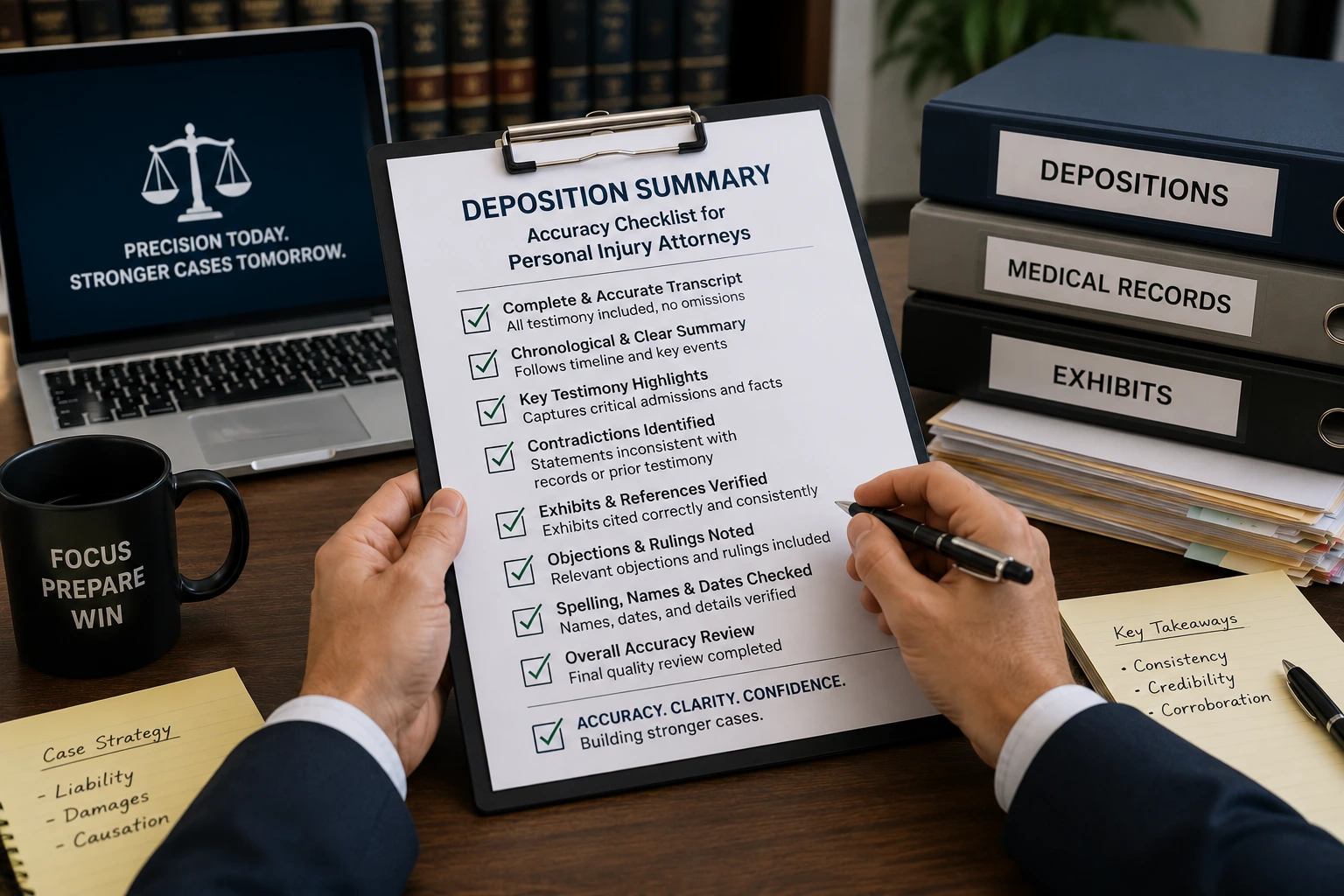
What should attorneys check before trusting a deposition summary?
Attorneys should check source references, issue grouping, medical terminology, witness qualifications, unclear answers and quality-control steps before relying on a deposition summary. A good-looking summary can still create rework if the page-line trail is weak.
Here is a practical gut-check before your team uses the next summary:
- Are page-line references included for key testimony?
- Does the summary preserve the witness's qualifications and corrections?
- Are injury history, prior conditions, treatment and limitations grouped clearly?
- Are medical terms explained without adding diagnosis or causation opinions?
- Are unclear answers or testimony needing record comparison flagged?
- Are names, dates, providers and exhibit references checked?
- Is there a final review step before delivery?
One more point: check whether the summary format fits your case use. A page-line summary may help when you need quick citations. A narrative summary may help when you need the testimony story. Many personal injury teams need both levels at different points in the case.
If your team is comparing vendors, the LezDo TechMed costestimator can give you a starting point before you send transcript volume and scope details.
Quality is built into the deposition summary process
Quality in deposition summary services is built through reviewer training, clear templates, page-line checks and final review. It cannot be painted on at the end.
For a personal injury attorney, that quality shows up in small places:
- the difference between "denied prior injury" and "did not recall prior treatment"
- the page-line range that takes you to the exact exchange
- the separate flag for testimony that should be checked against medical records
- the note that preserves a witness correction later in the transcript
- the restraint to avoid saying what the testimony proves
Those details may not make the summary look dramatic. They make it usable.
LezDo TechMed maintains ISO 27001 and ISO 9001:2015 certifications and has completed a SOC 2 Type II attestation. Its processes are designed to comply with applicable HIPAA and GDPR requirements.
Security matters because deposition summaries often sit beside medical records, identifying information and litigation work product. Quality and confidentiality should travel together.
LezDo TechMed quality signals
13+ years
Medical-legal experience
Founded in 2013, LezDo TechMed supports legal, medical, insurance and claims professionals across US workflows.
Three-layer QC
Quality-control process
Medical and paramedical reviewers work through structured checks before delivery.
99.8% accuracy
Published company figure
Use this as a company quality signal, with each summary still reviewed according to scope, source quality and delivery requirements.
Frequently Asked Questions
What are deposition summary services for law firms?

Deposition summary services for law firms condense deposition testimony into organized, source-referenced summaries for legal review. They may use page-line format, narrative format or issue-based organization depending on how the attorney needs to use the testimony.
How do deposition summaries help personal injury attorneys?
Deposition summaries help personal injury attorneys find key testimony about injury history, treatment, prior conditions, symptoms, work limits and record conflicts faster. They support case preparation, demand work, mediation preparation, expert review and trial planning.
What makes a deposition transcript summary accurate?
An accurate deposition transcript summary preserves the witness's meaning, includes clear page-line references and avoids adding conclusions that are not in the testimony. It should also keep qualifications, corrections and unclear answers visible for attorney review.
Should a deposition summary include page-line references?
Yes. Page-line references help attorneys verify testimony quickly and return to the transcript when preparing questions, citations or impeachment points. A summary without source references often creates extra review work.
Can AI create deposition summaries without human review?
AI can assist with extraction, classification and first-pass organization, but deposition summaries still need human review for context, relevance and accuracy. LezDo TechMed pairs AI-assisted workflows with medical-expert review.
Do deposition summaries determine causation or liability?
No. Deposition summaries organize and summarize documented testimony for qualified professionals. Attorneys, physicians, evaluators and claims professionals make causation, liability, standard-of-care, impairment, apportionment and damages determinations.
What should I ask before outsourcing deposition summaries?
Ask whether the vendor provides page-line references, issue-based organization, medical terminology review, quality-control checks and secure handling of sensitive information. Also ask how the reviewer flags unclear testimony or testimony that may need comparison with medical records.
Deposition summary services for law firms should make testimony easier to verify, question and use. The right summary preserves the page-line trail, groups testimony by case issue, explains medical language with restraint and flags places where the records may need a closer look.
That is the standard personal injury attorneys should expect before trusting a deposition transcript summary in case preparation.
Ready to turn deposition transcripts into clearer review-ready information? Partner with LezDo TechMed, or start with the cost estimator to plan your next deposition summary service.
Source Credit : All metrics derived from LezDo TechMed’s internal project data.
Anjana Devi Vijay
Anjana Devi Vijay is a Certified Legal Nurse Consultant (CLNC) and Medical–Legal Research Analyst with 9+ years of experience in medical record review, deposition summary analysis, and medico-legal research. She specializes in transforming complex healthcare documentation into accurate, actionable insights that support attorneys, insurers, and medical evaluators. With expertise in clinical documentation analysis and legal case support, she creates research-driven content focused on improving decision-making and case outcomes.













.png)