Home
>
Blog
>
>
When the Machine Lies: Reconciling EHR Notes with Medical Device Logs
- A connected-device injury claim rests on two records: the EHR clinical notes and the device's own logs. Reviewing only the chart leaves out half the evidence.
- "Digital exhaust" (readings, alerts, doses, error codes, connectivity gaps) usually lives in the manufacturer's system, not the EHR, and must be requested and reconciled separately.
- The value is a hybrid timeline that names the clock for every entry, marks silences, and flags discrepancies, so clock artifacts are not mistaken for real conflicts.
- LezDo TechMed organizes and flags. Causation, liability, and fault are for the attorney and the retained experts to determine.
A clinical note tells you what the clinician saw. The device log tells you what the machine did. When those two timelines disagree, the gap is the case.
When a connected insulin pump or continuous glucose monitor sits at the center of a hypoglycemia injury claim, the record you need is not one record. It is two. The electronic health record (EHR) holds the physician's clinical notes: what was observed, what was ordered, what was charted, each entry stamped with a time. The device holds its own account: alert histories, dose-delivery records, error codes, and connectivity gaps, also stamped with a time. Reconciling EHR notes with medical device logs is how a legal team sees whether the clinician and the machine agree on what happened, and when.
Most medical chronologies never open the second file. They summarize the chart, arrange it by date, and stop. For an ordinary slip-and-fall that is fine. For a case built on a connected medical device, it leaves out half the evidence. The device was keeping records too.
I run a medical record review company, so I will be clear about where the line sits. From the record review side, our job is to organize the documented evidence and flag where the two timelines diverge. We do not decide who is at fault. Whether the failure belongs to the clinician, the manufacturer, or neither is a question for the attorney and the retained experts. What we can do is make sure the timeline they are arguing over is complete and accurate.
What "digital exhaust" means
Digital exhaust is the trail of machine-generated data a connected device produces while it runs. On an insulin pump or a continuous glucose monitor (CGM), that trail usually includes glucose readings and the interval between them, low and high alerts and whether they fired, basal and bolus dose events, occlusion or delivery errors, battery and sensor status, and the timing of any lost connection between the sensor, the pump, and the phone app.
None of that lives in the EHR. It lives in the manufacturer's cloud, in the device firmware log, or in the companion app on the patient's phone. A treating physician usually never sees it. So when the chart says the patient was stable overnight and the device log shows a two-hour stretch with no readings and a silenced alarm, you have a documented conflict. That conflict is the reason these cases are worth reviewing carefully instead of quickly.
Connected-device failures are not rare edge cases
One 2025 to 2026 CGM sensor recall alone was tied to 860 reported serious injuries and seven reported deaths before it was classified as the most serious recall type. Every one of those events left a device-side record that a chart summary would miss. (Source: U.S. FDA recall notice for certain Abbott FreeStyle Libre 3 and Libre 3 Plus sensors; harm figures reported as of January 7, 2026. Confirm the current FDA notice before relying on these figures.)
Why the two timelines disagree more often than you would expect
The EHR and the device are recording different events, on different clocks, for different reasons. That alone produces gaps. A clinician charts an assessment when they have time to chart it, which may be an hour after the bedside moment. The device stamps an alert the instant it fires. Neither is lying. They are simply out of sync, and a good chronology has to account for that before anyone reads meaning into a five-minute difference.
The recalls of the last two years show how the machine side can fail quietly. In mid-2025, a continuous glucose monitor receiver was recalled because a speaker defect could keep the urgent low-glucose alarm from sounding at all. The patient hears nothing. The chart, written later, may show a hypoglycemic event that "came out of nowhere." It did not come out of nowhere. The device log shows the alert that should have been audible and was not.
Insulin pumps carry a parallel risk on the delivery side. Recalled infusion pump components have been linked to over-delivery or under-delivery of insulin, which shows up in the body as a hypoglycemic or hyperglycemic event and shows up in the device log as a dose record or an occlusion error. Put the dose log next to the nursing note and the nursing note next to the glucose trend, and you can see whether the delivery event and the clinical event line up. That reconstruction is documentation work. The clinical opinion about what it means belongs to the expert.
The three records a connected-device case needs
The EHR clinical record. Physician and nursing notes, orders, medication administration records, and vitals, with their native timestamps and, where available, the audit trail metadata that shows when each entry was created or edited.
The device data. The manufacturer's downloadable report, the firmware or cloud error log, and the companion-app history: readings, alerts, doses, and connectivity events.
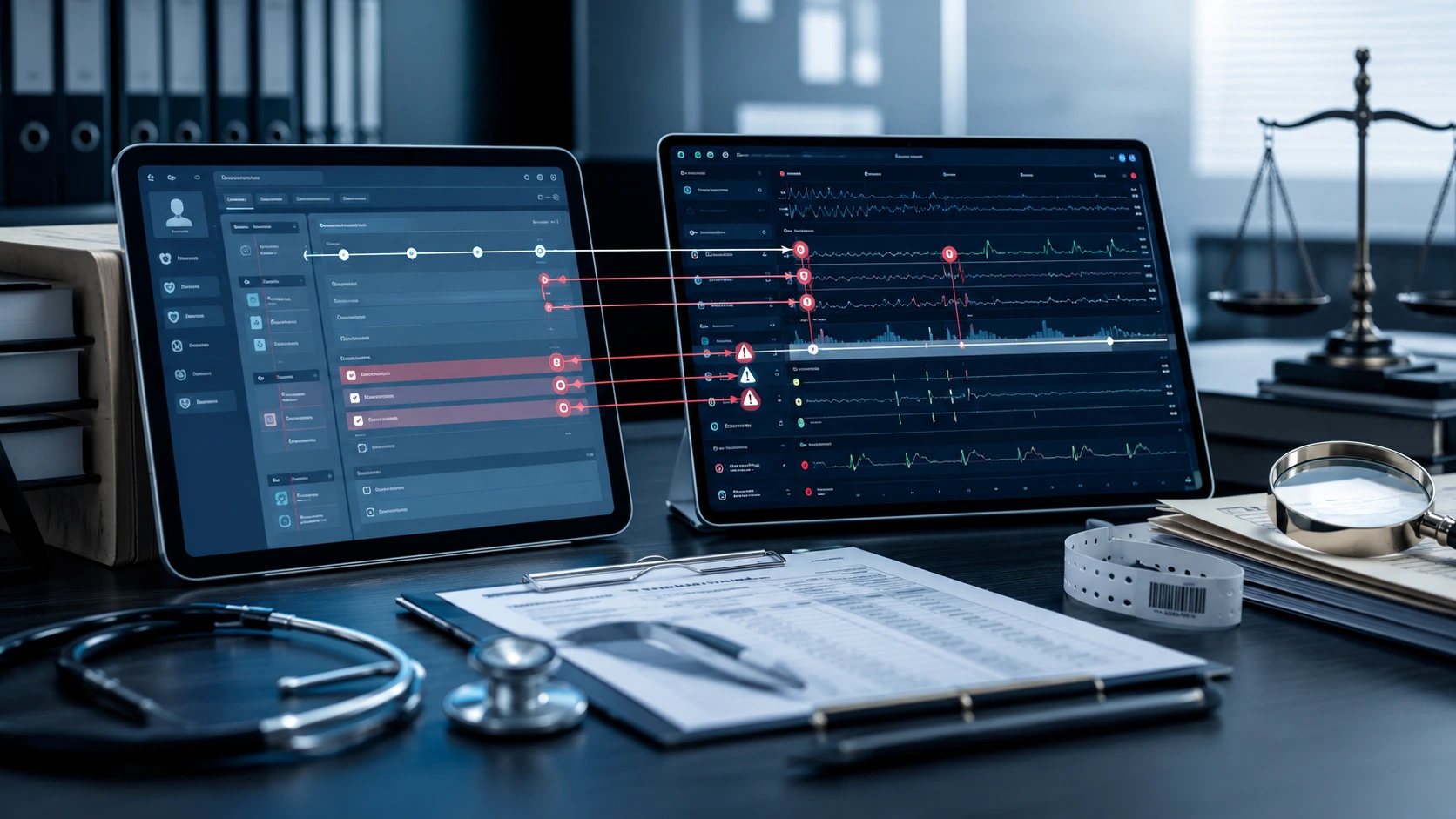
The reconciliation layer. A single timeline that places the clinical events and the device events side by side, normalizes the clocks as far as the data allows, and marks every point where the two disagree or where one is silent.
Skip the third record and you have two piles of paper that no one has read against each other. The reconciliation layer is the deliverable that makes the other two usable.
Have a device-injury file where the chart and the device data do not match? We can build the timeline that shows exactly where.
Where these cases break down
The most common failure is not a wrong conclusion. It is an incomplete record. A team requests the chart, gets a clean-looking chronology back, and never learns that the device data was available and never pulled. By the time a defense expert or a plaintiff expert asks for the device log in deposition, the window to request it cleanly may have narrowed.
The second failure is clock naivety. Device clocks, EHR clocks, and phone clocks are not guaranteed to agree. Time zones, daylight saving changes, and unsynced firmware can shift a log by minutes or more. If a chronology treats every timestamp as if it came from one master clock, it can manufacture a discrepancy that is really just a settings artifact, or hide a real one. A careful reconciliation names the clock source for each stream and flags where they cannot be aligned, rather than pretending to a precision the data does not support.
The third failure is interpretation creep. It is tempting, once you see the gap, to write the sentence that says what the gap proves. That sentence is not ours to write, and it is not the record reviewer's to write either. Our job stops at "here is the clinical entry, here is the device entry, here is the difference, here is which clock each came from." The causation call belongs to the biomedical engineer, the endocrinologist, or the human-factors expert the attorney retains.
What a hybrid, technical chronology looks like when it is done well
A hybrid chronology merges the clinical narrative and the device data into one reviewable timeline. Done well, it reads cleanly for a lawyer and holds up for an expert. A few things separate the strong ones from the rest.
It keeps the streams visually distinct so a reader can tell a charted note from a machine event at a glance. It carries the source and the clock for every entry, so nothing is orphaned. It marks silences, the stretches where a device that should have been recording produced nothing, because a silence is often the most important entry on the page. And it flags discrepancies as flags, not findings, leaving the meaning to the people qualified to assign it.
"The gap between what the clinician charted and what the device logged is not the answer. It is the question the record finally lets the experts ask".
How strong teams handle a connected-device file
The teams that do this well decide early that the device data is evidence, not an afterthought, and they request it while it is still easy to get. They treat the reconciliation as its own work product rather than a footnote to the chart summary. And they keep the record reviewer and the retained expert in their own lanes: the reviewer organizes and flags, the expert opines.
From the medical record review side, the pattern we see is simple. When the device log is pulled early and lined up against the chart from the start, the expert spends their time on the question that matters. When it is pulled late, the expert spends their time rebuilding a timeline that should have existed already.
Questions to ask before you rely on a connected-device chronology
- Was the device data requested, and does the timeline actually include it, or only the EHR?
- Does every entry name its source and its clock, so the clinical and device streams can be told apart?
- Are the timestamps reconciled across the EHR, the device, and any phone app, with clock differences flagged rather than assumed away?
- Are silences marked, the stretches where the device should have recorded and did not?
- Are discrepancies presented as flags for an expert, not as conclusions about fault or causation?
- Is there a clean chain from each timeline entry back to the source page or export it came from?
What a disciplined medical chronology process looks like at LezDo TechMed
3 layers
Quality-control review
Every deliverable passes through a three-layer quality-control process supported by medical and paramedical reviewers.
48 hours
Medical chronology turnaround
Standard chronology delivery once scope is confirmed, depending on record volume.
24 to 48 hrs
Sorting and indexing
Initial sort and index of a record set, depending on page volume and file condition.
Frequently asked questions
What does it mean to reconcile EHR notes with medical device logs?

It means building one timeline that places the physician's clinical notes from the electronic health record next to the device's own records: its glucose readings, alerts, dose events, and error codes. Reconciling the two shows where the clinical account and the machine account agree, where they disagree, and where the device recorded nothing at all.
What is "digital exhaust" on a medical device?
Digital exhaust is the machine-generated data a connected device produces as it runs. On an insulin pump or continuous glucose monitor that includes readings, low and high alerts, basal and bolus doses, occlusion or delivery errors, sensor and battery status, and connectivity gaps. It usually lives in the manufacturer's cloud or the device firmware, not in the EHR.
Why is the device log not already in the EHR?
Because the two systems are separate. The EHR holds what clinicians chart. The device log holds what the pump, sensor, or app recorded, and it sits in the manufacturer's system or on the patient's phone. A treating physician often never sees it, which is why it has to be requested and reconciled separately.
Can a medical record review company decide whether the doctor or the manufacturer is at fault?
No. A medical record review company organizes the documented evidence and flags where the clinical timeline and the device timeline diverge. The determination of causation, liability, or fault belongs to the attorney and the retained experts, such as a biomedical engineer, an endocrinologist, or a human-factors expert.
Why do the timestamps between the EHR and the device not match?
Clinicians often chart after the moment, while a device stamps an event as it happens, so a real difference can appear even when nothing went wrong. Device, EHR, and phone clocks can also drift due to time zones, daylight saving, or unsynced firmware. A careful chronology names the clock for each entry and flags differences rather than assuming one master clock.
What is a hybrid or technical medical chronology?
A hybrid chronology merges the clinical narrative from the EHR with the technical data from the device into one reviewable timeline. It keeps the two streams visually distinct, carries the source and clock for every entry, marks silences where the device should have recorded, and flags discrepancies for an expert to interpret.
What injuries are connected insulin pumps and CGMs linked to in litigation?
Reported claims commonly involve severe hypoglycemic or hyperglycemic events tied to missed alerts, incorrect readings, or dose-delivery problems, some following device recalls. Whether a specific device caused a specific injury is a contested question for the court and the retained experts, not a record-review conclusion.
How fast can LezDo TechMed build a medical chronology for a device case?
Standard medical chronology delivery is 48 hours once scope is confirmed, and initial sorting and indexing of a record set is generally 24 to 48 hours, both depending on record volume, file condition, and scope; 24-hour expedited delivery is available where feasible. Timelines are confirmed after a scope review and are not a per-case guarantee.
The bottom line
A connected-device injury claim is really an argument about two records that were supposed to describe the same night. When the chart and the device log agree, the case is simpler. When they disagree, the disagreement is the evidence, and it only exists if someone put the two timelines side by side and read them against each other.
That is the work: reconciling EHR notes with medical device logs into one honest timeline, with every clock named and every silence marked, so the attorney and the retained experts can do their part. We organize and flag. They decide. Get the reconciliation right and the expert can focus on the real question instead of rebuilding the record from scratch.
Source Credit : All metrics derived from LezDo TechMed’s internal project data.
Jerin Jose Nesamony
Jerin Jose Nesamony is the Founder and CEO of LezDo TechMed, a medical data analysis company he established in 2013 with a background in healthcare operations and multispecialty hospital settings. Skilled in bridging complex medical documentation with legal and insurance workflows, he understands the precision and compliance demands that drive high-stakes medico-legal decisions. He leads LezDo TechMed's work in pairing technology-assisted workflows with human medical review, helping law firms, insurers, IMEs, QMEs, and life care planners across the U.S. organize and review medical records with greater efficiency.









.png)