Home
>
Blog
>
>
What Personal Injury Attorneys Expect From an EHR Conflict Review
Key Takeaways
- Personal injury attorneys expect exact duplicates, near-duplicates, amended entries, and true conflicts to be classified separately.
- Each conflicting version should retain its author, date and time, document type, status, and source reference.
- Repeated EHR text should not inflate visit counts, symptom duration, treatment frequency, or the number of independent findings.
- The review should state whether the supplied export includes audit-trail or amendment information.
- Unresolved conflicts should remain visible instead of being blended into one smooth narrative.
- The final report should help counsel verify both versions without deciding what either version proves.
A clean EHR export can hide several versions of the same encounter. The conflict review should show what repeated, what changed, who documented each version, and which source remains unresolved.
Personal injury attorneys expect an EHR conflict review to separate exact duplicates from changed versions, place conflicting entries side by side, identify who entered or amended each item and when, preserve source links, and explain what remains unresolved. The review should organize the electronic health record without choosing the account that is medically or legally correct.
That expectation sounds straightforward until two notes look identical across several paragraphs and differ in one sentence, one medication status, or one timestamp. A useful review does not hide that difference. It gives counsel a short path from the conflict flag to both source entries and shows whether the available EHR export contains enough metadata to explain the change.
A conflict review should reduce rereading without reducing the record.
Group repeated content, preserve changed versions, and keep unresolved differences attached to their sources.
Attorneys Expect More Than Basic Deduplication
Personal injury attorneys expect EHR review teams to distinguish four different record states: exact duplicate, near-duplicate, amended version, and conflicting entry. Treating all four as duplicate pages can remove the only entry that contains a changed complaint, revised assessment, medication update, or later correction.
An exact duplicate repeats the same content and identifiers. A near-duplicate repeats most of the note but contains a meaningful change. An amended entry carries a documented correction or addition. A conflict exists when two retained sources give materially different information that the record set does not clearly reconcile.
This classification builds on the same concern described in how duplicate medical records affect review preparation: repeated pages add volume, but updated or corrected versions require closer checking before anything is removed.
The Review Should Preserve the EHR Version Trail
A reliable EHR conflict review should preserve the version trail for every material difference. That trail may include the author, entry time, service time, signature time, amendment label, note status, module, encounter identifier, and any available audit-trail event.
A flat PDF export may show only the latest visible note. It may not show who changed a field, what the prior value was, or whether text was copied forward. When metadata is absent, the review should say so. It should not reconstruct a version history that the supplied records do not contain.
- Encounter or service date and time
- Entry, filing, and signature timestamps
- Author, editor, and approving clinician when shown
- Original, corrected, amended, or final status
- EHR module and encounter identifier
- Stable page, Bates, or hyperlink reference
Need a Source-Aware EHR and Medical Record Review?
Conflicting Entries Should Appear Side by Side
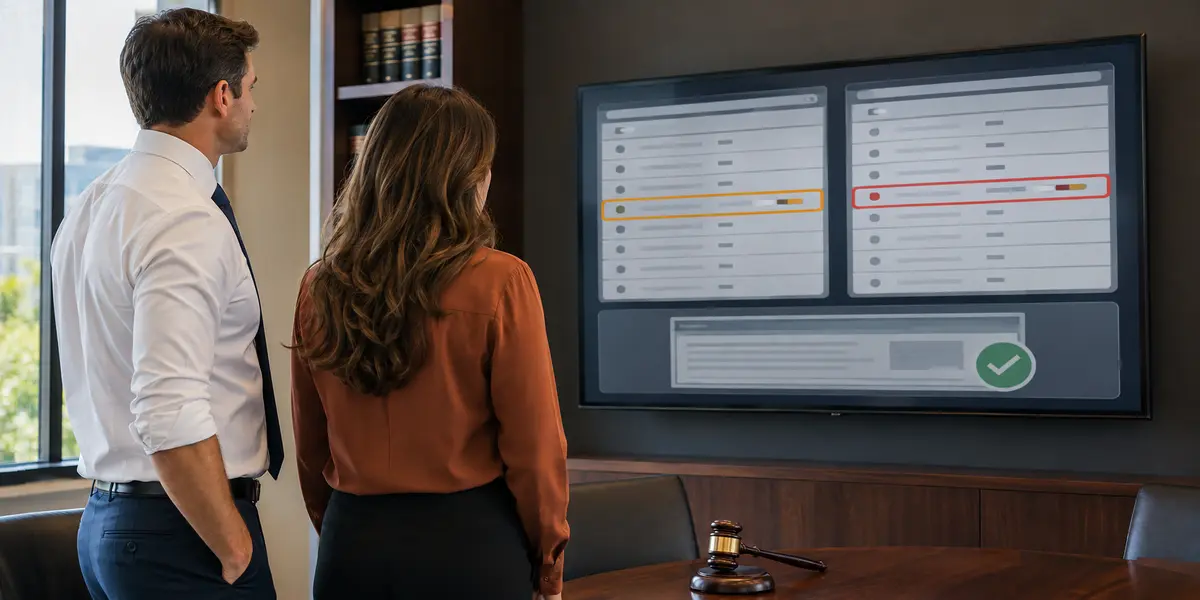
Attorneys expect each material conflict to be presented as a comparison, with both versions quoted or summarized neutrally and linked to their sources. The review should identify what differs, where each entry appears, and whether a later record documents reconciliation.
Common conflicts include different injury dates, symptom-onset accounts, pain scores, medication lists, work-status restrictions, prior-history statements, procedure descriptions, and diagnostic impressions. When one version appears in a copied-forward note and another in a direct report, the source type and attribution should stay visible.
The review may state: 'The emergency note records symptom onset on June 3; the orthopedic intake records onset on June 5. No supplied document reconciles the dates.' It should not select the date that better supports either party's position.
That neutral approach belongs in any personal injury medical record review because documented facts, inconsistencies, and gaps should remain separate from causation, liability, damages, and case-value conclusions.
Repeated Text Should Not Inflate the Timeline
An EHR conflict review should count documented events, not the number of times the same text appears. Copy-forward sections, automatically populated problem lists, repeated medication histories, and duplicated discharge material can make one complaint or condition look repeatedly confirmed.
Reviewers should group exact repetition while retaining the encounter in which the language first appeared and any later entry that changed its status. A diagnosis copied into six notes is not automatically six independent findings. A therapy note delivered through three provider packets is still one visit unless the sources document otherwise.
This is where careful sorting matters. The review team needs a record map before it can decide whether two pages are identical, related, or separate events. The map should also preserve provider and production boundaries so counsel can see how the same document entered the file more than once.
A dependable sorting and indexing handoff protects later review by identifying document types, duplicate groups, missing items, and questionable versions before the treatment narrative is built.
Attorneys Need the Conflict's Context, Not Only Its Wording
A useful EHR conflict flag explains the clinical-document context around the difference. The same phrase can carry a different meaning when it appears in patient-reported history, a templated review of systems, a provider assessment, an imaging impression, or a medication reconciliation field.
Negation and status matter too. 'No prior symptoms,' 'history of symptoms,' 'symptoms resolved,' and 'symptoms unchanged' should not be compressed into one generic history statement. The review should retain the words the record uses and identify who supplied them.
Context does not authorize the reviewer to decide which entry is true. The EHR review organizes the competing documentation and flags what another record, audit trail, or qualified professional may need to examine.
The Review Should Identify What Could Resolve the Conflict
Attorneys expect the review to identify the missing or available source that could clarify a conflict. That source might be the original imaging report, operative report, medication administration record, signed addendum, portal message, outside-provider chart, or native EHR audit trail.
The wording should stay precise. 'Audit trail not supplied' is different from 'audit trail shows no change.' 'Operative report referenced but absent' is different from 'procedure did not occur.' A missing source limits the review; it does not establish why the record is missing or what the absent record would show.
- Name the conflicting fields or statements.
- Cite both available sources.
- State whether a later note reconciles the difference.
- Identify the record that may clarify the issue.
- Label the conflict unresolved when the supplied file does not answer it.
A Practical Example: One Visit, Three EHR Versions
A defensible EHR conflict review keeps three versions of one visit separate when each carries a different status. Consider a hypothetical urgent-care encounter exported as a preliminary note, a signed note, and a later addendum.
The preliminary note records no prior neck complaints. The signed note contains a copied problem-list entry for chronic neck pain. Two days later, an addendum states that the problem list was imported and that the claimant denied active neck treatment before the incident. The pages share most of their text, but they are not interchangeable duplicates.
The review should group the three records under one encounter, label each version, cite the changed passages, and preserve the addendum's timing. It should not conclude whether a prior condition existed, whether symptoms were caused by the incident, or how the conflict affects damages. Those decisions belong to counsel and the qualified medical expert.
What the Final Deliverable Should Contain
The final EHR conflict review should contain a controlled record inventory, a duplicate and version log, a chronology that avoids double counting, a conflict table or clearly labeled flags, working source references, and an exception list for missing metadata or unresolved issues.
Counsel should also be able to see the record cutoff and production version. Supplemental records can change duplicate groups, add a missing primary source, or resolve a conflict. The update process should show which prior flags changed and which remain open.
- Record-set name, production date, and cutoff
- Exact-duplicate and near-duplicate handling notes
- Amendment and version identifiers
- Side-by-side conflict presentation
- Source page, Bates, or hyperlink references
- Missing-record and missing-metadata flags
- Final human quality-control confirmation
How LezDo TechMed Supports EHR Conflict Review
LezDo TechMed supports personal injury attorneys with human-led medical record review, sorting and indexing, duplicate handling, medical chronology preparation, source referencing, missing-record identification, and client-specific review formats. The team can organize repeated and conflicting EHR entries so counsel can locate each version without rereading the full export.
LezDo TechMed extracts, organizes, cross-references, and flags medical information documented in the supplied records. The service does not diagnose, determine causation or liability, assess damages, decide case value, or replace the attorney or qualified medical expert.
A Three-Part EHR Conflict Framework
1
Classify
Exact duplicate, changed version, amendment, or conflict
2
Compare
Wording, source, author, date, status, and metadata
3
Flag
Reconciliation trail, missing source, and unresolved issue
EHR Conflict Review: Frequently Asked Questions
What is an EHR conflict review?

An EHR conflict review compares repeated, amended, and contradictory electronic health record entries and keeps each material version tied to its source. It organizes the conflict without deciding its medical or legal meaning.
Are identical EHR notes always duplicates?
No. Notes that look identical may have different authors, encounter identifiers, timestamps, status labels, or one changed sentence. Review those fields before grouping or removing a page.
What is a near-duplicate EHR entry?
A near-duplicate repeats most of another entry but contains a meaningful change, addition, omission, or status update. It should be retained or logged as a separate version when the difference matters.
Can copy-forward text inflate a treatment timeline?
Yes. Repeated text can make one complaint, diagnosis, or event look newly documented across several visits. The review should distinguish repetition from a new encounter finding.
What metadata should an EHR review preserve?
Preserve the service time, entry time, signature time, author, editor, note status, module, encounter identifier, amendment label, and source location when those fields are available.
How should conflicting EHR entries be reported?
Present both versions with their dates, authors, document types, status, and source references. State whether later records reconcile the difference and flag the issue as unresolved when they do not.
Does a PDF export contain the full EHR audit trail?
Not necessarily. A PDF may show the visible chart without the underlying edit history. The review should state whether audit-trail data was supplied rather than assume it is included.
Should amended EHR notes replace the original note?
Keep the amendment linked to the original and identify what changed. Whether the original remains in the final working set depends on the agreed protocol, but the version trail should stay visible.
The Bottom Line
Personal injury attorneys expect an EHR conflict review to make uncertainty easier to inspect. The review should separate duplicates from versions, preserve amendments and metadata, prevent repeated text from inflating the timeline, and place unresolved entries beside their sources.
A shorter file is useful only when the review has not removed the difference that matters. Counsel needs to see what the EHR documents, what changed, and what remains unanswered before deciding how the information fits the case.
Refer to our blog, 'When the Medical Records Look Complete but the Case Questions Are Still Unanswered' to learn why record volume and a polished format do not establish that the treatment history, conflicts, missing sources, and case questions have been fully addressed.
Source Credit : All metrics derived from LezDo TechMed’s internal project data.
Jebisha Jenishofen
Jebisha Jenishofen is a Certified Legal Nurse Consultant and Medical–Legal Research Analyst with over five years of experience in the medical-legal industry. She specializes in medical record analysis, medical-legal research, and content development, creating clear and informative resources on personal injury, medical malpractice, insurance claims, and healthcare litigation. By combining clinical knowledge with research expertise, she transforms complex medical information into practical insights for medical-legal professionals.













.png)


