Home
>
Blog
>
>
When the Medical Records Look Complete but the Case Questions Are Still Unanswered
Before a medical file is treated as review-ready, the legal team should know whether it answers the core case questions:
- What injuries or conditions are clearly documented after the incident?
- Which treatment records support the claimed symptoms and care pathway?
- Are there prior conditions, treatment gaps, or conflicting notes that need attention?
- Are important diagnostics, procedures, referrals, and bills connected properly?
- What is still unclear, incomplete, or unsupported in the available records?
A complete file is not enough. The file has to be useful.
The records arrived. That should feel like progress.
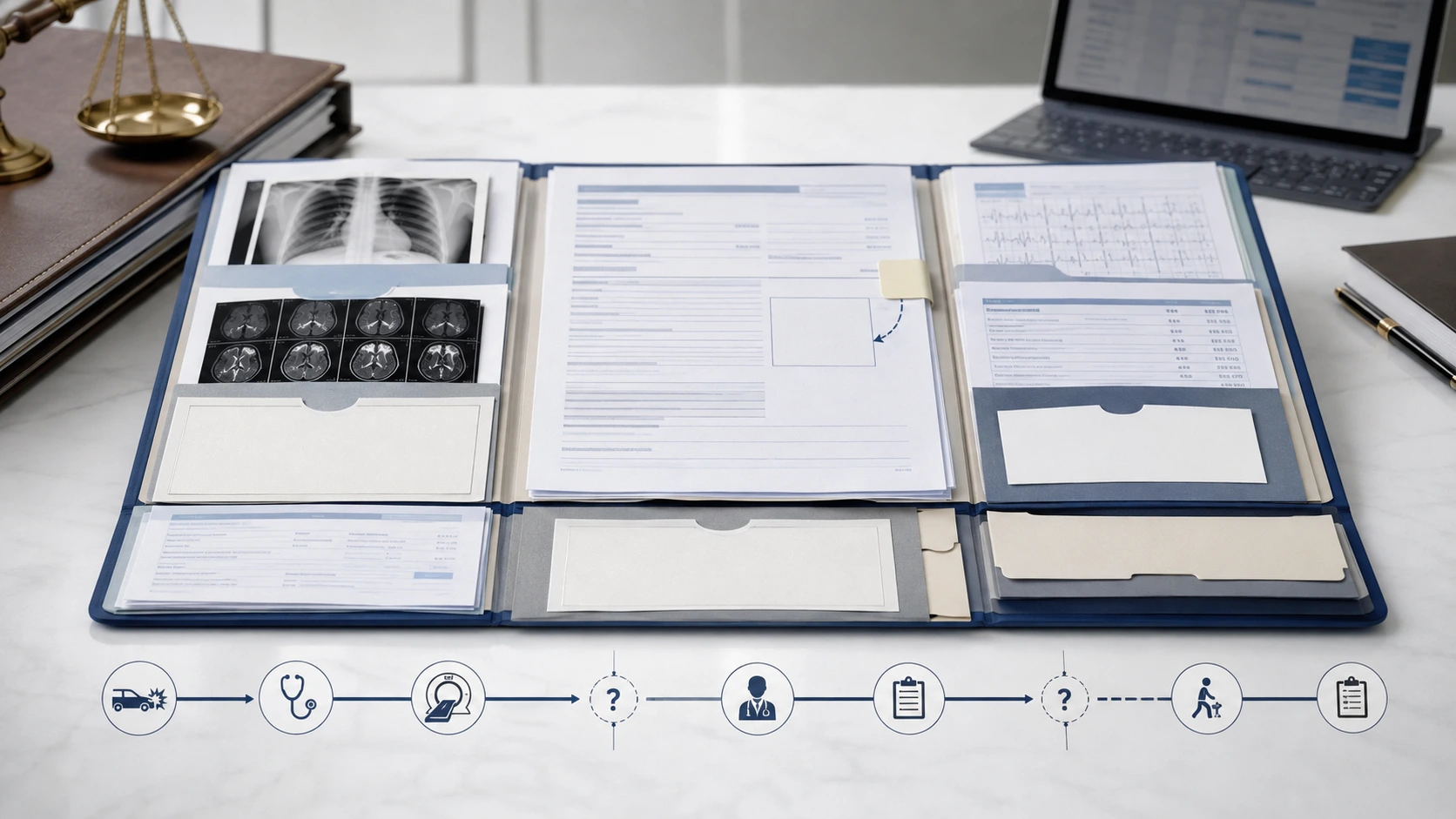
The provider folders are there. The hospital file is there. The imaging reports are there. The bills are saved. The treatment notes seem to cover the main dates. At first glance, the file looks complete enough to move forward.
Then the real review begins.
The attorney still cannot clearly answer when the symptoms first appeared. The paralegal cannot tell whether the pain management note connects to the accident or to a prior condition. The expert asks for a report that everyone thought was already included. The demand team realizes the bills are in the file, but the treatment support behind them is not easy to verify.
This is the problem with “complete-looking” medical records.
A file can be full and still be unclear. It can be organized and still leave the case questions unanswered. In personal injury work, that gap matters because medical records do not exist in isolation. They support injury claims, treatment history, damages evaluation, expert review, settlement discussions, and litigation strategy.
That is why medical record review should not stop at confirming whether the records were received. It should help the legal team understand what the records actually prove, what they raise questions about, and what still needs to be clarified before the case moves forward.
The Trap of “We Have the Records”
In many personal injury cases, record collection feels like the hard part. Once the records are received, there is a natural temptation to move quickly into demand preparation, expert review, or settlement evaluation.
But having records is not the same as understanding them.
A case file may include hundreds of pages from multiple providers, but the story may still be difficult to follow. Dates may overlap. Duplicate pages may create confusion. Specialist notes may reference prior complaints. Billing records may show services that are hard to match with treatment notes. One provider may document improvement while another documents ongoing pain.
These are not minor file-management issues. They affect how confidently the attorney can evaluate the case.
A strong review should answer a more useful question: “Do these records give us a dependable medical picture?”
Having Records Is Not the Same as Understanding Them
A strong medical record review goes beyond collection to confirm whether the records provide a clear, consistent, and dependable picture of the case.
Case Questions Should Guide the Review
Medical record review becomes stronger when it begins with the case questions, not the page count.
For a personal injury attorney, the questions are usually practical. Did the client seek treatment soon after the incident? Were the complaints consistent? Did the diagnostic findings support the treatment plan? Were there prior similar symptoms? Did the provider document functional limitations? Is there a clear medical path from injury to treatment to outcome?
If the review does not focus on those questions, it may produce a clean summary but still miss the point.
A well-structured review should help identify:
- The first documented complaint after the incident
- The sequence of providers and treatment changes
- Diagnostic findings that affected the care plan
- Prior medical history related to the same body part
- Gaps, missing records, or inconsistent entries
The reviewer should not make legal conclusions. But the reviewer can make sure the facts attorneys need are visible, organized, and traceable.
When the Timeline Looks Clear but the Meaning Does Not
A chronological order helps, but it does not automatically create clarity.
For example, the records may show an emergency room visit, then chiropractic care, then imaging, then pain management. That timeline seems simple. But the deeper questions may still remain.
Why was imaging ordered? Did symptoms worsen before the referral? Was the same complaint documented across providers? Did the client report prior pain during the intake? Did the MRI finding lead to a treatment change, or was it simply noted and left alone?
A basic timeline tells the legal team what happened next. A stronger review helps them understand what changed and why it may matter.
That difference is important because attorneys rarely need medical records just to know the dates. They need to know which dates carry case value.
Want to see how case questions shape a medical review?
Missing Records Are Sometimes Hidden in Plain Sight
A file may appear complete because it includes records from every known provider. But medical records often point to other records.
A primary care note may mention a referral to orthopedics. A pain management note may reference prior imaging. A hospital discharge summary may instruct the patient to follow up with a specialist. A physical therapy note may mention a surgery that is not included in the file.
If the review does not flag these references, the team may assume the record set is complete when it is not.
This is where medical record review can protect the case from avoidable surprises. The reviewer can identify records that are referenced but not available, such as:
- Missing imaging reports
- Missing specialist consults
- Missing operative reports
- Missing therapy progress notes
- Missing prior treatment records
The point is not to decide whether the missing record changes the case. The point is to make sure the legal team knows the record is missing before someone else points it out.
Prior History Needs Careful Handling
Prior medical history can be one of the most sensitive parts of personal injury review.
A prior condition does not automatically defeat a claim. Many clients have old injuries, degenerative findings, intermittent symptoms, or unrelated conditions. But if prior history is not identified early, it can become a problem later during deposition, expert review, or negotiation.
A good review should distinguish between prior history that appears related and prior history that appears unrelated based on the records. It should preserve the source details without overstating them.
For example, “prior back pain noted in 2021 primary care record” is more useful than simply writing “pre-existing back condition.” The first statement is traceable and factual. The second may sound like a conclusion.
This is an important E-E-A-T point. Medical record review should present documented facts clearly, not stretch them into opinions.
Bills Should Connect Back to Treatment
In personal injury cases, medical bills often sit beside the treatment records, but they do not always line up neatly.
A bill may show a procedure, but the procedure note may be missing. A provider statement may include multiple dates of service, but the clinical notes may only support some of those dates. A charge may appear under one provider while the treatment note comes from another facility.
If those details are not reviewed, the demand package may rely on numbers that are harder to support.
A careful medical record review helps attorneys see whether the financial side of the case connects back to documented care. It can help flag areas where billing and treatment support should be checked before the file is used for negotiation.
"The value of medical record review lies in connecting documented treatment, prior history, and billing records without turning incomplete information into conclusions."
Expert Review Starts Better When the File Is Clear
Experts should not have to spend their review time rebuilding the record set.
When a file is unclear, the expert may need to pause and ask basic questions. Where is the imaging report? Was there prior treatment? Which provider first documented the symptom? Are the therapy records complete? Did the treatment gap happen because care stopped or because records are missing?
Those questions delay the expert’s real work.
Before records are sent out, the legal team should already know whether the file has the major pieces needed for meaningful expert review. That includes ER records, diagnostic reports, specialist notes, operative reports, therapy records, medication history, prior related care, and updated treatment documentation.
A clean file does not guarantee a favorable opinion. But it gives the expert a stronger place to begin.
What Good Medical Record Review Should Deliver
A strong review should not overwhelm the attorney with every line of every record. It should organize what matters and make the uncertain parts easier to see.
Depending on the case scope, a useful review may include:
- A clear treatment timeline
- Provider-wise organization
- Diagnosis and procedure details
- Diagnostic findings and related follow-up
- Prior history and treatment gaps
- Missing record flags
- Inconsistencies across providers
- Medication and therapy details
- Work status or functional limitation notes
- Source references for important entries
The best review does not pretend the file is cleaner than it is. It shows both the support and the weak spots.
Where Professional Review Support Fits
For law firms handling high-volume or complex personal injury cases, medical record review services can help convert scattered medical documentation into clearer, case-ready information.
This support is especially useful when internal teams are managing multiple active cases, supplemental records, expert deadlines, demand timelines, and deposition preparation. Instead of spending hours searching across PDFs, attorneys and paralegals can work from a more structured view of the medical facts.
A medical record review outsourcing company can also help maintain consistency across files by applying a defined review process. That matters when several team members are working on different parts of the same case.
LezDo TechMed’s role is to extract, organize, and present documented medical information according to the agreed case scope. The review may identify provider sequence, treatment history, diagnostics, procedures, medications, prior conditions, gaps, missing records, and inconsistencies.
LezDo TechMed does not diagnose, decide causation, determine liability, calculate damages, or give legal opinions. The review supports attorneys, experts, claims professionals, and other qualified decision-makers by making the medical record easier to evaluate.
The Better Question to Ask
Instead of asking, “Do we have the records?” ask this:
“Can we answer the case questions from the records we have?”
That question changes the whole review.
It pushes the team beyond file collection and into case understanding. It helps identify what is confirmed, what is unsupported, what needs follow-up, and what may become a challenge later.
For personal injury attorneys and paralegals, that clarity can improve demand preparation, reduce expert delays, support better case valuation, and prevent avoidable surprises during litigation.
Clear Medical Records. Stronger Expert Review Preparation.
78%
Key Medical Records Clearly Organized
Faster Expert Review
86%
Gaps and Inconsistencies Identified
Earlier Issue Detection
93%
Case-Relevant Facts Made Traceable
Better Litigation Preparation
Frequently Asked Questions
What is medical record review in personal injury cases?

Medical record review is the process of organizing and evaluating documented medical information so attorneys can understand treatment history, diagnoses, procedures, gaps, prior conditions, and case-relevant medical facts.
Can a medical file be complete but still unclear?
Yes. A file may include many records but still leave questions about injury timing, treatment connection, missing diagnostics, prior history, billing support, or conflicting provider notes.
Why is medical record review important before demand preparation?
It helps attorneys confirm whether the treatment story, bills, diagnostics, and records support the demand before the case is presented for settlement discussion.
Does medical record review provide medical or legal opinions?
No. Medical record review should organize and present documented medical facts. It should not diagnose, determine causation, decide liability, or calculate damages.
When should a law firm consider outsourcing medical record review?
Outsourcing may help when a firm has large record volumes, multiple active cases, complex medical files, limited internal review time, or a need for consistent summaries across matters.
Final Thought
A complete-looking medical file can still leave the legal team uncertain.
The records may be present, but the treatment story may not be clear. The bills may be included, but the support may be scattered. The timeline may be built, but prior history, missing reports, and conflicting notes may still sit quietly inside the file.
That is why medical record review should do more than organize records. It should help the team understand what the records actually answer.
Because in litigation, the real risk is not only missing documents.
It is moving forward with a file that looks complete while the most important questions are still unanswered.
Source Credit : All metrics derived from LezDo TechMed’s internal project data.
Shabila Thomas
Shabila Thomas is a Certified Legal Nurse Consultant (CLNC) and Medical-Legal Research Analyst with over two years of experience in medical record review, medico-legal research, and content development. She specializes in blogs, articles, and content that decode complex medical information, industry trends, and regulatory updates for the medico-legal field. Her clinical background and research-first approach help law firms, medical evaluators, and insurance professionals understand complex medical data, identify relevant insights, and make faster, better-informed decisions.













.png)