Home
>
Blog
>
>
How Narrative Summaries Help QMEs Understand Complex Medical Histories Faster
Here's how a medical narrative summary helps a QME understand a complex history faster:
- Story, not stack – A narrative summary reads the history as one connected clinical account, so you grasp the sequence without scrolling 3,000 pages.
- Prior conditions surfaced – The pre-existing issues and treatment gaps that shape an apportionment discussion are flagged where they sit in the timeline, not buried.
- One consistent structure – A fixed format across cases means you always know where to look, so prep time drops even when the file is huge.
- Sourced to the page – Every clinical statement cites its record page, so you can verify anything before it enters your report.
Read on for how it works, and a quick gut-check before your next evaluation.
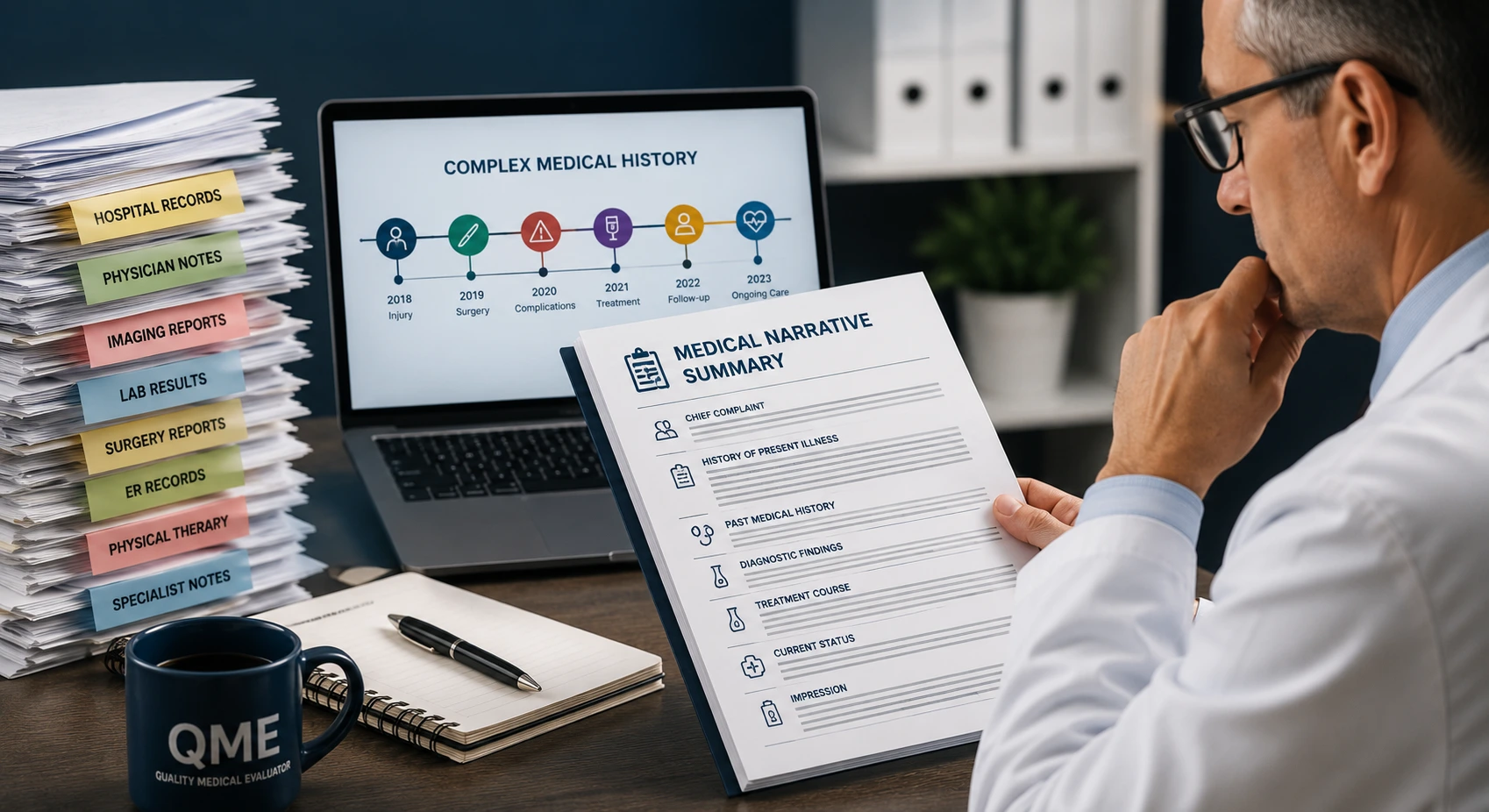
A medical narrative summary turns a Qualified Medical Evaluator's stack of records into a readable clinical story, so the history makes sense before the exam does. Are you a QME opening another 3,000-page file the week before an evaluation, trying to piece the treatment together provider by provider? You're not alone. And you don't have to read every page to understand the history.
A medical narrative summary is a chronological, plain-language write-up of a claimant's medical history, built from the records and sourced back to them. A QME (Qualified Medical Evaluator, the physician who performs California's independent medical-legal evaluations) usually works under real time pressure, often with disorganized records from a dozen providers. The narrative is what makes that history legible fast. Let's look at how it does that.
1. It reads the history as a story, not a pile of pages
When records arrive, they arrive as fragments: an ER note here, a specialist consult there, an imaging report filed out of order. Reading them cold means holding the whole sequence in your head while you sort it. A narrative summary does that sorting first. It walks the history in order, in sentences, so the injury, the treatment that followed, and the response to that treatment read as one connected account. You spend your time evaluating the history instead of assembling it.
The prep bottleneck is the reading, not the evaluating
One California neurosurgery IME firm restructured how its records were organized and summarized, with a human reviewer checking the output, and reported 62% less review time and 44% faster deposition analysis during the engagement. The evaluation itself did not get easier. The reading did. That is where a narrative summary gives a QME time back.
2. It surfaces prior conditions and gaps before they surprise you
The parts of a history most likely to matter to a QME opinion are often the hardest to find: a prior injury to the same body part, a treatment gap that raises questions, a pre-existing condition noted once in a five-year-old record. A good narrative summary flags these where they sit in the timeline. It does not tell you what they mean; that judgment is yours. It makes sure you see them before you are mid-report. If you want the deeper standard here, our guide on getting accuracy and completeness right in QME narrative summaries walks through what complete actually looks like.
3. It keeps one structure across every case
Consistency is quietly what saves the most time. When every narrative summary follows the same structure, you know where the history starts, where the imaging lives, where prior conditions are noted. You stop relearning each file from scratch. That predictability is part of why a professional medical narrative summary service is built around one format applied the same way to every case.
Prepping a complex QME file on a tight clock?
4. It sources every clinical statement to a page
Speed is only useful if you can trust it. A narrative summary earns a QME's trust when every clinical statement points back to the exact record page it came from. That way, when a finding is going to appear in your report or come up in deposition, you can verify it in seconds instead of hunting through the file. Accuracy you can trace is what separates a summary you rely on from one you have to re-check. This is also why medical record review accuracy for IME and QME work starts with sourcing, not speed.
5. It pairs AI speed with a human clinical check
AI is good at pulling events from a large record set and drafting a first-pass timeline quickly. But extraction is not clinical judgment. A first-pass draft can miss context, misread an abbreviation, or flatten a nuance that matters to your evaluation. The narrative summaries a QME should rely on pair that AI speed with a medical reviewer who checks context, relevance and completeness before it reaches you. AI handles the volume; a clinician makes sure the story is right.
A narrative summary should make the history legible, never make the medical call for you.
6. It gives you the history before the exam, not during it
Timing is part of the value. A narrative summary delivered before the evaluation lets you walk in already knowing the shape of the history: what happened, in what order, and what is missing. You are not reconstructing the treatment while the examinee sits in front of you. That head start is often the difference between a rushed review and a considered one.
Quick gut-check before your next evaluation: think about the last complex file you opened. How long did you spend just working out the sequence of care before you could actually evaluate it? If the honest answer is hours, a sourced narrative summary is built to give most of those hours back.
What a strong narrative summary changes for a QME
62%
Less review time
The IME firm's reported reduction after restructuring its record workflow.
44%
Faster deposition analysis
Reported by the same firm during the engagement.
One format
Every case
A fixed structure means you stop relearning where the history lives.
Frequently asked questions
What is a medical narrative summary for a QME?

A medical narrative summary is a chronological, plain-language write-up of a claimant's medical history, built from the records and sourced back to them. It lets a Qualified Medical Evaluator understand the sequence of care without reading every page.
How does a narrative summary save a QME time?
It organizes fragmented records into one connected clinical story, surfaces prior conditions and gaps, and keeps a consistent structure across cases. Prep time then goes to evaluation instead of assembling the history from scratch.
What is the difference between a medical chronology and a narrative summary?
A medical chronology is a dated, table-style timeline of events. A narrative summary tells that same history in connected prose, explaining how the events relate, which many QMEs find faster to read for context.
Should every entry in a narrative summary be sourced to a page?
Yes. Each clinical statement should cite the exact record page it came from, so a QME can verify any finding quickly before it enters a report or comes up in deposition.
Does using AI make a narrative summary less reliable for QME work?
Not when AI is paired with human review. AI drafts a first-pass summary quickly, then a medical reviewer checks context, relevance and completeness. The human step is what keeps it dependable.
When should a QME receive the narrative summary?
Before the evaluation. Having the summarized history in advance lets the QME understand the case going in, rather than reconstructing the treatment during the exam.
Bringing it back to your desk
A medical narrative summary helps a QME understand a complex history faster for one simple reason: it does the reading and organizing so you can spend your time on the evaluation. It turns fragments into a sequence, surfaces the prior conditions and gaps that shape an opinion, holds one structure across every case, sources each statement to a page, and lands on your desk before the exam rather than during it.
You became a Qualified Medical Evaluator to apply your clinical judgment, not to spend evenings rebuilding a treatment history from disordered records. Ready to walk into your next evaluation already knowing the history? Partner with LezDo TechMed, or start by estimating what a narrative summary for your next case would cost.
Source Credit : All metrics derived from LezDo TechMed’s internal project data.
Anjana Devi Vijay
Anjana Devi Vijay is a Certified Legal Nurse Consultant (CLNC) and Medical–Legal Research Analyst with 9+ years of experience in medical record review, deposition summary analysis, and medico-legal research. She specializes in transforming complex healthcare documentation into accurate, actionable insights that support attorneys, insurers, and medical evaluators. With expertise in clinical documentation analysis and legal case support, she creates research-driven content focused on improving decision-making and case outcomes.













.png)