Challenges in Medical Document Review for Malpractice Claims
A precise medical document review uncovers hidden negligence, clarifies treatment timelines, and strengthens malpractice claims with clear medical evidence.
Medical malpractice claims are often expensive and challenging to win due to their complexity. Proving a medical malpractice claim mainly revolves around the patient’s medical records. Traces of medical negligence or malpractice can be hidden among the multiple pages of medical documents.
Even the chances of medical document tampering cannot be completely precluded, as legal outcomes of med-mal claims can significantly affect the reputations and careers of medical professionals and facilities. A precise medical document review can be of great help in establishing medical malpractice.
Identifying the hints of medical negligence or tampered records is not that easy. Without solving these kinds of puzzles, attorneys cannot move further in the legal proceedings. Let’s see the challenges attorneys face in medical document review while handling medical malpractice claims and how to rectify them.
Find 90% of Critical Clues
Expert reviewers uncover 80–90% of overlooked details in malpractice records—key data that can make or break a case.
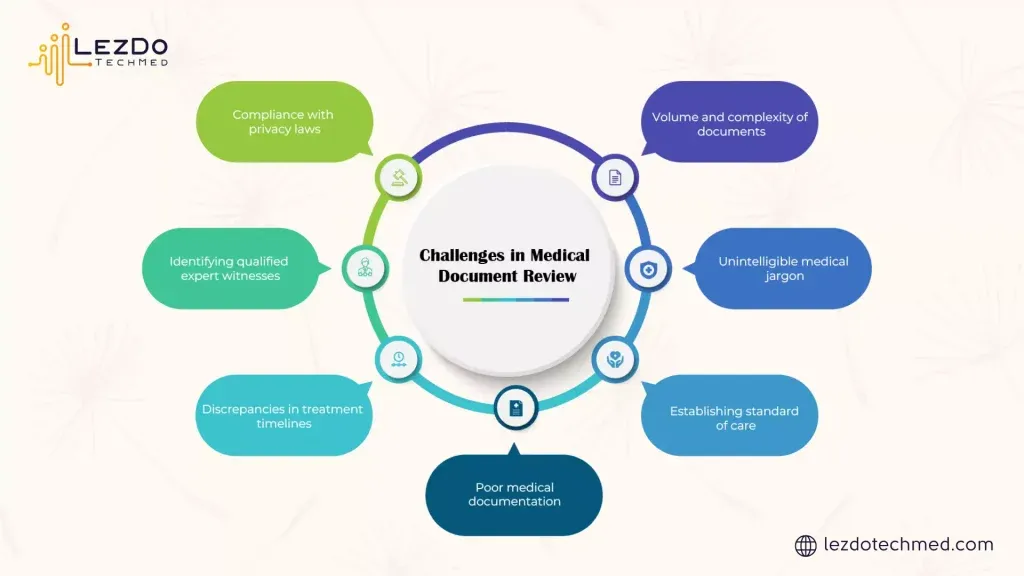
Medical Document Review Challenges
Volume and complexity of documents
Medical documents in malpractice claims are usually voluminous and complex. They include A-Z documents on a patient’s detailed medical charts, lab results, radiology findings, recommendations for therapies or surgeries, physician notes, correspondence records, and discharge notes.
The sheer volume of unorganized medical documents can be overwhelming, making it daunting for the attorneys to pinpoint crucial evidence to prove negligence.
Going through every document in search of traces of negligence can be time-consuming and requires due diligence. Making use of a structured document review process and advanced tools can help organize medical data efficiently.
Experienced medical malpractice record reviewers will not leave any stone unturned until they locate proof of malpractice. Their medical negligence reviews will be accurate and precise with facts.
Unintelligible medical jargon
Legal professionals without any medical background may find it challenging as the documents contain complex abbreviations, medical terms, and procedure narratives. Misrepresentation of these medical terms can lead to misunderstanding and incorrect conclusions, affecting the case’s outcome.
Only expert medical document reviewers with vast experience in medical fields can interpret these complex terminologies and understand the complex procedures. Their medical legal case reviews simplify them without missing the essence and make medical procedures crystal clear for non-medical people.
Seeking Clarity in medical Evidence? Get Expert Review Here! Hurry up!
Proving what the standard of care is in a particular specialty and how it was breached is vital in establishing the breach of the standard of care. Medical documents would show the types of care provided to the patient, but not what was not provided. A non-medical professional cannot find out the type of care that could have been provided under similar circumstances.
Medical professionals from the same specialty or field as the defendant can only understand the specific standard of care and what a breach of that care means. A document reviewer from the same field can assess the normal standard of care, whether it was met, and any deviations that occurred. They can clearly portray what should have been done instead of the care provided in their medical malpractice record review.
Poor medical documentation
Illegible and handwritten documents can make the medical malpractice review process hectic and impossible. There are chances for legal people to misinterpret health conditions or procedures. Missing records or incomplete records, too, make the patient’s medical history incomplete, preventing the attorneys from grasping out the strengths and weaknesses of the case.
Experienced document reviewers can locate the missing links and initiate the retrieval of the missing and incomplete records to make the document review complete. With their years of experience, they can comprehend illegible records or handwritten notes and provide coherent and valuable insights.
Discrepancies in treatment timelines
Establishing an accurate timeline of medical events is crucial in medical malpractice claims. Any discrepancies on dates and times noted in the documents can make matters worse. It will hinder comprehending the progression of the patient’s medical condition and the treatments provided.
Chart reviewers prepare a detailed chronology of all medical events that could align with witness statements and other vital evidence. This can prove the sequential order of medical events, progression or regression of pain levels, and inconsistencies of gaps in medical documents.
"Medical malpractice cases hinge on the facts—accurate document review reveals the truth buried in thousands of pages."
Identifying qualified expert witnesses
When the physicians who treated the patients turn out to be defendants and expert witnesses for the defense, there are chances for biased opinions. From prejudiced or partial medical opinions, lawyers cannot grasp the complete medical history of the patient. Many medical experts may not be ready to give expert testimony against the defendants.
Medical document review by experts can identify if the medical opinions of the expert witnesses or defense-favoring witnesses are biased or not by perusing the imaging and lab results. By conducting a thorough analysis, they can locate unbiased opinions and assist the attorneys in identifying potential medical experts to be included as expert witnesses.
Compliance with privacy laws
Patients’ medical documents are sensitive and need to abide by privacy laws such as HIPAA strictly while handling them. Data privacy and security play a vital role in managing these records. Unauthorized disclosure of patient information can lead to penalties and hinder the legal process.
People involved in medical malpractice case review should have proper training in HIPAA and other relevant privacy laws. Secure data handling is a must to prioritize protecting patient data confidentiality, which can be assured by trained med-mal reviewers.
Why Expert Analysis Is Vital in Malpractice Cases
70%
Clearer Case Understanding
Experts simplify complex medical jargon
75%
Negligence Detection
Timelines reveal care deviations effectively
80%
Missing Data Identified
Reviews catch incomplete or altered records
Frequently Asked Questions
Why are medical records critical in medical malpractice cases?
Medical records provide the primary evidence to identify negligence, establish the standard of care, and show deviations that caused patient harm.
What makes medical malpractice cases difficult to prove?
They involve complex medical details, voluminous records, expert testimony, and the need to prove a breach of the standard of care.
What challenges do attorneys face when reviewing medical documents?
Common challenges include large record volumes, complex medical jargon, missing or illegible records, and inconsistent timelines.
How can hidden negligence be identified in medical records?
Expert reviewers analyze timelines, treatment decisions, documentation gaps, and inconsistencies to uncover signs of negligence or malpractice.
Why is understanding the standard of care so important?
Proving malpractice requires showing what care should have been provided and how the actual care deviated from accepted medical standards.
How do expert reviewers help interpret medical jargon?
They translate complex medical terminology into clear explanations, preventing misinterpretation that could weaken the case.
What role do medical chronologies play in malpractice claims?
Chronologies align events by date and time, revealing delays, omissions, or inconsistencies in treatment.
Can expert document review detect altered or missing records?
Yes. Experienced reviewers can identify gaps, inconsistencies, and potential record tampering through cross-referencing and analysis.
Why is compliance with HIPAA important during document review?
Strict compliance protects patient privacy, prevents legal penalties, and ensures sensitive medical data is handled securely.
How does expert medical document review strengthen malpractice cases?
It uncovers critical evidence, clarifies negligence, supports expert testimony, and improves overall case strategy.
To conclude,
Medical documentation review in medical malpractice cases is a detailed and demanding process that requires expertise, precision, and an understanding of both medical and legal principles. Overcoming these challenges can be highly overwhelming for legal people. Only experts in medical document review can handle these challenges efficiently, as they have experience in both medical and legal fields.
Source Credit : All metrics derived from LezDo TechMed’s internal project data.
Anjana Devi Vijay
Anjana Devi Vijay is a Certified Legal Nurse Consultant (CLNC) and Medical–Legal Research Analyst with 9+ years of experience in medical record review, deposition summary analysis, and medico-legal research. She specializes in transforming complex healthcare documentation into accurate, actionable insights that support attorneys, insurers, and medical evaluators. With expertise in clinical documentation analysis and legal case support, she creates research-driven content focused on improving decision-making and case outcomes.















.png)