Medical Chronology vs. Raw Medical Records: What Helps CME Providers More?
Key Takeaways
Raw medical records contain the full source material, but they are often scattered, repeated, and difficult to review quickly before a CME.
A medical chronology organizes the same documented events in date order so CME providers can follow complaints, tests, treatment, gaps, and outcomes.
CME providers still need access to raw records. The chronology helps them reach the right records faster.
Source-linked chronologies are more useful because important entries can be verified through page references, Bates numbers, or hyperlinks.
A chronology should organize and flag documented facts. It should not form the provider's medical opinion.
Raw records show everything. A medical chronology helps CME providers see the sequence that matters before the examination begins.
What Is the Difference Between a Medical Chronology and Raw Medical Records?
Raw medical records are the original documents produced by hospitals, clinics, therapy providers, pharmacies, diagnostic centers, and other sources. A medical chronology is a date-wise summary prepared from those records.
For a Compulsory Medical Examination (CME) provider, both have value. The raw records are the source. They contain the complete documentation, original wording, signatures, reports, and provider details. The chronology is the map. It helps the provider see how the medical events unfolded over time.
The problem is that raw records rarely arrive in an ideal order. A single file may contain emergency records, imaging reports, therapy notes, billing pages, duplicate forms, intake histories, and provider progress notes mixed together. The CME provider may need to understand the entire sequence before the examination, but the record set may not make that easy.
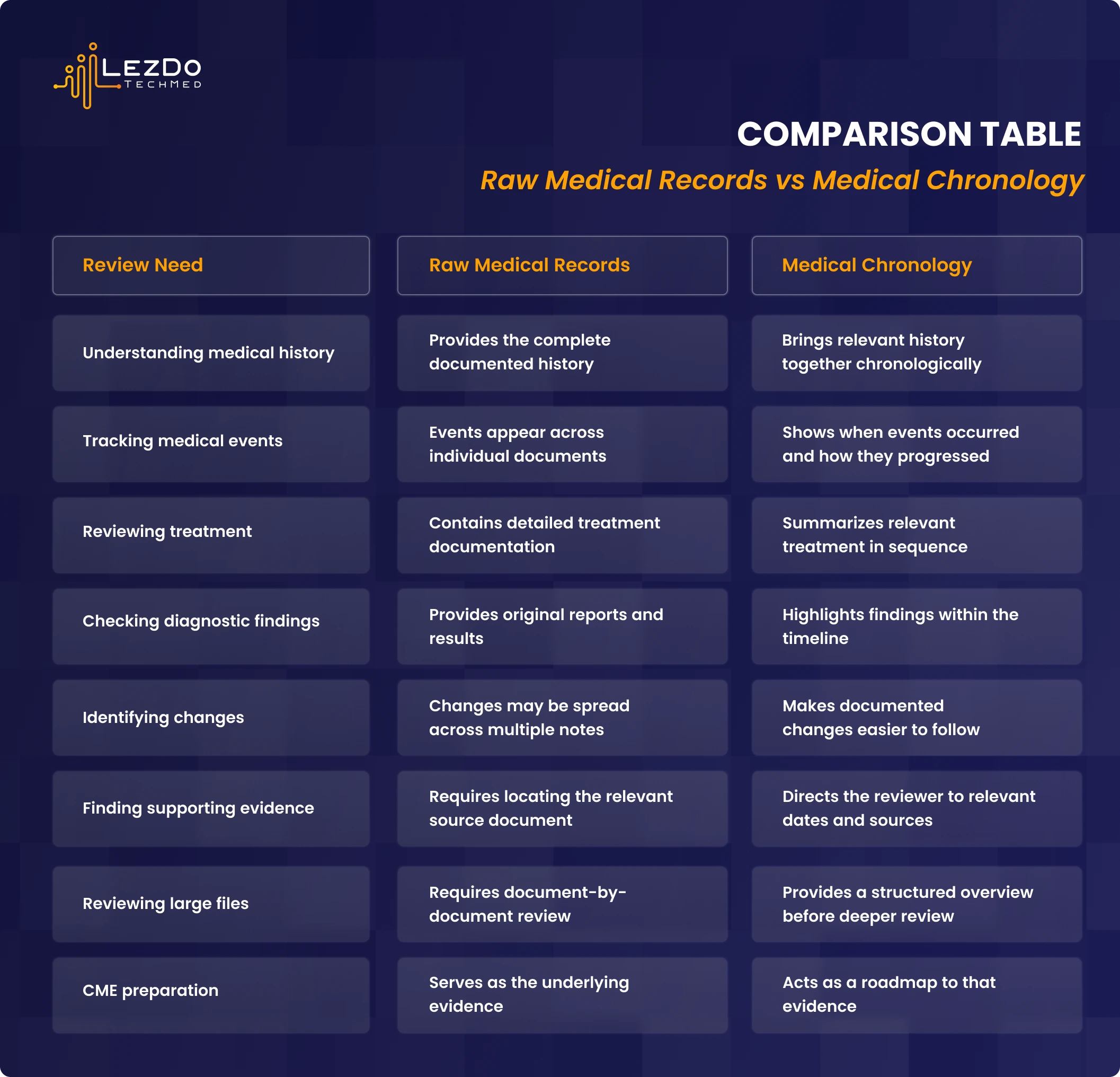
Raw Medical Records vs Medical Chronology
A medical chronology helps by organizing documented events in a way that supports medical record review. It does not replace the raw records. It points the provider toward them.
48hrs Standard IME Record Review Turnaround
Evaluation-focused medical record review can support faster preparation when records are organized, summarized, and source-referenced before the examination. Source Credit: All metrics derived from LezDo TechMed's internal project data.
Why Are Raw Medical Records Hard for CME Providers to Use Alone?
Raw medical records are hard to use alone because they are built for clinical care, billing, documentation, and provider communication. They are not built as a clean examination-prep tool.
The same event may appear in several places. A hospital note may mention a CT scan. The radiology report may contain the actual impression. A specialist may later repeat the result. A therapy note may show functional limits weeks later. If the provider reads the file from page one to the end, the sequence may still remain unclear.
CME providers also have to manage time. The examination date may already be scheduled. Supplemental records may arrive late. Some files may include hundreds or thousands of pages. Searching through raw records for one diagnostic report, prior condition, or missed follow-up can quietly consume preparation time.
The pain point is not that raw records are unnecessary. They are essential. The issue is that raw records alone can make the provider rebuild the entire timeline from scratch.
How Does a Medical Chronology Help CME Providers More?
A medical chronology helps CME providers more during preparation because it places key medical events in order and connects related facts across providers.
Instead of finding one orthopedic note, then jumping to a radiology report, then searching for therapy follow-up, the provider can first see the sequence:
Initial complaint or injury-related visit
Diagnostic testing and objective findings
Specialist evaluation
Conservative treatment
Procedures, injections, or surgery
Therapy progress or missed visits
Follow-up recommendations and outcomes
Gaps, duplicate records, or missing documents
This gives the CME provider a more usable starting point. It also helps identify questions that may need attention during the examination.
The chronology should remain neutral. It can organize prior history, treatment progression, and documented inconsistencies. It should not diagnose, determine causation, decide impairment, or form the CME opinion.
Want to compare a source-linked chronology with your next raw record set?
When Should CME Providers Go Back to the Raw Records?
CME providers should return to the raw records whenever an entry affects the examination focus, report wording, or professional opinion.
A chronology is a review aid. The raw record remains the primary source. If a chronology flags a prior injury, abnormal MRI, surgery, work restriction, medication change, or treatment gap, the provider should be able to verify the entry in the source document.
This is why source references matter. A useful medical chronology should show where the fact came from. A page reference, Bates number, or hyperlink can save the provider from searching across multiple PDFs.
The best workflow is not chronology or raw records. It is chronology first for orientation, then raw records for verification.
"Raw records preserve the evidence. A medical chronology gives CME providers the order, source trail, and gap view needed to use it well."
What Problems Can a Medical Chronology Reveal Faster?
A medical chronology can reveal timeline problems faster because it brings related events into one view.
For example, a treatment gap may be difficult to see when records are separated by provider. In a chronology, the gap appears between two dated entries. A missing report may also become clearer when a provider note says an MRI was reviewed, but no MRI report appears in the record set.
Chronologies can also make duplicate records easier to control. If the same note appears twice, the reviewer can identify the duplicate instead of turning one visit into two timeline events.
For CME providers, these flags matter before the examination because they shape what needs verification:
Was there treatment before the claimed event?
Is the original diagnostic report present?
Did the provider document improvement, worsening, or no change?
Are there conflicting dates across records?
Did the patient miss therapy visits or stop treatment?
The chronology does not answer the medical opinion question. It gives the provider the organized record path needed to evaluate it.
CME Record Review: Format Signals That Matter
3
Review Layers
Human quality review should check timeline order, medical context, and source support before delivery.
2M+
Records Analyzed
Large record exposure helps reviewers handle duplicate files, EHR exports, multi-provider histories, and supplemental records.
99.8%
Accuracy Rate
Accuracy depends on source-linked facts, stable citation methods, and careful human review of medical context.
Frequently Asked Questions
Can a medical chronology replace raw medical records for CME providers?
No. A chronology supports review, but the raw records remain the source documents. CME providers should use the chronology to navigate and verify key entries in the records.
Why are raw medical records hard to review before a CME?
Raw records may be out of order, repetitive, incomplete, and spread across many providers. That makes it harder to see the treatment sequence quickly.
What makes a medical chronology useful for CME preparation?
It should include date-wise events, provider names, diagnoses, diagnostic findings, treatment, outcomes, gap flags, and source references.
Should CME providers use source-linked chronologies?
Yes. Source-linked chronologies help providers verify important facts faster through page references, Bates numbers, or hyperlinks.
Does a chronology form the CME provider's opinion?
No. It organizes and flags documented medical facts. The CME provider forms the professional opinion after reviewing the records and examining the individual.
To Sum Up
Medical chronology and raw medical records serve different purposes for CME providers. Raw records preserve the complete source. A medical chronology organizes the source into a timeline that can be reviewed, questioned, and verified.
For CME preparation, the strongest approach is to use the chronology as the roadmap and the raw records as the evidence. That keeps the review faster, clearer, and traceable.
Source Credit : All metrics derived from LezDo TechMed’s internal project data.
Vishnu Priya Vinu
Vishnu Priya Vinu is a Certified Legal Nurse Consultant (LNC) and Medical-Legal Research Analyst with over two years of experience in medical record review, medico-legal research, and content development. She specializes in blogs, articles and E-books that bridges the gap between healthcare and law. Her strong medical background brings depth and accuracy to content, enabling law firms, medical evaluators, and insurance professionals to gain insights on complex medical data analysis. She delivers evidence-based insights and strategic content that strengthen case outcomes and support informed decision-making.















.png)