Medical Chronologies: What Lawyers Focus On vs. What Adjusters Look For
The same medical chronology serves two purposes, but the lens through which each professional views it is unique.
Why Medical Chronologies Matter
Medical records can be long, confusing, and filled with jargon. Now imagine sifting hundreds of pages of medical records into a structured timeline. It is a major task for lawyers and adjusters. Medical chronologies organize these complex records into an accurate timeline, highlighting treatments, diagnosis, and outcomes. But the need for lawyers and adjusters differs. Here’s the real twist:
Lawyers use them to prove the link between injury and incident, and damage.
Adjusters use them to validate claims and control costs.
35–45% Improved Decision Accuracy
A well-structured chronology helps lawyers prove causation and damages while enabling adjusters to validate claims and control costs.
What Lawyers Focus On in a Medical Chronology
For lawyers, a medical chronology helps connect the patient's medical history with the issues being evaluated in a case. The focus is often on sequence, causation, prior conditions, and evidence that may support or challenge the claim.
Key areas include:
Timeline of events: When symptoms, diagnoses, treatments, and procedures occurred.
Causation: What happened before and after the reported injury and how the documented timeline relates to the claim.
Pre-existing conditions: Prior complaints, diagnoses, injuries, and treatment that may affect the case.
Treatment progression: How the patient's condition and treatment changed over time.
Treatment gaps: Periods where expected follow-up or treatment is not documented.
Objective findings: Imaging, laboratory results, examinations, and other documented medical findings.
Provider opinions: Relevant assessments, restrictions, prognosis, and causation opinions when documented.
Conflicting information: Differences in dates, symptoms, diagnoses, or other medical details that may require closer review.
Case-relevant evidence: Medical information that may help evaluate causation, damages, liability, or potential defenses.
Lawyers rely on chronologies to build a clear overview of the harm involved. They show the path to recovery in a way that feels real. This approach strengthens their points about liability. It also supports claims for damages every time.
For insurance adjusters, a medical chronology can provide a structured view of the treatment history and help them understand the medical information connected to a claim. The focus is often on treatment, claim-related medical evidence, progression, and gaps or inconsistencies that may need clarification.
Key areas include:
What treatment was provided?
When did treatment begin?
What diagnoses were documented?
What treatment is related to the reported injury?
Was there relevant treatment before the incident?
What procedures, imaging, or specialist care occurred?
How long did treatment continue?
Were there treatment gaps?
What medical expenses are documented?
What does the overall treatment history show about the claim?
Why the Priorities Can Differ
Although both lawyers and adjusters rely on accurate medical information, their review priorities may differ based on the questions they need to answer.
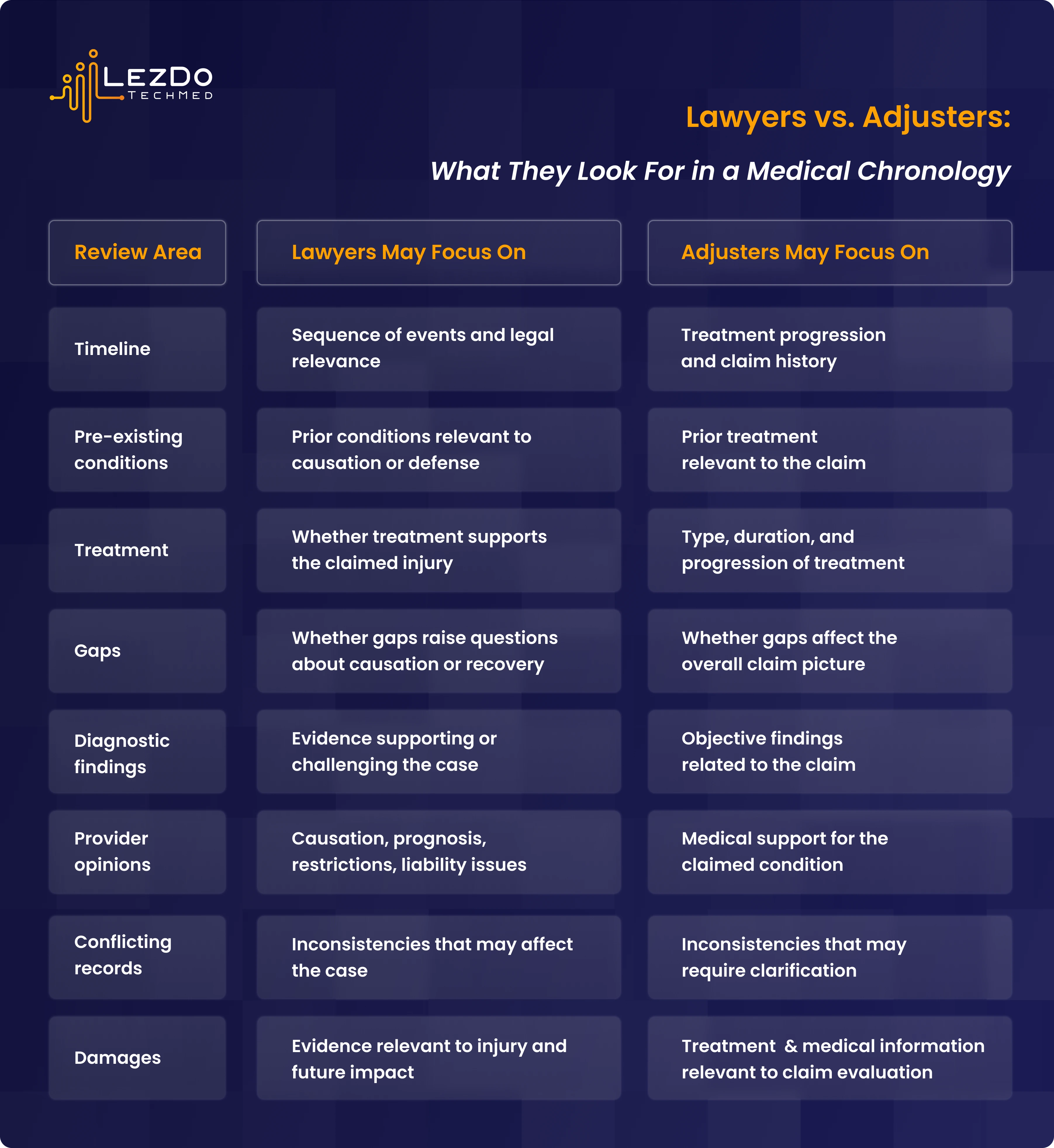
A lawyer may focus more closely on causation, pre-existing conditions, conflicting evidence, and issues that could support or challenge a legal position. An adjuster may place greater emphasis on treatment history, claim-related care, progression, and information relevant to evaluating the medical aspects of the claim.
A well-structured medical chronology can organize the same underlying records in a way that makes these different review priorities easier to identify.
"A well-structured medical chronology delivers clarity, simplifies complex medical information, and supports confident decision-making for both lawyers and adjusters."
Lawyers vs. Adjusters: What They Look For in a Medical Chronology
Boost Case Confidence Through Structured Medical Chronologies
35%
Causation Confidence
Chronologies strengthen legal arguments and support claim checks
40%
Evidence Impact
Imaging and lab reports boost credibility and cost control.
30%
Review Efficiency
Organized timelines speed up decisions for both sides.
Common FAQs About Medical Chronologies for Lawyers and Adjusters
What do insurance adjusters check in a medical chronology?
Adjusters review chronologies to verify the claims and monitor the expenses. They take account of prior conditions, the necessity of treatments, breaks in providing care, and test outcomes.
How do lawyers use medical chronologies?
Lawyers use them to prove that the injury was caused by the incident. You could look at the timeline of her treatment, gaps in care, long-term effects, and emotional impact to help your case.
Why do lawyers and adjusters see the same chronology differently?
Lawyers want to establish liability and recover fair compensation. Adjusters want to minimize payouts and identify unnecessary treatments. Their agendas determine their interpretation of the data.
How can you make chronology useful for both lawyers and adjusters?
Include important dates, significant procedures, and MMI (Maximum Medical Improvement). Emphasize pre-existing conditions, add yourself to your accounts, and maintain a neutral tone.
What objective evidence should be included?
X-rays, MRIs, lab reports, and physician notes must all be included. They provide objective evidence for injury severity and the need for treatment.
What do lawyers primarily look for in a medical chronology?
Lawyers look for a clear link between the incident and injury, consistent treatment timelines, long recovery periods, permanent impairment, and evidence supporting future care or damages.
What do insurance adjusters focus on when reviewing a medical chronology?
Adjusters examine prior medical history, treatment reasonableness, gaps in care, Maximum Medical Improvement (MMI), and objective evidence like imaging and lab results.
Why is Maximum Medical Improvement (MMI) critical for adjusters?
MMI helps adjusters determine when recovery has plateaued, enabling claim closure and limiting future medical cost exposure.
How can a medical chronology be written to serve both lawyers and adjusters?
By maintaining a neutral tone, clearly flagging pre-existing conditions, including objective evidence, and structuring timelines accurately without bias.
How to Make Medical Chronologies Work for Both Lawyers and Adjusters?
Follow these tips for crafting a chronology that serves both.
Include important dates like the accident date and the first treatment date to show urgency and connection. Add major procedures, surgeries, and the point of Maximum Medical Improvement (MMI).
Separate the summaries of sections according to the needs of lawyers and adjusters.
Flag pre-existing conditions to assess claim validity and potential impact on settlement value.
Add imaging reports (X-rays, MRIs) and lab results because objective evidence strengthens credibility for both sides. Lawyers use it to prove severity, and adjusters use it to validate the necessity of treatment.
Always maintain a neutral tone because it ensures the chronology is trusted by both parties and doesn’t appear biased.
To wrap up,
A well-structured medical chronology delivers accurate, error-free timelines, simplifies complex medical information, and supports litigation. This clarity helps lawyers and adjusters build effective strategies and make confident decisions.
Source Credit : All metrics derived from LezDo TechMed’s internal project data.
Vishnu Priya Vinu
Vishnu Priya Vinu is a Certified Legal Nurse Consultant (LNC) and Medical-Legal Research Analyst with over two years of experience in medical record review, medico-legal research, and content development. She specializes in blogs, articles and E-books that bridges the gap between healthcare and law. Her strong medical background brings depth and accuracy to content, enabling law firms, medical evaluators, and insurance professionals to gain insights on complex medical data analysis. She delivers evidence-based insights and strategic content that strengthen case outcomes and support informed decision-making.















.png)


