How Underwriters Use APS Summaries to Build a Complete Risk Profile
A complete risk profile comes from connecting medical evidence rather than reviewing individual findings in isolation.
Track conditions over time – Separate historical, ongoing, and recent health issues.
Connect treatment to diagnosis – Review medications, procedures, and follow-up in context.
Interpret tests with context – Link findings to their purpose, physician assessment, and follow-up.
Flag what’s incomplete – Identify missing records, conflicting documentation, and unclear current status.
Underwriters use APS summaries to review relevant diagnoses, treatments, medications, test results and other medical evidence in an organized format. This helps them identify relevant health factors, understand medical history and evaluate the applicant’s overall risk during the underwriting process.
Reviewing an applicant’s health history can involve information from several physicians, specialists, hospitals and diagnostic providers. The challenge is determining which findings are relevant to the underwriting review and how they relate to the applicant’s overall medical history.
This blog explains how underwriters use APS summaries to evaluate medical information, identify relevant risk factors, and develop a complete applicant risk profile.
What Information Shapes an Insurance Risk Profile?
A complete insurance risk profile provides a broader view of an applicant’s documented medical history rather than focusing on one diagnosis or medical event. Its usefulness depends on having enough relevant information to understand the condition, its management and the applicant’s documented health status.
The information that contributes to this profile can include:
Relevant past and current medical conditions
Disease severity and management
Treatment history
Current and previous medications
Diagnostic and laboratory findings
Hospitalizations and procedures
Specialist care
Follow-up visits
Changes documented over time
Current documented health status
Missing or unclear medical information
Multiple medical findings come together to shape one risk profile
APS summaries connect diagnoses, treatments, medications and clinical findings to give underwriters a clearer view of the applicant's documented health history.
How APS Summaries Support Underwriting Risk Assessment
By organizing relevant medical information in a structured format, an APS summary can assist with the underwriting review. This allows the underwriter to examine different aspects of the applicant’s health without viewing each medical finding in isolation.
Reviewing Relevant Medical History
The APS summary can identify significant medical events and conditions documented across the available records. This information outlines the medical history that may be relevant to the underwriting process.
This may include:
Previous diagnoses
Chronic conditions
Major surgeries
Hospitalizations
Specialist consultations
Significant medical events
Evaluating Medical Conditions
The underwriter needs to understand which conditions are relevant to the overall health profile and what information surrounds them. This provides more information than a simple list of diagnoses.
Reviewing Treatment and Medications
Treatment history can add important context to a medical condition. An APS summary may connect a diagnosis with the medications, procedures, or other treatments documented in the records.
Follow-up: Quarterly HbA1c testing; annual eye and kidney screening
This sequence can help the underwriter understand how a condition has been managed.
Interpreting Diagnostic Findings
Laboratory results, imaging and other diagnostic findings may provide important evidence about an applicant’s health.
The underwriter may need to know:
What prompted the test
Which condition it relates to
What the documented result showed
Whether the physician addressed the finding
Whether follow-up occurred
An APS summary can place these findings alongside the related medical information instead of presenting them as isolated results.
Considering Multiple Medical Conditions
An applicant may have multiple conditions that appear across records from different physicians or specialists. Reviewing each condition independently may not provide the broader health picture.
For example, an applicant may have one chronic condition managed by a primary care physician and another condition requiring specialist care. The medications, diagnostic findings, and follow-up associated with both conditions may provide additional context when reviewed together.
The summary can help bring these related findings into one organized view.
Assessing Current Health Status
Past medical information may still be relevant, but underwriters also need to know what the records show about the applicant’s recent health.
An APS summary can distinguish between:
Historical conditions
Ongoing conditions
Recent diagnoses
Current treatment
Recent follow-up
Documented improvement
Continuing medical concerns
This distinction can help prevent older medical events from being viewed without consideration of more recent documentation.
What Can Make an APS Summary Incomplete?
An APS summary can only reflect the information available in the underlying records. When relevant details are missing or unclear, the underwriter may need additional documentation or clarification to complete the review.
Several issues can limit the information available for underwriting review, including:
Missing Medical Records
Missing Test Results
Missing Chronology
Conflicting Documentation
Incomplete Treatment Information
Missing Diagnostic Results
Important Details in Narrative Notes
Unclear Current Status
Want to see how relevant medical details are organized for underwriting review?
What Medical Details Matter During Underwriting Review?
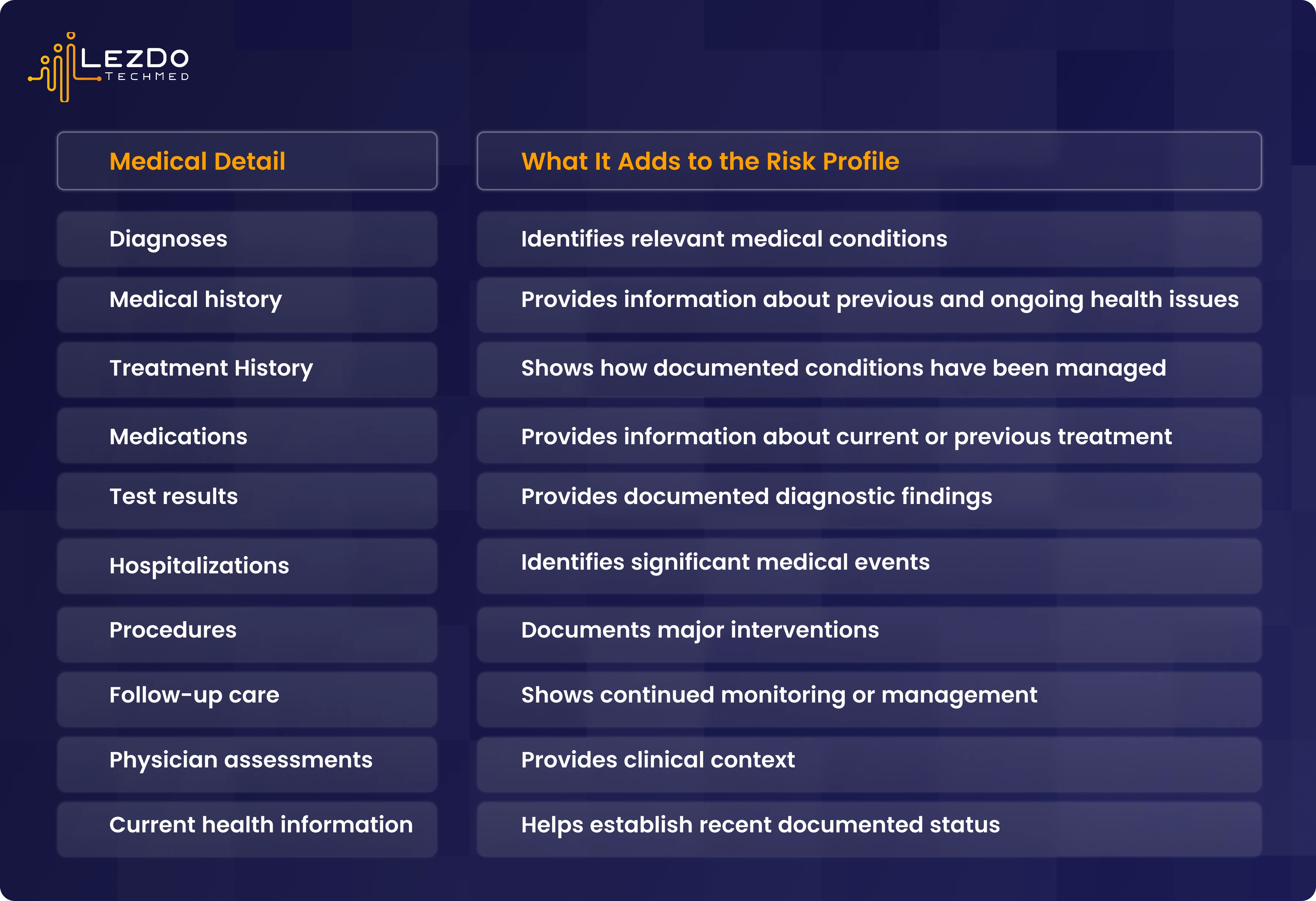
The relevance of medical information depends on what it tells the underwriter about the applicant’s health and medical management.
Key Medical Details in an APS Summary
The value of these details comes from how they connect with one another, rather than simply appearing as separate entries in a summary.
Why Medical Findings Need Clinical Context
An APS summary can contain many medical findings, but individual findings may not provide enough context for underwriting review. Clinical context helps show how those findings relate to the applicant’s broader medical history.
Diagnoses
A diagnosis identifies a condition, but related documentation may provide information about its history, treatment, progression or current status.
Medications
A medication can indicate treatment, but the prescription alone may not establish the reason for use, treatment changes, or response.
Diagnostic Results
A test result may require information about why the test was performed, the physician’s interpretation, and any subsequent follow-up.
Related Conditions
When several conditions appear in the same medical history, their individual documentation may need to be considered together to understand the applicant’s overall health.
The key point is that medical evidence gains meaning from its surrounding clinical documentation.
“The real value of an APS summary is not fewer pages. It is a clearer view of the medical evidence.”
How APS Summaries Help Underwriters Complete Their Review
An APS summary supports the underwriting review by providing an organized reference to relevant medical information.
It can help underwriters:
Review complex medical histories systematically.
Follow relevant conditions over time.
Connect diagnoses with treatment information.
Consider information documented by multiple providers.
Identify findings that may require closer review.
Recognize missing or unclear information.
Locate relevant information in the source records.
The summary does not replace the original medical records. It also does not make the underwriting decision on behalf of the underwriter.
Instead, it helps organize the documented medical evidence so the underwriter can conduct the appropriate review.
When additional questions arise, the underwriter can refer back to the underlying records for clarification or further detail.
Building the Full Risk Picture
10
Key Health Factors Connected
APS summaries organize conditions, treatments, tests, medications, and current status.
3
Layers of Clinical Context
Diagnosis, management, and follow-up reveal more than isolated medical findings.
7
Review Tasks Simplified
Structured APS summaries help underwriters review, connect, flag, and verify medical evidence.
Frequently Asked Questions About APS Summaries in Underwriting
What is an APS summary in insurance underwriting?
An APS summary is a structured overview of an applicant’s medical records that highlights relevant diagnoses, treatments, medications, test results, follow-up care, and current documented health status.
Do APS summaries replace the original medical records?
No. APS summaries organize relevant information for easier review, but underwriters may still need to refer to the original records for clarification or additional details.
What medical information is included in an APS summary?
An APS summary may include diagnoses, treatment history, medications, diagnostic and laboratory findings, hospitalizations, procedures, specialist care, follow-up visits and current documented health status.
Can an APS summary make the underwriting decision?
No. The summary supports the underwriter by presenting medical evidence clearly, but the final risk assessment and underwriting decision remain with the underwriter.
Why are APS summaries valuable in risk assessment?
They reduce the complexity of reviewing scattered medical records and help underwriters build a clearer, more complete view of the applicant’s documented health history and risk factors.
Can APS summaries help underwriters assess current health status?
Yes. A well-structured APS summary distinguishes historical conditions from ongoing issues, recent diagnoses, current treatment, documented improvement, and continuing concerns.
Conclusion
A complete risk profile requires an understanding of relevant medical conditions, their management, diagnostic findings and current documented status.
APS summaries support this review by organizing information that may otherwise be scattered across multiple medical records. They can help underwriters identify relevant evidence, understand its clinical context, and recognize areas that may require additional documentation.
The value of an APS summary isn't simply in reducing the volume of records an underwriter must read. It is in presenting relevant medical information in a structured form that supports a more focused and informed underwriting review.
Source Credit : All metrics derived from LezDo TechMed’s internal project data.
Jerin Jose Nesamony
Jerin Jose Nesamony is the Founder and CEO of LezDo TechMed, a medical data analysis company he established in 2013 with a background in healthcare operations and multispecialty hospital settings. Skilled in bridging complex medical documentation with legal and insurance workflows, he understands the precision and compliance demands that drive high-stakes medico-legal decisions. He leads LezDo TechMed's work in pairing technology-assisted workflows with human medical review, helping law firms, insurers, IMEs, QMEs, and life care planners across the U.S. organize and review medical records with greater efficiency.















.png)


