How to Handle Duplicate Medical Records When Building a Chronology
Duplicate records should be compared before they are excluded from a chronology.
Similar records may contain meaningful differences that need to be preserved.
Exact duplicates should not be counted as separate clinical events.
Source references help reviewers verify chronology entries without repeating duplicate information.
Duplicate medical records should be identified, compared and verified before they are included in a medical chronology. Reviewers should determine whether records are exact duplicates, overlapping records or different versions. Confirmed duplicates should not create repeated clinical events, while meaningful differences should be preserved and clearly documented.
Medical records in legal cases are often compiled from various sources and may not follow a clear chronological order. The file may contain documents from multiple providers, separate record submissions, duplicate PDF pages and repeated versions of the same encounter.
When these records are used to build a medical chronology, simply removing everything that looks duplicated can create new problems. A record that appears to be a duplicate may contain additional information, a correction or a meaningful difference.
The goal is not to remove information. It is to create an accurate treatment timeline while preserving meaningful differences between records.
This blog explains how reviewers can identify duplicate medical records, determine how they should be handled and maintain an accurate medical chronology.
8 checks help distinguish duplicates from meaningful records
Dates, providers, document types, content, pages, sources, versions, and unclear records should be reviewed before classification.
What Are Duplicate Medical Records?
Duplicate medical records are repeated copies of the same medical information within a patient's record set. They may appear because the same document was produced by different sources, included in multiple record batches or scanned more than once.
Not every similar-looking document is an exact duplicate. A reviewer should compare the content before deciding how to handle it.
Common situations that can cause confusion during duplicate review include:
Exact duplicates: The same document appears more than once.
Near duplicates: Two documents look almost identical but may contain small differences.
Overlapping records: Different providers document the same clinical encounter from their own perspective.
Different versions: A record may have been corrected, amended, or updated.
Duplicate pages: Individual pages may be repeated within a larger PDF or medical record production.
Why Do Duplicate Records Appear in Legal Case Files?
Duplicate medical records can appear for several reasons during medical record collection and litigation. The same information may be requested, exported or provided more than once, even when it represents a single clinical event.
As a result, a large medical record set may contain many repeated pages without indicating an equal number of distinct medical events.
Common causes include:
Multiple requests for records from the same provider
Separate medical record productions or batches
Records received from both a provider and another source
Repeated pages within scanned documents
Electronic health record exports
The same clinical note appearing in different record sections
Amended or corrected documentation
Multiple copies saved in different files
How Do Duplicate Records Affect a Medical Chronology?
Duplicate medical records can make a patient's treatment appear more extensive than it was if the same clinical event is entered more than once in the medical chronology. It can affect both the accuracy and usability of a chronology.
For instance, if the same emergency department visit appears three times in the source records and the reviewer creates three separate chronology entries, the timeline may incorrectly suggest that the patient had three visits instead of one.
Duplicate records can also:
Inflate the apparent frequency of treatment
Create confusion about the source of information
Make treatment dates more difficult to verify
Add unnecessary entries to the chronology
Increase review time for attorneys, paralegals, claims professionals, and medical experts
Increase the risk that meaningful differences between records will be overlooked
Duplicate records can affect how different legal professionals review and use a medical chronology. What lawyers focus on and what adjusters look for may differ depending on the purpose of the review.
What Does a Chronology Look Like When Duplicate Records Are Handled Correctly?
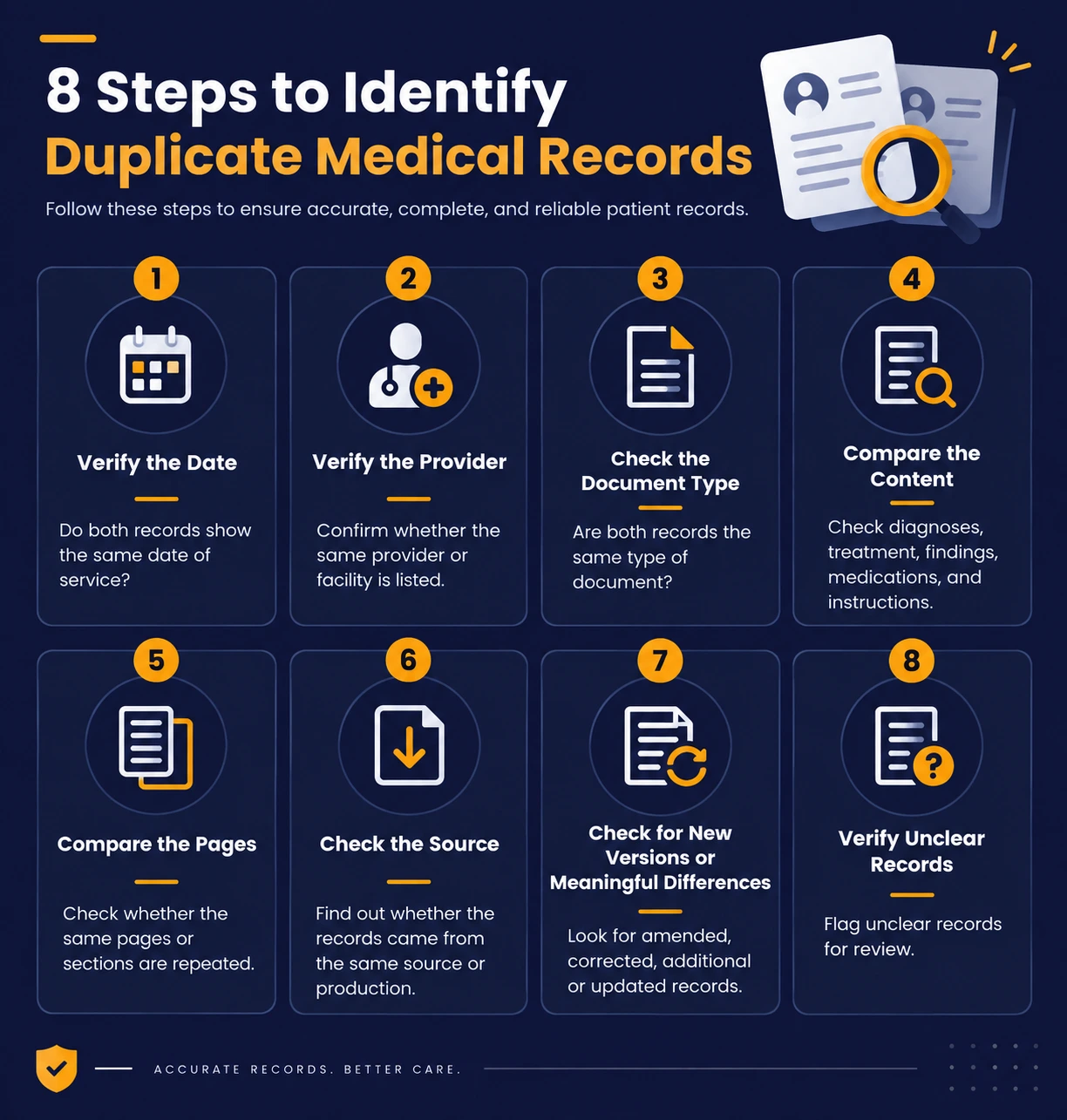
How Can Reviewers Identify Duplicate Medical Records?
Reviewers should compare records using several identifying details rather than relying on appearance alone.
How Should Reviewers Handle Duplicate Records When Building a Chronology?
Reviewers should follow a consistent process when duplicate records are found during chronology preparation. The goal is to determine whether the records describe the same clinical event and whether any record contains information that should be included.
A practical approach is:
1. Identify the suspected duplicate
Mark the records that appear to represent the same document or clinical event.
2. Compare the records
Review the dates, providers, content, page references, and source information.
3. Confirm whether they represent the same event
Don't assume that similar records describe the same encounter. Confirm the relationship between them.
4. Check for additional information
Determine whether one copy contains information that is missing from another.
5. Decide where the record belongs in the timeline
Avoid creating a separate entry for an exact duplicate.
6. Preserve relevant source information
The reviewer should maintain enough source information to allow the underlying record to be located and verified.
7. Flag meaningful differences
If two copies contain different or conflicting details, the difference should be identified instead of combined without noting the difference.
8. Review the timeline again
After handling duplicates, check the surrounding chronology to make sure treatment frequency, sequence, and gaps still make sense.
This approach keeps the chronology focused on the patient's actual medical history rather than the number of times a document appears in the production.
“An accurate chronology counts clinical events, not copies of documents.”
Should Duplicate Medical Records Be Removed from a Chronology?
Not always. The decision depends on whether the record is an exact duplicate or contains additional medical information.
If two records are exact copies of the same document and describe the same clinical event, only one chronology entry is generally needed. The duplicate can remain in the underlying case record for reference.
Before excluding a record, reviewers should check for:
Corrections or amendments
Additional pages or clinical details
Updated findings or treatment information
Different signatures or timestamps
If the record contains meaningful information that is not in the other copy, that information should be retained in the chronology. The goal is to avoid duplicate entries without losing relevant medical details.
How Should Different Versions of the Same Medical Record Be Handled?
Different versions of a medical record require closer review. Reviewers should compare the versions rather than automatically treating one as a duplicate.
If the difference could affect the patient's medical history or the legal review, it should be preserved and clearly identified.
Reviewers should check for:
Corrections
Addenda
Signatures
Different timestamps
Handwritten notes
Additional pages
Updated findings
Version dates or timestamps
Changes in diagnosis or treatment information
How Should Duplicate Records Be Documented in a Medical Chronology?
Duplicate records should be documented in a way that allows each chronology entry to be traced back to its supporting medical record.
Reviewers should record the source, page number or other identifying reference for the record used to support the entry. This allows the information to be verified later without creating separate entries for repeated copies.
Clear source documentation makes the chronology easier to verify and audit.
What Should Reviewers Check Before Completing the Medical Chronology?
Before finalizing a chronology, reviewers should complete a final duplicate record check.
Exact duplicate records have been identified.
Near duplicate records have been compared.
Different versions have been reviewed.
Repeated documents have not been counted as separate clinical events.
Meaningful differences have been preserved.
Relevant source information remains traceable.
Conflicting information has been flagged.
Treatment frequency has not been inflated by duplicate entries.
The final timeline accurately reflects the documented clinical events.
This final review can catch duplicate entries that were missed during the initial record review.
The Duplicate Record Check
8
Checks Before Classification
Compare dates, providers, content, pages, sources, and versions before calling a record a duplicate.
1 Event
Not Multiple Entries
Exact duplicates should not turn one clinical encounter into repeated chronology events.
100%
Traceable Sources
Keep page numbers and source references so every chronology entry can be verified.
Frequently Asked Questions About Duplicate Medical Records in a Chronology
What are duplicate medical records?
Duplicate medical records are repeated copies of the same medical document or clinical information in a record set. They can come from multiple record requests, productions, providers, or scanned files.
How do you identify duplicate medical records?
Compare the date of service, provider, document type, content, pages, and source information. Also check whether one record is an amended or updated version of another.
What is the difference between duplicate and overlapping medical records?
Duplicate records contain the same information, while overlapping records may document the same encounter from different providers or perspectives. Overlapping records may contain unique clinical details that should be retained.
Can duplicate medical records affect legal cases?
Yes. Repeated records can distort the apparent frequency of treatment, create timeline confusion, and make important differences harder to identify during legal medical record review.
How can duplicate records be prevented from affecting a medical chronology?
Reviewers should verify suspected duplicates before entering them into the chronology and maintain source references for traceability. A final duplicate check can help catch repeated entries before completion.
How do you handle duplicate records in a medical chronology?
Reviewers should identify, compare, verify, and classify suspected duplicates before creating chronology entries. Exact duplicates should not be counted as separate clinical events.
Should duplicate medical records be removed from a chronology?
Not always. Exact duplicates usually need only one chronology entry, but records containing additional or changed information should be reviewed and preserved.
To wrap up,
Duplicate medical records can occur frequently in large legal record sets, but they require careful review before being included in a chronology.
The better approach is to identify, compare, verify and classify each suspected duplicate. Exact duplicates may require only one chronology entry, while different versions or records containing additional information require closer review.
A well-prepared medical chronology should reflect the patient's actual treatment history without allowing repeated documents to distort the timeline. A consistent duplicate review process helps reviewers maintain accuracy while keeping the chronology clear and useful for legal case review.
Source Credit : All metrics derived from LezDo TechMed’s internal project data.
Jerin Jose Nesamony
Jerin Jose Nesamony is the Founder and CEO of LezDo TechMed, a medical data analysis company he established in 2013 with a background in healthcare operations and multispecialty hospital settings. Skilled in bridging complex medical documentation with legal and insurance workflows, he understands the precision and compliance demands that drive high-stakes medico-legal decisions. He leads the development of technology-driven solutions — including the proprietary CaseDrive platform — that help law firms, insurers, IMEs, QMEs, and life care planners across the U.S. streamline medical record review, improve case outcomes, and operate with greater efficiency.














.png)



.webp)