Home
>
Blog
>
>
Deposition Summaries for Medical Malpractice Cases
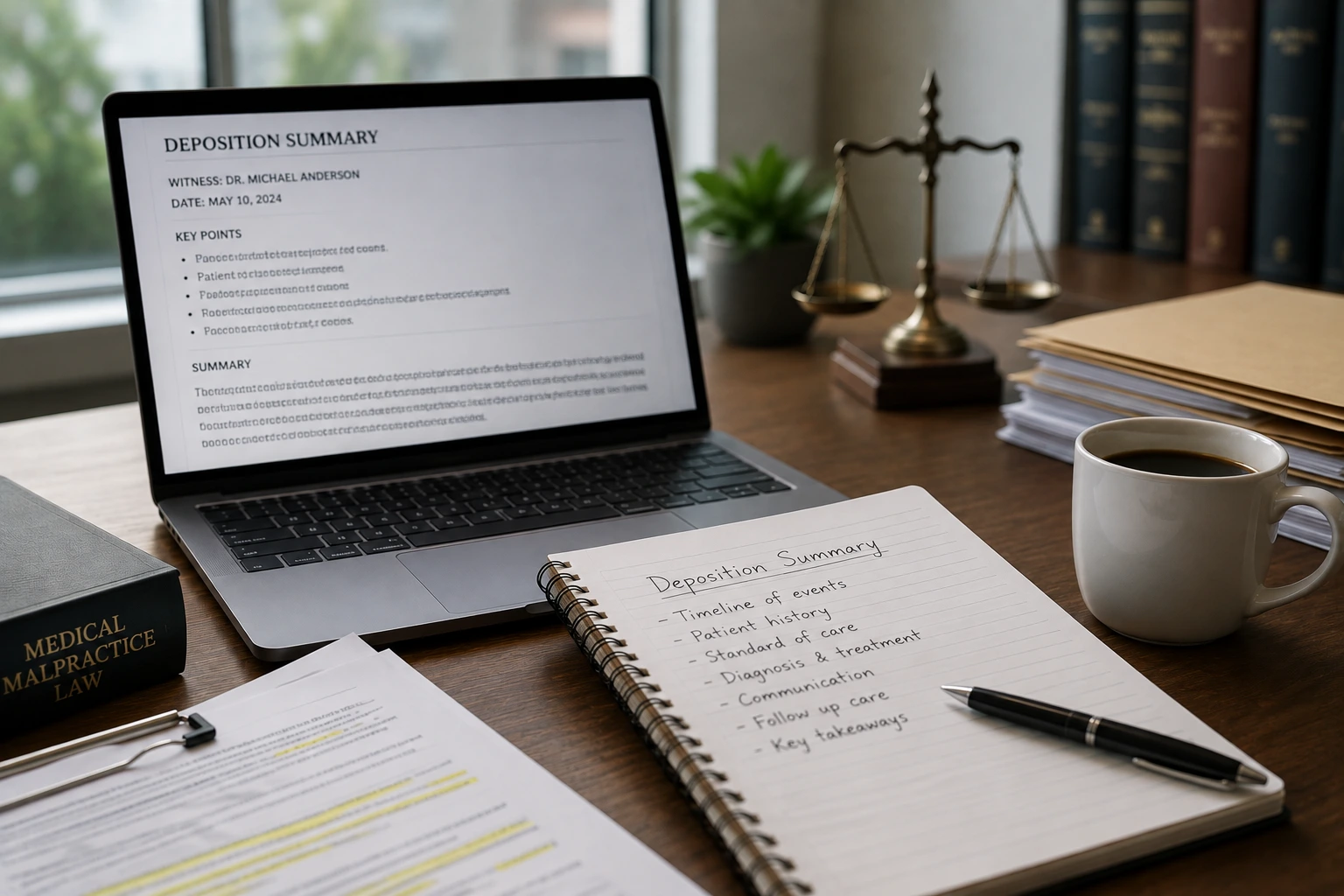
Medical malpractice cases are decided on sworn testimony, and a deposition summary is how that testimony becomes usable. Here is what a malpractice summary has to do:
- Capture the standard-of-care testimony: what each expert says the standard was and whether it was met, quoted and cited to the page and line.
- Preserve the defendant provider's admissions: the moments a treating provider concedes a deviation or a different choice, exactly as stated.
- Track the opinion and its basis: an expert's conclusion is only as strong as the reasoning under it, and that reasoning is impeachment material.
- Cross-reference against the chronology: testimony that conflicts with the medical record is where malpractice cases turn.
Read on for what a malpractice deposition summary must capture, and the line it does not cross.
Medical malpractice cases live or die on two things: the medical record and what the witnesses say under oath about it. The depositions in these cases are dense, technical, and expert-heavy, and the summary of them is what turns hours of testimony into something an attorney can actually use at trial. Buried in a standard-of-care expert's deposition is the one admission that changes the case, and a summary is how you find it fast.
Start with the definition. A deposition summary condenses a deposition transcript into its key statements, admissions, and facts, with each point tied back to the page and line of the transcript. In a malpractice case, that testimony is unusually loaded: it is where the standard of care gets defined, where causation gets contested, and where a provider either holds the line or gives something away. A malpractice deposition summary is not a shorter transcript. It is a map to the testimony that decides the case.
Why are medical malpractice depositions different?
Malpractice depositions are different because the central question, whether the care met the standard, can only be answered through expert testimony. That makes these depositions technical and opinion-heavy in a way most are not. A retained expert lays out what the standard of care required and whether it was met. A treating or defendant provider explains what they did and why. Both are giving testimony that turns on clinical detail, and the summary has to capture that detail precisely, because a paraphrase that softens a word can lose the admission entirely.
Malpractice cases carry high stakes and heavy testimony
U.S. physician malpractice payouts totaled about 36.5 billion dollars from 2012 to 2022 (National Practitioner Data Bank). Cases at that stake are decided on expert testimony, which is what a deposition summary organizes.
Capturing the standard-of-care testimony
The first thing a malpractice deposition summary has to capture is the standard-of-care testimony, in the witness's own words. When an expert states what the standard required, or concedes a point about it, the exact wording matters, because the defense and the plaintiff will read the same lines very differently. A summary that reports "the expert discussed the standard of care" is close to useless. One that captures what the expert actually said, quoted and cited to the page and line, is the version an attorney can take into cross. The summary reports the testimony; it does not judge whether the standard was met. That determination belongs to the attorneys and the experts.
Preserving the provider's admissions
The second thing a malpractice summary must preserve is the admission. In a defendant provider's deposition, the decisive moments are often small: a concession that a step was skipped, that a result would have changed an approach, or that a different choice was available. These are easy to miss in a long transcript and easy to flatten in a careless summary. Capturing them exactly, and flagging them, is a large part of what makes the summary worth having. This is also why the summary has to distinguish a retained expert's deposition from a treating provider's, because what each one must capture is not the same.
Handling a malpractice deposition and need the testimony that matters surfaced?
Tracking the opinion and the reasoning under it
The third thing a malpractice summary does is separate an expert's conclusion from the basis the expert gives for it. An opinion on the standard of care or on causation is only as durable as the reasoning and the facts under it, and that reasoning is exactly where cross-examination and any reliability challenge go to work. A summary that captures both the opinion and its stated basis, cited to the transcript, hands the attorney the raw material for impeachment. What the summary never does is weigh whether the opinion is right. It organizes the testimony and cites it; the reliability call belongs to the court and the attorneys.
Reading the testimony against the medical record
The fourth thing a malpractice summary supports is the comparison that decides many of these cases: testimony against the chart. When a witness's account of the treatment conflicts with what the records document, that gap is often the case. A summary that is built to be cross-referenced against the medical chronology makes those conflicts findable, and a summary that flags contradictions as it goes saves the attorney from discovering them late. The summary surfaces and cites the conflict. Whether it establishes a breach or causation is the attorney's and the expert's call.
In a malpractice case, the deposition summary does not decide the standard of care. It captures the testimony precisely enough that the argument can be won on the record.
Where AI helps with a malpractice deposition summary, and where it does not
AI speeds up the first pass. It can index a long transcript, locate where the standard of care and causation come up, and draft a rough summary faster than a person alone, which matters when a malpractice case carries several expert depositions. What AI cannot reliably do is tell a real admission from a hedge, hold the clinical context that gives a line its weight, or notice that a phrasing quietly concedes more than it appears to. That is why a dependable malpractice summary pairs AI drafting with a trained medical reviewer who checks each key line against the transcript before it is relied on.
The boundary is worth stating plainly, because malpractice is where the temptation to cross it is strongest. A deposition summary organizes, captures, and flags what the witness said, and it cites the page and line. It does not decide whether the care met the standard, whether the breach caused the injury, or who is liable. Those are determinations for the retained experts and the attorneys. The summary's job is to make the testimony accurate, complete, and traceable, so the professionals can argue it on a record no one can accuse of leaning.
What a summary brings to a malpractice deposition
$36.5B
Physician payouts, 2012-2022
Reported to the National Practitioner Data Bank over the decade. (NPDB)
Standard of care
The core question
Most malpractice cases turn on expert standard-of-care testimony given under oath.
2
Deposition types to capture
Retained-expert and treating-provider depositions each need a different summary focus.
Frequently Asked Questions
How do deposition summaries support medical malpractice cases?

They condense dense, expert-heavy depositions into their key testimony, capturing standard-of-care statements, provider admissions, and causation testimony, each tied to the page and line. That gives attorneys a fast, sourced map to the testimony that decides the case.
What should a malpractice deposition summary capture that a general one might not?
The standard-of-care testimony in the witness's exact words, the defendant provider's admissions, and each expert opinion together with the basis given for it. In malpractice, a paraphrase that softens the wording can lose the admission entirely.
Does a deposition summary decide whether the standard of care was met?
No. A summary captures and cites what the witness said. Whether the care met the standard, and whether any breach caused the injury, are determinations for the retained experts and the attorneys, not for the summary.
How does a summary help with expert depositions in malpractice cases?
It separates the expert's conclusion from the reasoning and facts beneath it and cites both to the transcript. That gives the attorney the raw material for cross-examination and any reliability challenge, without the summary judging the opinion itself.
Why cross-reference a deposition summary against the medical record?
Because many malpractice cases turn on a conflict between what a witness testified and what the chart documents. A summary built to be checked against the medical chronology makes those conflicts findable early, instead of at trial.
Can AI write a malpractice deposition summary on its own?
AI can index the transcript and draft a first pass quickly, which helps when a case has multiple expert depositions. It cannot reliably tell an admission from a hedge or hold clinical context, so a trained reviewer checks each key line against the transcript.
A deposition summary supports a medical malpractice case by making the testimony that decides it usable. It captures the standard-of-care statements in the witness's own words, preserves the provider's admissions, tracks each opinion and the reasoning under it, and lines the testimony up against the medical record, all while staying on the organizing side of the line and off the opinion side. Get the summary right and the attorney walks into cross with the exact page and line, instead of hunting for it.
Ready for malpractice deposition summaries that capture the admissions and hold up against the record? Partner with LezDo TechMed, or start with a free trial and see how the testimony reads when it is done right.
Source Credit : All metrics derived from LezDo TechMed’s internal project data.
Anjana Devi Vijay
Anjana Devi Vijay is a Certified Legal Nurse Consultant (CLNC) and Medical–Legal Research Analyst with 9+ years of experience in medical record review, deposition summary analysis, and medico-legal research. She specializes in transforming complex healthcare documentation into accurate, actionable insights that support attorneys, insurers, and medical evaluators. With expertise in clinical documentation analysis and legal case support, she creates research-driven content focused on improving decision-making and case outcomes.













.png)