Home
>
Blog
>
>
Defending and Proving Cumulative Trauma: Why the Timeline Is Everything
A cumulative trauma claim has no single date of injury, so the case turns on a timeline rebuilt from the records. Here is what defense firms, IMEs and applicants' attorneys need to know.
- No single date of injury: Under Labor Code section 5412, a cumulative trauma claim's date of injury is when disability began and the worker knew, or should have known, it was work-related, which is why the timeline is contested.
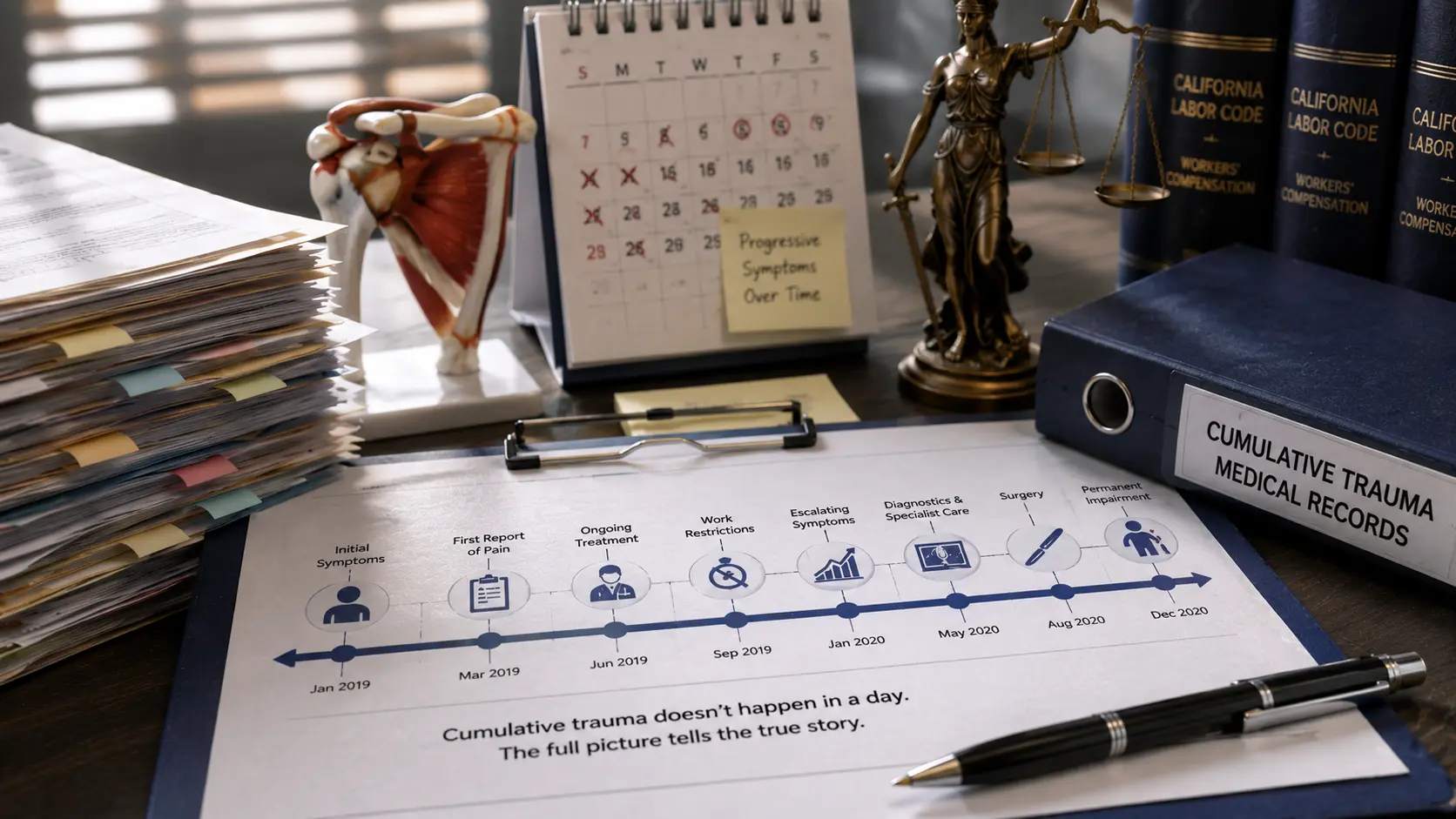
- The chronology is the evidence: In a cumulative trauma case the disputed facts are dates and sequence, so a source-linked medical chronology does much of the evidentiary work.
- 37.5% and climbing: Cumulative trauma is now roughly 37.5% of all California workers' compensation claims, and most recent CT claims are filed after employment ends.
- We organize, the professional decides: LezDo TechMed builds the timeline; the QME or IME physician and counsel determine causation, apportionment and the date of injury.
Read on for why the missing date of injury drives the whole dispute, and what a court-ready timeline documents.
A cumulative trauma claim does not come with a date. A worker slips on a Tuesday and hurts a knee, and everyone knows when the injury happened. A worker who develops back or shoulder problems over eight years of lifting has no such moment. That single missing fact, the absence of one clear date of injury, is why cumulative trauma cases turn into long discovery fights, and why so much of the outcome rides on a timeline that has to be rebuilt from the records.
This matters more in California than anywhere else. Cumulative trauma (CT) claims now make up roughly 37.5% of all workers' compensation claims in the state, more than double their share in 2022, and California remains the only state that permits CT stress claims. That growth has pulled attention from the Workers' Compensation Appeals Board (WCAB) and the California Insurance Commissioner toward rising medical-legal fees and prolonged discovery. For defense firms, independent medical examiners (IMEs) and applicants' attorneys, the practical problem is the same on both sides: the record has to establish when the condition began, and against which period of employment.
Source Credit: Laughlin, Falbo, Levy & Moresi LLP, "2026 Forecast in California Workers' Compensation."
A cumulative trauma claim is defined by repeated exposure, not a single event
Cumulative trauma is an injury that develops from repetitive activities or exposures over a period of time, rather than from one identifiable incident. Think of repeated lifting, typing, standing, or exposure to a workplace condition that produces harm gradually. Because the harm accumulates, there is no accident report, no single emergency-room visit, and no obvious first day. The medical picture builds slowly, often across more than one job and more than one insurer.
That is the operational difference that everything else flows from. A specific injury gives you a clean anchor to organize the file around. A CT claim gives you a range, and the range is contested.
Why the missing date of injury drives the whole dispute
For a cumulative injury, California does not use the first symptom or the first day of exposure as the date of injury. Under Labor Code section 5412, the date of injury is the date the worker first suffered disability from the condition and knew, or with reasonable diligence should have known, that the disability was caused by the employment. Both parts have to line up: actual disability, plus knowledge that work caused it.
That definition sounds technical, but it decides real questions. It sets the statute of limitations. It interacts with Labor Code section 5500.5, which generally assigns liability to the last year of injurious exposure, so it helps determine which employer or carrier is on the hook. And it frames the apportionment analysis, because you cannot separate work-related contribution from a pre-existing or non-industrial condition until you can see, in dates, what came before the exposure and what came after.
So the fight is rarely about whether the worker has a real condition. The fight is about timing. When did disability begin? When did the worker know it was work-related? What was already documented before the claimed period of exposure started? Every one of those is a question the records can answer, but only if the records are assembled into a timeline instead of a stack.
Cumulative trauma in California, in one number
Cumulative trauma claims now make up roughly 37.5% of all California workers' compensation claims, more than double their 2022 share, and California remains the only state that permits CT stress claims. About 58% of recent CT claims are filed after employment ends, and nearly all of those involve litigation.
The timeline is the evidence
Here is the part that gets underestimated. In a CT case, the disputed facts are dates and sequence, so the medical chronology sits close to the evidence itself rather than off to the side as a convenience document.
A medical chronology is a date-ordered account of a claimant's documented medical history, built from the records with each entry traceable back to its source page. In a cumulative trauma matter, a well-built chronology lets a reviewer see, side by side:
- the first documented complaint or symptom, and the date it appears in the records
- prior treatment for the same body part before the claimed period of exposure
- the span of employment and the claimed exposure window
- gaps, and the points where the worker sought or stopped care
Line those up and the questions that drive the case become answerable with documents rather than argument. A defense firm or an IME can see whether a shoulder was already under treatment years before the exposure period. An applicant's attorney can show a clean progression that supports a compensable claim. The same organized record serves both purposes, because organizing the timeline is not the same as deciding what it means.
Turn cumulative trauma records into a defensible timeline
Where these cases break down
The problem in practice is almost never a shortage of records. It is the opposite. The records arrive from multiple providers, across years, often across more than one employer, frequently out of order and with duplicates. The one prior-treatment note that changes the apportionment picture is real, but it is sitting on page 4,300 of a set that nobody has time to read line by line before a deposition or a panel QME evaluation.
The timing pressure has gotten worse, too. In recent California data, about 58% of CT claims were filed after employment had already ended, up from 44% a decade earlier, and nearly all of those post-termination claims involve litigation. That means more of these files land as contested matters from day one, with discovery disputes and rising medical-legal cost built in. Medical-legal services now account for a growing share of the paid medical cost on CT claims, which is exactly the trend regulators have started to scrutinize.
Source Credit: Workers' Compensation Insurance Rating Bureau of California (WCIRB) data, reported by Risk & Insurance, "California Cumulative Trauma Claims Surge."
When the case turns on sequence and the sequence is buried, the reconstruction of the timeline is the work. Do it well and the evaluating professional can reach a defensible conclusion faster. Do it poorly and everyone spends the next several months arguing about what the file actually says.
The teams that handle cumulative trauma well are not the ones with the most records. They are the ones who turned the records into a timeline first.
What organizing the record does, and what it does not do
This is where the line has to stay clear. LezDo TechMed extracts, organizes, cross-references and flags the documented medical information so the appropriate qualified professional can evaluate it. We build the chronology. We do not decide the case.
We do not determine causation, apportionment, whether a condition is pre-existing, disability, or the date of injury. Those are conclusions for the QME or IME physician, the defense counsel, and the applicant's attorney to reach on the evidence. What a medical record review partner can do is make sure the evidence is complete, in order, traceable to its source, and fast enough to be useful before the next deadline. The professional still owns the opinion. We make the opinion easier to support or challenge, because it is grounded in a clean record instead of a pile of PDFs.
That distinction is the whole value. A chronology that quietly took a position would be worth less, because the other side would spend the deposition attacking the reviewer instead of engaging the medicine.
Where LezDo TechMed fits
For cumulative trauma matters, the relevant service is the medical chronology, supported by sorting and indexing when the records arrive as a large unstructured set. LezDo TechMed organizes the documented history into a date-ordered, source-linked timeline that isolates first-symptom dates, prior treatment, and the claimed exposure window, so IMEs, QMEs and counsel on either side can run their own apportionment and causation analysis on an evidence base they can trust.
Standard medical chronology deliverables are generally completed within 48 hours once scope is confirmed, depending on record volume, with the review passing through a three-layer quality-control process supported by medical and paramedical reviewers. On large workers' compensation programs, that turnaround is often the difference between walking into a panel QME evaluation prepared and walking in still trying to figure out what the file says.
Source Credit: LezDo TechMed published service figures.
The cumulative trauma numbers that shape the fight
37.5%
Share of CA workers' comp claims
Cumulative trauma now accounts for roughly 37.5% of all California workers' compensation claims, more than double its 2022 share.
58%
CT claims filed post-termination
About 58% of recent CT claims are filed after employment ends, up from 44% a decade earlier, and nearly all involve litigation.
48 hours
Medical chronology turnaround
Standard medical chronology deliverables are generally completed within 48 hours once scope is confirmed, depending on record volume.
Frequently asked questions
What is the date of injury in a California cumulative trauma claim?

Under Labor Code section 5412, the date of injury for a cumulative trauma claim is the date the worker first suffered disability from the condition and knew, or reasonably should have known, that the disability was caused by employment. It is not the first symptom or the first day of exposure. Both the disability and the knowledge of its work-relatedness must be present.
Why are cumulative trauma claims harder to litigate than specific injuries?
A specific injury has a single, documented date. A cumulative trauma claim develops over time, so the date of injury, the period of exposure, the liable employer, and the apportionment analysis all have to be reconstructed from the records. That reconstruction is where most of the discovery disputes happen.
How does a medical chronology help in a cumulative trauma case?
A medical chronology arranges the claimant's documented medical history in date order with each entry linked to its source page. In a CT case, that lets a reviewer isolate the first documented symptom, prior treatment for the same body part, and the claimed exposure window, which are the facts that drive causation and apportionment questions.
Does a medical record review company decide causation or apportionment?
No. A medical record review partner such as LezDo TechMed organizes, cross-references and flags the documented medical information. The qualified professional, meaning the QME or IME physician and the attorneys, evaluates causation, apportionment, and whether a condition is pre-existing.
How common are cumulative trauma claims in California?
Cumulative trauma claims now account for roughly 37.5% of all California workers' compensation claims, more than double their 2022 share, and California is the only state that permits CT stress claims. A large majority of recent CT claims are now filed after employment ends, and nearly all of those involve litigation.
Source Credit: cumulative trauma claim-share and post-termination figures per Laughlin, Falbo, Levy & Moresi LLP (2026 California workers' compensation forecast) and WCIRB data reported by Risk & Insurance; the turnaround figure is a LezDo TechMed published service figure.
Cumulative trauma cases will keep growing in California, and the scrutiny on discovery cost will grow with them. The teams that handle them well will not be the ones with the most records. They will be the ones who turned the records into a timeline first.
Source Credit : All metrics derived from LezDo TechMed’s internal project data.
Jerin Jose Nesamony
Jerin Jose Nesamony is the Founder and CEO of LezDo TechMed, a medical data analysis company he established in 2013 with a background in healthcare operations and multispecialty hospital settings. Skilled in bridging complex medical documentation with legal and insurance workflows, he understands the precision and compliance demands that drive high-stakes medico-legal decisions. He leads LezDo TechMed's work in pairing technology-assisted workflows with human medical review, helping law firms, insurers, IMEs, QMEs, and life care planners across the U.S. organize and review medical records with greater efficiency.













.png)