APS Summary for Attorneys: Key Medical Details in Legal Case Review
An APS summary is a structured overview of relevant medical information documented in an Attending Physician Statement (APS).
Attorneys may review diagnoses, symptoms, treatment, diagnostic findings, major medical events, and functional limitations.
Important findings should be traceable to the underlying medical records.
An APS summary does not independently establish causation, disability, or functional capacity.
Original records may be needed to understand findings in the full clinical context.
An APS summary provides attorneys with a quick view of the medical information that may be relevant to a case. It brings together key details from the patient’s records including medical conditions, symptoms, treatment, test results, major medical events and functional limitations. Attorneys can use this information to see which areas may need a closer look and refer to the original records when they need more detail.
Medical records may contain years of diagnoses, treatments, test results, and physician notes. Finding the information that matters to a legal case can therefore take time.
An APS summary gives attorneys a focused view of the documented medical history and can highlight events, findings, or conditions that may need additional context.
This blog explains which medical details to look for, why they matter during case review, and when the original records may need further examination.
What Is an APS Summary for Attorneys?
An APS (Attending Physician Statement) is a medical statement completed by a treating physician that provides information about a patient's documented medical history, diagnoses, treatment, symptoms, and other relevant clinical details. An APS summary for attorneys presents the medical facts from an Attending Physician Statement that are most relevant to legal case review in a structured, easy-to-navigate format. It makes it easier for legal teams to review information quickly without having to search through lengthy medical records.
A strong APS summary should answer practical review questions such as:
What diagnoses are documented?
When was the condition first documented in the available records?
What treatment was provided?
What medications were listed?
Were there work restrictions or functional limitations?
Are prior conditions mentioned?
Are any records missing?
Does the APS refer to outside providers, imaging, or tests not included in the file?
A strong APS summary does not rewrite the record into a legal argument. Instead, it presents relevant medical information in a structured format so the attorney can evaluate it more efficiently and decide which issues need more investigation.
5 Stages Where APS Summaries Can Support Attorneys
From initial case review to deposition and trial preparation, an APS summary can help legal teams locate relevant medical information more efficiently.
What Medical Details Should Attorneys Look for in an APS Summary?
Attorneys should first identify the medical details most relevant to the issues being reviewed. These may include the patient’s conditions, symptoms, treatment history, diagnostic findings, major medical events, and documented functional limitations.
Diagnoses and Medical Conditions
Attorneys should identify diagnoses that are relevant to the case and determine how they are described in the medical history.
Important details may include:
Diagnosis: The specific medical condition documented
Date first documented: When the condition was first noted in the medical record
Current or historical status: Whether the condition is ongoing or resolved
Related findings: Associated symptoms, test results, or clinical observations
Changes over time: How the diagnosis evolved or was modified
Symptoms and Clinical Complaints
Symptoms can help attorneys see what the patient was experiencing and whether those symptoms changed over time. It is also important to separate symptoms reported by the patient from findings noted by the physician and results from medical tests, as each provides different information about the patient’s condition.
The APS summary may provide details about:
Onset: When symptoms first began
Duration: How long symptoms have persisted
Frequency: How often symptoms occur
Severity: The intensity or impact of symptoms
Related symptoms: Other symptoms that occur together
These details can help clarify the patient's documented symptoms and show when the underlying records may be useful for additional context.
Treatment History
Treatment history may include medications, procedures, therapy, referrals, and other care documented for a relevant condition.
These details provide a record of the care documented in the APS and can be reviewed alongside symptoms, diagnostic findings, and physician notes.
How Can Treatment History Help Attorneys Understand Pre-Existing Conditions?
Treatment history can help attorneys understand how a pre-existing condition was managed before the issue being reviewed. Looking at earlier symptoms, treatment, diagnostic findings, and changes in care can provide a clearer view of the condition's documented history.
Example: Reviewing a Pre-Existing Condition
Suppose an APS documents a history of lower back pain, physical therapy, and intermittent medication use. These details can help an attorney locate the related physician notes, therapy records, imaging reports, and work-status documentation in the underlying file.
The summary itself does not establish whether the pre-existing condition caused a later injury or determined the patient's functional capacity.
Diagnostic Findings
Diagnostic findings can provide additional information about a documented condition and add context to the diagnosis or treatment recorded in the medical history.
Important diagnostic findings may require review of the original report because a summarized result may not contain the complete clinical context.
Hospitalizations and Major Medical Events
Attorneys may also need to identify major medical events such as:
Hospital admissions and length of stay
Emergency treatment or urgent care visits
Surgeries and major procedures
Documented complications or adverse events
Discharge summaries and follow-up care plans
Functional Limitations
Functional information can help attorneys understand how a documented medical condition affected the patient's ability to work or perform daily activities.
Where documented in the medical records, attorneys may look for:
Physical restrictions or limitations
Limitations in daily activities or self-care
Work-related restrictions or modifications
Mobility limitations or impairments
Activity limitations or precautions
Documented changes in functional ability over time
The summary should reflect what the medical documentation states. It should not independently determine whether a person is disabled or what their functional capacity is. Those determinations require expert analysis and review of the complete medical record.
Source References
Whenever possible, important medical details should be tied back to the part of the record where they were originally documented. This allows attorneys to go back to the physician’s note, test result, imaging report or other source when they need to verify a finding or understand it in more detail.
This is particularly helpful when an APS summary includes a diagnosis, treatment change, restriction or test result that may need to be checked against the original medical record.
How Can Attorneys Use an APS Summary During Case Review?
An APS summary can help attorneys organize medical information during different stages of case review. It can also highlight information that may point to areas requiring additional records or closer examination.
Initial Case Review: Provides a quick view of the patient's documented medical history and helps identify areas that may require further review.
Discovery and Record Requests: Can present references to outside providers, tests, procedures, or treatment that may not be included in the available records.
Deposition Preparation: Helps attorneys locate relevant dates, symptoms, treatment changes, and restrictions when preparing for a deposition.
Expert Review: Gives attorneys and experts an organized reference for locating medical issues before examining the complete record in greater detail.
Demand, Mediation, and Trial Preparation: Helps locate key medical events and supporting records when specific information needs to be reviewed quickly.
Want to See What an Attorney-Focused APS Summary Looks Like?
What the Timeline Can Reveal About a Medical Event
The timing of a medical event helps attorneys see where a diagnosis, symptom, treatment, or other finding fits into the patient’s medical history. This can be especially useful when reviewing what happened before and after an event related to the case.
Attorneys may need to establish the timing of:
First documented treatment or clinical contact
Initial diagnosis or problem identification
Diagnostic testing dates
Start of treatment or medication
Hospital admission or discharge dates
Surgery or other procedure dates
Specialist evaluations
Follow-up care appointments
Changes in treatment or clinical status
Looking at these dates together helps establish the sequence of medical events and whether a condition, treatment or finding was documented before or after another event. It can also help attorneys find the records related to a specific point in the patient’s medical history.
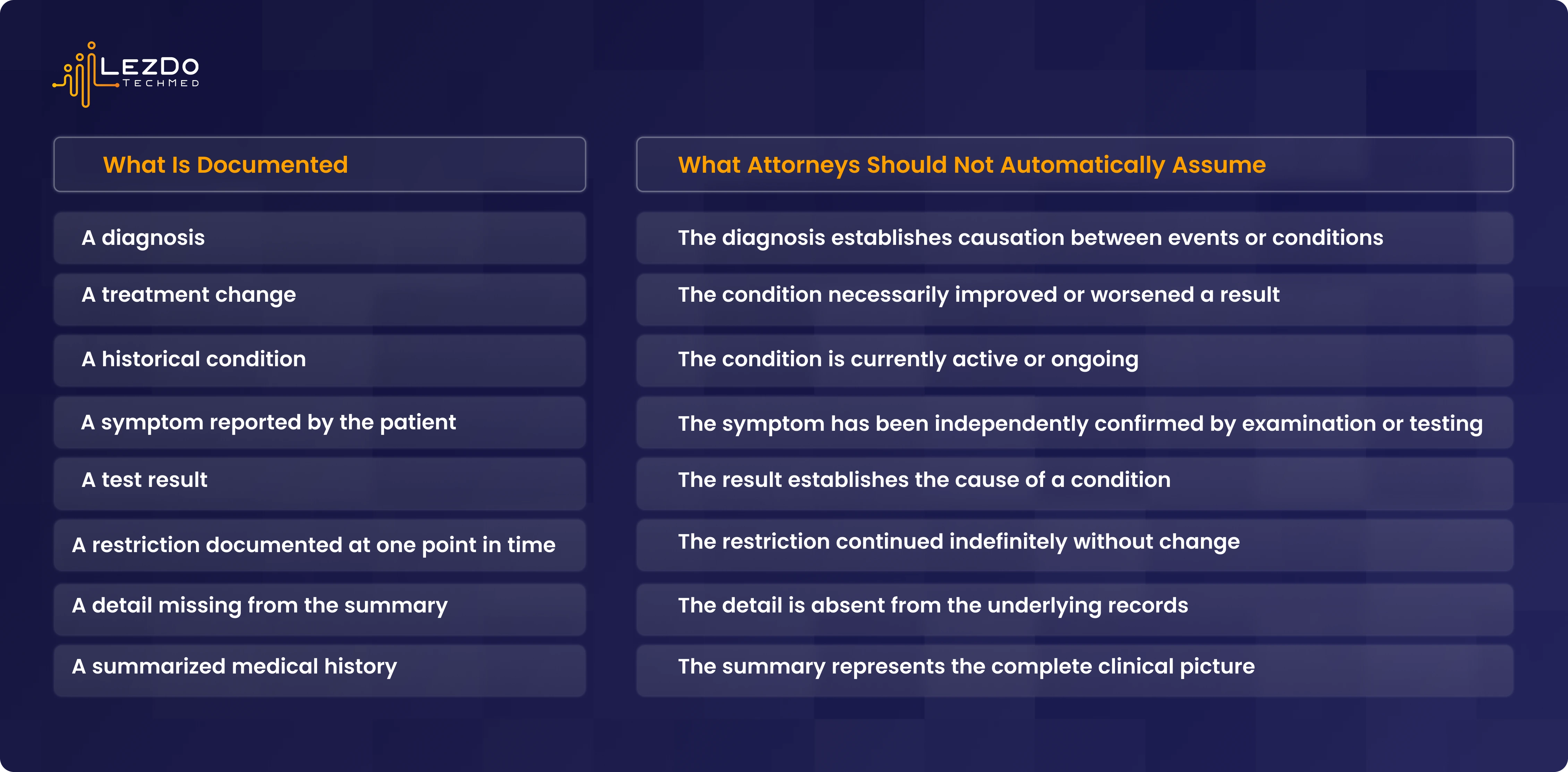
What Should Attorneys Not Assume from an APS Summary?
These distinctions help attorneys identify relevant medical information while keeping the documented context of each finding in view. Verifying important findings against the original medical records is always recommended before drawing conclusions.
“An APS summary can point attorneys to the right medical details, but the original records provide the full context.”
How Can LezDo TechMed Support APS Summary Review?
LezDo TechMed can help legal teams organize APS information into structured summaries covering diagnoses, symptoms, treatment, diagnostic findings, functional limitations, prior conditions, missing information, and source references. Quality checks help maintain accuracy and consistency.
This gives legal teams a clear reference for locating important medical information and identifying records that may need further review.
What Attorneys Can Find Faster
7
Key Medical Details
Review diagnoses, symptoms, treatment, tests, events, limitations, and sources.
10
Case-Review Uses
Support initial review, discovery, depositions, expert review, mediation, and trial preparation.
100%
Source-Traceable Findings
Important medical details can be checked against the underlying records for context.
Frequently Asked Questions About APS Summaries for Attorneys
What is an APS summary in a legal case?
An APS summary is a concise presentation of relevant medical information from an Attending Physician Statement, including diagnoses, treatment, symptoms, medications, and functional limitations.
What information is included in an APS summary?
An APS summary may include diagnoses, symptoms, treatment history, medications, diagnostic findings, hospitalizations, functional limitations, and relevant physician statements. Source references may also be included when available.
How can an APS summary help attorneys?
An APS summary gives attorneys a focused view of documented medical information without requiring them to search through every record initially. It can help identify important issues and records that may need closer examination.
Does an APS summary replace medical records?
No. An APS summary is a reference tool and does not replace the underlying medical records. Attorneys may need to review the original records to verify findings and understand the full clinical context.
Why are dates important in an APS summary?
Dates help establish when diagnoses, symptoms, treatments, tests, and major medical events were documented. Reviewing these dates together can clarify the sequence of events and identify records that may need further review.
How can attorneys get an APS summary prepared?
Attorneys can work with a medical record review provider that examines the APS and organizes relevant medical information into a structured summary. The summary can then be used alongside the underlying records during case review.
Can attorneys use an APS summary for deposition preparation?
Yes. Attorneys can use an APS summary to locate relevant medical dates, symptoms, treatment changes, prior conditions, and restrictions when preparing to review the medical history for a deposition.
What should attorneys verify in an APS summary?
Attorneys should verify important diagnoses, treatment changes, test findings, dates, restrictions, and other information against the original medical records when accuracy or additional context is important.
How does an APS summary help with missing medical records?
An APS may reference outside providers, diagnostic tests, procedures, or earlier treatment that are not present in the available file. These references can help attorneys identify records that may need to be requested.
Can an APS summary establish causation in a legal case?
No. An APS summary organizes documented medical information but does not independently establish causation. Attorneys may need to review the underlying medical records and other evidence to evaluate the relationship between a condition and an event.
To wrap up,
An APS summary can give attorneys a focused view of the medical history and help them identify records or issues that may need closer examination.
It should be used as a reference rather than a substitute for the underlying medical record. Reviewing the summary alongside the original records allows attorneys to verify important findings and understand them in context.
Source Credit : All metrics derived from LezDo TechMed’s internal project data.
Jerin Jose Nesamony
Jerin Jose Nesamony is the Founder and CEO of LezDo TechMed, a medical data analysis company he established in 2013 with a background in healthcare operations and multispecialty hospital settings. Skilled in bridging complex medical documentation with legal and insurance workflows, he understands the precision and compliance demands that drive high-stakes medico-legal decisions. He leads the development of technology-driven solutions — including the proprietary CaseDrive platform — that help law firms, insurers, IMEs, QMEs, and life care planners across the U.S. streamline medical record review, improve case outcomes, and operate with greater efficiency.















.png)