

How Automation Cut APS Costs and Scaled Underwriting for an Insurance Firm
 Anjana Devi Vijay
 March 19, 2026
Client Overview
Our client is a New York based insurance provider, managing life and disability insurance policies. Their underwriting and claims teams heavily relied on Attending Physician Statements to their processes. Whether to assess medical risks, validate disclosures, and make accurate policy decisions, they needed a thorough review of APS records. These reviews directly impacted policy issuance timelines, claim closures, and overall operational costs.

Challenges
With growing application volumes, APS processes had become a critical pressure for their team.
Even with experienced underwriters and adjusters, their APS process was slow, costly, and difficult to scale.
They faced repeated issues with their existing APS process:
- APS records arrived late, incomplete, or in inconsistent formats from different physician offices.
- Medical records were lengthy and unorganized, forcing underwriters to manually search for key details.
- Important information such as diagnosis timelines, treatment compliance, functional limitations, and prognosis was scattered and unclear.
- Frequent follow-ups with physicians increased administrative costs and delays.
- Underwriters spent excessive time reviewing raw medical records instead of focusing on risk evaluation.
As APS case volumes increased, the client had two choices, either to hire more staff or find a smarter, automated approach.

Solutions
We identified that the major issue was not with APS record retrieval but with the way the APS records were processed, organized, and delivered to the decision-makers.
We designed a solution combining AI-automation of APS processes with medical expert supervision to provide clear, organized APS summaries that reduced manual efforts and operational costs for them.
See what we did for them:
Understanding the Client’s Workflow
We worked with the underwriting and claims teams to understand their processes like:
- What medical details they needed the most for their risk analysis and claim eligibility decisions
- How APS records should be organized for quick review
- Where delays and rework were happening in their current workflow
- How in-depth they look into the medical facts
Based on these, we designed a custom APS summary process aligned with their underwriting and claims requirements.
Building an AI+ Human APS Review Model
We implemented a hybrid APS review process where:
- AI handled volume and speed
- Medical experts ensured accuracy, relevance, and compliance
This ensured faster turnaround without compromising quality and medical reliability.
The impact of this AI-driven APS model was immediate and measurable.
APS Process – Before vs After AI + Automation


Execution
AI-Powered Medical Data Extraction with CaseDrive
Our AI system processed large volumes of APS records, extracting key insurance-related information such as:
- Diagnoses and onset dates
- Treatment history and compliance
- Medications and test results
- Functional limitations and restrictions
- Physician assessments and prognosis
This removed hours of manual review per case.
Structured, Underwriter-Ready APS Summaries
We delivered APS summaries in a clean, structured format. Underwriters could easily locate critical medical facts without shuffling through hundreds of pages.
Intelligent Gap Detection and Follow-Ups
AI systems flagged missing and unclear information, such as incomplete timelines or vague physician statements, early in the process. This reduced repeated follow-ups and eliminated additional rework.
Audit by Medical Experts
Every APS summary was reviewed by trained medical professionals to ensure:
- Clinical accuracy
- Use of current, accepted medical terminology
- Clear link between medical facts and documentation
This reduced disputes and improved defensibility in underwriting and claims decisions.
Insurance-Friendly Report Delivery
Final APS summary reports were delivered in formats aligned with the client’s underwriting and claims systems, allowing teams to use them directly for their decision-making.

Results
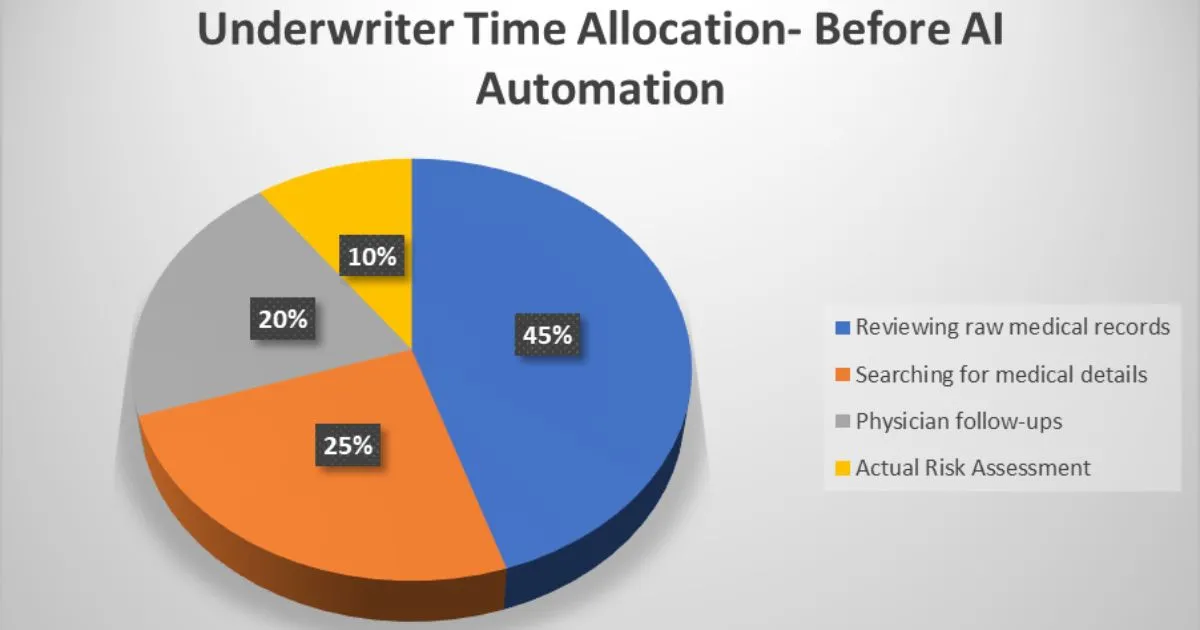
Before automation, underwriters and claims team spent most of their time on manual review and follow-ups rather than decision-making.
After implementing AI-driven APS automation, underwriter time shifted toward high-value risk assessment.
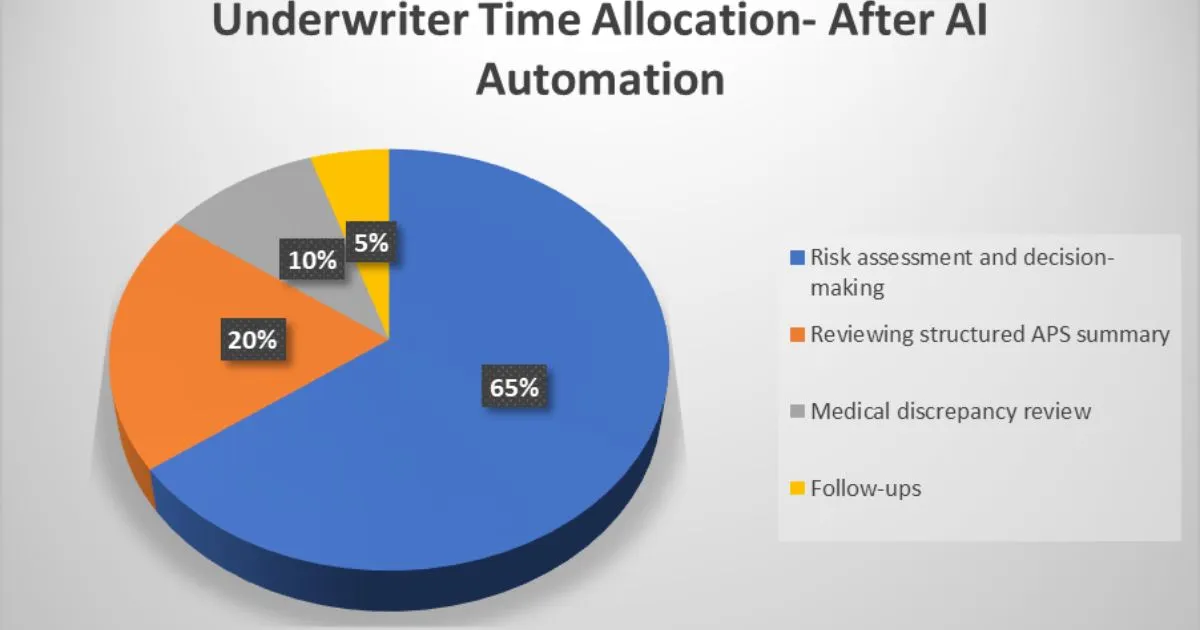
AI automation shifted underwriter effort away from administrative work towards faster and more confident decision-making.
ROI & Cost Savings Impact
Underwriters reclaimed 6–8 hours per week, allowing them to handle more cases without working overtime.
- Reduced physician follow-ups controlled administrative and vendor-related costs
- Faster policy issuance improved quicker premium collection timelines
- Shorter claim cycles reduced operational overhead and cost escalation risks
Within months, the client achieved a clear return on investment by lowering cost per APS while increasing decision-making capacity.
Business Impact
By combining APS process automation with medical expertise, we helped the client transform a slow and laborious APS process into a scalable and cost-efficient insurance claim support system. Underwriters and insurance adjusters gained faster access to clear medical insights, reduced operational costs, and made more consistent and defensible claim decisions.
Client Feedback
“The structured APS summaries significantly reduced review time for our underwriting team. The clarity and consistency helped us make faster, more confident decisions while keeping costs under control.”
— Senior Underwriting Manager, Insurance Provider

Anjana Devi Vijay is a Certified Legal Nurse Consultant (CLNC) and Medical–Legal Research Analyst with 9+ years of experience in medical record review, deposition summary analysis, and medico-legal research. She specializes in transforming complex healthcare documentation into accurate, actionable insights that support attorneys, insurers, and medical evaluators. With expertise in clinical documentation analysis and legal case support, she creates research-driven content focused on improving decision-making and case outcomes.

Ready to Achieve Similar Results?


