Home
>
Blog
>
>
The Answers That Aren’t Really Answers: Why Deposition Summaries Should Track Evasive Testimony
Key Takeaway
A useful deposition summary should help attorneys see:
- When a witness gives an unclear or qualified answer
- When “I don’t recall” appears around important facts
- When the witness talks around the question
- When the answer depends on an exhibit, assumption, or memory gap
- When the testimony should be checked against records or prior statements
A clean summary should not accidentally make weak testimony look strong.
The witness says a lot. But did they answer the question? That is the part attorneys often need to know.
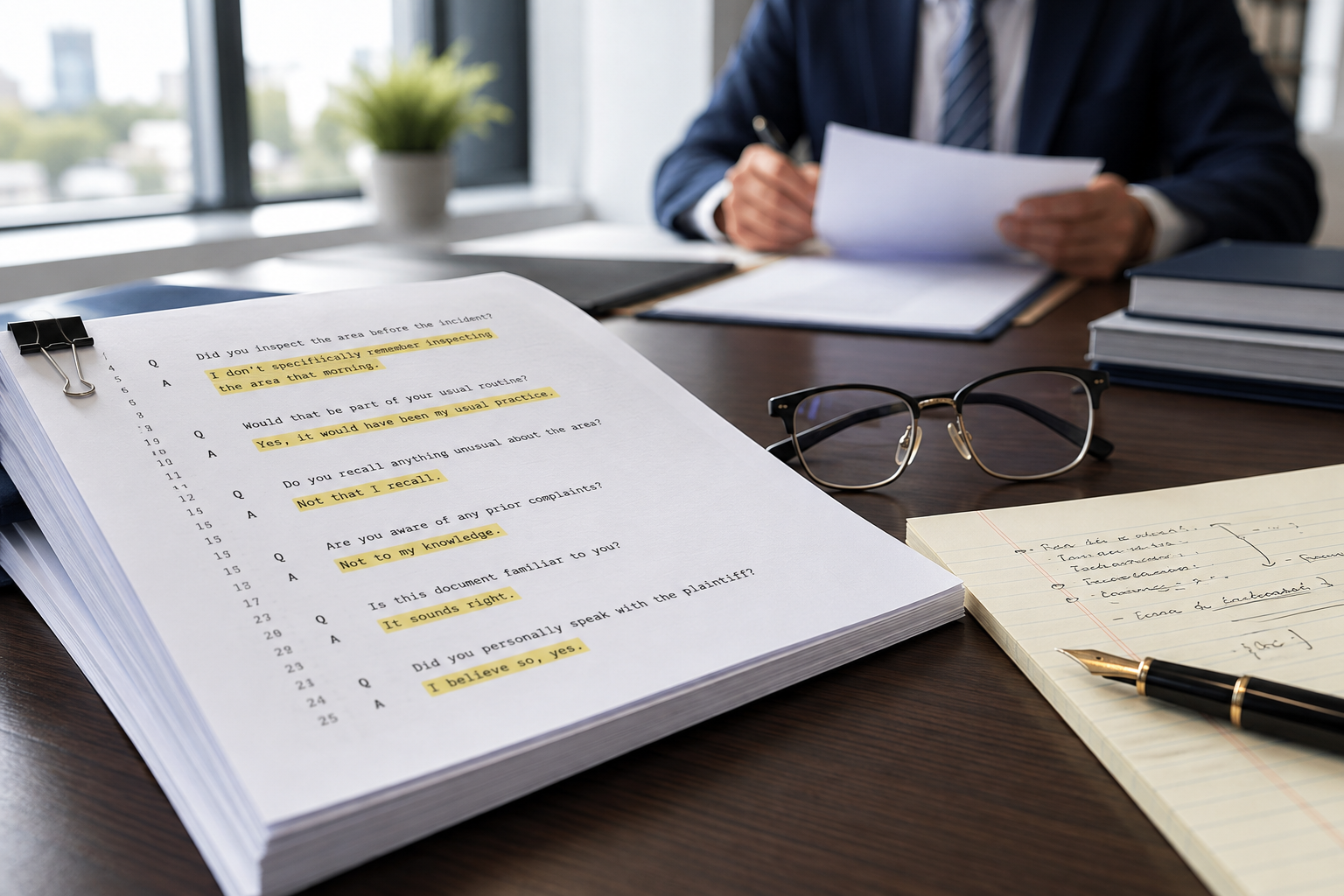
A witness may talk for half a page and still avoid the core issue. They may say, “I don’t recall,” “I would have,” “I believe so,” “not to my knowledge,” or “that sounds right,” without making a clear admission or denial. In a long transcript, those answers can disappear inside polished paragraphs.
A strong deposition summary should not smooth out evasive testimony until it sounds clearer than it really was. It should preserve uncertainty, hesitation, limits, and non-answers so attorneys can decide whether the testimony needs follow-up, impeachment, clarification, or trial attention.
In litigation, what a witness avoids saying can matter almost as much as what they confirm.
Why Evasive Testimony Is Easy to Miss
Deposition transcripts are full of natural speech. Witnesses pause, correct themselves, guess, qualify, forget, and sometimes avoid direct answers.
That is normal.
The problem starts when a summary turns that messy testimony into neat language that loses the weakness.
For example, a witness may testify:
“I don’t specifically remember checking the floor that morning, but it would have been my usual practice.”
A weak summary might say:
“Witness checked the floor that morning.”
That is not the same thing.
The stronger summary preserves the limit:
“Witness did not specifically recall checking the floor that morning but testified that doing so would have been their usual practice.”
That difference matters during cross-examination, motion preparation, mediation, or settlement evaluation.
Preserve the Limits of Testimony
A strong deposition summary does not turn uncertain answers into definite facts. Capturing pauses, qualifications, and gaps in memory helps attorneys see the true strength of the testimony.
“I Don’t Recall” Is Not Empty Testimony
Attorneys know that “I don’t recall” can be important. It may show a genuine memory gap. It may limit the witness’s usefulness. It may create room for another document, prior statement, or witness testimony to carry the point.
A deposition summary should not treat every “I don’t recall” the same way. Some memory gaps are harmless. Others involve central issues.
For example:
- A supervisor does not recall whether an inspection was completed.
- A plaintiff does not recall prior treatment for the same body part.
- A provider does not recall discussing surgical risks.
- An employee does not recall whether a warning sign was present.
- An expert does not recall reviewing a key medical record.
These answers should be visible. If they are buried inside a general paragraph, attorneys may miss a useful follow-up point.
Qualified Answers Need Exact Handling
Phrases like “I believe,” “to the best of my knowledge,” “I would have,” “usually,” and “not that I remember” can change the strength of testimony.
They show that the witness may not be testifying from direct memory. They may be relying on habit, assumption, standard practice, or incomplete recollection.
That does not make the testimony useless. But it does affect how attorneys may use it.
A deposition summary should preserve those qualifiers when they matter.
For instance:
“Witness testified that nurses ‘usually’ documented discharge instructions, but did not independently recall giving instructions to the plaintiff.”
That is far more useful than:
“Witness gave discharge instructions.”
The first version shows the boundary of the testimony. The second version overstates it.
Evasive Testimony Can Shape Cross-Examination
A non-answer may become the starting point for cross-examination.
If a witness cannot confirm whether a safety check occurred, the attorney may use inspection logs, photos, policies, or other witnesses to press the issue. If an expert cannot confirm reviewing a key record, the attorney may question the foundation of the opinion. If a treating provider does not recall discussing a recommendation, the attorney may compare testimony with the medical chart.
A good deposition summary helps attorneys find these openings faster.
It should not argue the case. It should show the exact testimony, the limitation, and where to verify it.
Wondering how key testimony points are highlighted?
When a Witness Talks Around the Question
Some witnesses answer at length without answering directly.
They explain background. They repeat a policy. They describe general practice. They say what “would have” happened. But they do not say what actually happened in this case.
That distinction is important.
For example, in a premises case, a witness may explain the store’s inspection policy for several pages. But when asked whether they inspected the aisle before the fall, they may say they do not remember.
A summary should not confuse policy testimony with fact testimony.
A useful entry might say:
“Witness described the store’s inspection policy but did not recall whether they personally inspected the aisle before the incident.”
That gives the attorney a clear trial-prep point.
Exhibits Can Expose Non-Answers
Sometimes evasive testimony becomes clearer after an exhibit is introduced.
A witness may avoid confirming a date until shown an email. A provider may not recall a conversation until shown the chart. An employee may not remember an incident report until the document appears. An expert may qualify an opinion after being shown missing or additional records.
A deposition summary should show how the answer developed.
It should capture what the witness said before the exhibit, what they were shown, and whether the answer became clearer, narrower, or more uncertain afterward.
This is especially important in cases involving medical records, incident reports, employment files, photographs, policies, billing records, and expert reports.
Why Page-Line References Matter for Weak Answers
Weak or qualified testimony needs page-line support.
If an attorney wants to use a non-answer during motion practice, mediation, or cross-examination, they need the exact place in the transcript. A general summary is not enough.
Page-line references help attorneys verify:
- The question asked
- The witness’s exact wording
- Any objection or clarification
- Whether an exhibit was shown
- Whether the answer changed later
A good summary helps the attorney reach the testimony quickly without rereading the entire transcript.
"A strong deposition summary identifies qualified answers, incomplete responses, and changes in testimony with clear transcript support."
What a Summary Should Not Do
A deposition summary should stay neutral.
It should not label the witness as evasive in an argumentative way. It should not decide credibility. It should not say the witness lied. It should not make legal conclusions about liability, negligence, causation, damages, or trial strategy.
The summary can show that the witness did not answer directly. It can preserve exact qualifiers. It can flag statements that may need attorney review.
But the legal interpretation belongs to the attorney.
A strong deposition summary does not make testimony cleaner than it was. It preserves the limits that may matter later.
How LezDo TechMed Supports Deposition Summary Work
LezDo TechMed supports legal and insurance teams with deposition summary services that organize sworn testimony into clear, review-ready formats based on the agreed case scope. Depending on the need, summaries may be page-line, topic-based, narrative, chronological, or issue-focused.
For testimony involving non-answers, memory gaps, and qualified statements, the goal is to preserve the wording and context attorneys need for review.
LezDo TechMed’s role is to summarize and organize testimony. We do not decide credibility, liability, causation, damages, negligence, or legal strategy. Attorneys and qualified legal professionals decide how the testimony affects the case.
Neutral Deposition Summaries. Clearer Testimony Review.
95%
Preserved Testimony Context
Accurate Witness Statement Review
90%
Structured Deposition Insights
Faster Attorney Evaluation
87%
Objective Summary Format
Better Case Preparation
Frequently Asked Questions
Why should deposition summaries track evasive testimony?

Deposition summaries should track evasive testimony because unclear, qualified, or non-responsive answers may affect cross-examination, impeachment, mediation, or trial preparation.
Is “I don’t recall” important in a deposition summary?
Yes, when it relates to a key issue. “I don’t recall” may show a memory gap, limit a witness’s testimony, or create a need to compare the answer with documents or other testimony.
Should a deposition summary label a witness as evasive?
No. A summary should avoid argumentative labels. It should present the question, answer, qualifiers, and page-line references so attorneys can evaluate the testimony.
Why are qualifiers important in deposition testimony?
Qualifiers such as “I believe,” “usually,” “would have,” and “not to my knowledge” show the limits of the witness’s certainty. Removing them can make testimony sound stronger than it is.
What format works best for tracking non-answers?
Page-line or topic-based summaries usually work well because they preserve exact transcript references while organizing testimony by issue.
Final Thought
Not every important answer sounds dramatic. Sometimes the most useful testimony is quiet.
“I don’t recall.”
“I would have.”
“Not to my knowledge.”
“That sounds right.”
“I cannot say for sure.”
Those phrases can change how testimony is used. They can show uncertainty, limited memory, weak foundation, or the need for follow-up.
A deposition summary should protect those details instead of smoothing them away. Because sometimes the answer that matters most is the one the witness never clearly gave.
Source Credit : All metrics derived from LezDo TechMed’s internal project data.
Shabila Thomas
Shabila Thomas is a Certified Legal Nurse Consultant (CLNC) and Medical-Legal Research Analyst with over two years of experience in medical record review, medico-legal research, and content development. She specializes in blogs, articles, and content that decode complex medical information, industry trends, and regulatory updates for the medico-legal field. Her clinical background and research-first approach help law firms, medical evaluators, and insurance professionals understand complex medical data, identify relevant insights, and make faster, better-informed decisions.













.png)