Home
>
Blog
>
>
The Role of Medical Chronologies in Life Care Planning
Here is what a medical chronology does for a life care plan before the planner projects a single future cost:
- It gives the plan a complete, sourced treatment history – Every provider and every episode captured and tied to a page, so the plan rests on the full record, not a partial one.
- It ties future projections to a documented past – Each future-care line item traces back to treatment that actually happened, at a frequency the record shows.
- It separates prior conditions from injury-related needs – So the plan reflects what the injury caused, not what predated it.
- It leaves the projections to the planner – The chronology organizes and flags; the future-care opinion stays the life care planner's.
Read on for how the chronology turns a record stack into a life care plan that holds up.
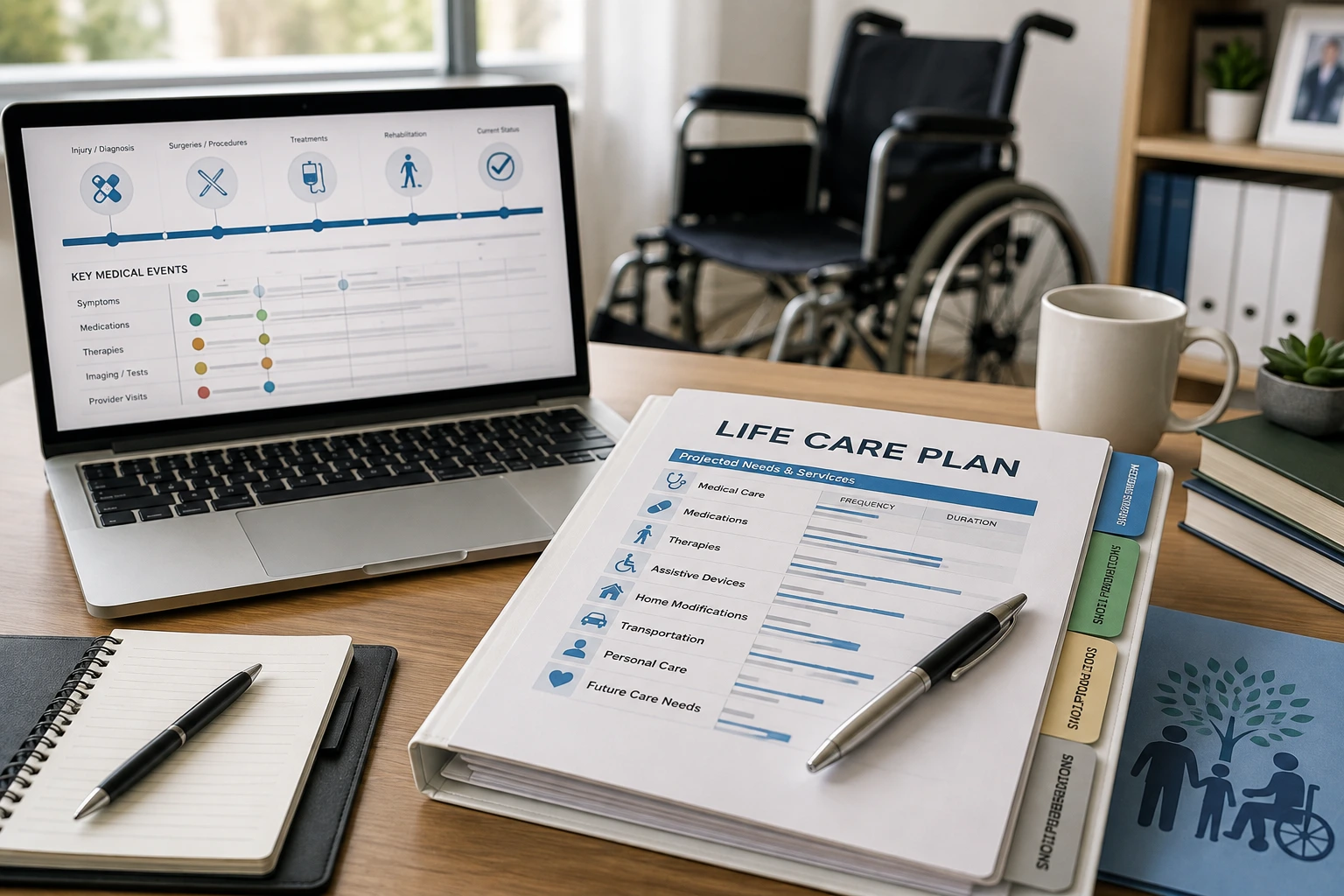
A life care plan projects decades of future care and cost, and every one of those projections has to rest on something documented. That something is the treatment history, and in a catastrophic-injury file it usually arrives as thousands of pages from many providers over many years, out of order, duplicated, and incomplete in ways that are not obvious until someone looks. A plan built straight from that stack inherits its holes. A plan built from an organized, sourced chronology of it does not.
That is the role a medical chronology plays in life care planning. It is not clerical support, it is the evidence base the plan stands on. A chronology organizes, summarizes, and cross-references the documented care into a dated, sourced sequence, and flags the gaps, prior conditions, and inconsistencies. It does not set the future-care projections, that is the life care planner's work. What it does is make sure that when the planner projects, and when those projections are questioned, the record underneath is complete, sourced, and defensible. Here is how.
It gives the plan a complete, sourced treatment history
A life care plan is only as defensible as the treatment history underneath it, and a chronology is what makes that history usable. Instead of a plan built on the records the planner happened to reach, every provider, admission, procedure, therapy course, and medication is captured in date order and tied to the exact page it came from. That completeness matters twice: it keeps a whole episode of care from being missed, and it lets the planner produce the source behind any projection the moment they are asked. A treatment history assembled from memory of a file is not the same as one that traces to the page.
Less time assembling the record, more time on the plan
One Florida life care planning firm moved its record review into a structured workflow and reported cutting turnaround from around 20 weeks to 8, roughly 2.5 times faster, without losing the sourcing its plans relied on.
It ties every future projection to a documented past
The projections in a life care plan are only defensible if they trace to documented care. A recommendation for lifelong physical therapy has to connect to a therapy history that shows what was ordered, how often it happened, and how the patient responded. A projected surgery has to connect to a documented indication, not a hope. A chronology built to source every entry gives the planner that thread, so each future-care line item can be walked back to the past treatment it grows from. LezDo TechMed's medical chronology services are built to preserve exactly that traceability, the documented past a projection has to rest on. This is also why a chronology built specifically for life care planners reads differently from a general summary: it is organized around the treatment history a plan projects from.
It separates prior conditions from injury-related needs
The fastest way to overstate a life care plan is to fold a pre-existing condition into the injury. A chronology that flags the prior conditions puts the patient's documented history before the injury in front of the planner, so the plan can separate what the injury caused from what predated it. That separation is not a courtesy to the defense, it is what keeps the plan credible, because a projection that quietly includes a pre-existing need is the projection opposing counsel takes apart first.
Building a life care plan from a large, multi-year catastrophic file?
It gives you a frequency and utilization picture to project from
Future care is projected from patterns, and patterns live in the record. How often the patient saw each specialist, how many therapy sessions actually occurred, how medications changed over time, how often a complication recurred, all of it is the raw material a projection is built on. A chronology that captures utilization in date order, rather than leaving it scattered across thousands of pages, hands the planner a frequency picture they can reason from instead of estimate. The projection is stronger when the past frequency it extends is documented and sourced, not approximated.
It keeps the plan defensible on cross and under a Daubert challenge
A life care plan gets attacked at its foundation before it is attacked at its conclusions. Opposing counsel asks where a projection came from, whether the planner saw a particular record, and whether the treatment history is complete. A plan whose every element traces to a sourced chronology is hard to shake on the facts, so the cross has to move to methodology, where a qualified planner is strongest. A plan built on a record set with an unseen gap hands the challenger an easier target. A complete, sourced chronology closes that opening before the deposition or the Daubert motion begins.
A life care plan projects the future, but it has to be built on a documented past. The chronology is what makes that past complete and sourced.
The line the chronology holds
Here is the boundary, and it is the whole reason the chronology strengthens the plan rather than compromising it. A medical chronology organizes the documented care, orders it, sources each entry to its page, and flags gaps, prior conditions, and inconsistencies. It does not project future care, assign cost, decide what the injury caused, or opine on causation or damages. Those are the life care planner's determinations, formed by the planner, defended by the planner. If a chronology ever crossed into setting the projections, it would weaken the plan, not strengthen it, because the plan has to be the planner's independent work built on a neutral record. The chronology strengthens the plan precisely by staying on its side of that line.
AI has a place in building the chronology, within limits. It extracts, indexes, and builds a first pass across a large multi-year file faster than a person alone, which is part of what makes a fast, sourced evidence base possible at catastrophic-file scale. But whether a flagged record matters to a projection, and whether the sourcing is faithful to what the chart says, still takes a trained reviewer, which is why a chronology a life care plan can rest on pairs AI with human review rather than trusting automation to build the foundation alone.
A gut-check before you build the next plan: can you trace every projected future need back to a documented, sourced past treatment, and have the prior conditions been separated out for you? If yes, the plan has a foundation that holds. If not, the projections are only as strong as the record nobody finished reading.
What a chronology gives the life care plan to stand on
Complete
Every provider and episode
The full treatment history captured in date order and sourced, so no episode of care is missed.
Traceable
Future ties to past
Each projected need walked back to the documented treatment and frequency it grows from.
Separated
Priors flagged
Pre-existing conditions surfaced and set apart, so the plan reflects what the injury caused.
Frequently asked questions
What role does a medical chronology play in life care planning?

It gives the life care planner a complete, date-ordered, sourced treatment history to build from, with gaps and prior conditions flagged. That lets the planner tie every future-care projection back to documented past care rather than to memory of a disorganized file, which is what keeps the plan defensible.
Does a medical chronology set the future-care projections in a life care plan?
No, and it must not. The chronology organizes the documented care, sources it, and flags gaps and prior conditions. The future-care projections, cost, and clinical judgment are the life care planner's independent determinations. Keeping that line clean is exactly what makes the plan defensible.
How does a chronology help a life care plan survive a Daubert challenge?
A plan is attacked at its foundation first. When every projection traces to a complete, sourced treatment history, the challenge has to move from the records to the methodology, where a qualified planner is strongest. A plan built on a record set with an unseen gap is the easier target.
Why does separating prior conditions matter in a life care plan?
Because folding a pre-existing condition into the injury overstates the plan and is the first thing opposing counsel attacks. A chronology that surfaces the patient's documented history before the injury lets the planner separate injury-related needs from pre-existing ones, so the plan reflects what the injury caused.
How does a chronology support future-care frequency projections?
Future care is projected from patterns in the record: how often each provider was seen, how many therapy sessions occurred, how medications and complications changed over time. A chronology captures that utilization in date order, so the planner projects from a documented frequency rather than an estimate.
Can AI build a life-care-ready chronology on its own?
AI extracts and indexes a large multi-year file quickly, but whether a flagged record matters to a projection, and whether the sourcing is faithful to the chart, takes a trained reviewer. A chronology a life care plan can rest on pairs AI indexing with human review.
Bringing it back to your plan
The role of a medical chronology in life care planning is to make the plan's foundation unshakable. It gives the plan a complete, sourced treatment history, ties every future projection to a documented past, separates prior conditions from injury-related needs, and hands the planner a frequency picture to project from. The projections, the costs, and the clinical judgment are still the life care planner's. The chronology just makes sure the record they rest on can carry decades of projected care.
The boundary holds throughout: the chronology organizes, sources, and flags, and the planner forms and owns the plan. That division is not a limitation, it is what makes the plan defensible, because the evidence is neutral and complete and the projections are independent.
Ready to build a life care plan on a chronology that traces every projection to the record? Partner with LezDo TechMed, or start with a single treatment episode and see the chronology first.
Source Credit : All metrics derived from LezDo TechMed’s internal project data.
Anjana Devi Vijay
Anjana Devi Vijay is a Certified Legal Nurse Consultant (CLNC) and Medical–Legal Research Analyst with 9+ years of experience in medical record review, deposition summary analysis, and medico-legal research. She specializes in transforming complex healthcare documentation into accurate, actionable insights that support attorneys, insurers, and medical evaluators. With expertise in clinical documentation analysis and legal case support, she creates research-driven content focused on improving decision-making and case outcomes.













.png)