Home
>
Blog
>
>
Data Security in Medical Record Review: The Questions Claims Adjusters Ask Most
Here's what a claims adjuster needs to know about keeping PHI secure when outsourcing medical record review:
- Ask for evidence, not logos – Real security shows up as certifications, encryption standards and access logs, not a "HIPAA compliant" badge on a homepage.
- Certifications you can verify – ISO 27001 and a SOC 2 Type II attestation are independent checks a vendor should be able to produce on request.
- Control who sees the file – Role-based access and an audit log tell you exactly who opened a claimant's records and when.
- Human-in-the-loop is a security posture – AI handles the volume; trained medical reviewers keep the sensitive context inside controlled workflows.
Read on for the exact questions to ask, and what a strong answer sounds like.
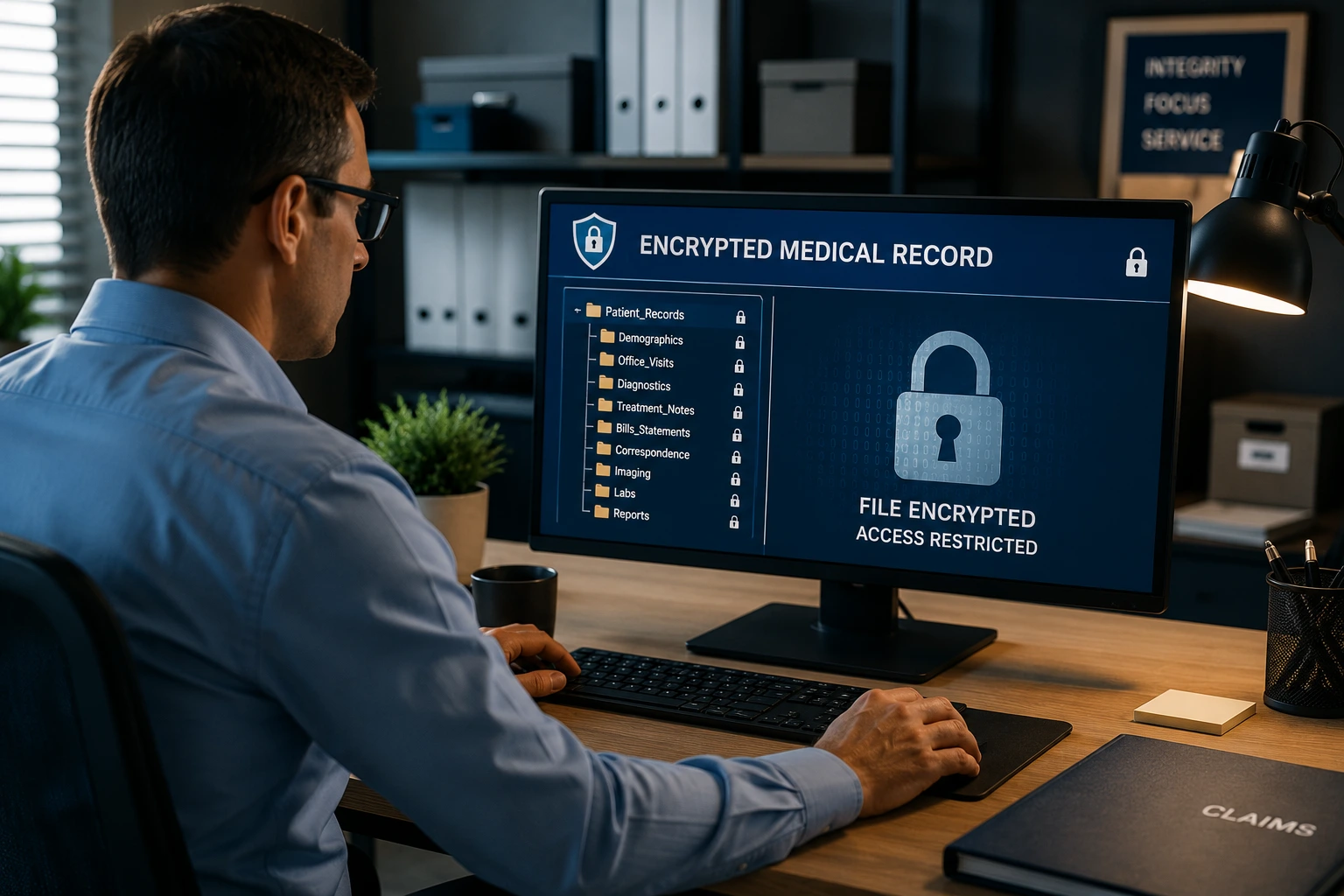
A secure medical record review process protects a claimant's PHI at every step, from the moment you upload the file to the moment the finished summary returns to your queue. Worried about where those records actually go once a vendor has them? You're not alone. For a claims adjuster, the medical file is the most sensitive thing on your desk, and your name is on the assignment.
Here's the reassurance: you can outsource medical record review without losing control of the PHI inside it. The trick is knowing which questions to ask, and what a real answer sounds like. Let's go through the ones adjusters raise most.
Why does data security matter so much in medical record review?
Because a single claim file can hold a claimant's entire medical history: diagnoses, medications, mental health notes, substance use, all of it. That is exactly the information HIPAA was written to protect. When you send it to a review vendor, the PHI does not stop being your responsibility. If it leaks, the breach notification, the audit questions, and the reputational hit land on the carrier, not the vendor alone. So "is this vendor secure?" is really "am I protected?" That deserves a specific answer, not a compliance logo.
PHI is the most regulated data in a claim file
Across more than 2 million medical records reviewed, one pattern holds: the records that stay secure are the ones handled inside controlled workflows, not personal inboxes. Certifications like ISO 27001 and a SOC 2 Type II attestation exist so you can verify that, instead of taking a vendor's word for it.
What should a claims adjuster ask a record review vendor about security?
Start with the questions that have concrete, checkable answers. Vague reassurance is easy to give. Evidence is not.
- Is PHI encrypted in transit and at rest? "Yes" should come with the method, not a shrug.
- Who can open my file after I upload it? Look for role-based access, so only the assigned reviewers see it.
- Is there an access log? You want a record of who touched the file and when, in case the claim is later disputed.
- What certifications back this up? ISO 27001 and SOC 2 Type II are independent checks. A website badge is not.
- Where are the records stored, and are they ever in someone's personal email or an open drive? The answer should be no.
A vendor that handles PHI properly won't be thrown by these. At LezDo TechMed, PHI moves through a secure workflow with controls aligned to ISO 27001, SOC 2 Type II, ISO 9001:2015, HIPAA and GDPR requirements, and you can review the details on our Trust Center before a single file changes hands. If you want to see how the review itself is structured, our medical record review services page walks through the workflow.
Want a record review partner your infosec team can clear once?
How do I know a vendor's "HIPAA compliant" claim actually means something?
Ask what sits behind the phrase. HIPAA compliance is a set of administrative, physical and technical safeguards, not a certificate you frame on a wall. So the useful follow-up is simple: show me. A vendor with real controls can point to an independent SOC 2 Type II attestation, ISO 27001 certification, signed business associate agreements, documented access controls, and staff trained on PHI handling rather than gig workers pulled in for volume.
There is a difference between "we're HIPAA compliant" and what your infosec team finds when they actually look. The first is a sentence. The second is an audit trail, an encryption standard, and a name attached to every access event. When those two match, you have a vendor you can defend in a review. When they don't, you have a risk with your assignment number on it.
HIPAA compliance is not a badge on a website. It is an audit trail, an encryption standard, and a name attached to every file.
Is outsourcing medical record review riskier than keeping it in-house?
Not automatically. A specialized vendor with tested controls often protects PHI better than an overloaded internal team emailing files back and forth. The risk is not in outsourcing itself. It is in outsourcing to someone who cannot show you how the data is handled.
The same logic applies to AI. AI-assisted review speeds up sorting, indexing and chronology building, and that helps when a claim runs to thousands of pages. But the PHI still needs a human boundary around it. LezDo TechMed pairs AI-assisted workflows with medical-expert reviewers and a three-layer quality-control process, so automation handles the volume while trained people handle the judgment and the sensitive context. That human boundary is what keeps PHI protected while the AI handles the heavy lifting.
Weighing the switch? One honest test helps: ask your current process the same questions you would ask a vendor. Can you name everyone who has opened the last claim file you handled? If the in-house answer is fuzzy, moving to a controlled workflow may be the safer option, not the riskier one.
What backs up the security claim
ISO 27001
Certified ISMS
Information security management, independently certified.
SOC 2 Type II
Independent attestation
Controls tested over time, not a one-day snapshot.
3-layer
Quality control
Every file passes medical and QC review before it returns to you.
Frequently asked questions
Is it safe to outsource medical record review that contains PHI?

Yes, when the vendor uses encryption, role-based access, signed business associate agreements, and independent certifications like SOC 2 Type II and ISO 27001. Outsourcing to a controlled workflow can protect PHI better than an overloaded in-house team. The risk lies in choosing a vendor that cannot show how data is handled.
What certifications should a medical record review vendor have?
Look for ISO 27001 (information security management), SOC 2 Type II (independently tested controls over time), and ISO 9001:2015 (quality management), plus processes designed to meet HIPAA and GDPR requirements. Certifications are independent checks; a website badge alone is not.
Does "HIPAA compliant" guarantee my claim files are secure?
No. HIPAA compliance is a set of safeguards, not a certificate. Ask the vendor to show the controls behind the phrase: encryption standards, access logs, business associate agreements, and staff trained on PHI handling.
How can I tell where my claimants' records go after I upload them?
Ask for an access log and role-based permissions so only assigned reviewers can open the file. A secure vendor can show who accessed each record and when, which also protects the chain of custody if the claim is disputed.
Is AI-assisted medical record review secure?
It can be, when AI is paired with human review inside a controlled workflow. AI handles sorting, indexing and chronology building at volume, while medical experts review context and accuracy. The PHI stays inside the same security controls that govern the rest of the process.
How quickly can a secure review be delivered?
Turnaround depends on record volume, condition and scope, but sorting and indexing typically runs 24 to 48 hours and review deliverables 48 hours once scope is confirmed. Security controls do not have to slow delivery when the workflow is built for both.
Bringing it back to your desk
Data security in medical record review comes down to one thing you can act on: ask for evidence, not adjectives. Encryption you can name. Access logs you can pull. Certifications an outside auditor signed. Reviewers trained on PHI. When a vendor meets that bar, outsourcing stops being a compliance risk and starts being the reason a claim moves faster, because infosec has already cleared the path.
You handle sensitive records every day, and you should not have to choose between speed and keeping PHI locked down. Ready to work with a medical record review partner built around that standard? Partner with LezDo TechMed, or start by checking what a secure review would cost for your next file.
Source Credit : All metrics derived from LezDo TechMed’s internal project data.
Anjana Devi Vijay
Anjana Devi Vijay is a Certified Legal Nurse Consultant (CLNC) and Medical–Legal Research Analyst with 9+ years of experience in medical record review, deposition summary analysis, and medico-legal research. She specializes in transforming complex healthcare documentation into accurate, actionable insights that support attorneys, insurers, and medical evaluators. With expertise in clinical documentation analysis and legal case support, she creates research-driven content focused on improving decision-making and case outcomes.












.png)