3 Important Reasons Why You Need Medical Narrative Summaries to Win Claims
A medical narrative summary is not just a summary—it’s the strategic backbone of litigation, guiding every major legal decision.
Medical narrative summaries help legal professionals quickly understand the patient’s injuries, treatment, diagnoses, medical history, and key case facts. By reducing lengthy records into an organized summary, they save review time, highlight relevant medical evidence, and support better preparation for claims, negotiations, demand letters, depositions, and litigation.
What is a narrative summary in the healthcare and legal contexts? Medical narrative summaries are terse and crispy accounts of all the possible medical records of the patient about the causes and consequences of injuries. They play a pivotal role in winning the litigation. Most of the litigations have a huge number of medical records to be perused to detect the favorable points to take your lawsuit forward.
Medical summaries encompass the major facts in a clear and easily perusable format. These medical narrative reports give a panoramic view of the patient’s case summary in a compact form. They provide the reader with the essence of the case in an effective manner. They can even give discoveries to the lawyer about the case. Let’s take a tour to know the prominent reasons for composing medical narrative summaries.
Save 60% of Attorney Review Time
Well-structured medical narrative summaries reduce record-review effort by 55–60%, allowing attorneys to focus on strategy instead of paperwork.
A well-written summary saves time:
Sifting through the numerous pages of medical records for reference or preparing the vital points supporting the litigation is a time-consuming and arduous task. Attorneys would have to plan multiple strategies to win the lawsuits. Spending more time reviewing the medical records will obstruct their proceedings.
In-house or offshore medical record analysts would review the multiple sets of records and summarize them into a precise and effective narrative summary quickly. Such patient narratives would be of great boon to the litigators in saving their precious time. They can use their time efficiently in building their lawsuit.
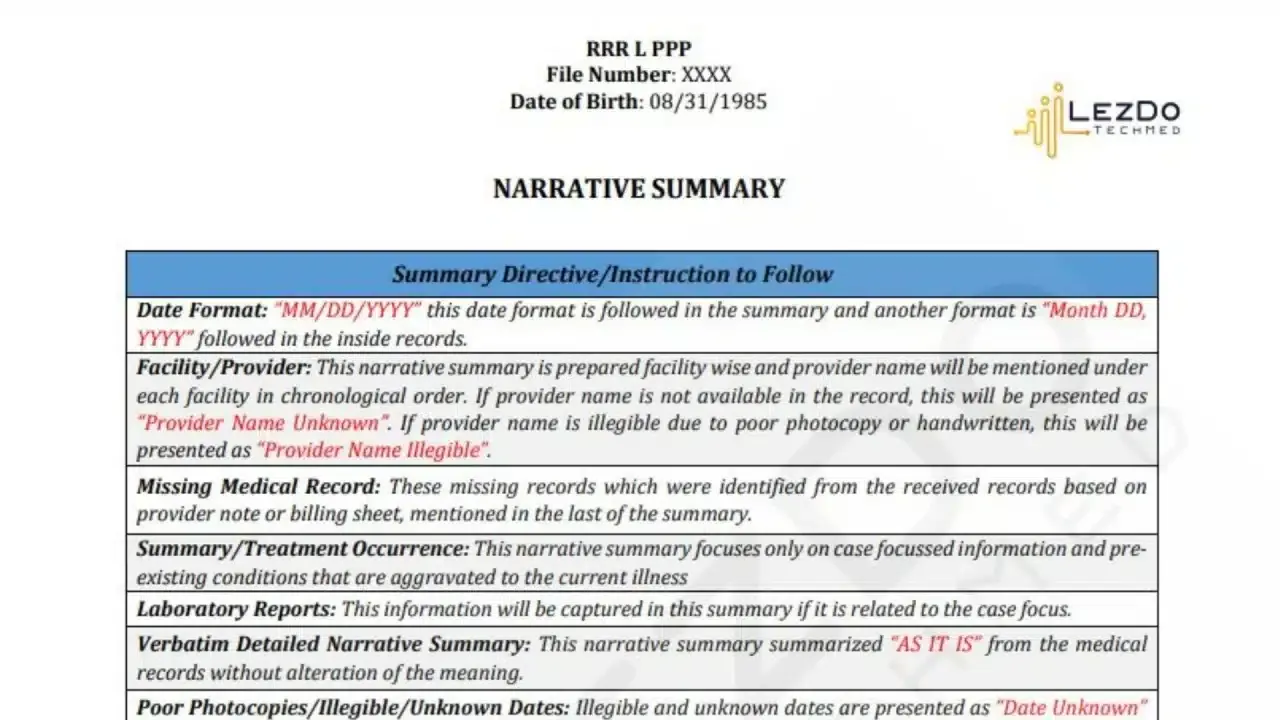
Go through the legal medical summary example to know why you need narrative medical reports to win your litigation.
The medical narrative summaries give the key factors in a nutshell:
Demographic data of the patient:
The patient’s personal information, such as gender, age, height, weight, etc., is provided for easy identification of the patient. In med-legal claim suits, this becomes important to distinguish the different people involved.
The chronological flow of events:
Patients’ medical records are scrutinized thoroughly to recognize the vital information. All the events about the medical history of the patient are presented in a chronological sequence. Lawyers can easily grasp the points they need from medical narrative summaries.
Vital facts about accidents:
The prominent factors, like the date, venue, and kind of impact, the factor that led to the impact causing the injuries, and the facts about seatbelts and the details of airbag deployment, are noted precisely.
Crucial test findings:
The findings in the laboratory, X-ray, MRI, or other tests, which can sometimes alter the course of litigation, will be perceived and drafted without fail in the medical records summary.
The past and present medical condition of the patient:
Sometimes, the patient’s preexisting medical conditions become a turning point in the litigation. Therefore, significant pre-medical conditions of the patient will be recorded. Present medical conditions caused by the incident will also be noted in brief in medical narrative summaries.
Past and present treatment:
The treatment undergone by the patient in the past, as well as the present, with accurate dates, is noted. Regularity or lapse in the continuity of treatment has an important role in the lawsuit. The visits to different medical providers and key findings or opinions, and suggestions from them are also penned without fail.
Past and present medications taken by the patient:
The medications taken by the patient in the past and present also need to be presented precisely. In wrong medication error cases, if the medicine taken by the patient in the past had caused the current situation will also be analyzed and noted.
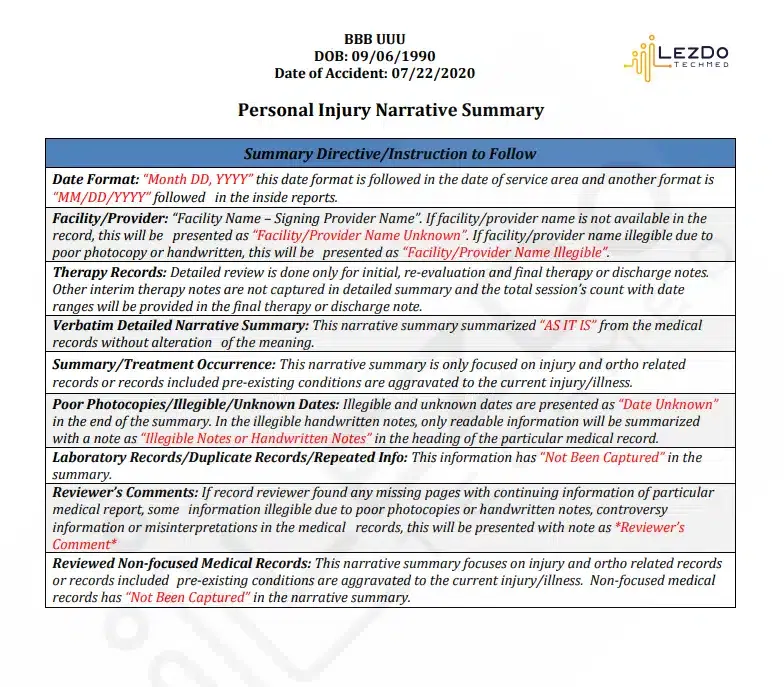
The given personal injury narrative report sample will be a testament to its importance.
"From demand letters to trials, medical narrative summaries shape outcomes by turning complex records into clear, persuasive stories."
Narrative summary is crucial throughout the litigation:
A clear summary can support several stages of legal, insurance and medical review.
Tailored to the attorney’s needs:
A medical summary report is usually tailored according to the requirements of the lawyers. It is prepared either in Word or PDF format. If the attorney prefers to concentrate on the current injuries or the pre-existing but exacerbated injuries also will be crucial in preparing the narrative medical record summary.
Additional medical reports summary can be incorporated easily later:
Since the medical narrative summaries are prepared chronologically, a summary of additional medical records or findings can be added in the appropriate places without much difficulty later.
For demand letter preparation:
A demand letter should consist of all the essential points. Going through the entire medical records to percolate the essentials will not be a piece of cake. A condensed patient narrative will aid the attorney to prepare the demand letter, which is authenticated enough to fortify the claim. Crispy medical narrative summaries will make the work easy.
To prepare the depositions:
The succinct medical narrative summaries will guide the attorney while preparing depositions, where he has to lead the deponent through the different events that occurred related to the litigation. The key findings in the records will abet the lawyer in preparing an effective questionnaire while executing cross-examinations.
To prepare for the trial:
As the laconic summary narrates the vital events, in a nutshell, the lawyer can easily identify the possibility of the claim. In some cases, he can elicit the possibility of medical malpractice or medical error, which led to the plaintiff’s current condition.
For law and motion practice:
The medical narrative summaries notify the prominent missing information vital for the suit. This will alert the lawyer in preparing motion practice to request an extended time for collating them before the case gains momentum. The patient’s case summaries can be inevitable to be presented to the jury to identify the validity of the request and convince him to grant additional time to the attorney.
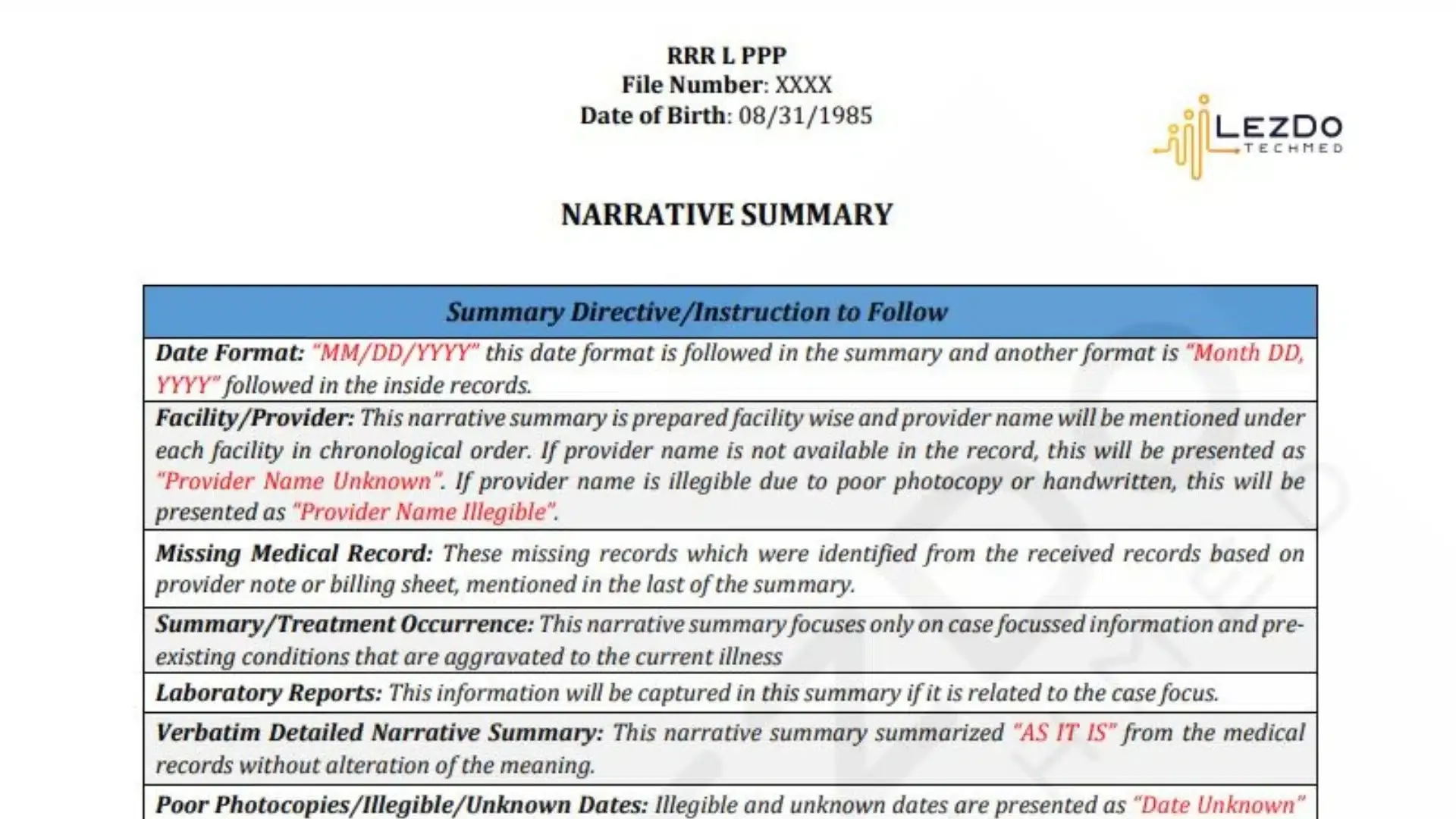
The medical-legal narrative report sample on disability stands as proof of how a powerful medical narrative summary format can be beneficial for your litigation.
Do you know how to write a medical narrative report?
Basically, a person writing a narrative report medical summary should keep in mind one thing- the purpose of a narrative summary. A well-written narrative medical report summary can be the base for either drafting demand letters or for deciding on the people to be deposed. The invaluable insights in medical narrative reports can enlight the attorneys with the key facts in a claim. It can also link the connections between the causation of injuries and the extensive treatment necessitated by the severity of injuries. Attorneys will find it easier to calculate the damages demanded in a claim. The significant details narrated in the medical summary report can even fortify personal injury or medical malpractice claims.
What a Narrative Summary Should Not Determine
A narrative summary may report opinions documented by qualified professionals. It should not independently determine:
medical causation
negligence
standard-of-care deviation
permanent impairment
disability
apportionment
maximum medical improvement
future-care requirements
liability
damages.
Why Medical Narrative Summaries Win Claims
1,000+ Pages
turns into 1 clear story
Narratives condense records into a single case story
3×
Faster Legal Preparation
Ready narratives speed letters, depositions, and trial prep
100%
Litigation Coverage
Summaries support every stage of litigation
Frequently Asked Questions
How is a medical narrative summary different from a medical chronology?
A chronology focuses strictly on timelines and dates, while a narrative summary adds interpretation, context, and connections between events, explaining why treatments occurred and how injuries progressed.
Why are medical narrative summaries important in litigation?
They transform complex medical records into an understandable format, helping attorneys quickly identify strengths, weaknesses, causation, damages, and key evidence needed for negotiations, depositions, and trials.
Who typically uses medical narrative summaries?
Personal injury attorneys, medical malpractice lawyers, workers’ compensation attorneys, insurance adjusters, IMEs, QMEs, life care planners, and expert witnesses rely on them throughout litigation.
What information is included in a medical narrative summary?
Summaries typically include patient demographics, accident details, chronological medical events, diagnoses, treatments, medications, test results, pre-existing conditions, prognosis, and future care needs.
Can a narrative summary be updated?
Yes. When new records arrive, the additional documents should be logged, reviewed and incorporated into a controlled revision. The revised document should identify new material and preserve source references.
Can medical narrative summaries help during depositions and trials?
Yes. They guide attorneys during witness questioning, help identify inconsistencies, support cross-examinations, and allow quick reference to critical medical facts during trial.
Are medical narrative summaries suitable for non-medical professionals?
Absolutely. They are written in clear, plain language, reducing medical jargon so attorneys, judges, juries, and insurance professionals can easily understand the case.
How detailed should a medical narrative summary be for litigation purposes?
A medical narrative summary should be detailed enough to capture all medically and legally relevant facts such as causation, treatment progression, and outcomes—while avoiding unnecessary clinical clutter. The goal is clarity and persuasion, not repetition of raw records.
Who prepares medical narrative summaries?
They may be prepared by qualified medical reviewers, legal nurse consultants, physicians, nurses, medical-legal analysts or specialized medical-record-review teams, depending on the purpose and required level of review.
Final Thoughts
Medical narrative summary services for law firms have medical experts who concentrate on all the patient’s pre and post-accident medical histories, the vital facts about the accident, and the pre-existing conditions being aggravated by the accident. These facts are garlanded into a storytelling format to back up the attorney in the lawsuit.
The medical narrative summaries are prepared in the SOAP (Subjective, Objective, Assessment, and Plan) format. Since they capture the diagnosis, therapy details, and doctor consultations, the medical summaries help attorneys to scrutinize the facts in the voluminous medical records easily. They have an inevitable role throughout the litigation process not only to the attorney but also to the jury.
With the revolution of AI in medical record review industry, many providers offer AI medical narrative summary services in USA to enhance the efficiency of medical summary narratives in claims.
Source Credit : All metrics derived from LezDo TechMed’s internal project data.
Anjana Devi Vijay
Anjana Devi Vijay is a Certified Legal Nurse Consultant (CLNC) and Medical–Legal Research Analyst with 9+ years of experience in medical record review, deposition summary analysis, and medico-legal research. She specializes in transforming complex healthcare documentation into accurate, actionable insights that support attorneys, insurers, and medical evaluators. With expertise in clinical documentation analysis and legal case support, she creates research-driven content focused on improving decision-making and case outcomes.









.png)


