Are Incomplete Medical Chronologies Undermining Your IME Reports?
When chronologies lack clarity, IME doctors spend more time reconstructing the case than evaluating it.
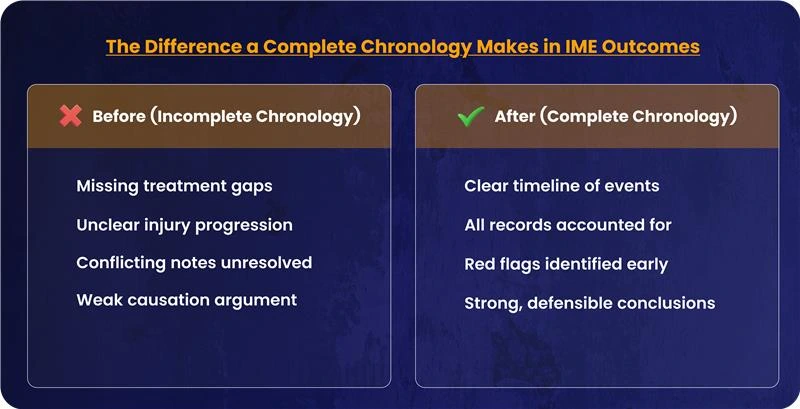
Incomplete medical chronologies can quietly undermine even the most well-prepared IME reports by creating gaps, confusion, and credibility issues.
When an Independent Medical Examination (IME) goes wrong, it’s rarely because of a lack of expertise. More often, the issue is hidden in plain sight. You might have the right records and a solid medical opinion. But if the medical chronology for IME reports is fragmented, inconsistent, or missing key events, your entire IME report can lose credibility.
2× Faster IME Reviews
Structured medical chronologies help evaluators analyze injury timelines up to 2x faster and improve report defensibility.
Where Medical Chronologies Go Wrong in IME Reports
Here’s where most chronologies go wrong and what actually makes them work.
1. Missing causation logic
Mostly chronologies list the events such as:
Visit dates
Complaints
Treatments
However, you cannot decide your IME opinions based on the number of visits or treatments. What you need to know is the patterns.
Instead of writing only as “the patient reported pain”, the chronology must show the patient’s:
Loss of strength
Reduced range of motion
Sensory changes
Failed conservative care
This shift from just listing the events to explaining the injury and treatment progression, gives medical story a logical flow, helping IMEs align their opinions naturally.
2. Confusion in pre-existing vs aggravated condition
During your IME evaluations, you should have a clear distinction of the injury- is the injury new or a pre-existing one. When chronologies fail to clarify this, you cannot make accurate and informed medical opinions.
A defensible chronology clearly separates the conditions before and after the event:
Before:
Long treatment-free gaps
Full-duty work status
Normal functional activity
After:
New findings (e.g., herniation, deficits)
Increased medication intensity
Reduced work capacity
This creates a clean comparison of the patient’s baseline versus the changes after the event.
Without this, you may be forced to assume and assumptions often weaken your case.
3. The mechanism of injury and medical findings mismatch
You may have to think biomechanically to justify your IME opinions. If the chronology doesn’t correlate how the injury occurred with what the records show, the injury causation becomes questionable.
A strong chronology bridges this gap when it clearly mentions:
Body position during injury
Direction and type of force
Type of load involved
This explanation should be aligned with known injury patterns:
Twisting+ planted foot → ligament injury
Overhead strain → rotator cuff involvement
When mechanism and pathology align with each other, IME resistance drops significantly.
However, failing to add context to the studies can impact your IME decisions.
A high-quality chronology should provide:
Timing of imaging (acute vs delayed)
Signs of recent injury (e.g., edema)
Correlation with physical findings
When the testing aligns with symptoms at the same point in time, it creates a coherent medical picture instead of isolated data points, supporting your IME report preparations.
Want to See How a Well-Structured Medical Chronology Looks?
Pain is subjective but functional capacity is measurable. A chronology that ignores functional data leaves you without the objective evidence you need to make defensible decisions.
A chronology that ignores the following can lead to wrong decisions and legal disputes thereafter:
Work status changes
Therapy progress
Strength and endurance
Outcome scores
Your IME assessments rely heavily on objective function to decide:
Impairment
Disability
Maximum Medical Improvement (MMI)
Without functional tracking, your case lacks real-world proof.
6. Unexplained treatment gaps
Gaps in treatment should be explained with valid supporting proof. When a chronology shows months without treatment, it raises questions of credibility.
Even small details (like prescription refills) help prove continuity of care. This can give a solid base for your opinions.
7. Weak structure leads to biased IME conclusions
An unstructured chronology can force you to:
Interpret scattered data
Fill in missing links
Rely on assumptions
This increases cognitive bias and inconsistency in your IME reports.
A better approach includes:
Clean executive summaries
Neutral, fact-based language
Clearly linked evidence
Well-segmented timelines
When information is structured clearly, your IME conclusions become more accurate and more defensible.
“A complete medical chronology doesn’t just list events — it connects symptoms, diagnostics, function, and causation into one defensible medical story.”
Incomplete Chronologies Shift the Burden to the IME Doctor
When chronologies lack clarity, you may:
Have to reconstruct the case
Miss critical connections
Feel conclusions become less reliable
But when a chronology is done right, it does the heavy lifting and you can focus on validation, and not on reconstruction.
What a Complete Medical Chronology Should Include
To support a strong IME report, the chronology must be:
Comprehensive
Every relevant medical event included
No gaps in treatment timelines (if any, reasons to be explained)
Chronological
Events arranged in clear date order
Easy to follow progression
Contextual
Notes on symptom changes
Treatment responses
Physician observations
Flagged for Issues
Missing records
Inconsistencies
Red flags
It should not just list events, it should make sense of them.
Highly accurate, causation-focused medical chronologies
Structured timelines aligned with medical-legal standards
Identification of inconsistencies and missing links
Clear, defensible documentation that supports IME decisions
We Make This Work with AI + Human Review
LezDo TechMed uses the proprietary AI tool, CaseDrive to extract data from large datasets. With NLP and OCR, our tool identifies patterns and gaps, highlights inconsistencies, and captures what manual review often misses under time pressure.
But we do not rely on AI alone. Our certified medico-legal experts review every AI output for:
Clinical relevance
Accurate interpretation
Contextual accuracy
This ensures that the medical chronology you get reflects the real medical picture and not some fragmented facts.
Our AI and human collaboration make the chronology both fast and clinically defensible, specifically built for IME decisions, not just documentation.
How Strong Chronologies Improve IME Outcomes
7
Key Risk Areas Identified
Missing causation links, treatment gaps, and unclear diagnostics can weaken IME conclusions
2x
Faster Clinical Validation
Structured timelines reduce reconstruction time and sharpen medical opinions
100%
Clearer Injury Tracking
Separating baseline vs. post-event health strengthens causation and defensibility
Frequently Asked Questions
What is a medical chronology in an IME report?
Medical chronologies in IME reports mean structured outlining a patient’s medical history, including symptoms, treatments, diagnostic findings, and functional changes in chronological order. It provides the foundation the IME physicians need to assess causation, impairment, and maximum medical improvement.
How do incomplete medical chronologies affect IME outcomes?
Incomplete medical chronologies affect IME outcomes by leading to the risk of missing connections, cognitive bias, and less defensible conclusions. IME physicians are forced to reconstruct the medical picture from scattered medical data. Unclear medical histories make IME opinions harder to defend.
What should a medical chronology include for an IME evaluation?
An effective IME chronology should include a causation narrative, pre vs. post-injury baseline comparison, mechanism of injury aligned with medical findings, diagnostic interpretation, functional tracking, treatment gap explanations, and neutral evidence-linked formatting.
What is the difference between pre-existing conditions and aggravation in an IME?
Pre-existing conditions refer to the medical conditions present before an accident. Aggravation means the accident worsened or aggravated a pre-existing condition. A defensible chronology clearly differentiates both, by showing the baseline functions before the accident and changes documented after it.
What functional data should be included in an IME chronology?
Functional data includes work status changes, therapy progress notes, strength and endurance assessments, range of motion measurements, and standardized outcome scores. Since pain is subjective, functional data provides the objective evidence IME physicians rely on to determine impairment, disability, and MMI.
Why does mechanism of injury matter in a medical chronology?
IME physicians must evaluate injury cases biomechanically. They have to align the mechanism of injury, body position, direction of force, and type of load with documented medical findings to make causations credible. Without presenting this connection, the correlation between the incident and injury becomes questionable.
How should treatment gaps be handled in a medical chronology?
Treatment gaps should be explained with context. A strong chronology addresses gaps with context, such as insurance delays, provider unavailability, temporary improvement, home care, or medication continuation. Even small details like prescription refills help establish continuity of care.
How does a medical chronology support maximum medical improvement determination?
A chronology should track functional status over time, documenting periods with little or no progress, failed conservative care, and ongoing treatment needs. With this, the IME physician gets clear evidence to determine whether the patient has reached maximum medical improvement (MMI) or still has recovery potential.
What is the difference between a medical chronology and a medical narrative summary?
A medical chronology is a sequentially-ordered timeline of medical events with source citations, structured for quick reference during IME evaluations and litigation. A medical narrative summary gives the full medical story in narrative format, explaining the context and significance of the medical history.
How can outsourcing medical chronology services improve IME report quality?
Outsourcing to a specialized medical chronology service ensures records are reviewed with both clinical and legal expertise, identifying causation patterns, separating pre-existing from new injuries, interpreting diagnostics in context, and delivering structured, neutral documentation that reduces the burden on the IME physician and strengthens report defensibility.
Bottom Line
Incomplete medical chronologies don’t just weaken your IME reports. They force critical decisions to be made on incomplete logic. If the chronology doesn’t clearly tell the medical story, your IME report will struggle to defend it.
Make your chronologies precise and align with medical data to ensure accuracy in your IME reports. Outsource medical chronology services to LezDo TechMed and get tailored chronologies to support your IME needs.
Source Credit : All metrics derived from LezDo TechMed’s internal project data.
Anjana Devi Vijay
Anjana Devi Vijay is a Certified Legal Nurse Consultant (CLNC) and Medical–Legal Research Analyst with 9+ years of experience in medical record review, deposition summary analysis, and medico-legal research. She specializes in transforming complex healthcare documentation into accurate, actionable insights that support attorneys, insurers, and medical evaluators. With expertise in clinical documentation analysis and legal case support, she creates research-driven content focused on improving decision-making and case outcomes.













.png)