How to Handle Data Breaches in Sorting and Indexing
Data breaches do not begin with noise. They begin with unnoticed workflow gaps that quietly expose sensitive information.
Are your medical record sorting and indexing processes exposing PHI without you realizing it? Many professionals are unaware of this risk. Most life care planners believe their systems are secure until a small indexing error creates a serious compliance issue.
As a life care planner, you work with highly sensitive medical records every day. These records are not just documents — they are legal evidence. They influence settlements, court decisions, and long-term care planning.
Because of this, protecting Patient Health Information (PHI) is not optional. Many professionals assume data breaches happen only because of hackers, but most begin in everyday workflows. These risks can lead to data breaches in sorting and indexing, but stronger controls help prevent them.
Let’s look at where the real risks are and how you can control them.
How Small Errors Lead to Big Breaches
Under HIPAA requirements, organizations handling medical-legal records must implement administrative, technical, and physical safeguards to protect patient health information. Failure to protect PHI can result in regulatory penalties, legal exposure, and reputational damage.
A file saved in the wrong folder, a document shared without checking access, or a record labeled under the wrong case can create serious exposure. These small errors can expose protected health information and create serious compliance trouble.
Many life care planners rely on structured workflows to manage medical records and ensure documentation accuracy during litigation and care planning. Without proper controls, even routine record handling can increase the risk of data exposure.
Why Life Care Planners Face Greater Exposure
Life care planning workflows are more complex than traditional clinical environments.
You manage:
IME reports
QME evaluations
CME records
Hospital files
Specialist reports
Long-term treatment history
Litigation-related documentation
These records arrive from multiple providers, in different formats, through different systems. Some records arrive as scans, some are digital files, and others come as large PDF bundles.
Every time a document is opened, renamed, sorted, indexed, moved, or shared, there is risk. Sorting and indexing medical records requires careful attention because even a small organizational mistake can expose sensitive information.
Without structured controls, routine handling can result in indexing errors and data exposure, especially in legal cases where documentation accuracy is critical.
Up to 70% Lower Risk of PHI Exposure
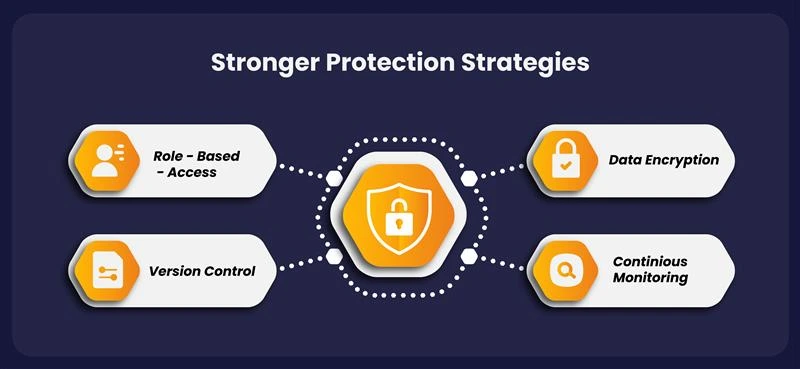
Structured workflows, combined with controlled access and continuous monitoring, significantly reduce the risk of PHI exposure during medical record handling.
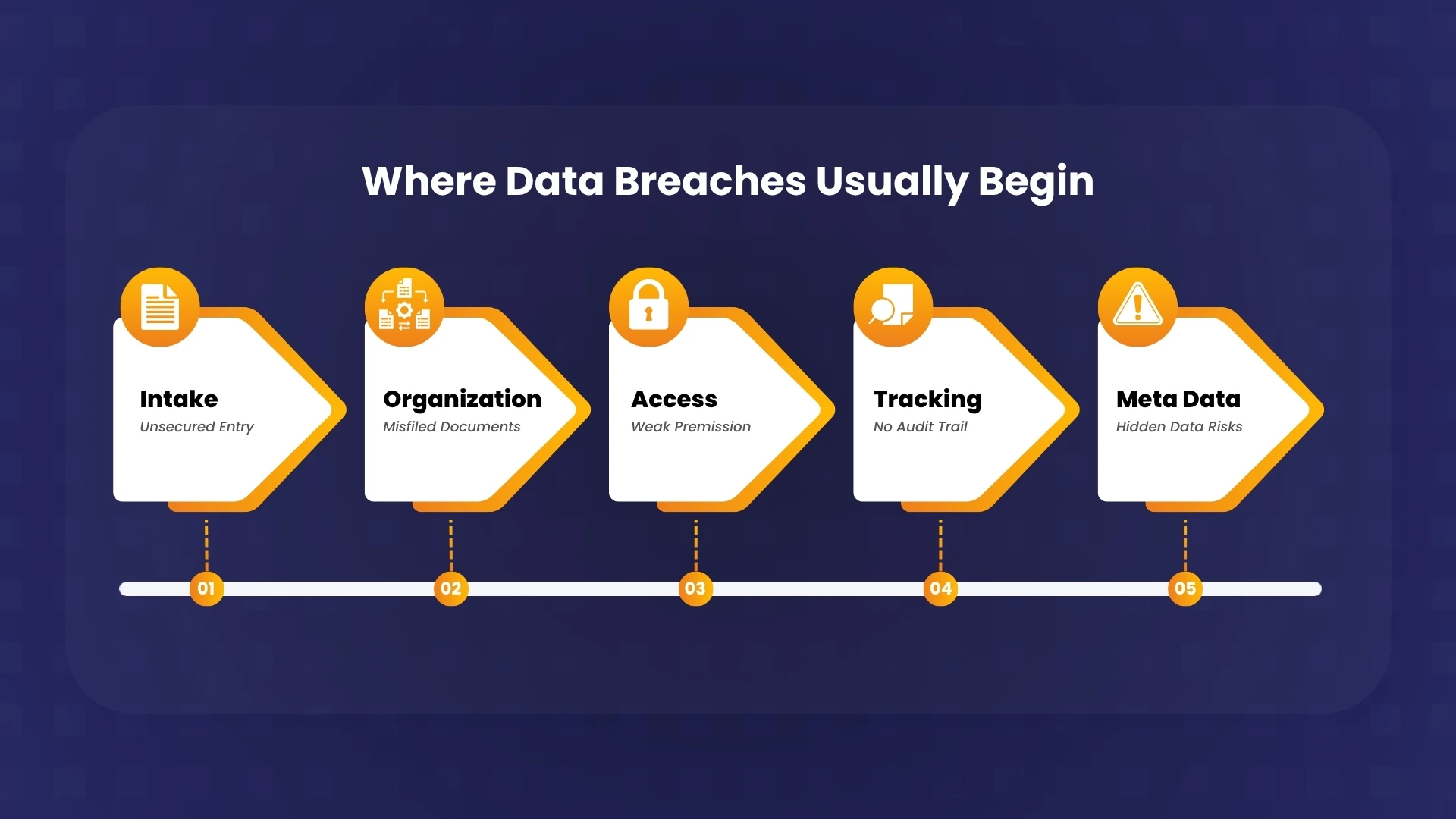
Where Medical Record Data Breaches Usually Begin
1. Intake Stage Weakness
In life care planning workflows, this stage is especially critical because records come from multiple providers and legal sources.
Medical records commonly arrive through:
Email attachments
Secure portals
Cloud sharing links
Physical scans
Many organizations secure final storage, but they ignore the earlier stage when the data is first received.
If files are initially saved:
On personal desktops
In open shared drives
Without encryption
Exposure may already have occurred.
The intake stage is one of the most common origins of data exposure risks.
2. During Document Organization
The sorting and indexing phase introduces classification risk. In complex case environments handling multiple records, these errors can easily occur without structured controls.
Common internal errors include:
Placing a document in the wrong case folder
Mixing patients with similar names
Overwriting original files
Retaining unnecessary duplicate copies
Sharing draft folders externally
In medical-legal documentation, even one indexing mistake can disclose PHI to the wrong party. That is not just a clerical error — it is a compliance event.
3. Weak Access Control
If everyone involved in a life care planning case can access all records, exposure risk increases significantly.
Access should be based on:
Role
Case involvement
Level of responsibility
Applying role-based access control aligns with the minimum necessary standard under HIPAA. Limiting visibility is one of the most effective ways to prevent unauthorized data access.
4. Lack of Audit Trails
As a life care planner, you must be able to answer:
Who accessed the file?
When was it accessed?
What changes were made?
Was it downloaded or shared?
Without activity logs and audit tracking, investigating data exposure incidents becomes difficult and legally vulnerable.
Audit visibility strengthens defensibility.
5. Hidden Metadata Exposure
Documents contain embedded metadata such as:
Patient’s name
System username
File path location
Edit history
If records are shared externally without reviewing metadata, internal system details may be unintentionally disclosed. Metadata review should be part of standard outbound document procedures.
See how structured sorting and indexing is handled in real cases
In medical-legal workflows, preventing data breaches in sorting and indexing requires structured safeguards — not informal caution.
Implement Role-Based Access
Grant minimum necessary access
Remove access when a case closes
Immediately disable access when staff leave
Conduct periodic access reviews
Access governance significantly reduces internal exposure. Regular monitoring helps identify risks early and prevent errors.
Encrypt Data Throughout Its Lifecycle
Files should be encrypted:
During upload
During transmission
While stored
During archival retention
In medical-legal workflows, encryption ensures that even if access occurs improperly, the data remains unreadable.
Establish Formal Version Control
In medical-legal documentation, traceability is essential.
Best practices include:
Preserving original source files
Using structured version naming (e.g., CaseName_Date_V1)
Maintaining revision history
Restricting overwrite permissions
Clear version control protects evidentiary integrity and reduces confusion.
Use Automation and AI Carefully
AI-assisted sorting can improve efficiency but introduces governance responsibilities. For life care planners, this is especially important when handling complex medical-legal records.
Risks may include:
Misclassification of medical terminology
Incorrect document categorization
Storage in unsecured systems
Before implementing automation:
Confirm data storage location
Verify retention policies
Review access controls
Conduct manual validation checks
Technology must operate within compliance frameworks to prevent workflow-related data risks.
“Strong systems do not rely on individual caution — they are built on structured controls, monitored processes, and consistent safeguards that prevent errors before they occur.”
Vendor Risk Management
Outsourcing does not remove responsibility.
Using professional medical record sorting and indexing services helps organizations maintain HIPAA-compliant workflows while reducing operational risks. As a life care planner, if you rely on external providers offering medical record sorting and indexing services, confirm that they maintain strict:
HIPAA-aligned safeguards
Encrypted storage systems
Restricted employee access
Activity monitoring capabilities
Signed Business Associate Agreements
Even if a vendor makes an error, you remain accountable for PHI protection. Vendor oversight is a critical part of preventing third-party data exposure risks.
Create a Breach Response Plan
Even well-controlled systems require a clear response plan.
Your written plan should include:
Immediate containment of access
Internal investigation
Identification of affected records
Evaluation of notification requirements
Workflow correction
Documentation of corrective actions
Timely response reduces regulatory and reputational damage.
Many life care planners choose to work with professional medical record sorting and indexing services to improve accuracy, reduce internal workload, and maintain secure, compliant documentation workflows when handling complex medical-legal records.
Stronger Controls. Safer Workflows.
80%
Vendor risk reduced
With proper compliance checks
85%
Better damage control
Quick action limits impact
60%
Improved efficiency
Reduces internal workload
FAQs: Medical Record Data Breaches
What are Medical Record Data Breaches?
They happen when patient information is exposed because of mistakes while organizing or labeling medical records. Most of the time, this happens inside normal office work — not because of hackers.
Why is sorting and indexing risky?
During sorting and indexing, files are opened, renamed, and moved. Small mistakes can send a record to the wrong case or the wrong person.
Can a small indexing mistake become a legal problem?
Yes. Under the Health Insurance Portability and Accountability Act (HIPAA), even accidental exposure of patient information can be treated as a data breach.
How can life care planners prevent these breaches?
Use limited access controls, secure systems, clear file names, and regular checks. Train staff to follow strict steps when handling records.
What does “minimum necessary access” mean?
It means staff can only see the records they truly need for their work. This reduces unnecessary exposure.
Is AI safe for sorting medical records?
AI can help, but it must be used in a secure system. A human should always review the final output.
Why are audit logs important?
Audit logs show who opened or changed a file. This helps track problems and prove compliance.
If I outsource sorting, am I still responsible?
Yes. You are still responsible for protecting patient information, even if another company handles the sorting.
What is a controlled sorting environment?
It is a secure system where access is limited, activity is monitored, and patient data is protected.
What should I do if a sorting mistake exposes PHI?
Act immediately. Stop access, check what was exposed, fix the mistake, and follow legal reporting rules if required.
Conclusion
Data breaches in medical record workflows rarely start with large cyberattacks. In most cases, they result from small gaps in everyday workflows.
For life care planners, protecting medical records is closely tied to professional responsibility and legal compliance. When records are handled with proper controls and secure systems, the risk of exposing patient information is significantly reduced.
In medical-legal documentation, preventing mistakes is always easier than fixing them later. Strong compliance practices protect patient information while maintaining professional credibility and trust.
Even small workflow improvements can prevent major compliance risks when applied consistently. In highly regulated medical-legal environments, strong data handling practices are not just operational requirements — they are essential for compliance, accuracy, and trust.
Source Credit : All metrics derived from LezDo TechMed’s internal project data.
Shabila Thomas
Shabila Thomas is a Certified Legal Nurse Consultant (CLNC) and Medical-Legal Research Analyst with over two years of experience in medical record review, medico-legal research, and content development. She specializes in blogs, articles, and content that decode complex medical information, industry trends, and regulatory updates for the medico-legal field. Her clinical background and research-first approach help law firms, medical evaluators, and insurance professionals understand complex medical data, identify relevant insights, and make faster, better-informed decisions.














.png)


.webp)