Home
>
Blog
>
>
How Should LNCs Cite Medical Facts for Fast Verification?
Key Takeaways
- Cite each material medical fact with the service date, provider or facility, document type, and stable page identifier.
- Use the record that directly documents the fact, not a later note that repeats the history.
- Separate encounter dates, order dates, performance dates, result dates, and signature dates.
- Preserve conflicting accounts with their own citations instead of choosing one version.
- Test every hyperlink and page reference in the exact file that will be delivered.
- Update citations whenever records are reordered, deduplicated, supplemented, or renumbered.
A citation has one job: take the next reviewer to the supporting record without a search. The medical fact, its context, and its source location should stay together from the first review note through the final deliverable.
Legal nurse consultants should cite medical facts with four linked identifiers: the date relevant to the fact, the provider or facility, the source document type, and a stable page or Bates reference. For facts that depend on wording, the citation should also preserve enough context to show whether the statement was a direct finding, reported history, copied-forward text, an order, a result, or a later correction.
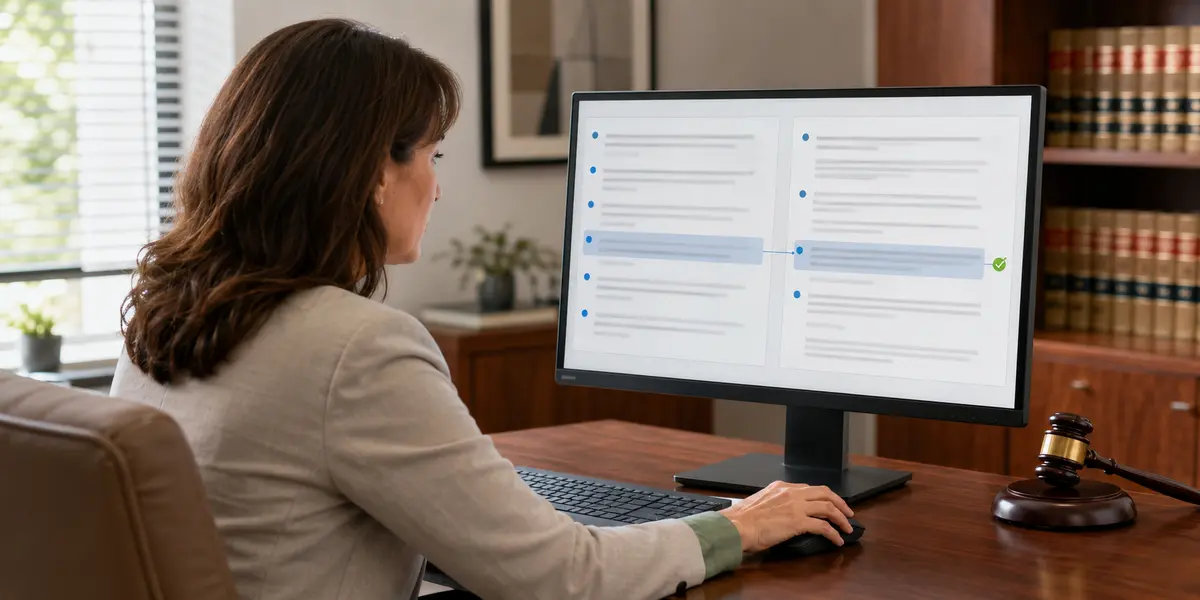
Fast verification means an attorney, expert, or second reviewer can move from the summary statement to the correct source passage without searching the entire production. A page number alone may open the right file and still leave the reviewer hunting for the sentence. The steps below show how LNCs can prevent that problem before the review is delivered.
Fast verification begins with a complete source trail.
Date, author, document type, and page location give the next reviewer enough information to confirm what the record actually says.
Why Page Numbers Alone Fail
Page numbers alone fail when the record set changes, several documents share a page, or the cited language comes from a different source than the reviewer assumes. The page may contain a diagnosis term, but that term could appear in the patient history, a problem list, a radiology impression, or a provider assessment. Those are not interchangeable sources.
Take a common chart pattern. An emergency department note records the claimant's report of a prior lumbar condition. A later orthopedic note copies the same condition into the history. If the medical record review cites only the orthopedic page, the reader may mistake repeated history for a new orthopedic finding. The citation needs attribution and document type, not only a location.
The broader role of legal nurse consultants in medical litigation includes organizing the chart so legal teams can locate and understand documented medical information. Source citations are where that organization becomes testable.
Build Every Citation Around Four Anchors
A fast-verification citation should identify the relevant date, source author or facility, document type, and stable record location. These four anchors answer the questions a second reviewer asks first: when, who, what kind of document, and where?
- Date: Use the date that matches the cited fact, such as service, order, performance, result, or signature date.
- Provider or facility: Name the author, ordering clinician, interpreting clinician, or facility shown in the source.
- Document type: Identify the progress note, operative report, imaging report, laboratory result, medication record, discharge summary, or other source.
- Stable location: Use the agreed Bates label, exhibit number, PDF page, native page, or working hyperlink.
A compact format may read: 03/14/2025, Dr. A. Smith, orthopedic follow-up, Bates MED000842. If the fact is easy to misunderstand, add a short qualifier such as 'patient-reported history,' 'radiology impression,' or 'amended report.' That qualifier can save a second trip to the chart.
Need Source-Aware Medical Record Review Support?
Cite the Record That Directly Supports the Fact
LNCs should cite the source that directly documents the medical fact whenever that source is available. An imaging finding belongs with the imaging report. A procedure belongs with the operative or procedure note. A medication administration belongs with the medication administration record, not a later summary that mentions it.
Later notes still matter. They may document follow-up, interpretation, response, or a changed plan. But they should not silently replace the primary source. If the original report is missing and a later note is the only supplied reference, say so: 'MRI result referenced in orthopedic note; source imaging report not included.' That wording shows both what is known and what remains unavailable.
Skipping primary sources is one of the common accuracy mistakes in malpractice record review. The safest correction is simple: distinguish direct documentation from repeated, summarized, or patient-reported information.
Match the Citation to the Correct Date Role
The citation should state which date controls the fact because one document can contain several valid dates. An imaging study may be ordered on Monday, performed on Wednesday, interpreted on Thursday, and discussed with the patient the following week. Collapsing those dates into one event can change the apparent sequence.
The same problem appears in late-signed notes, addenda, pathology reports, medication orders, and discharge documents. LNCs should retain the date roles instead of choosing whichever date appears first on the page. When the timeline matters, cite the source once and label each date separately.
- Encounter or service date
- Order date and time
- Performance or collection date and time
- Result or interpretation date
- Signature, filing, or addendum date
This is an organization task. The LNC shows the documented sequence and flags uncertainty. The attorney or qualified medical expert decides what that sequence means for the matter.
Keep Conflicts, Corrections, and Missing Sources Visible
Conflicting medical facts should be cited side by side, with each version tied to its own source. If the incident date, symptom onset, medication list, or prior history changes across records, the review should not select the preferred account. It should show who documented each version, when, and where.
Corrections need version control. An addendum or amended report may change a finding after the original note was signed. Cite both when the change matters, label the later version, and make clear which document is an amendment. For missing sources, cite the document that references the absent item and flag the missing companion record.
A disciplined accurate medical record review workflow confirms record scope, checks dates and clinical details, and keeps key facts traceable to their sources before the file moves to attorney or expert review.
Protect Citations During Deduplication and Revision
Citations should be regenerated or retested whenever pages are removed, reordered, merged, or supplemented. Deduplication can change PDF page numbers. A new production can shift Bates ranges. A hyperlink can continue opening the document while landing on the wrong page.
The safest workflow keeps a stable source identifier outside the changing display order. If the production already has Bates numbers, preserve them. If it does not, assign a controlled document and page label before drafting the final review. Then keep the citation attached to the sentence or table row it supports during editing.
- Freeze the reviewed record version before final citation testing.
- Track supplemental productions separately until they are incorporated.
- Avoid cutting and pasting statements without their source fields.
- Recheck citations after deduplication, OCR replacement, or PDF optimization.
- State the record cutoff date in the final deliverable.
Test the Exact File the Client Will Receive
Final verification must be performed in the delivered DOCX, PDF, spreadsheet, or linked record package, because working links can break during export. The reviewer should open each material citation, confirm the destination, and compare the cited statement with the surrounding source text.
Do not stop after confirming that the right page opens. Check that the passage supports the wording, the attribution is correct, negation and uncertainty remain visible, and no later correction controls the fact. High-risk statements selected for an expert packet, demand, deposition outline, or mediation document deserve full source-level verification.
A Published Example of Why Findability Matters
A published, anonymized LezDo TechMed case study involving an expert witness reported that prior summaries contained unverified facts and disorganized clinical data. The revised work used standardized, hyperlinked chronologies and evidence documentation, paired with human review.
The expert described the resulting summaries as easier to use because the supporting documentation was easy to locate. The case study reported a 60% reduction in report-preparation time. That figure reflects the full review workflow, not citation formatting alone. Read the published AI and human record-review case study for the complete context.
The practical lesson for an LNC is narrower: source access affects how much checking the next professional must do. A polished sentence saves little time when the reader still has to search hundreds of pages to confirm it.
How LezDo TechMed Supports Source-Aware Medical Record Review
LezDo TechMed supports legal nurse consultants, attorneys, medical evaluators, and claims professionals with human-led medical record review, medical chronology preparation, narrative summaries, indexing, hyperlinking, missing-record identification, and client-specific formatting. The review team can organize documented facts with source references that match the agreed record structure.
LezDo TechMed extracts, organizes, cross-references, and flags medical information documented in the supplied records. The service does not diagnose, determine causation or liability, assess damages, decide case value, or replace the attorney or qualified medical expert.
A Practical Citation Framework
4
Citation anchors
Date, provider, document type, and stable location
2
Release checks
Correct destination and supporting context
1
Controlled version
The exact file tested before delivery
Medical Record Citations: Frequently Asked Questions
What should a medical record citation include?

A medical record citation should include the relevant date, provider or facility, document type, and stable page, Bates, exhibit, or hyperlink reference. Add a context label when the fact is reported history, a direct finding, or an amended statement.
Should LNCs use Bates numbers or PDF page numbers?
Use Bates numbers when they are stable and shared across the review team. If Bates labels are unavailable, use controlled document and PDF page identifiers and test them after the final file is assembled.
Which record should support an imaging finding?
The imaging report should support the finding when it is available. A later progress note may show that the result was reviewed, but it should not replace the original report without explanation.
How should copied-forward diagnoses be cited?
Cite the source in which the statement appears and label it as copied or historical when the record supports that description. Do not present repetition as a new independent finding.
How should conflicting medical facts be handled?
Present each documented version with its own date, author, document type, and source location. Flag the conflict and leave its significance to the attorney or qualified medical expert.
What if the source report is missing?
Cite the available note that references the missing report and state that the source document was not included in the supplied record set. Do not reconstruct the absent result from assumption.
Do hyperlinks replace written citations?
No. Hyperlinks improve access, but written identifiers protect the source trail if links break or files are exported. Use both when the workflow supports them.
When should citations be rechecked?
Recheck citations after deduplication, reordering, OCR replacement, supplemental production, renumbering, or format conversion. Perform a final test in the exact deliverable the client will receive.
The Bottom Line
LNCs make medical facts fast to verify by keeping four things together: the fact, its attribution, its date role, and its stable source location. Primary documents should support primary facts. Conflicts should retain separate citations. Missing sources should be flagged. Every material link should be tested in the final file.
A citation should remove searching, not shift it to the attorney or expert. When the source trail works, the legal nurse consultant's analysis becomes easier to check, reuse, and update without asking the next reviewer to rebuild the chart.
Refer to our blog, 'What Determines Quality in Medical Chart Analysis?' to learn how source references, clinical literacy, record completeness, and structured quality control shape a useful medical chart analysis.
Source Credit : All metrics derived from LezDo TechMed’s internal project data.
Jebisha Jenishofen
Jebisha Jenishofen is a Certified Legal Nurse Consultant and Medical–Legal Research Analyst with over five years of experience in the medical-legal industry. She specializes in medical record analysis, medical-legal research, and content development, creating clear and informative resources on personal injury, medical malpractice, insurance claims, and healthcare litigation. By combining clinical knowledge with research expertise, she transforms complex medical information into practical insights for medical-legal professionals.













.png)


