The Four-Date Rule IME Providers Can Use to Prevent Timeline Errors
Key Takeaways
A single timestamp can make an order look like completed care or make a late-signed note look like a later encounter.
The chronology should preserve conflicting dates and cite each source instead of silently choosing one version.
AI-assisted extraction can locate date fields, but trained human review is needed to confirm what each date represents.
The IME provider retains responsibility for interpreting the documented evidence and forming the professional opinion.
IME providers can prevent many timeline errors by requiring each material chronology entry to distinguish four dates: the date of service, the order or referral date, the performance or collection date, and the result or finalization date. The chronology should be anchored to what actually happened, while the remaining dates stay visible as context. That simple rule stops an ordered MRI from appearing as a completed MRI and prevents a late-signed note from becoming a second visit.
The rule sounds like a formatting detail. It is really a verification method. One line in an electronic health record may display several timestamps, and each answers a different question. The sections below show how to separate them, what to do when they conflict, and which human checks keep the timeline tied to the source records.
4 dates. 1 verifiable event.
Keeping the timestamps separate lets an IME reviewer see when care was planned, delivered, performed, and documented without reconstructing the sequence from multiple pages.
Why Can One Date Create a Timeline Error?
One date creates a timeline error when it is treated as proof of an event it does not represent. An order date proves that a clinician requested a test or treatment. It does not prove the test was performed. A signature date shows when documentation was authenticated. It does not automatically establish when the encounter occurred.
Consider an MRI ordered on March 4, performed on March 12, interpreted on March 13, and discussed during an office visit on March 20. If a chronology lists only March 4 beside “lumbar MRI,” the sequence is compressed into the wrong day. If it lists only March 20, the imaging may appear to have occurred after the actual performance date. The IME physician then has to reopen the radiology report, order, and follow-up note to rebuild a sequence the chronology should have preserved.
The same problem appears in laboratory records, referrals, procedures, prescriptions, therapy authorizations, and addenda. The mistake is rarely dramatic on the page. It becomes important when multiple events are compared across a narrow time period.
What Are the Four Dates?
The four dates are the service date, order date, performance or collection date, and result or finalization date. Each should be labeled by function rather than placed in the chronology as an unlabeled timestamp. This keeps the timeline readable while preserving the record’s own sequence.
1. Date of service or encounter
The date of service identifies when the patient was seen or care was delivered. It is usually the primary chronology date for an office visit, emergency department encounter, therapy session, or hospital admission. When a note is signed later, the service date remains the encounter anchor and the later signature is recorded separately if material.
2. Order or referral date
The order or referral date identifies when a clinician requested a test, consultation, procedure, medication, or course of care. It documents an intended next step. The chronology should not describe the requested service as completed unless another record confirms performance.
3. Performance or collection date
The performance or collection date identifies when the test, procedure, imaging study, specimen draw, or treatment actually occurred. For diagnostics, this date often belongs at the center of the chronology entry because it establishes when the underlying clinical event took place.
4. Result, report, or finalization date
The result or finalization date identifies when findings became available, when a report was signed, or when an addendum changed the documentation. This date can explain why a clinician acted later, but it should not silently replace the performance date. If an addendum materially changes the original report, both versions and dates should remain traceable.
How Should the Four-Date Rule Appear in a Medical Chronology?
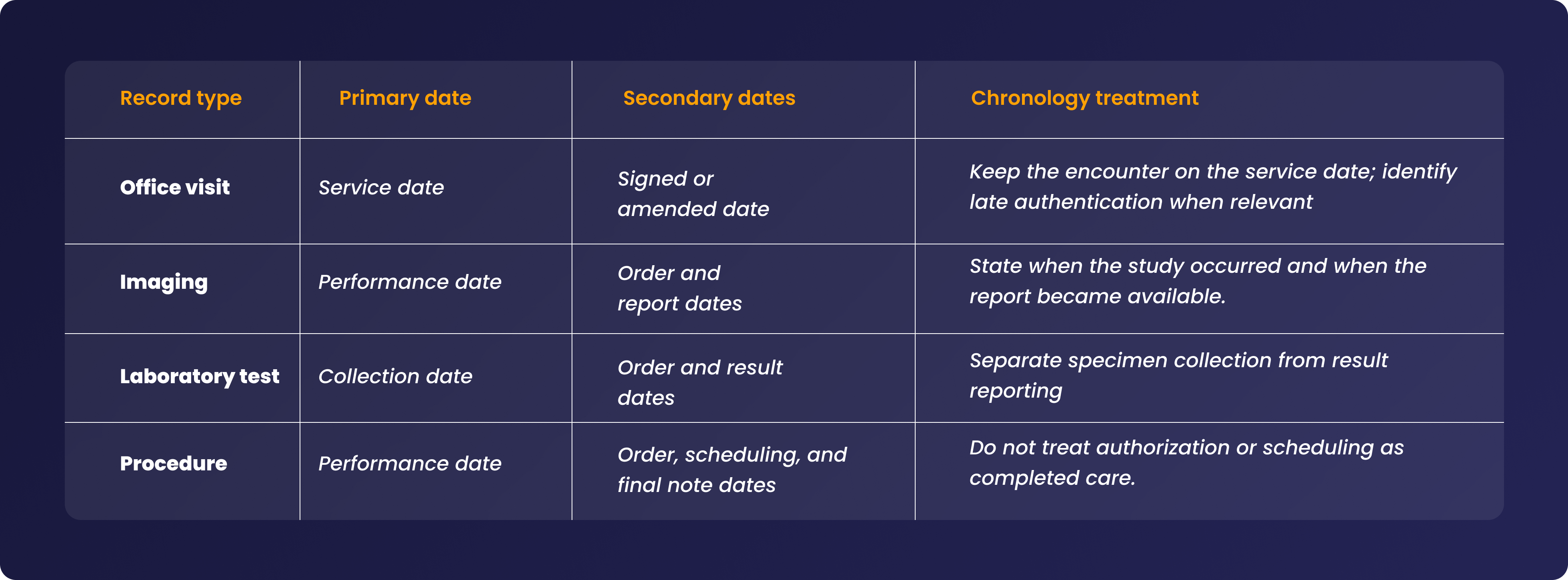
The Four-Date Rule should appear as one event-centered entry with labeled secondary dates, not as four disconnected entries that inflate the treatment history. The primary date follows the event type, and the supporting dates appear in the description or dedicated fields with source references.
The rule catches the most errors in records where several timestamps are legitimate but serve different purposes. Imaging, laboratory testing, surgery, referrals, medication changes, and amended notes deserve special attention because the wrong date can change the apparent order of care.
Imaging studies
Imaging should be anchored to the performance date, with the order and report dates retained when they add context. A later office note may summarize the findings, but that discussion date should not replace the study date. If the actual report is absent and only referenced elsewhere, the chronology should say so.
Laboratory testing
Laboratory entries should distinguish the order, specimen collection, and result dates. CMS technical specifications acknowledge that a laboratory test can carry multiple dates, including order, collection, reported, claim, and documented dates. The chronology should identify the date used and avoid presenting an order as a result.
Procedures and surgery
Procedures should be anchored to the performance date documented in the operative or procedure record. Authorization, scheduling, preoperative evaluation, and postoperative documentation are separate events. When only a later history mentions the procedure, the chronology should attribute that statement to the later record rather than manufacture a precise operative entry.
Referrals and treatment plans
Referrals and plans should be described as recommendations until the records show that the consultation or treatment occurred. This wording protects completeness without converting intent into action. The difference is especially important when the file contains repeated recommendations but no corresponding specialist or therapy records.
Late signatures and addenda
Late signatures and addenda should preserve both the original service date and the later documentation date. The chronology can report that a note was signed or amended later and cite the version supplied. It should not speculate about the reason for the timing or decide whether the change affects credibility.
The correct date is not always one timestamp. It is the relationship among the timestamps. A chronology should show that relationship clearly enough for the IME provider to verify the underlying record in seconds.
What Should Happen When the Dates Conflict?
When dates conflict, the chronology should preserve the disagreement, identify each source, and avoid choosing a winner without support in the records. A factual entry can state that the operative report lists one date while a later history lists another. The evaluator can then decide what weight, if any, the difference deserves.
A practical conflict note includes three parts: the competing dates, the documents in which they appear, and a neutral flag. It should never repair the timeline by guessing. If the source set appears incomplete, the chronology can identify the missing document that may resolve the issue, such as an operative report, imaging report, laboratory result, referral note, or discharge summary.
Retain both dates exactly as documented.
Use page or Bates references for each version.
Label the discrepancy in neutral language.
Check for an addendum, corrected report, or duplicate export before finalizing the flag.
Leave clinical and legal interpretation to the qualified IME provider and other appropriate professionals.
How Do AI and Human Review Support the Four-Date Rule?
AI-assisted tools can support the Four-Date Rule by locating date fields, grouping related records, and identifying possible duplicates, while trained human reviewers confirm what each timestamp means in context. The human check matters because the same page may display an encounter date, printed date, signed date, and imported-document date with similar visual weight.
At LezDo TechMed, AI-assisted extraction is paired with human-in-the-loop clinical review. Reviewers compare the extracted date to the note type, event language, surrounding records, and source citation. A three-layer quality-control process then checks structure, accuracy, and requested formatting. Technology reduces avoidable search work. Human accountability remains part of the workflow.
What Should IME Providers Check Before Accepting the Timeline?
IME providers should accept the timeline only after a focused verification confirms that material events are anchored to the correct date type and can be traced to the source. This does not require rereading every page. A short, repeatable sample can reveal whether the chronology follows the rule consistently.
Select one office encounter, one diagnostic study, one procedure, and one amended note.
Confirm that the primary chronology date matches the event that occurred.
Check whether secondary dates are labeled rather than blended into the narrative.
Verify the page or Bates citation for every sampled entry.
Search for referenced but missing reports or consultations.
Confirm that conflicts are preserved and neutrally flagged.
Return repeated date-handling issues as a workflow correction, not isolated edits.
A Quality Workflow Built for Verifiable Chronologies
A verifiable medical chronology depends on scale, clinical review, and consistent quality checks working together. The following published LezDo TechMed figures describe company-level experience and operations, not a guarantee for an individual deliverable.
Proven Performance
2M+
Medical records analyzed
Published company-level experience
3
Layers of quality control
Structured review before delivery
24x7
Operating model
Support across US time zones
Frequently Asked Questions
What is the Four-Date Rule for a medical chronology?
It is a date-verification method that separates the service date, order date, performance or collection date, and result or finalization date for a material medical event.
Which date should lead an imaging entry?
The performance date should usually lead an imaging entry because it identifies when the study occurred. The order and report dates can be included as labeled secondary dates.
How should a chronology handle an ordered test that was never performed?
It should report the documented order or recommendation and avoid describing the test as completed. If the corresponding report is missing, that absence can be flagged neutrally.
What if two records list different procedure dates?
Both dates should be preserved with source citations and a neutral discrepancy flag. The chronology writer should not guess which date is correct.
Can AI apply the Four-Date Rule without human review?
AI can locate and classify date fields, but a trained reviewer should confirm what each date represents, check the record context, and verify the source citation.
Finally,
The Four-Date Rule prevents timeline errors by separating when care occurred, when it was ordered, when a test or procedure was performed, and when the result or documentation was finalized. It gives IME providers a clear sequence without asking the chronology writer to interpret the clinical meaning of that sequence.
Apply the rule first to imaging, laboratory testing, procedures, referrals, and amended notes. Keep each material entry source-referenced. When dates disagree, show the conflict instead of smoothing it over. That is how a medical chronology remains accurate, complete, and useful for independent professional review.
Source Credit : All metrics derived from LezDo TechMed’s internal project data.
Jebisha Jenishofen
Jebisha Jenishofen is a Certified Legal Nurse Consultant and Medical–Legal Research Analyst with over five years of experience in the medical-legal industry. She specializes in medical record analysis, medical-legal research, and content development, creating clear and informative resources on personal injury, medical malpractice, insurance claims, and healthcare litigation. By combining clinical knowledge with research expertise, she transforms complex medical information into practical insights for medical-legal professionals.













.png)