7 Ways Defense Firms Can Keep Skilled Staff Out of Routine Record Organization
Key Takeaways
Record organization and substantive case review are different jobs and should be assigned accordingly.
One controlled master record set prevents attorneys, paralegals, experts, and reviewers from cleaning separate copies.
Duplicates, weak file names, and late supplements create repeated work at every handoff.
AI-assisted classification and OCR should be paired with trained human review before delivery.
Compare organization costs against the internal hours the workflow removes, not against page price alone.
Defense firms can keep skilled staff out of routine record organization by treating sorting and indexing as a controlled intake function rather than an informal task attached to legal or clinical review. The firm still controls scope, naming rules, access, quality checks, and final use. The difference is that attorneys, paralegals, nurse reviewers, and experts receive a file that is ready for their actual work.
The cost problem is easy to miss because record organization rarely appears as one large task. It shows up in ten-minute searches, duplicate downloads, renamed PDFs, rebuilt exhibit folders, and repeated questions about whether the operative report is in the file. Below are seven practical ways to stop that work from following the record set from person to person.
24 to 48 hours
LezDo TechMed's standard sorting and indexing range is generally 24 to 48 hours, depending on page volume, file condition, and scope.
Stopping Duplicate Work Before It Starts
1. Separate File Control From Substantive Review
Defense firms should separate file control from substantive review by assigning record receipt, naming, sorting, deduplication, pagination, and index creation before an attorney or clinical reviewer begins analyzing the documented facts. This protects skilled time without shifting legal or medical judgment to the organization team.
A defense attorney may need to evaluate pleadings, defenses, testimony, or expert strategy. A nurse reviewer may need to track documented treatment, prior history, or inconsistencies. Neither task requires that professional to rename hospital PDFs or identify where one provider packet ends and another begins.
Write the boundary into the workflow. The organization team controls the file. The qualified professional interprets the evidence.
2. Create One Controlled Master Record Set
A controlled master record set keeps skilled staff out of repeat organization because every authorized user works from the same indexed source. The master set should have a clear owner, stable page references, a record-received date, and a defined location for later additions.
Without a master set, defense counsel may send one PDF to an expert, another to a nurse reviewer, and a third to the insurer. Each recipient may remove duplicates, reorder pages, or apply a different naming method. When someone cites page 742, nobody is certain which version that number belongs to.
Assign one file owner or case-workflow owner.
Preserve the original production separately from the working set.
Apply stable Bates or page references before broad distribution.
Record when the master set was last updated.
3. Define What ‘Review-Ready’ Means
A review-ready standard prevents routine cleanup from reaching skilled staff because it states exactly what must be completed before the file is released for analysis. The standard should cover searchability, provider labels, date order, document types, duplicates, page references, illegible pages, and missing-record flags.
A searchable PDF alone is not necessarily review-ready. OCR may make text searchable while provider packets remain mixed, dates stay out of order, and duplicate discharge records appear three times. The standard should describe the usable result, not only the software step.
Searchable text with legibility exceptions identified
Provider and facility names normalized
Records ordered by the firm’s chosen method
Document type and date range included in the index
Duplicates handled according to written instructions
Missing, mixed, or unclear records flagged neutrally
4. Remove Duplicates Before the File Reaches an Expert
Duplicate review should occur before expert distribution because every repeated page consumes search time and can make the treatment history appear larger than it is. The organization team should identify exact duplicates, near-duplicates, re-signed notes, and overlapping provider productions while preserving anything that is materially different.
Deduplication requires care. Two versions of a radiology report may look identical until one contains an addendum. Two office notes may share copied-forward text but document different service dates. Technology can group likely matches, but a trained reviewer should confirm whether removal is appropriate under the assigned scope.
What would it cost to organize your next defense record set?
5. Use Technology for Classification, Then Apply Human Checks
Technology should handle repeatable classification work while trained reviewers confirm context, exceptions, and final accuracy. OCR can make scans searchable, and AI-assisted tools can identify likely providers, dates, document types, and duplicate groups. Human review verifies whether those labels match the records.
This division of work matters in mixed hospital exports, handwritten pages, records with inconsistent facility names, and documents carrying several dates. Automation can reduce avoidable searching. It should not make unreviewed decisions about document relevance, clinical meaning, or legal significance.
6. Control Supplemental Records as New Versions
Supplemental records should enter through a version-control process so skilled staff do not rebuild the entire file after every new production. Each supplement should be logged, checked for duplicates, inserted into the master structure, and issued with a clear change note.
A late therapy packet or operative report can affect several working files at once. If counsel, an expert, and a reviewer each maintain a separate copy, all three may repeat the update. A controlled supplement process performs the organization once and tells every recipient what changed.
Date and identify each supplement at receipt.
Compare it with the controlled master set.
Preserve stable references or document any changed references.
List added providers, date ranges, and document types.
Notify authorized recipients using one version label.
7. Outsource Routine Volume With a Measurable Scope
Defense firms should outsource routine record-organization volume when the external workflow costs less than the skilled internal capacity it releases and still meets the firm’s control requirements. The scope should define the input condition, sorting method, index fields, duplicate rules, turnaround assumptions, quality checks, security expectations, and supplement process.
Avoid measuring the decision by vendor page price alone. Include internal intake time, correction time, attorney or paralegal searches, expert reorganization, and repeated updates. A lower external quote is not a saving if the finished file still requires substantial cleanup.
Start with a representative case. Track the questions and corrections that return to the firm. Then refine the written instructions before increasing volume.
Skilled review should begin with the evidence, not with file repair. Sorting and indexing prepares the path. Attorneys, evaluators, experts, and other qualified professionals decide what the documented evidence means.
How Should a Defense Firm Compare Cost and Workload?
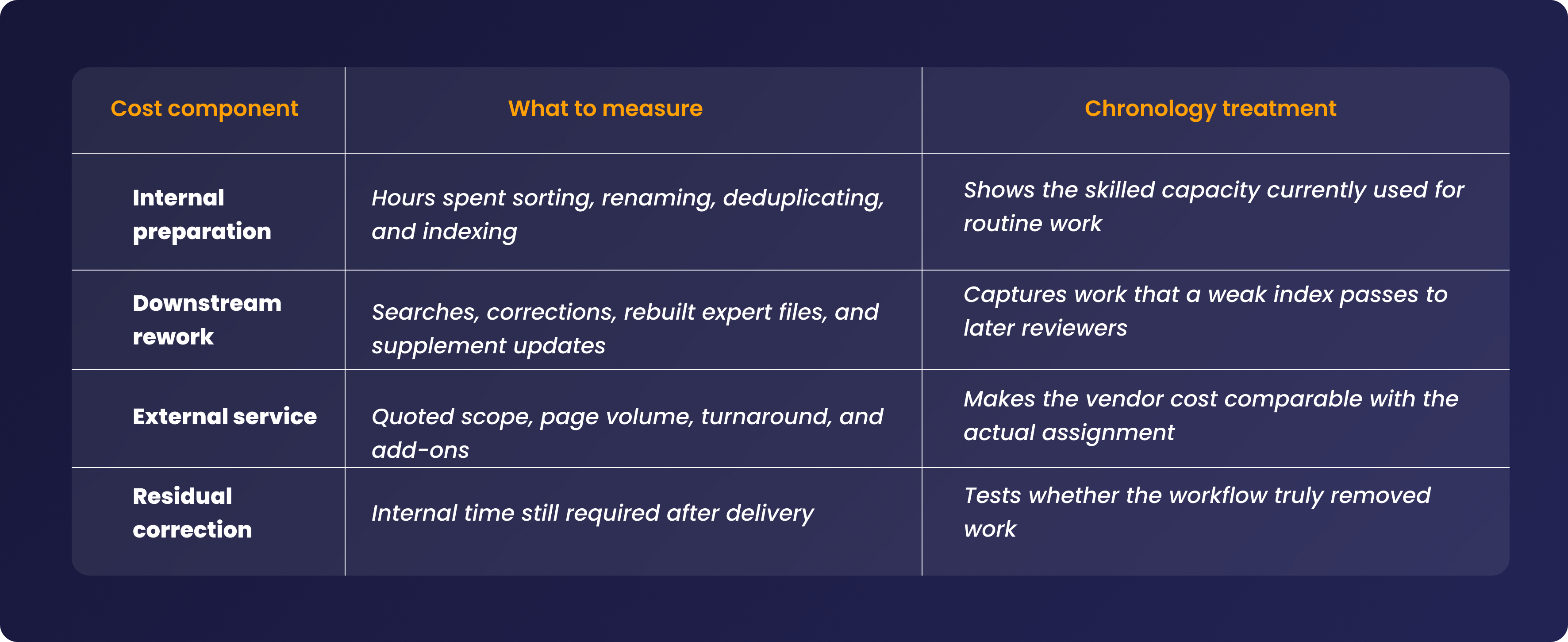
A defense firm should compare cost and workload by calculating the internal preparation hours removed, the external service cost, and any correction work that remains after delivery. This creates a more useful comparison than looking at page price in isolation.
Operational Support for Record Organization
24-48 hrs
Sorting and indexing
Standard range, subject to volume, condition, and scope
3
Layers of quality control
Structured checks before delivery
24x7
Operating model
Coverage across US time zones
Frequently Asked Questions
Which defense-team tasks can be moved out of the skilled-review queue?
Routine receipt checks, file naming, OCR, provider grouping, date ordering, duplicate review, pagination, hyperlinking, and index preparation can be assigned to a controlled organization workflow.
Can AI organize defense medical records without human review?
AI can assist with classification, OCR, date extraction, and duplicate detection. Trained human review is still needed to confirm context, exceptions, and the requested output.
How does deduplication reduce defense workload?
It reduces repeated pages that counsel, reviewers, and experts would otherwise search or read. Materially different versions, corrected reports, and addenda should remain traceable.
How should late supplemental records be handled?
Log the supplement, compare it with the controlled master set, insert new records according to the existing structure, identify changes, and issue a clear version label.
How can a defense firm estimate the cost of outsourcing?
Compare the quoted scope with internal preparation hours, downstream search and correction time, expert reorganization, and the residual work remaining after delivery.
The Bottom Line
Defense firms can keep skilled staff out of routine record organization by building one controlled path from intake to review. Centralize the master set, define review-ready requirements, remove duplicates early, use technology with human checks, control supplements, and measure outsourcing against the workload it actually removes.
The objective is not to distance the defense team from the records. It is to give each professional a reliable, source-referenced file so their time goes toward analysis, preparation, and professional judgment.
Source Credit : All metrics derived from LezDo TechMed’s internal project data.
Jebisha Jenishofen
Jebisha Jenishofen is a Certified Legal Nurse Consultant and Medical–Legal Research Analyst with over five years of experience in the medical-legal industry. She specializes in medical record analysis, medical-legal research, and content development, creating clear and informative resources on personal injury, medical malpractice, insurance claims, and healthcare litigation. By combining clinical knowledge with research expertise, she transforms complex medical information into practical insights for medical-legal professionals.













.png)