Home
>
Blog
>
>
7 Navigation Rules for Building Paralegal-Friendly Medical Record Files
Key Takeaways
- A hyperlink should open the exact supporting page, not the first page of a large provider file.
- Bates numbers, PDF page numbers, index entries, and bookmarks must describe the same destination.
- Bookmark labels should identify the provider, date, and document type without forcing the reviewer to guess.
- A return path matters because paralegals move repeatedly between the index, source page, chronology, and exhibits.
- Supplemental records require controlled re-indexing and link testing before the revised file is released.
- AI-assisted classification can support the first pass, but trained human review remains responsible for context and final link validation.
Paralegal-friendly medical record files follow seven rules: establish stable page identifiers, design the index around real retrieval tasks, link to the exact supporting page, use descriptive labels, provide a reliable return path, control every supplemental-record update, and test the final file in the software where the legal team will use it. These rules turn a sorted PDF into a source-referenced working file.
A Useful File Must Work Like a Map
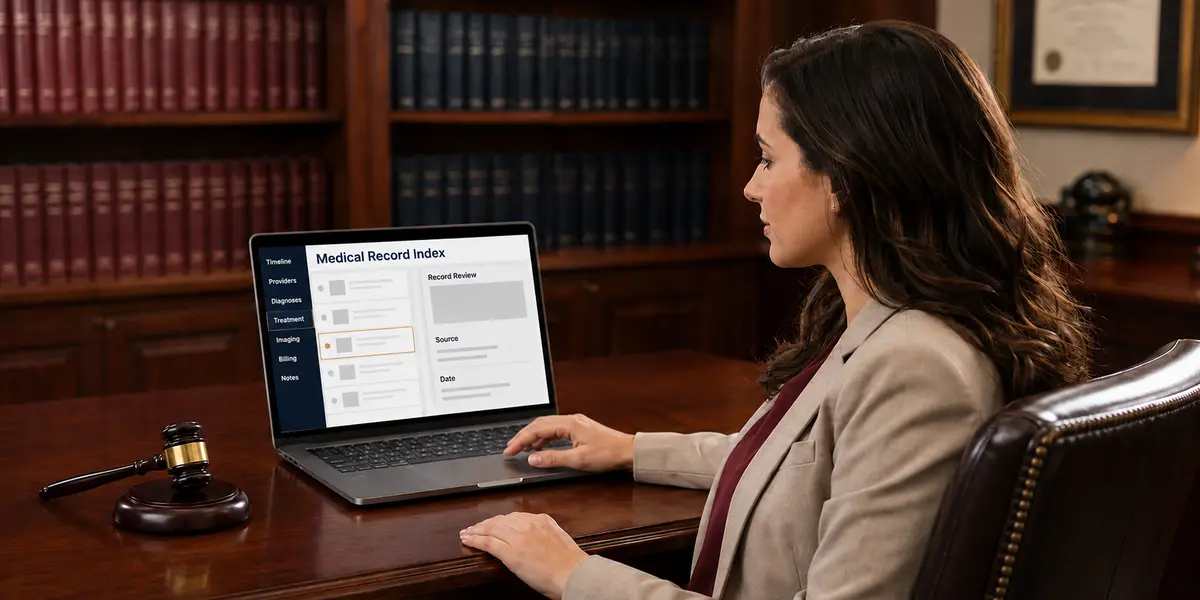
A useful medical record file must tell a paralegal what a document is, when it was created, who produced it, and where the supporting page sits. If any one of those details is missing, the reviewer starts searching again. The file may look organized, yet the work has moved back to scrolling, opening tabs, and comparing page numbers.
That problem often appears late. The index worked during intake, but a new hospital production was appended. The PDF page count changed. Some bookmarks still open correctly, while others land two hundred pages away. The labels look familiar, so the error is easy to miss until an attorney asks for the source during deposition preparation.
The seven rules below are built for that moment. Each one treats navigation as part of record accuracy, not as decoration added after sorting is complete.
Every Click Should Provide Enough Information
One click should answer four questions: What is this document? Who created it? When was it created? Where is the exact supporting page?
1. Establish Stable Page Identifiers Before Adding Links
Stable page identifiers must be finalized before hyperlinks and bookmarks are built. The legal team needs one dependable citation system, usually a controlled Bates sequence, because PDF page numbers can shift when covers, slip sheets, or supplemental records are inserted.
A good index can show both the Bates range and the PDF page location when the workflow requires both. The important point is consistency. An entry that says LTD000842 should open the page carrying LTD000842, and the bookmark label should not point to a different range. If the production has no Bates numbers yet, the team should decide whether to apply them before link creation rather than rebuilding every destination later.
This decision belongs near the start of the sorting and indexing process, when file condition, duplicates, pagination, and organization rules are still being checked.
2. Design the Index Around Real Retrieval Tasks
A paralegal-friendly index should mirror the questions the case team will ask, not merely list files in the order received. At minimum, each entry should identify the provider, date of service or document date, record type, page or Bates range, and a clickable destination.
That structure helps with ordinary retrieval: locate the emergency department note from the date of loss, find the first orthopedic consultation, open the MRI report, or compare two versions of a discharge summary. A label such as “Medical Records, pages 1-68” gives the reviewer almost nothing. “Mercy Hospital | 03/14/2025 | Emergency Department Note | LTD000214-LTD000226” gives the reviewer a usable decision point before the click.
Some matters also benefit from provider-based or document-type views. Those views can coexist, but they should resolve to the same source pages. Two paths are helpful. Two conflicting maps are not.
3. Link to the Exact Supporting Page
Every hyperlink should land on the first page of the specific document or passage named in the index. Opening the front of a 300-page hospital chart still leaves the paralegal with a search task, which defeats the purpose of source-referenced navigation.
Exact-page links matter most when the indexed item is short and buried inside a long production: a radiology impression, operative report, medication reconciliation form, discharge instruction, or one-page specialist letter. The destination should also preserve enough surrounding context for verification. A link to a single isolated line may be technically precise while making the source harder to understand.
The reviewer should test destination accuracy against the visible provider name, date, document heading, and Bates number. Matching only one field is not enough when duplicate pages or similar notes are present.
LezDo TechMed sorts, indexes, deduplicates, applies Bates references, and prepares searchable medical record files with AI-assisted processing and trained human quality review.
Need Review-Ready Medical Record Files?
4. Use Labels That Explain the Destination Before the Click
Bookmark and index labels should describe the destination clearly enough that another team member can choose the right record without opening several options. Provider, date, and document type usually give the best compact label.
Vague labels are a common source of delay. A bookmark tree containing “Office Note,” “Report,” and “Records” may be technically populated, but it transfers identification work back to the paralegal. Consistent labels also help when the same provider submitted records in three batches or when a facility name appears in more than one form.
The same labeling discipline applies when a team compares manual and automated record organization. Technology may classify pages quickly, but a trained reviewer must confirm that the label matches the document and the intended source range.
5. Give Reviewers a Reliable Return Path
A useful medical record file should help the reviewer return to the index or prior working location after opening a source page. Without that return path, every verification click can end with another scroll through the index or a hunt through browser history.
The return path may be a back-to-index link, a previous-view function, a persistent bookmark pane, or a paired workflow between the summary and source PDF. The exact choice depends on the delivery format and the software used by the firm. What matters is that the reviewer can move out and back without losing context.
This is especially important during deposition, mediation, expert coordination, or demand preparation, when the paralegal may verify several records in quick succession. One-way hyperlinks look useful during a sample review. Repeated use exposes the friction.
“A medical record link is complete only when the reviewer can reach the source, verify it, and return without losing the working thread.”
6. Treat Supplemental Records as a Controlled Revision
Supplemental records should be integrated through a controlled update that protects the citation system, bookmark structure, and existing link destinations. Appending a PDF to the end of the file may preserve old page numbers, but inserting records chronologically can shift every later PDF destination.
Take a common workflow example. A 1,400-page file has already been indexed when a new imaging center production arrives. The team inserts the records by date so the treatment sequence remains readable. The Bates stamps remain stable, but the PDF page locations change. Any link built only against the old PDF positions may now open the wrong page. The revised file therefore needs re-indexing, link regeneration where required, and a fresh quality check.
A revision log should identify the new batch, its page or Bates range, the date added, duplicate decisions, and the navigation elements retested. The paralegal receiving the file can then see what changed instead of comparing two large PDFs from the beginning.
7. Test Every Navigation Path in the Delivery Environment
Final quality control should test the actual files, links, bookmarks, and software that the legal team will receive. A link that works on the creator’s workstation may fail after files are renamed, moved to a different folder, uploaded to a case platform, or opened in another PDF application.
Testing should include a sample from every provider, document type, and record batch, plus every unusual destination such as attachments, rotated scans, or pages with weak optical character recognition. High-risk links should receive full review, including index entries used in a chronology, expert packet, exhibit list, or attorney work product.
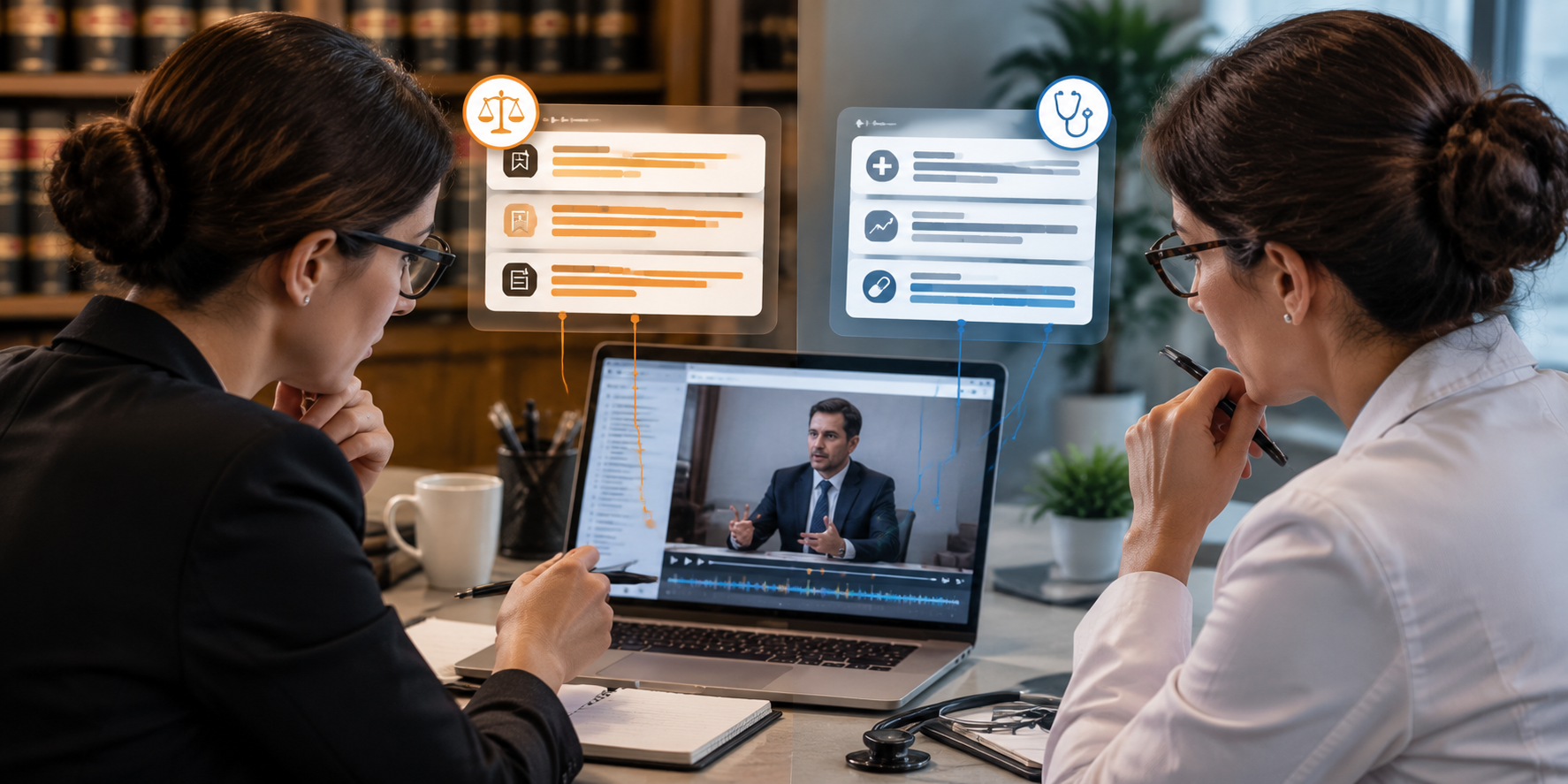
AI-assisted tools can classify documents, identify likely destinations, and flag duplicates. Human review still has to confirm meaning, context, and link behavior. That distinction matters because a technically valid link can still point to the wrong clinical document.
The final check is what turns organized PDFs into court-ready medical records that attorneys and paralegals can cite and verify with less searching.
Paralegal Navigation Acceptance Checklist
A record set is ready for paralegal use when the following checks are complete and any exceptions are documented. The checklist should be applied to the delivered file, not an earlier working copy.
- The index identifies provider, date, document type, and page or Bates range.
- Every tested hyperlink opens the exact named document or source passage.
- Visible Bates numbers agree with the index and bookmark labels.
- Bookmarks follow one naming convention throughout the record set.
- Duplicate versions are retained, removed, or flagged according to the agreed scope.
- Searchable text works on representative typed, scanned, and rotated pages.
- The reviewer can return to the index or prior location without starting over.
- Supplemental records are recorded in a revision log and added to the index.
- Links still work after the files are renamed, packaged, uploaded, and reopened.
- Any broken, ambiguous, or unsupported link is corrected or clearly flagged before delivery.
Current Sorting and Indexing Service Benchmarks
1M+
Pages Annually
Medical record pages sorted and indexed
24 hrs
Standard Turnaround
Company-level benchmark; scope and file condition apply
30%
Deduplication Rate
Company-level average across processed record sets
Frequently Asked Questions
What makes a medical record file paralegal-friendly?

A paralegal-friendly medical record file has a clear index, descriptive bookmarks, stable page references, exact-page hyperlinks, searchable text, and a return path. The reviewer should be able to locate and verify a source without repeated scrolling.
Should hyperlinks use PDF page numbers or Bates numbers?
Bates numbers usually provide the more stable legal citation, while PDF page numbers help with on-screen location. When both are used, the index and link destination should show a consistent relationship between them.
What information should appear in a medical record index entry?
A useful medical record index entry should identify the provider, date of service or document date, document type, page or Bates range, and clickable source destination. Additional fields may be added when the case workflow requires them.
Why do medical record hyperlinks open the wrong page?
Medical record hyperlinks often fail after files are inserted, renamed, moved, combined, or uploaded to another system. Duplicate documents and links built against unstable PDF positions can also produce incorrect destinations.
How should supplemental medical records be added to an indexed file?
Supplemental medical records should be logged, checked for duplicates, placed according to the agreed sorting rule, added to the index, and followed by link and bookmark testing. The revised file should carry a clear version or revision record.
Are bookmarks and hyperlinks the same thing?
No. A bookmark is a labeled location in a PDF’s navigation pane, while a hyperlink is a clickable connection from one document location to another. Strong record sets may use both because they support different review actions.
Can AI create medical record indexes and hyperlinks?
AI-assisted tools can support document classification, metadata extraction, duplicate identification, and first-pass link creation. Trained human review is still needed to confirm context, labeling, and final destination accuracy.
What should paralegals test before accepting a vendor’s indexed file?
Paralegals should test representative links from every provider and batch, compare destinations with visible Bates numbers, check bookmark labels, confirm searchability, review supplements, and open the package in the firm’s normal software environment.
The Bottom Line
Paralegal-friendly medical record files are built by controlling citations, writing useful index entries, linking to exact source pages, labeling destinations clearly, preserving a return path, managing supplements as revisions, and testing the final delivery. When those seven rules are followed, the index becomes a dependable working map rather than a decorative front page.
The practical test is simple: can a paralegal find the right document, confirm the source, and resume the task without rebuilding the search? If the answer is no, the navigation work is not finished.
Refer to our blog, ‘Sorting and Indexing Medical Records: The Handoff That Protects Every Review After It,’ to learn how a controlled record-organization handoff supports every chronology, summary, expert review, and litigation task that follows.
Source Credit : All metrics derived from LezDo TechMed’s internal project data.
Jebisha Jenishofen
Jebisha Jenishofen is a Certified Legal Nurse Consultant and Medical–Legal Research Analyst with over five years of experience in the medical-legal industry. She specializes in medical record analysis, medical-legal research, and content development, creating clear and informative resources on personal injury, medical malpractice, insurance claims, and healthcare litigation. By combining clinical knowledge with research expertise, she transforms complex medical information into practical insights for medical-legal professionals.












.png)


.webp)