
How a Product Liability Law Firm Organized 450 Hip Implant Claims in 45 Days
 Jebisha Jenishofen
 August 12, 2026
Client Overview
Client: Product liability law firm, United States
Matter: Hip implant litigation involving 450 plaintiffs
Services used: Medical record review, product-specific medical chronologies, device documentation, cross-plaintiff data extraction, and revision-surgery tracking
Engagement scope: 450 plaintiff files processed in 45 days
The client represented 450 plaintiffs in litigation involving failed hip implants. Each claimant's records contained a separate history of implantation, symptoms, imaging, follow-up care, and, where documented, revision surgery.
The firm needed more than individual record summaries. Its legal team needed a consistent way to review the same product-related data points across the full plaintiff group while preserving a clear link back to the source records.

Challenges
The relevant information was distributed across operative reports, device records, orthopedic visits, imaging reports, pain-management notes, and revision-surgery documentation. Terminology and documentation practices also varied by provider and facility.
This created several practical problems:
- Implant dates, device specifications, and later procedures were not presented in one consistent timeline.
- The onset and progression of documented complications had to be traced across multiple providers and encounters.
- Revision-surgery details were difficult to compare across hundreds of plaintiff files.
- The firm needed to identify recurring documentation patterns without losing the individual facts of each claim.
- Attorneys and retained experts needed an efficient way to locate the source record behind each summarized fact.
The central issue was consistency at scale. A review method that worked for one claimant also had to work across 450 files without turning individual medical histories into unsupported generalizations.

Solutions
LezDo TechMed developed a standardized review framework for the plaintiff group. The framework captured a defined set of data points from every file, including:
- Implantation date and procedure details
- Available manufacturer, model, lot, and device specifications
- Pre-implant medical history documented in the records
- Reported symptom and complication onset
- Pain scores and functional complaints as recorded by treating providers
- Imaging findings
- Follow-up treatment
- Revision or removal procedures and their timing
- Gaps, inconsistencies, and missing product documentation for follow-up
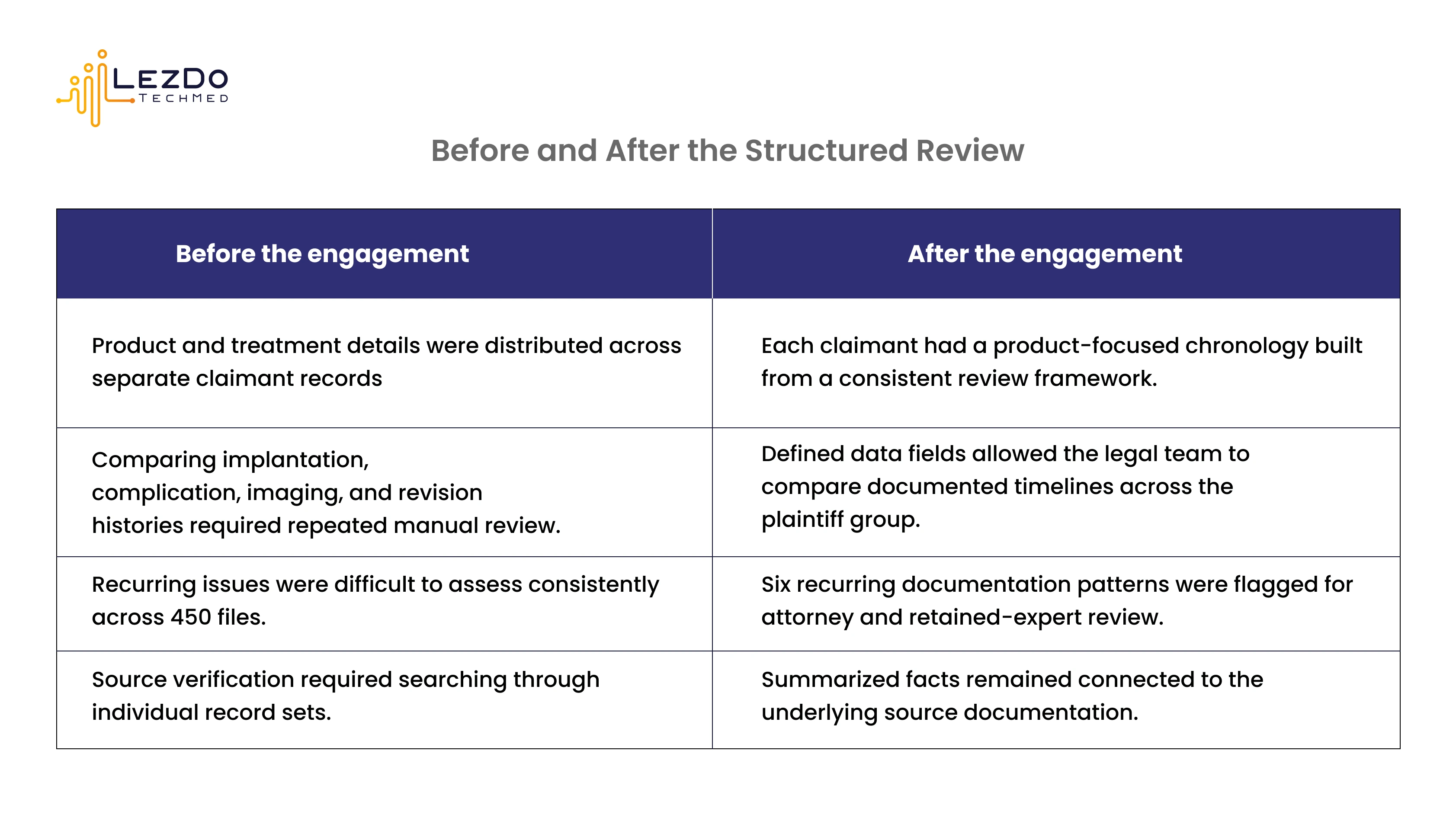
Each claimant received a product-focused medical chronology. The team also structured common fields across the plaintiff population so the law firm could compare documented timelines and recurring patterns.
LezDo TechMed's role was to organize, extract, cross-reference, and flag the medical documentation. Decisions about defect, causation, liability, damages, and case strategy remained with the client's attorneys and qualified experts.

Execution
1. Review framework and quality criteria
Before full production began, the project team aligned the chronology format, required data fields, naming conventions, and quality checks with the client's workflow. This gave reviewers one consistent standard across all 450 files.
2. Record intake and organization
Records were sorted by claimant, provider, date, and document type. Reviewers identified operative reports, implant records, imaging, follow-up visits, and revision documentation for detailed review.
3. Claimant-level chronology
For each claimant, the team created a chronological account of documented care from the pre-implant period through follow-up and revision, where applicable. Relevant facts were tied to their source documents so the legal team could verify the record efficiently.
4. Standardized data extraction
The same defined variables were captured across the plaintiff group. This allowed the client to compare implant histories, documented complication timelines, imaging, and revision procedures without manually rebuilding the data from each chronology.
5. Pattern flagging and human review
The team identified recurring documentation patterns for attorney and expert review. These patterns were treated as review flags, not medical or legal conclusions. Completed work passed through a medical-expert quality review before delivery.
6. Phased delivery
The 450 files were processed within 45 days. Delivering the work in organized batches allowed the client's team to begin its review while the remaining files were still in production.

Results
450 plaintiff files processed in 45 days
The firm received a consistent set of product-focused chronologies and structured data across the complete plaintiff group within the stated 45-day period.
89% had documented revision surgery within five years
The review found that 89% of the included cases contained documentation of revision surgery within five years of implantation. This was a record-based finding within the reviewed plaintiff group, not a prevalence estimate for all recipients of the product.
Six recurring documentation patterns flagged
The standardized review identified six common patterns for further assessment by the client's attorneys and retained experts. Presenting these as structured review flags helped the firm compare files while preserving the clinical history and source support of each claimant.
Reported $380 million settlement
The underlying litigation later reached a reported aggregate settlement of $380 million. This legal outcome depended on many factors beyond medical record review. LezDo TechMed does not attribute the settlement amount to its work. Its contribution was providing organized, traceable medical documentation that supported the client's case review and expert preparation.
Business Impact
The structured review gave the client one consistent medical-documentation framework across 450 individual claims. Attorneys and retained experts could examine recurring patterns without first rebuilding every treatment timeline from the source files.
The work also preserved an important distinction: a repeated documentation pattern may guide further review, but it does not independently establish product defect, medical causation, or liability. Those determinations remained with the client's attorneys and qualified experts.
By completing the plaintiff-level chronologies and cross-plaintiff extraction within 45 days, LezDo TechMed helped the firm move from record organization to legal and expert evaluation sooner.
Client Testimonial
"What stood out most was the consistency of the work. LezDo TechMed transformed a large volume of medical records into organized, easy-to-review chronologies across 450 claims. The project was completed on schedule, helping us move into the next phase of review much sooner than anticipated."
— Product Liability Litigation Team, United States
Why This Matters
High-volume product liability review is not only a page-volume problem. The larger challenge is applying the same review standard to every claimant while retaining the facts that make each medical history different.
In this engagement, standardized chronologies and cross-plaintiff data extraction gave the law firm a clearer view of implantation histories, documented complications, imaging, and revision procedures. The result was a review set that attorneys and qualified experts could examine without first reconstructing hundreds of medical timelines.
For law firms managing medical device, pharmaceutical, consumer product, or industrial product claims, the practical value lies in traceability. Every comparison should lead back to the claimant's records, and every medical or legal conclusion should remain with the qualified professional responsible for making it.
Need a Consistent Review Process for a Product Liability Docket?
LezDo TechMed organizes complex medical records into product-focused chronologies and structured plaintiff data, with medical-expert quality review and source-level traceability. Whether the matter involves one claimant or a large plaintiff group, the review framework can be configured around the product, alleged injury, and information your legal team needs to evaluate.

Jebisha Jenishofen is a Certified Legal Nurse Consultant and Medical–Legal Research Analyst with over five years of experience in the medical-legal industry. She specializes in medical record analysis, medical-legal research, and content development, creating clear and informative resources on personal injury, medical malpractice, insurance claims, and healthcare litigation. By combining clinical knowledge with research expertise, she transforms complex medical information into practical insights for medical-legal professionals.

Ready to Achieve Similar Results?


